
Tech
Meta inks deal for solar power at night, beamed from space


The race to secure electricity for AI models has reached new heights: Meta has signed an agreement with the startup Overview Energy that could see a thousand satellites beam infrared light to solar farms that power data centers at night.
In 2024, Meta’s data centers used more than 18,000 gigawatt-hours of electricity—roughly enough to power more than 1.7 million American homes for a year—and its need for compute power is only increasing. The company has committed to building 30 gigawatts of renewable power sources, with a focus on industrial-scale solar power plants.
Typically, data centers turning to solar power must either invest in battery storage or rely on other generation sources to operate at night.
Overview, a four-year-old, Ashburn, Virginia, outfit that emerged from stealth in December, has a different solution: The company is developing spacecraft that collect plentiful solar power in space. It then plans to convert that energy to near-infrared light and beam it at sufficiently large solar farms—on the order of hundreds of megawatts—which can convert that light to electricity.
By using a wide, infrared beam to power existing terrestrial solar infrastructure, Overview thinks it can sidestep the technological challenges and safety and regulatory issues that bedevil plans to transmit power to Earth through high-power lasers or microwave beams. CEO Marc Berte says you’ll be able to stare right into his satellite’s beam with no ill effects.
The technology would increase the return on investment from building solar farms and reduce reliance on fossil fuels — if it can be deployed at scale.
Overview says it has already demonstrated power transmission to the ground from an aircraft, and is planning to launch a satellite to low Earth orbit in January 2028 to perform its first power transmission from space.
Techcrunch event
San Francisco, CA
|
October 13-15, 2026
In today’s announcement, Meta said it signed the first capacity reservation agreement with Overview to receive up to 1 gigawatt of power from the company’s spacecraft, although it’s not clear if any money changed hands. Overview developed a new metric for this contract, megawatt photons, which is the amount of light required to generate a megawatt of electricity.
Berte expects to begin launching the satellites that would fulfill that commitment in 2030, with a goal of flying 1,000 spacecraft in geosynchronous orbit, a high orbit in which each satellite remains fixed above the same point on Earth. He expects each of the company’s spacecraft to provide power from space for more than 10 years.
Once in space, Berte says the fleet of spacecraft will be able to cover about a third of the planet, with an initial deployment that will reach from the West Coast of the United States across to Western Europe. As the Earth rotates below and customer solar farms enter evening and night, Overview’s spacecraft should boost their electrical generation with additional light from space.
Berte sees opportunity in combining both generation and transmission, with the flexibility to deliver power to solar farms wherever and whenever it is most valuable.
“There’s a big difference between being in any one energy market, and being in all of the energy markets,” Berte told TechCrunch.
When you purchase through links in our articles, we may earn a small commission. This doesn’t affect our editorial independence.
>

Lightspeed is sharpening its India strategy around AI, targeting $250 million for a new early-stage fund as the venture firm bets the technology will drive the next wave of startups in one of the world’s largest markets.
The Silicon Valley venture firm is already a major investor in AI companies including Anthropic, xAI, and Databricks. In India, it has backed Sarvam AI, one of the country’s leading large language model developers and a startup selected by the Indian government to help develop sovereign AI models.
The new fund, Lightspeed India Partners V, will be half the size of its $500 million predecessor, which was raised in 2022 and has already committed 80% of its capital to startups, according to a letter sent to investors on Thursday and seen by TechCrunch.
In late April, Lightspeed disclosed the new fund in a U.S. regulatory filing, though the filing did not specify its target size. Indian media had previously reported that the firm was looking to raise between $300 million and $350 million for the vehicle.
Lightspeed plans to begin investing from the new fund within two months and has designed it around an investment period of roughly two and a half years, per the letter. Until then, it will continue making its final investments from the existing fund.
A Lightspeed spokesperson declined to comment.
Starting with the new fund, Lightspeed is also moving its India funds onto the same fundraising cycle as its global funds for the first time, per the investor letter. The change brings a regional business it established nearly two decades ago more closely in line with the rest of the firm.
The move follows a similar shift by rival firm Accel, which in August raised its latest $550 million India fund alongside new U.S. and Europe funds and a global growth vehicle as part of a coordinated $3.5 billion fundraising effort. It was the first time Accel had raised all four funds simultaneously.
The $250 million fund is sized to match how quickly Lightspeed is currently investing and its shorter investment period, according to the letter. Lightspeed suggested to investors that the smaller size lets it focus on individual deals rather than fund size, and raise its next fund sooner.
The new fund also marks a sharper focus on AI for Lightspeed’s early-stage investment strategy in the region. The investment thesis outlined in the letter anticipates AI creating more value in India than the internet did, with the fund seeking out AI companies across India and Southeast Asia.
India has yet to produce a major frontier AI model developer on the global stage and has attracted far less investment in AI than the U.S. and China. Investors, nonetheless, increasingly see an opportunity for India in the application layer, drawing on the country’s large pool of software developers and its decades-long history as a hub for software and technology services.
The new $250 million India vehicle is a fraction of the capital available across Lightspeed’s global platform. The firm, which manages more than $65 billion in assets globally, raised $9 billion across several new funds last December, the largest fundraising haul in its history. The total included a $980 million early-stage venture fund.
Lightspeed’s dedicated India and Southeast Asia funds represent only part of the capital the firm has put to work in the region. Those funds have deployed roughly $900 million, while Lightspeed’s global funds have invested another $1.6 billion to support companies from the regional portfolio, according to the investor letter.
The decision to dedicate its newest regional fund entirely to AI also marks a sharper thematic focus for Lightspeed in a market where it has historically invested across sectors. Its India portfolio spans businesses including quick commerce, consumer internet, software, and household services.
Lightspeed’s bets in India have included companies such as quick-commerce startup Zepto, audio platform Pocket FM, house-help startup Snabbit, rooftop solar startup SolarSquare, and a range of enterprise software businesses.
The same team that led Lightspeed’s previous four India funds will manage the new fund, per the letter.
When you purchase through links in our articles, we may earn a small commission. This doesn’t affect our editorial independence.
>

Waymo’s commercial robotaxi ramp-up looks expansive, both in geographic reach and in ridership. And by almost every measure, it is — until you pay attention to where the bulk of those robotaxis are actually showing up.
The numbers over the past two years reflect the kind of commercial rollout you’d expect from a deep-pocketed company like Waymo, which spun out of Google and still counts Alphabet as its majority owner. In September 2024, Waymo was operating in just three cities — Phoenix, Los Angeles, and San Francisco. Today, it offers robotaxi service in 15 U.S. cities, with most of those commercial launches occurring in the past year. Ridership has skyrocketed, too with Waymo now averaging 500,000 paid robotaxi rides every week.
But a closer look at its fleet shows a company concentrating its efforts in just two states. About 80% of Waymo’s roughly 4,000 robotaxis are in California and Texas, and Texas is where the action is now: Waymo’s fleet there has grown by nearly half in the past three weeks, fueled by a new Chinese-built minivan the company is betting will help it scale, even as tariffs drive up its costs.
The other 800 or so vehicles are spread across cities in other states, including Arizona and Florida, another burgeoning hotspot. Most are the familiar white Jaguar I-Pace electric SUVs, but a growing share are that new minivan — a modified Zeekr RT that Waymo has branded “Ojai.”
Waymo’s focus on California is no surprise. It is headquartered in Silicon Valley, and much of its early testing and development work was conducted there. Plus, a segment of the population there is inclined to adopt tech at its earliest stages.
The recent growth in Texas is more interesting. Waymo has increased its Texas fleet by 49% in the past three weeks, according to state vehicle registrations and data from the Texas Autonomous Vehicle Fleet Tracker. As of September 24, Waymo had 1,102 autonomous vehicles registered in the state.
Waymo first launched in commercial service in Austin through a partnership with Uber in March 2025, letting riders hail its robotaxis through the uber app. Since then, the company has expanded its robotaxi services in Dallas, Houston, and San Antonio.
Waymo’s Texas fleet remained relatively static for most of the summer, inching up from about 600 vehicles in June to more than 700 by the end of August. Then came September, when the he fleet surged, driven by an influx of new Ojai minivans, which now make up about a third of Waymo’s Texas fleet.
Expect that share to grow.
The Ojai robotaxi, equipped with Waymo’s sixth-generation self-driving system, is supposed to help Waymo reach mass scale. Its interior is built to withstand heavy use, and it comes with an upgraded rider interface and Google’s Gemini AI, which acts as an in-car assistant for riders.
Strip away that technology, though, and the Ojai is a minivan made by Zeekr, a brand owned by China’s Geely Holding Group (which also owns Volvo). The Ojai is built on Zeekr’s SEA-M platform, a shared vehicle platform designed for uses like robotaxis and delivery vans. The base Zeekr vehicles are shipped to the U.S. without any Chinese connected-car technology on board. Once they arrive, the vehicles are sent to Waymo’s Arizona factory, where they are outfitted with Waymo’s self-driving system.
The Ojai is supposed to drive down costs and ultimately help Waymo reach profitability. For now, though, tariffs are cutting any savings. Under current U.S. trade policy, vehicles built in China face steep import tariffs, raising Waymo’s costs for every Ojai it brings into the country.
Waymo appears willing to absorb that cost. New York-based research firm MoffettNathanson, which tracks Ojai imports using detailed shipping records, said in its September report that Waymo is on track to bring 5,100 of the vehicles into the U.S. by the end of the year.
Where will all those Ojai vehicles go? Texas is certainly on the list. But Florida, where Waymo operates in three cities, and newer markets like Las Vegas will likely see an influx as well.
When you purchase through links in our articles, we may earn a small commission. This doesn’t affect our editorial independence.
>
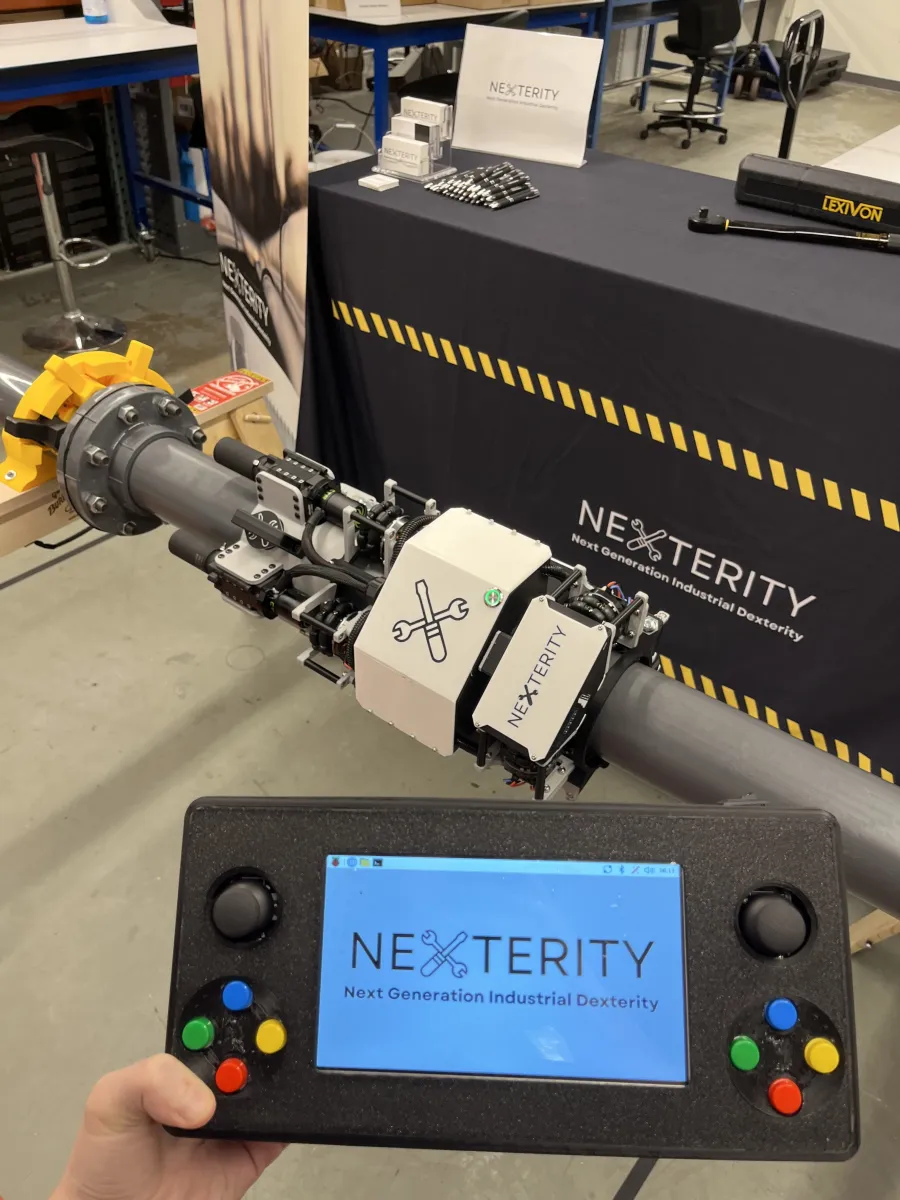
Lindsey Elliott is big into bolts. At last year’s Bolting Symposium — the 13th annual — she said the highlight was playing “Bolting Bingo” against the many self-proclaimed “torque dorks” who were in the room.
A former engineer and planner at ExxonMobil, Elliott has spent years thinking about how to improve the infrastructure that moves oil, gas, and petrochemicals. Bolts are what she landed on. Specifically, the bolts that connect sections of pipe (technically called “bolted flange joints”). These bolts require hard, physical work to loosen and tighten, and are the source of many pipefitters’ injuries. Like many trade industries, there’s also a labor shortage.
“Those people get really tired when they’re asked to work 12 hours a day for three months in a row,” she told TechCrunch. “I’ve talked to pipefitters across the U.S. across Canada, and just repeatedly have been told North American pipefitting productivity is notoriously low.”
The solution Elliott came up with at her startup Nexterity, which is one of the Startup Battlefield 200 selected to participate in TechCrunch Disrupt, is a remote-controlled robot that can handle this part of the job. It’s the kind of idea that could fundamentally change this particular blue collar job if widely adopted, making the workers safer and more productive.
Think: more dork, less torque.
The robot comes in two main pieces that fit around a pipe. Powered by batteries, the robot can slide across the pipe once it’s attached and quickly loosen and tighten four bolts at a time.
Elliott said Nexterity has developed a few different configurations of the robot to fit different standard pipe sizes, but they’re all small enough to fit in a Pelican case and be carried by a single worker. That makes them easy to deploy to new sites — flexibility that is crucial to Nexterity’s business model of treating the robot like rental construction equipment.
Elliott said she arrived at this particular design as a result of conversations she’s had over the last few years — not just at the Bolting Symposium, but also with members of the Pressure Vessels & Piping Division of the American Society of Mechanical Engineers.
“What I learned from the people, the torque dorks per se,” she said, “is that 80% of our pipes are between two to eight inches in diameter, or what they call NPS2 to NPS8. And so when you have that much repeatability, you have a fantastic candidate for automation.”
It’s a pretty straightforward idea, but one that Elliott believes has a lot of upside.
“I think it would shock a lot of people just how big this market is,” she said. “I mean, day to day, most of us don’t think about piping infrastructure, but even water, wastewater, water treatment, food and beverage, mining, nuclear, any kind of green and sustainable manufacturing facility — they all use the same kind of piping.”
When you purchase through links in our articles, we may earn a small commission. This doesn’t affect our editorial independence.
>

NFL: Green Bay Packers booed during ‘butt-whooping’ at home to Atlanta Falcons

Zee 5 Global Releases ‘Hi’, Romantic Pic Starring Nayanthara & Kavin

Chizuna Nakajima’s Where is the Elf Teacher’s Toilet? Manga Gets TV Anime – News
-

 movies4 months ago
Search For Canadian TV Actor Stewart McLean Now Homicide Investigation
-

 Fashion9 years ago
These ’90s fashion trends are making a comeback in 2017
-
Fashion9 years ago
According to Dior Couture, this taboo fashion accessory is back
-
Fashion9 years ago
Model Jocelyn Chew’s Instagram is the best vacation you’ve ever had
-
Fashion9 years ago
Emily Ratajkowski channels back-to-school style
-
Fashion9 years ago
9 Celebrities who have spoken out about being photoshopped
-

 Anime4 months ago
Rurouni Kenshin: Hokkaido Arc Manga Takes 1-Issue Break – News
-

 Anime3 months ago
HIDIVE to Stream English Dubs for The World Is Dancing, The Forsaken Saintess and Her Foodie Roadtrip in Another World, The Dangers in My Heart: The Movie Anime – News