
Entertainment
Running Point Creators Explain Season 2 Ending and What’s Next

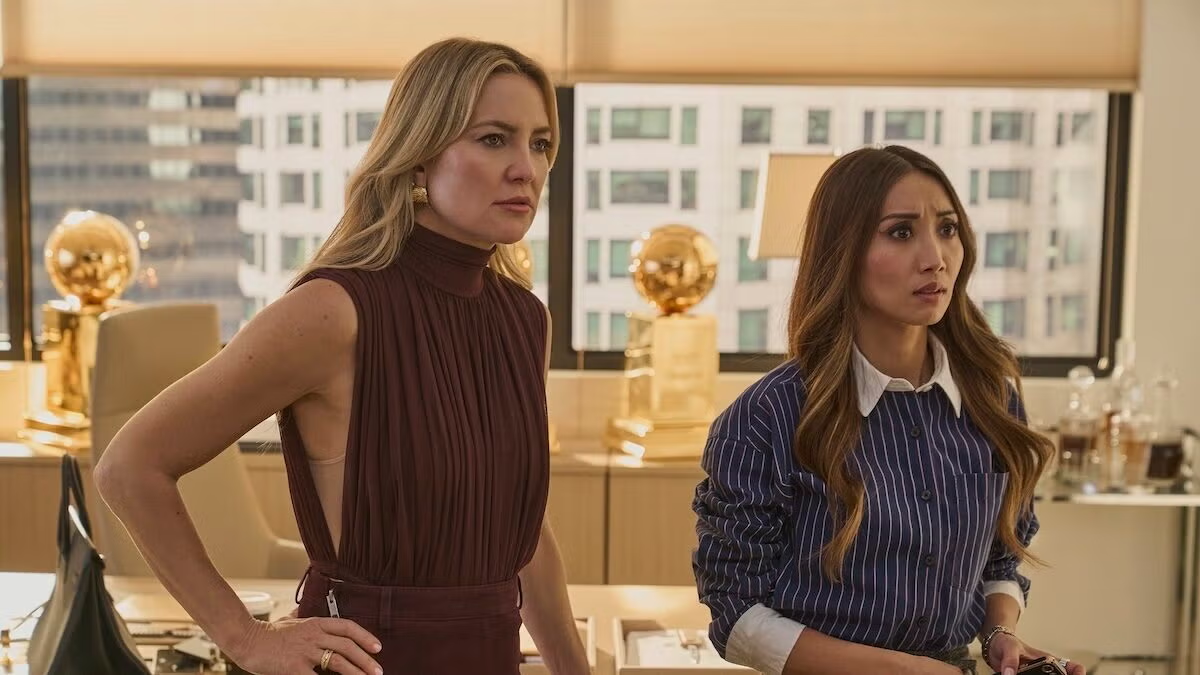
Note: This story contains spoilers from “Running Point” Season 2, Episode 10.
Coming off of the freshman season of basketball comedy “Running Point,” creators Mindy Kaling, Ike Barinholtz and David Stassen knew they wanted to crank up the conflict for Kate Hudson’s Isla in Season 2, both by dialing up the screen time for Justin Theroux’s Cam — who returned from rehab not fully sober — and shaking up Isla’s love life after Season 1 left off with that love triangle.
But first, the team had to resolve the lingering situation with Max Greenfield’s Lev. Despite him having calling off his engagement to Isla in the Season 1 finale, Season 2 sees the pair work their way back together and eventually get to their long-delayed wedding weekend, satisfying Kaling’s hopes of seeing Hudson in a wedding dress.
“The characters had sort of comedically been engaged for so many years that we did want to see the wedding, or almost wedding, and a rehearsal dinner,” Kaling told TheWrap. “And because I’m a loser I wanted to see Kate Hudson in a wedding dress … I just think that’s something that some people want to see … some women want to see that — and gay men.”

The closest viewers got to seeing Isla in a wedding dress was her rehearsal dinner outfit, since she called off the wedding the night before after realizing her heart wasn’t in the right place to marry Lev, joking that at least she didn’t call it off day-of. The creators revealed they toyed with having Isla leave Lev at the altar, but ultimately decided they didn’t want it to “get that far.”
“I think that joke is very true … it is more palatable to leave someone the day before than to leave them at the actual wedding,” Barinholtz said.
While Isla bid farewell to Lev, the creators said they’re already kicking around ideas for Greenfield to return for future seasons, with Barinholtz saying “there’s no way we can’t bring him back, we love him so much.”
“We all met on ‘The Mindy Project,’ and what was so fun about that show was all the funny characters that my character got to date, and I think that’ll be really fun going into hopefully the next season is to see Kate Hudson, one of the great movie stars of all time, dating on screen,” Kaling said.
One of those prospects is, of course, Jay Brown (Jay Ellis), who, by the end of the season ended up taking a gig as the head coach and part owner of the L.A. Industry, which has just been bought by Cam and Al (Ken Marino). Kaling, Barinholtz and Stassen break down all of Season 2’s biggest moments and tease what’s next below. This interview has been edited for length and clarity.

TheWrap: We finally get to see Jay and Isla together. How did you want to craft that moment with all the build up we’ve experienced?
Barinholtz: I had diagrammed every moment of that in my head. I had extensive sketches that I had drawn longhand of Jay and Isla making love.
Stassen: He wasn’t allowed on set.
Barinholtz: Yeah, but in the writers’ room, I was very vocal about it — a lot of visual aids, and I think when I saw it, I was very happy to see that they executed it pretty close to what I imagined, although mine was a lot dirtier, but it was very fun to watch them hook up.
Stassen: I think also we wanted to make sure there was enough distance between ending it with Isla and Lev for it to feel like appropriate, but also she had this long time friendship and attraction with Jay, so it also felt okay not to worry about it being about it being too rushed.
Last season we ended with a Waves loss, but this season we ended with a title win. Why did you want to give the Waves a win and how fun was it to shoot that scene with the champagne flowing?
Stassen: It’s funny. I feel like the actors dread the champagne scene for some reason. It is a lot of fun. It just takes forever because of all of the various
water, the rigging of the champagne bottles and the cameras and the covering of the plastic and everything. And you can’t really do a reset because you don’t have all the wardrobe doubles. It was really fun. We felt like it was great for Isla to get close and really prove herself Season 1, but to establish herself Season 2, in the face of battling Cam all season, felt important that she get to the next level and achieve something more.
Barinholtz: We’ve given her a lot of losses throughout the season, so to give her a big win at the end before the rug pull felt like the right thing to do.
Kaling: In talking to Jeanie Buss, who is an executive producer on the show, and we love her so much … she’s experienced life as an outsider and an underdog, but then there’s also what happens … the unique challenges, which we find very interesting, of being a winner that everyone hates and wants to take down, and so that felt like something really fun to explore in Season 3, is what happens when you get what you want.
One of the other things that we loved about the season was … the most fortuitous thing, which is completely not something that we had thought could happen, which was Ray Romano joining the show as the coach, because we knew we had to replace Jay, and we wanted something that was going to be very different energy. And I think we achieved that.

In the middle of the celebration we see Marcus imply he might be retiring. Will we see him exploring that more next season?
Barinholtz: Marcus is such a great character, but … it’s like Michael Jordan or Kobe. He’s just so amazing and doesn’t lose a lot, and the moments where we have Marcus being kind of frustrated [are] very, very fun, but we thought, in the midst of this big celebration to have this character realize that he might be done and to be at peace about it.
Stassen: We’re really looking forward to watching Marcus be very bad at retirement in Season 3.
Barinholtz: Why we did it is because we just want to see a world where he’s not good at something.
We leave off with Cam and Al partnering to buy LA industry with Jay becoming a coach and part owner. What can you tease about how this sets up for some conflict for next season?
Barinholtz: First of all, can I just say — I don’t toot my own horn a lot. I came up with the name the LA Industry.
Kaling: It’s a good name. We were talking about this earlier, that crosstown rivals is really fun with the Clippers and the Lakers, obviously … these guys, we grew up in Chicago.
Barinholtz: It’s a fun thing, and to put two siblings at the head of both of them feels irresistible to us. They’re literally in your town, stealing your fan base, stealing your thunder.
Kaling: Your ex-boyfriend and your older brother running a team that puts your job in jeopardy felt like a good, juicy, juicy area.

About how many seasons have you mapped out for the show?
Barinholtz: 16-17. The good thing about the show is the characters are so defined, and they’re so fun, and they have such a deep history with each other, that even if it wasn’t a workplace comedy, I feel like there’s a lot of possibility. But by taking them and putting them in this position and in this pressure cooker … we have a lot of episode ideas.
Kaling: We come from network TV too, where we did 24 episodes a season. I think we take pride in the fact that we like to shoot a lot of episodes. We like to come out every single year — we’re not trying to take two years off to go on sabbatical or whatever …. Kate is like on a roll right now. We love working with her. She’s so much fun. Set is a joy.
“Running Point” Seasons 1-2 are now streaming on Netflix. The series has not officially been renewed for Season 3.

>
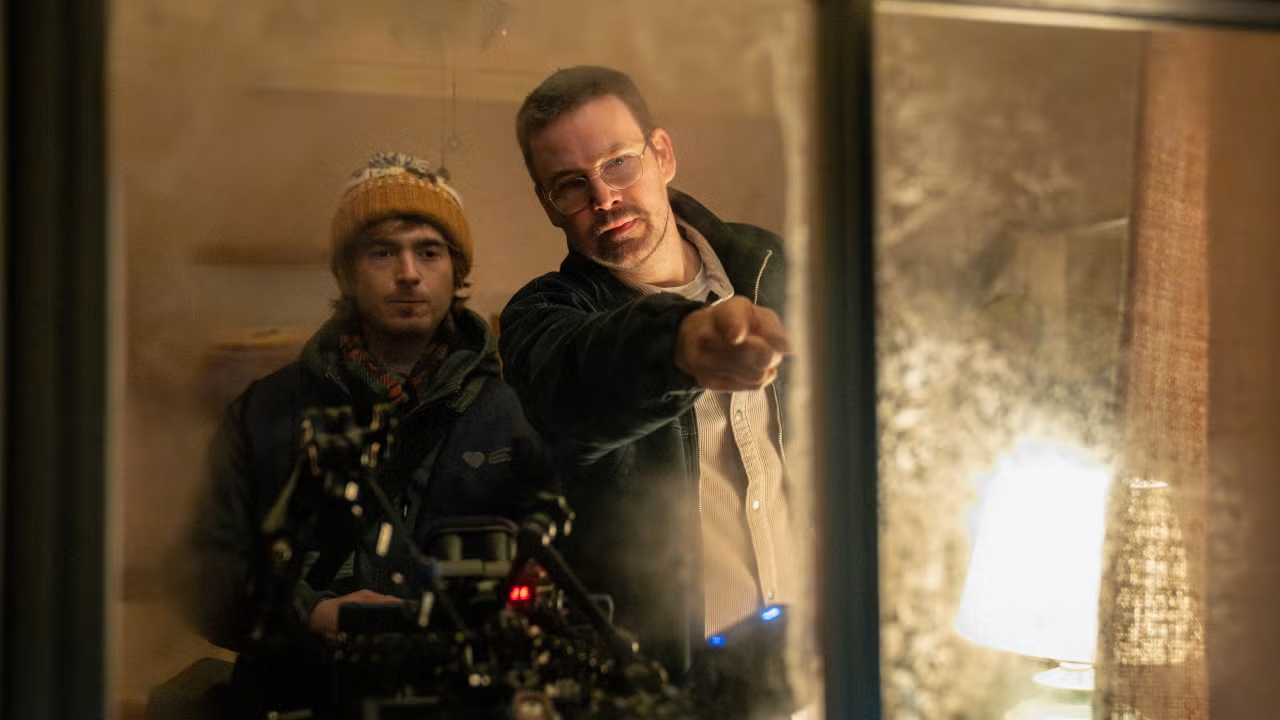
Zach Cregger’s “Resident Evil,” in a little more than two weeks, has already amassed nearly $200 million at the global box office.
Instead of a straight adaptation of the long-running video game series (or an extension of the already-existing film franchise), Cregger chose to tell a new story within the world of the games – a story that follows a hapless medical courier named Bryan (played by Austin Abrams), who is sent on a desperate mission to the heart of Raccoon City during a zombie outbreak. It is an all-gas, no-brakes rollercoaster ride that is carried along by Abrams’ performance – vulnerable, hilarious, inquisitive, the perfect audience surrogate. Even when things get weird, really weird, Abrams’ oddly emotional performance keeps us engaged.
Abrams said that Cregger first mentioned the project while the two were working on “Weapons,” which would go on to be a box office hit and an unlikely Oscar winner. But Cregger didn’t say anything specific about Abrams joining the project.
“It wasn’t until he was in post-production for ‘Weapons’ that he called and wanted me to read the script basically,” Abrams said. He hadn’t played the games (“Other than seeing it and being too afraid to play it”) but once he got the part it emboldened him to play horror/survival games that had a similar spirit.
Whereas “Weapons” was an ensemble piece, with Abrams portraying an unforgettable character (a junkie/thief who stumbles upon the mystery of a missing classroom of kids), with “Resident Evil” he would take center stage. The movie is him. And that left him a little nervous.
“You never know if you can do something until it’s done. It’s huge question marks. I feel personally like we’re going to be interested enough in watching this person,” Abrams said. “Not that everyone could feel that way. Or are they going to be like, I don’t really care about this guy that much. I don’t really want to watch this movie? It could happen. There’s a lot of feelings of the unknown came up.”
While shooting the movie, Abrams started to get the impression that it was going to be okay. “You catch the vibe of the people around you and they’re seeming to be into the character and that helps. You’re not getting like red lights. You keep going,” he added.
And while Abrams knew that he would be the audience stand-in, crafting a character through physicality rather than dialogue (“It feels good being in the body and using it as a tool,” he said) there were still some pretty radical changes to the final film, like when Cregger admitted that, after a test screening, he went through the movie and pulled out most of the jokes.

“There were some asides where I was like, ‘Are you going to keep that?’ Or ‘maybe check that out again.’ There was a bunch of stuff like that where we would take it to a place that was too far, really for our own enjoyment. And you never really know, until you get in the edit, how much you’re going want or not,” said Abrams. ”Especially for like this, where it’s a straight shot and there aren’t all these other characters that you’re interacting with. You want options. I don’t think it would be as enjoyable to watch if it was just straight through. If there wasn’t any laughs in it, I think it would be too unrelenting. Adding comedy, which is what I think Zach is so smart about too, really helps the enjoyment of it and relieves some of the pressure.”
One thing scarier than zombies or plague-infested monsters was the response of the die-hard Resident Evil fans to Cregger making a movie that eschewed the classic characters and established lore of the series. They were very upset about his approach.
Abrams was sympathetic. “I read a book that I love and then they’re going to do another one or make it into a different one. You don’t want someone to f–k it up. You have a personal connection with it. I get what that feeling is like. There’s that passion there,” Abrams said.
He said that he and Cregger “did the best job we could.” “We had a strong base of love and I think our best shot at making something that they would enjoy,” Abrams said. Cregger is a huge fan of the games and has played them all, including this year’s Resident Evil: Requiem. Their approach? “Make what you dig and then hope that other people dig it,” said Abrams.
Fan service was not something that they were interested in (Abrams said it doesn’t work in “a meaningful way”). “If you’re going to end up making something that feels fresh, I think that’s the best shot you have making something interesting,” he said. But still, he said, “I only send love to all those people.”
Before he started working with Cregger, Abrams was a fan of “Barbarian,” his debut feature. He remembers thinking, I love whoever’s made this movie, because they have guts and extreme talent and skill, and a comedic understanding that is really rare and that I relate to. Meeting him, Abrams found that they were perfectly in sync.
“We connect on many other levels, aspiring for the same thing and we have a similar level of what we deem to be the work that we want to make,” Abrams said. “I think that helps us to push each other. We both understand what it is we’re trying to make and have a similar sensibility.”
“He is a total dream to work with. I mean, truly a dream, and he is a beautiful, kind person. And he’s such a formidable actor. He’s so good at whatever he tries to do. I have yet to see him find his limit. That guy’s range is miraculous,” said Cregger. “When it was time to go and put this one together, it was like there wasn’t even a decision. There was not a moment of like, Well, who else could we? No, it’s Austin.”

There isn’t a role for Abrams in Cregger’s upcoming sci-fi freakout “The Flood” (which just cast Jennifer Lawrence in the lead role), but when we asked Abrams if he was the Kurt Russell to Cregger’s John Carpenter, he smiled wide and said, “Hey, you said it. I didn’t say it.”
When it came to – spoilers ahoy! – Abrams’ monstrous transformation towards the end of the film, he said that he actually found the motion-capture process enjoyable.
“I was shocked at like how minimal they needed to be able to capture everything,” said Abrams. “It’s all those other guys. You see them in a room, just imagining all this stuff.”
And given the open-endedness of the movie (and the fact that the video game series has been running for so long), we had to ask if Cregger had said anything to him about coming back for another installment. Another entry seems more and more likely, especially as its box office tally continues to grow.
“We’ve had the smallest of discussions. I also don’t want to go into it too much at all because I don’t know how things would play,” said Abrams.
Still, it’s very clear – if Cregger has an idea for how to bring Bryan back to snowy Raccoon City, Abrams would be there. In whatever shape – monstrous or otherwise – that would take.
“Resident Evil” is in theaters now.

>
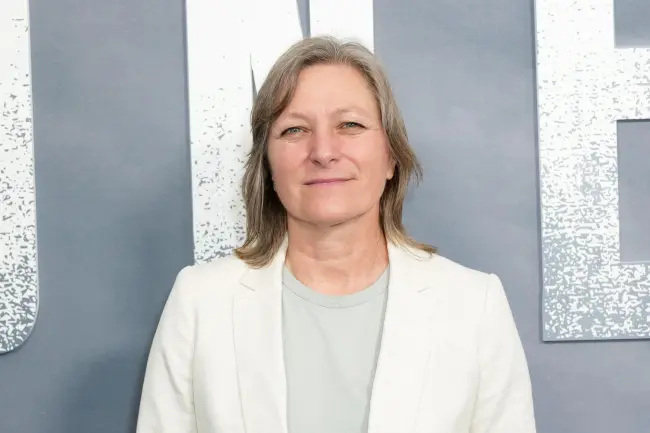
Cindy Holland, the chair of Paramount‘s direct-to-consumer division overseeing the company’s streaming plans, announced in a memo to staff that she’s exiting the company, according to reports in Variety and Deadline. The move most likely paves the way for Casey Bloys, who leads HBO and HBO Max at Warner Bros. Discovery, to lead streaming, something Holland hinted at in her exit memo. Today, September 29, is her last day at Paramount.
Holland’s exit provides some clarity for Paramount’s streaming vision. While Holland’s memo didn’t mention Bloys by name, it hints that “David is optimizing for HBO stability as we move into this next chapter, and I fully support that.” Bloys became president of HBO programming in 2016 and his role has only expanded since then to encompass HBO Max and other aspects of Warner Bros. Discovery.


Holland joined Paramount in January 2025 and described in her memo that she was tasked with reviving Pluto TV as well as integrating Paramount+ and advising on the WBD merger, and she helped grow Paramount+ to 79.6 million subscribers. She also was a pivotal force in the early days of Netflix’s expansion into original streaming programming with shows like “House of Cards” and “Stranger Things,” and she ultimately spent 18 years at Netflix.
While Bloys coming aboard isn’t official, nor has the merger itself closed just yet, it could be solidified in a matter of days. And what happens to HBO and HBO Max, how it’s integrated into Paramount+ or whether it stands alone, are big questions that remain. Bloys, though, has as good a track record as anyone in town. Consider HBO’s continued dominance at the Emmys and how the brand has sustained over the years even as Paramount’s own premium cable brand Showtime has dwindled, ultimately becoming integrated into Paramount+.
Unanswered still is what will be the fate of Warner Bros. Pictures executives Mike DeLuca and Pam Abdy and what their role would be in a combined WarnerMount. Paramount still needs to deliver on an aggressive slate of 30 movies per year across the two studios, so there’s plenty of opportunity to go around.
>
>
Michael Jordan 'Last Dance' NBA Finals jersey sells for record $12.26 million
Tim Ream, USMNT World Cup captain, announces retirement from international soccer

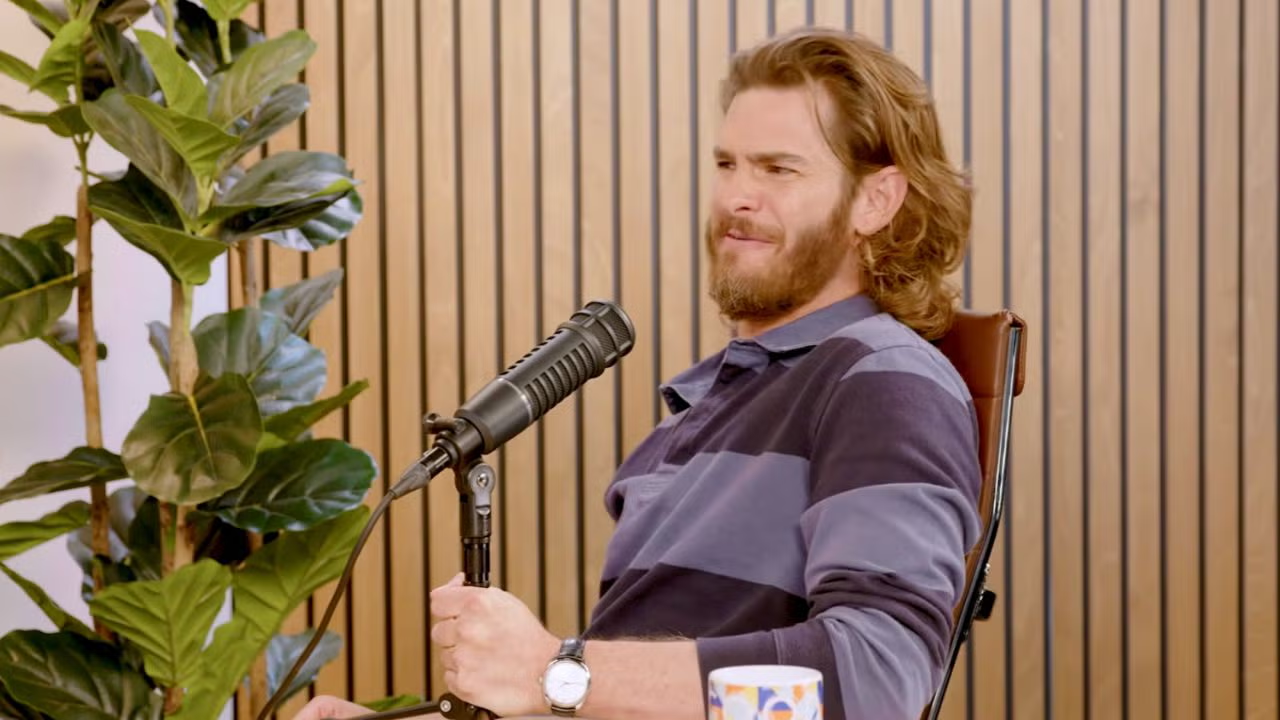
Austin Abrams Talks Resident Evil’s Fan Backlash
-

 movies4 months ago
Search For Canadian TV Actor Stewart McLean Now Homicide Investigation
-

 Fashion9 years ago
These ’90s fashion trends are making a comeback in 2017
-
Fashion9 years ago
According to Dior Couture, this taboo fashion accessory is back
-
Fashion9 years ago
Model Jocelyn Chew’s Instagram is the best vacation you’ve ever had
-
Fashion9 years ago
Emily Ratajkowski channels back-to-school style
-
Fashion9 years ago
9 Celebrities who have spoken out about being photoshopped
-

 Anime4 months ago
Rurouni Kenshin: Hokkaido Arc Manga Takes 1-Issue Break – News
-

 Anime3 months ago
HIDIVE to Stream English Dubs for The World Is Dancing, The Forsaken Saintess and Her Foodie Roadtrip in Another World, The Dangers in My Heart: The Movie Anime – News