
Entertainment
‘Animal Farm’ Review: Andy Serkis Woefully Misunderstands Orwell

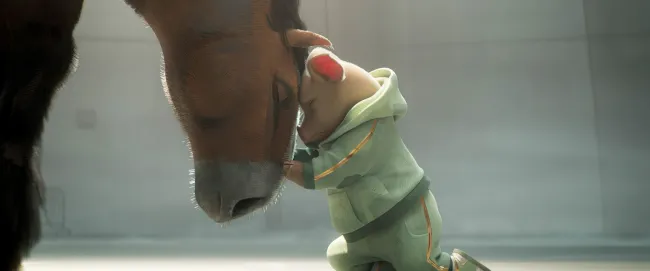
That’s one small setback for the legendary George Orwell. One giant leap for actor/director Andy Serkis’ baffling use of free will. A passion project more than 15 years in the making, Serkis’ animated new film take on Orwell’s revolutionary “Animal Farm” is just now hitting theaters in the U.S. — but it might as well have been made on the Moon.
This bizarre miscalculation isn’t a cynical IP cash-in, but it is something stranger and ultimately more dispiriting from “The Lord of the Rings” icon. A deeply felt interpretation of a historic fictional work, Serkis’ “Animal Farm” seems to have lost its way somewhere between reverence and reinvention over the past decade. It’s not the byproduct of a director who misunderstands Orwell’s anti-fascist fable, so much as the result of an ambitious filmmaker letting this text’s power warp in his hands.


For a pioneering English thespian, whose career has been largely defined by a character consumed with obsession, this particular project carries an unintended symbolism. Whatever Serkis intended to do as a storyteller here, the movie he directed plays more like a misguided concept kept in a death-grip well after its execution had spiraled out of control. Even considered generously, watching Serkis’ “Animal Farm” feels like brain surgery — possibly performed by a sheep in the basement of an abandoned AMC.

When a naïve piglet named Lucky (Gaten Matarazzo) rises to farmhouse leadership alongside the cunning boar Napoleon (Seth Rogen), the revolution sparked by their human farmer’s bankruptcy in the film‘s first act takes a turn for the fascist worse. Lucky is forced to watch as the utopia he was promised crumbles under the weight of corruption. That collapse is spurred not just by Napoleon, but also outside pressure from the human-run Pilkington Corporation, intent on reclaiming the freedom that these precious cartoon animals just seized.
It’s a disorienting, intermittently grotesque experience that crescendos into a finale that swaps Orwellian dread for a Marvel-ish spectacle (no doubt a side effect of past partnerships between Disney and Serkis’ Imaginarium Studios). The structural problems reveal themselves early, as the revolution that defined Orwell’s novella is dispatched by minute 6. By minute 46, the animals are no longer equal, and that leaves nearly half the film left to fill with new material. This includes an extended corporate war arc, and metaphor for dopamine consumption, that bloats the length while draining allegorical clarity.

The issue isn’t the narrative expansion itself, but what the changes reveal about the team behind them. The script, credited to screenwriter Nicholas Stoller (“Forgetting Sarah Marshall”), fundamentally confuses what “Animal Farm” was designed by Orwell to do as a work of literary journalism.
In his 1946 essay “Why I Write,” Orwell explained that his storytelling was never meant to drift into abstraction or polite ambiguity, but to instead confront oppression with intent. He noted then, “The opinion that art should have nothing to do with politics is itself a political attitude.” That guiding principle, along with Orwell’s stated desire to “make political writing into an art” in the same piece, underscores how deliberate and pointed the author felt “Animal Farm” was meant to be.
But in an essay sent to critics, director Serkis describes his version as having “no ideology,” instead promoting a parable with mass appeal that he said was meant to apply in any context. It’s a well-intentioned idea in terms of universality, but also the film’s fatal flaw. Orwell’s work doesn’t endure because it is ideologically blank. It endures because it is both undeniably compelling and unafraid to be precise. More fundamentally, as a matter of genre, the “fable” is not something that can mean anything to anyone — but rather, a story that communicates so clearly it is understood everywhere.

Sanding that motivation down into a more kid-friendly and open-ended spectacle, this adaptation doesn’t broaden Orwell’s message so much as empty it. That mistranslation is most visible in its tonal incoherence. The introduction of new younger characters, presumably designed to help guide children through Stoller’s already simplified narrative, signals a desire for intergenerational accessibility. But Serkis’ sweetly queasy film can’t reconcile with the brutality of Orwell’s original writing. A gag that reframes a slaughterhouse as a “laughter house” turns one of the book’s most chilling ideas into cute wordplay, and undercuts the stakes before they are driven.

The humor only grows more erratic and unpleasant from there. Fart jokes, an “Old McDonald” rap, and dialogue like “glue de gras” (used to describe the fate of Buster, a hard-working horse voiced by Woody Harrelson) collide with scenes of exploitation and authoritarian control. The story is only “updated” for 2026 in the sense that every totalitarian pig in this thing wears a Silicon Valley-type hoodie. And watching Minion-esque farm animals ride around on hoverboards and play beer pong creates the uncanny sensation of watching something that feels like A.I. slop, even as its authors proclaim years of human effort.
At times, the tonal clash introduced by those pops of ultra-modernity borders on absurdism. But a sharper satirical movie never breaks through, and in the end, “Animal Farm” feels caught between impulses. It’s unsure whether it wants to provoke, entertain, or simply get away with existing — and its star-studded voice cast spoils in a similar way. A lineup that includes Glenn Close, Kieran Culkin, Laverne Cox, Kathleen Turner, Jim Parsons, and more should be an asset. But instead, for “Animal Farm,” they blur into a sort of bleating celebrity noise.

Close is saddled with an overextended subplot as the film’s main human antagonist, who adds semi-stylish layers without much meaning. And meanwhile, Rogen’s Napoleon gestures toward contemporary political caricature, without ever fully calling out Trump. The result leaves nearly every performer fumbling for traction in Serkis and Stoller’s muddy-yet-gutless cinematic sty. That sense of aimless moral drift seems to have inspired many of their most baffling choices.
The climactic credits sequence for “Animal Farm,” layering painterly images of pigs reenacting real human conflicts (from the French Revolution to World War I) pushes the overextended allegory to a feverish level of insulting confusion. The dagger comes to an insufferable point in a final post-credits gag that directs viewers to a pay-it-forward initiative via a literal QR code. Released regionally by Angel Studios, widely known for conservative and Christian content, the movie’s last moment is framed as partisan generosity. But after the catastrophe that precedes it, the moment feels like passing around a collection plate at a funeral.

For better or worse, that disconnect between intention and outcome is what makes the odor of this “Animal Farm” linger. Serkis clearly reveres Orwell. His accompanying essay to critics, dense with biographical detail and (possibly misapplied) ideological framing, suggests an admiring artist who understands the challenge he attempted. And yet, Serkis’ “Animal Farm” itself reflects a shameful reluctance to commit to the courageousness that defined Orwell’s life.
At a moment when media literacy feels increasingly fragile worldwide, that hesitation from someone as beloved as Serkis matters. “Animal Farm” wasn’t written to invite interpretation. It was penned to expose the mechanics of corruption at a point in time when Orwell believed the issue of fascism was of the utmost urgency. To flatten that into a more palatable, PG-friendly vision risks destabilizing the text itself and opening Orwell up to potentially deliberate misreadings that feel less like individual interpretations and more like cultural erosion.

There’s too much effort, too much time, and too much sincerity apparent behind this film to dismiss it outright. That’s what makes it frustrating, and maybe even tragic. A version of “Animal Farm” that tried and failed to say something specific might have been worth engaging. But a version that insists on saying nothing, particularly through such a politically-loaded distributor, is far harder to defend.
Early in the movie, the animals debate what to do with the farmer’s abandoned house. “May it sit empty,” Snowball suggests, “as a symbol of what we must not become.” Serkis would have done well to consider that advice. Some works don’t need to be reimagined to remain relevant, and their singularity should be reason enough alone for the people most inspired by them to leave them untouched. And yet, this new “Animal Farm” doesn’t just reopen the door to Orwell’s genius. It yanks at it, kicks at it, and leaves Serkis, Stoller, and their cast hanging from its hinges.
Grade: D+
Distributed by Angel Studios, “Animal Farm” will be in U.S. theaters on Friday, May 1.
Want to stay up to date on IndieWire’s film reviews and critical thoughts? Subscribe here to our newly launched newsletter, In Review by David Ehrlich, in which our Chief Film Critic and Head Reviews Editor rounds up the best new reviews and streaming picks along with some exclusive musings — all only available to subscribers.
>

Surprise! M. Night Shyamalan‘s hotly anticipated next feature Remain had an impromptu premiere at the 2026 Beyond Fest and the early reaction to the supernatural thriller has already hit social media.
Remain screened at the genre festival ahead of a planned retrospective screening of Shyamalan’s 1998 classic The Sixth Sense. The filmmaker personally introduced Remain at Beyond and to say festivalgoers were surprised is an understatement as his new feature is not slated to be released in theaters by Warner Bros. until Feb. 5, 2027. Although, Remain‘s original release date was Oct. 23, 2026 it was moved to be closer to Valentine’s Day.
Clearly Shyamalan and Warners are feeling bullish about the prospects of Remain, and the early screening and hype building backs up comments he made at Warner Bros. Discovery’s upfront presentation to advertisers in New York earlier this year, when he confessed that Remain was “my highest-testing movie of my career.” The positive reaction to Remain‘s first trailer also suggests Shyamalan is on to something.
Remain is a romantic supernatural thriller starring Jake Gyllenhaal, Phoebe Dynevor and Julie Hagerty, and tells the story of an architect recovering from depression who moves to Cape Cod and encounters a mysterious woman.
Shyamalan co-created the project with bestselling The Notebook and Dear John author Nicholas Sparks and Remain first appeared as a bestselling novel from the pair in 2025.
Remain is Shyamalan’s second consecutive film for Warners after 2024’s Trap which made $84 million at the box office off a $30 million budget and became something of a memeable pop culture phenomenon.
See the early reaction to Remain below.
>

Sam Pollard and Amir El-Masry are among those tapped to head up the BFI London Film Festival competition juries this year.
Pollard will preside over the event’s official competition jury, which will select the winner of the best film award. His decades-spanning career includes Peabody and Emmy Awards, an Academy Award nomination and the International Documentary Association’s Career Achievement Award. Pollard’s recent directing credits include Tutu, which won the Peace Film Prize at this year’s Berlinale, as well as I Was Born This Way (2025), The League (2023), South to Black Power (2023), Citizen Ashe (2021) and MLK/FBI (2020).
Pollard is joined by Argentine filmmaker and writer Mariano Llinás (The Life of Jorge Luis Borges, The Flower) and Julie La Bassiere, chief strategy officer at DDA Global. “When I was asked to be the jury president for the London Film Festival, I was very surprised,” said the filmmaker on Wednesday. “I have been a jury member at other festivals but to be asked by the London Film Festival leaves me over the moon and very excited to weigh in on the films we will be asked to screen.”
The first feature competition (Sutherland Award) jury will be headed up by British-Egyptian actor and producer Amir El-Masry. El-Masry won a Scottish BAFTA for his performance in Limbo and named a BAFTA Breakthrough Brit in 2020. His recent screen work includes the Naseem Hamed biopic Giant and Julia Jackman’s 100 Nights of Hero. The star is joined by Filipino independent film producer and former schoolteacher Alemberg Ang (Moonglow) and Rosa Bosch, an international film sales, distribution, and awards strategy executive and AMPAS member.
Leading the jury selecting the winner of the Grierson Award for the documentary competition is British-Indian writer Sandhya Suri, whose narrative fiction debut Santosh was shortlisted for the Oscars and won the BIFA for best screenplay. Suri originally made her debut with the 2005 documentary I For India (which played at the Sundance Film Festival) and is now working with BBC Film on a J.G. Ballard adaptation. She is joined by Kate Fitzpatrick, senior programmer at Melbourne International Film Festival, and Andee Ryder, a BAFTA and Emmy Award-winning film producer.
The short film competition jury is led by producer, writer and Erebus Pictures co-founder Helen Simmons. Her producing credits include the BAFTA-nominated Hoard, the 2025 LFF closer 100 Nights of Hero and Berlinale Crystal Bear winner Last Swim. She also co-wrote and co-directed the Méliès Award-winning short Measure.
Simmons is joined by New York Times Critics’ Pick and Sky Arts breakthrough award nominee Leo Reich, a comedian and creator of forthcoming Channel 4 and A24 series It Gets Worse. Joining them is script editor, story consultant and executive producer Jack Casey (Wren Boys, White Girl), who is also a story consultant on Black Church Bay, which screens at this year’s LFF.
“We are delighted to share our 2026 competition titles with audiences and our esteemed jury members,” said BFI London Film Festival Kristy Matheson. “Our competition films bring together an extraordinary range of stories and filmmaking voices, and our juries bring distinct perspectives to the films. My thanks to each of them for their generous participation in the festival this year.”
>

EXCLUSIVE: Orange County Choppers Originals is headed out of the garage and travelling to Europe.
Hearst Networks has bought UK rights to the ‘reborn’ ob doc series from Off The Fence, which has boarded the show after striking an agreement to represent it worldwide (excluding the U.S.).
The new series – which aired in the U.S. on Discovery Channel, Discovery Turbo TV, Discovery+, and Discovery GO after launching in February – is the latest chapter in the motorbikes franchise that began in 2002 with American Chopper and is bases around the Orange County Choppers custom bikes business. A second season has been ordered, with the number of eps doubling to 12.
Prior to Orange County Choppers Originals‘ launch, there had been no new American Chopper episodes since 2020’s finale, American Chopper: The Last Ride. At one point, there had been a six-year gap due to legal problems between Paul Teutul Sr. and his son, Paul Teutul Jr., the father and son at the center of the series, but they were ultimately settled and the pair reunited on-screen.
The Hearst agreement, brokered by OTF’s SVP North America and Global Networks, Sam Thompson and Hearst Networks’ Acquisitions Manager, Hannah Gray, marks a first international deal for the revival.
Orange County Choppers Originals is based around Teutul Sr., founder and CEO of Orange County Choppers, who has spent over 30 years crafting custom motorcycles for major corporations and sports teams. The series shifts the focus to his workshop in Florida, where he reunites with some of the original team while introducing fresh talent. It also delves into his personal life, highlighting his charity work and passion for animal welfare and rescue on his hobby farm.
Hearst’s Gray said: “Orange County Choppers has everything we look for in great factual entertainment: big builds, strong characters and plenty of heart. With Paul Sr. back at the centre of the story, we’re excited to bring this new chapter to UK audiences.”
Orange County Choppers Original sees Teutul Sr.’s team design and build one-of-a-kind motorcycles for charitable causes, with each episode following them through engineering challenges, tight deadlines, and unexpected setbacks, culminating in auctions or raffles to raise funds and awareness.
Joan Kay, co-CEO of OCC said: “Everyone loves a comeback story and this one comes with the rebirth of an iconic brand and frankly, Paul Sr. is kicking ass. We’re very excited to partner with OTF on the global revival of the show as the company shares our values of working with entertainment with purpose and has an enviable reach and network of partners around the world across all platforms.
“This show isn’t just television, it has proved itself as a cultural phenomenon with the power to ignite fans and enthusiasts and turbocharge bike culture – we can’t wait for you all to see it.”
OTF’s Thompson said: “We’ve seized this opportunity wholeheartedly because the facts speak for themselves. There’s an existing fanbase hungry for more, with proven ratings, engagement, sponsorship and merchandising potential. We’re especially excited to have Hearst Networks on board as a quality broadcast partner and look forward to sharing the rollout of this rare gem.”
The American Chopper franchise has previously broadcasted in 160 territories in 35 languages worldwide, and OTF’s acquisition offers a new opportunity for buyers at MIPCOM in just under two weeks’ time in Cannes, France.
>

First Reactions to M. Night Shyamalan’s Remain

Drawing of lots sends Oman through to Gulf Cup semi-finals at expense of Iraq
'We've seen it all': Jared Spurgeon and Jonas Brodin reflect on a lifetime with the Minnesota Wild
-

 movies4 months ago
Search For Canadian TV Actor Stewart McLean Now Homicide Investigation
-

 Fashion9 years ago
These ’90s fashion trends are making a comeback in 2017
-
Fashion9 years ago
According to Dior Couture, this taboo fashion accessory is back
-
Fashion9 years ago
Model Jocelyn Chew’s Instagram is the best vacation you’ve ever had
-
Fashion9 years ago
Emily Ratajkowski channels back-to-school style
-
Fashion9 years ago
9 Celebrities who have spoken out about being photoshopped
-

 Anime4 months ago
Rurouni Kenshin: Hokkaido Arc Manga Takes 1-Issue Break – News
-

 Anime3 months ago
HIDIVE to Stream English Dubs for The World Is Dancing, The Forsaken Saintess and Her Foodie Roadtrip in Another World, The Dangers in My Heart: The Movie Anime – News