
Jeremy Allen White and Mikey Madison in The Social Reckoning.
Sony Pictures


It has become a routine — another social media post by President Donald Trump demanding Jimmy Kimmel‘s firing is followed by another response by the comedian on his ABC late-night show Jimmy Kimmel Live.
In the opening monologue Thursday, Kimmel showed Trump’s post from the morning, “When is ABC Fake News Network firing seriously unfunny Jimmy Kimmel, who incompetently presides over one of the Lowest Rated shows on Television? People are angry. It better be soon!!!”
In his reaction, Kimmel took issue with Trump’s own approval ratings, displaying a headline that they have hit an all-time row for his second term.
“If incompetently presiding over not just ‘one of’ but the lowest rating in history is the reason I should be fired, we should both be out of a job because you’re not doing too good either!,” Kimmel said.
Noting that Trump also called into Newsmax Thursday afternoon to call Kimmel a “lowlife” and demand he be fired again, the comedian remarked, “this guy is so mad, you would think I posted a picture of seashells or something,” a reference to ex-CIA director James Comey’s recent indictment over a photo he had posted of seashells on a beach arranged to form the numbers 86 47.
Kimmel pointed out that Trump’s attacks on him are taking place with a war going on.
In fact, “Trump has three wars going on right now – Iranians, Ukrainians, and Comedians,” Kimmel said.
Continuing to compare Trump’s feud with him to the ongoing war in Iran, Kimmel said, “I’m worried this conflict is going to escalate. He might put a blockade on Hollywood Boulevard.”
Kimmel’s solution? Peace talks.
“Send a delegation,” he proposed to Trump. “Send JD Vance and Jared and your friend the real estate broker – send them all, we can meet in a neutral location. Like Pakistan or, I don’t know, Van Nuys. We can go to the Buffalo Wild Wings down the street.”
Added Kimmel, “Let’s see if we can come up with a cease-fire agreement. This could be good for both of us. I get to keep my job, you get to end your 11th war.”
You can watch the opening monologue above.
>

Other Mommy is the head of the household at the box office in its opening weekend, while The Social Reckoning faces a tough status report.
Universal Pictures released Other Mommy in 3,200 North American theaters, and the horror title grossed $12.6 million Friday, including Thursday previews, as it heads to around $28 million for the weekend. Director Rob Savage’s film looks to end up above the studio’s projected $20 million opening for the $19 million-budgeted film, which stars Jessica Chastain as a sinister entity that appears in a young girl’s closet.
Word of mouth is unlikely to be in the movie’s favor, as it earned a woeful D+ CinemaScore from audiences, the lowest grade for a film since Francis Ford Coppola’s Megalopolis in September 2024. Critical response has been similarly dismal, with Other Mommy holding a 19 percent approval rating from reviewers on Rotten Tomatoes, along with a 46 percent audience score. In his review for The Hollywood Reporter, critic Richard Lawson deemed the movie “an attractive but mostly vacuous collection of jumpy bits and half-baked mythology.”
The launch for Sony Pictures’ The Social Reckoning is even softer than expected, as director Aaron Sorkin‘s Facebook-focused feature notched $2.1 million Friday, including Thursday previews, for a start of roughly $6 million. This is slightly below the $7 million the studio expected for the fact-based thriller starring Mikey Madison, Jeremy Allen White and Jeremy Strong, which follows a Facebook staffer (Madison) working with a journalist (White) to expose concerning truths about the company. The $30 million-budgeted movie launched in 2,606 North American locations.
Jeremy Allen White and Mikey Madison in The Social Reckoning.
Sony Pictures
After winning an Academy Award for penning the screenplay for 2010’s The Social Network, Sorkin replaces David Fincher in the director’s chair for the companion piece. Starring Jesse Eisenberg as Mark Zuckerberg in the story of Facebook’s early days, that film was a bona fide hit, opening at No. 1 with $22.4 million in October 2010 before an impressive run took it to $224 million globally. Strong portrays an older Zuckerberg in the new movie.
While The Social Network boasts a 96 Rotten Tomatoes score, critics have been mixed on the follow-up, as The Social Reckoning holds a 54 percent approval from reviewers and a 71 percent audience rating. In his review for THR, chief film critic David Rooney praised it as an “engrossing whistleblower thriller.”
Debuting in limited release from A24 was Chris Rock’s Misty Green, which nabbed $27,000 on Friday from six locations in New York and Los Angeles. Rosalind Eleazar, Adam Driver and Daniel Kaluuya star in the film that Rooney described as “the work of a mature director who knows what he wants to say.”
Rosalind Eleazar in Misty Green.
A24
Another specialty release hitting theaters was Alex Gibney’s Elon Musk-focused documentary Musk, with the Bleecker Street title collecting $28,000 on Friday from four screens.
Also launching theatrically was the documentary NAZA, earning $85,000 Friday from 72 North American locations. The Israeli-American Council organized a protest on Friday outside of the Laemmle NoHo 7 in North Hollywood, timed to the screening of the feature that examines Israel’s military operations in Gaza.
Looking to claim second place is Verity, Amazon MGM Studios’ Colleen Hoover adaptation that was last weekend’s winner. It is expected to gross around $12.5 million for a domestic cume of $54.8 million, marking a decline of roughly 61 percent in its sophomore frame. Anne Hathaway, Dakota Johnson and Josh Hartnett star in filmmaker Michael Showalter’s thriller about a woman getting in over her head after landing a ghostwriting gig.
Sony’s Resident Evil eyes $8.2 million in its fourth frame to bring its total domestic take to roughly $138.3 million. Austin Abrams stars in Zach Cregger’s reboot of the franchise that adapts the video game property.
Paramount’s Heart of the Beast looks to add $6.7 million to bring its domestic total to $49.3 million in its third weekend. David Ayer’s thriller stars Brad Pitt as a Special Forces officer navigating the wilderness with his combat dog.
>
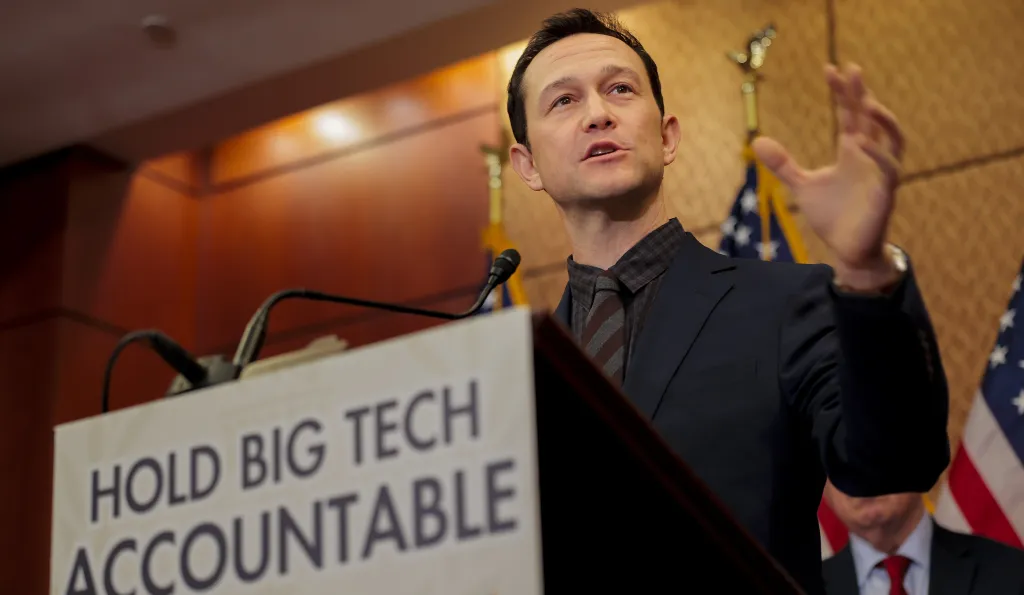
In a new video interview for The New York Times, actor Joseph Gordon-Levitt, serving as the United Nations’ global advocate of human-centric digital governance, has some concerning words about the impact of artificial intelligence. Things like the “decline of democracy, the decline of human empathy” and the hijacking “of your intimacy.”
The video interview takes place as Gordon-Levitt is in en route to address world leaders and officials gathered at the U.N. on the impact of A.I.
Watch the full video below.
First question: Why should the public listen to an actor on A.I. safety?
“Very fair question,” Gordon-Levitt responds. “Why listen to an actor? Don’t listen to an actor. You should read Human Compatible by Stuart Russell. Go look up Yoshua Bengio. Read posts by people who work in alignment and safety and policy. You don’t want to read all those things? Well, I did! So, you know, if you want to listen to me, that’s a shortcut.”
Gordon-Levitt continues, “What we don’t want is a bunch of people confused or apathetic while these very fast-moving businesses design the future by themselves, just in the interests of their own profits. A lot of what needs to happen, I think, has to do with communication, which is ultimately kind of what acting or filmmaking is.”
At one point in the direct-to-cell phone-camera interview, Gordon-Levitt is asked what he fears most about A.I.
“At the risk of annoying The New York Times,” he responds, “I would object to that question just because reducing these concerns into one sound bite of fear — that’s one of the problems. To me, saying: Oh, I’m scared that A.I. could exterminate all of humanity — that doesn’t really get at the substance of the concern. There’s real validity to that concern. But that’s not the thing that really worries me.
“The thing that worries me is a lot more complicated and a lot more boring to talk about, because it’s a lot more dense. The decline of democracy, the decline of human empathy. These companies are betting on the notion that they’re going to take over the entire economy. That would be totalitarianism, and that would be really bad.”
He continues, “Simultaneously, these models are being trained to hijack your intimacy, to make friends with you, to get you to fall in love with it. We shouldn’t be scared of an A.I. We should be concerned about the people building A.I.”
When Gordon-Levitt, a co-founder of Creators Coalition on A.I. and recently named one of Time magazine’s 100 most influential “innovators, leaders, and thinkers” on the topic, is asked to explain the “human-centric digital governance” phrase in his U.N. title, the actor concedes “it’s sort of a mouthful.”
“It just means that digital technology should be governed by people and for people,” he says. “’A.I.’ is nothing but algorithmically recombined, human-produced data. It’s humans. Calling it artificial intelligence sort of decenters humans. It offers this kind of magical fictitious character, this A.I. that we’ve seen in various sci-fi movies, but really — really all it is is us. It’s us.”
On whether the “slow-moving” U.N. can force a “fast-moving” Silicon Valley to play by certain rules, Gordon-Levitt responds, “To be honest, this is one of the things that I have found sort of daunting or troubling. I don’t know the answer. I think if it does take, say, seven years for the U.N. to put together an internationally agreed upon regulatory framework for A.I., then seven years from now we’ll be glad that we started now.”
>
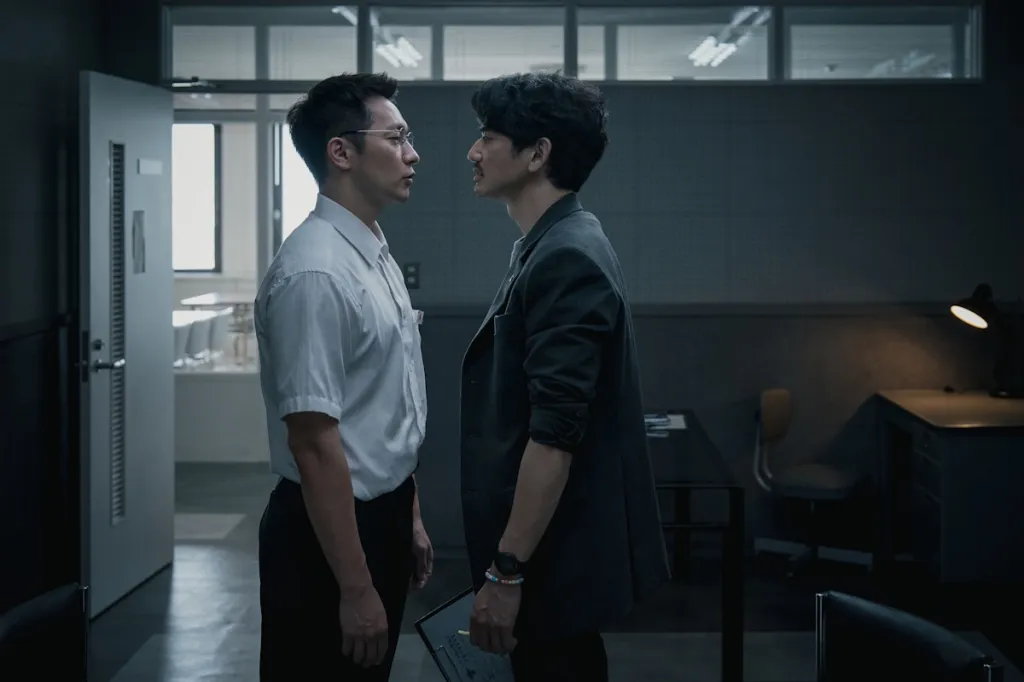
Korean writer-director Han Jun-hee talked strategies for getting audiences to respond to risky or unfamiliar material in a masterclass at Netflix’s Creative Asia day at Busan International Film Festival.
“There has to be risk for something to be interesting. Only if you take risks can you tell an interesting story. Trying to play it safe all the time, especially in Korea, is a risk in itself,” said Han, who is involved in two series premiering in Busan’s On Screen section – The Blue Road, which he wrote and directed, and Dead-End Job, which he created.
In a talk moderated by Netflix Korea content manager Kim Kijae, Han explained how he approached his breakout hit series D.P. (2021), about Korean military police on a mission to catch deserters, and Weak Hero Class (2022), about bullying and high school violence. Han wrote and directed D.P. while he served as creative director on Weak Hero Class.
“When it comes to army stories, some people think only guys can relate; but for female audience, they all have fathers or brothers who might have been in the army. If you think outside of the box, it could be an interesting story,” Han said.
In the case of Weak Hero Class, which revolved around a group of male friends and features a lot of fighting, Han said: “In Korea, the perception is that this genre can only be made into a film with a small budget. And again, the story looks like it might only appeal to guys. But we all went through high school; met friends there, got jealous of someone, wanted to be someone; these are universal feelings. But then we also added action to the story.”
Half joking, Han also said that casting a trio of hot, young actors – Park Ji-hoon, Choi Hyun-wook and Hong Kyung – was a conscious decision to draw in female audiences. But he also noted that all three have gone on to prove themselves as talented actors and big stars. Park starred in The King’s Warden, released earlier this year, which has become the highest-grossing Korean film of all time.
Han also talked about the importance of working with new directors as he stepped back from the directing role for Weak Hero Class: “We have so many new talents emerging, so we can help them make something great, and by bringing in an emerging director, I knew Weak Hero Class would really shine.”
Moving on to 2024 feature Pilot, Han described how he used genre, in this case comedy, to convey a message to the audience. Directed by Kim Han-gyul, the film is an adaptation of 2012 Swedish film Cockpit about a pilot who pretends to be his own younger sister after being fired from his job.
“When we gave the script to the main actor [Jo Jung-suk], he responded in just three days. He said he wanted to try different things in comedy and felt this part could go deeper than being a superficial comedy role,” Han recalled.
“With all the writers and directors I work with, if we take on something we’re not familiar with, we have to show that we understand it,” he added. “We can’t be prejudiced or biased. Whatever the story, I don’t think there’s a topic we can’t cover in a series or film. I don’t think you can say, ‘This isn’t commercial enough.’ If you have a message you want to convey to the audience, what is it you want to say? That is the most important part of filmmaking.”
He took a similar approach when creating Dead-End Job, directed by Kim Da-min, which deals with a serious subject, the vagaries of the labor market, but also uses genre to convey a message: “When the scriptwriters first brought this to me, Netflix said it’s either going to be a short film or not work out at all. The story needed to be told in a familiar way to resonate with people, so that’s why we thought a fantasy element would be interesting.”
Han also talked about The Blue Road, his return to directing, based on a manhwa about two detectives from Korea and Japan who form an alliance to track down a serial killer staging high-profile murders in both countries. While the two detectives have to navigate different working styles and jurisdictional hurdles, Han said the crews in the two countries also found they had to overcome cultural differences.
“Korean crews are very fast and flexible, while Japanese teams are meticulous and prepare everything very carefully. Neither way is better or worse; just different,” Han said.
“Japanese crew members all have unique roles to play and focus on getting everything perfect, while in Korean teams, we all help out on everything and do it quickly. If it doesn’t work out, we just try it again. At first, there were lots of misunderstandings, but we found we had a lot to learn from each other and eventually found a way to make it all work.”
The Blue Road is streaming on Netflix from November 20, while Dead-End Job is scheduled for October 30. The third series premiering in Busan’s On Screen section, Disney+’s The Remarried Empress, is streaming from November 4.
>


Search For Canadian TV Actor Stewart McLean Now Homicide Investigation


These ’90s fashion trends are making a comeback in 2017
According to Dior Couture, this taboo fashion accessory is back
Model Jocelyn Chew’s Instagram is the best vacation you’ve ever had
Emily Ratajkowski channels back-to-school style
9 Celebrities who have spoken out about being photoshopped


Rurouni Kenshin: Hokkaido Arc Manga Takes 1-Issue Break – News


HIDIVE to Stream English Dubs for The World Is Dancing, The Forsaken Saintess and Her Foodie Roadtrip in Another World, The Dangers in My Heart: The Movie Anime – News