
Sports
From YouTube to the Giro d’Italia: How the Unibet Rose Rockets prepared for their debut Grand Tour

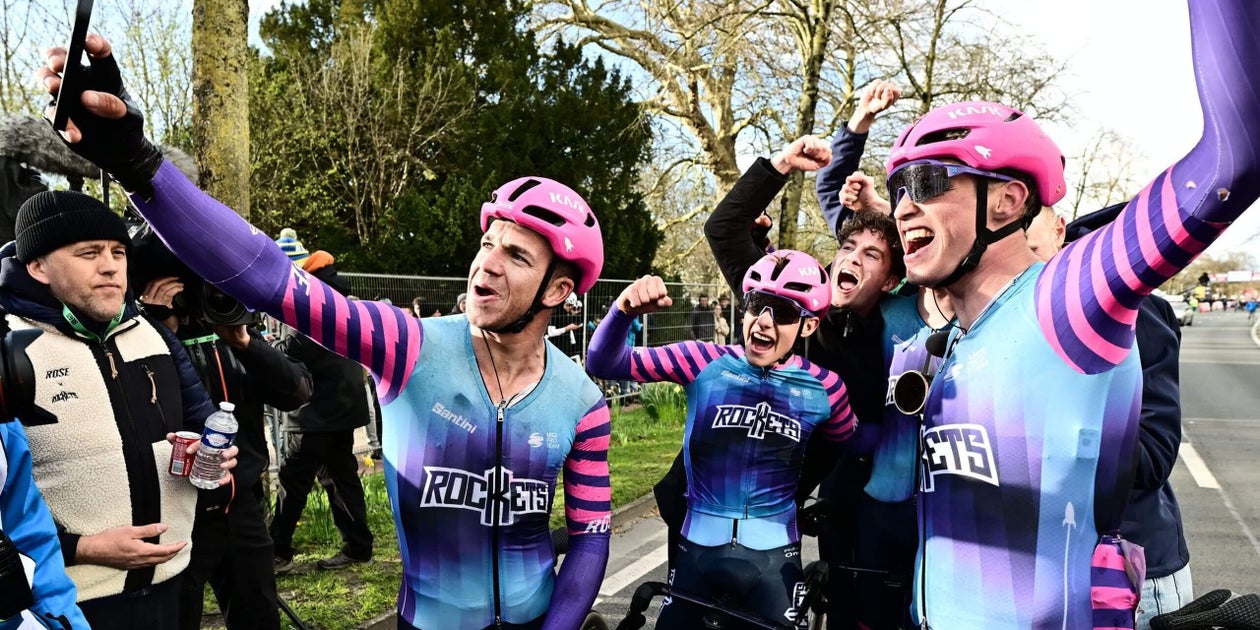
The only things brighter than Dylan Groenewegen’s pink and blue sleeves are the blinking camera lights around him, all videographers belonging to his Unibet Rose Rockets team.
Footage will be transferred to remote editors — then clipped, enhanced, storyboarded, and soundtracked — before going live on YouTube by late that evening. Groenewegen, meanwhile, rolling off in search of the pink jersey, has his own work to carry out.
Seven years ago, the team’s founders had only just posted their first videos on YouTube, fun cycling-themed skits and challenges. Now, after what began as a Covid-19 pipedream, they are at the Grande Partenza in Bulgaria, with both their own professional squad and over half a million cross-platform subscribers, competing in one of the world’s most prestigious races.
This is stage one of the Giro d’Italia — the Unibet Rose Rockets’ first ever participation in a Grand Tour.
Their goal is to win a stage, and this first day — an afternoon for the sprinters from Nessebar to Burgas — is the shot at history they have targeted. No team has won their first ever stage in a Grand Tour this century.
“Cycling is the perfect vehicle for stories. I think that has been shown already with newspapers owning cycling races, the way the sport is broadcast on television, the talk shows, the columns,” says founder Bas Tietema.
“The history and sentiment of the sport is unique. But I think every generation has their own way of communicating — and this is an opportunity for the next generation to tell the story in their own way.”
It is time to take them seriously. Groenewegen is amongst the favourites for the stage, now coached by German sprint legend Marcel Kittel. But in the cycling ecosystem, the Rockets are still minnows, a bunch of merry men with a camera — up against teams funded by international business conglomerates and nation states.
The Athletic was invited to go behind the scenes of how a team prepares for their first-ever Grand Tour — planning stages, buying buses, last-minute emergencies and everything in between.

The team line up at the 2026 Giro d’Italia presentation on Wednesday. (Dario Belingheri / Getty Images)
The Founders
None of this was Tietema’s initial plan. As a teenager, the Dutchman was a talented footballer, playing in the youth system of Eredivisie side PEC Zwolle, after which he turned to cycling. A member of the BMC development team, he finished third in Paris-Roubaix Espoirs in 2014, before injuries and allergies brought his professional career to an end by his early twenties.
“I was always really into social media — I remember Taylor Phinney was one of the first trying to connect with his audience on Strava,” he remembers. “But back in those days, it was seen as a distraction from your job as a professional athlete.
“Looking back, I don’t think a professional cycling career suited me best — this entrepreneurial lifestyle suited me way better than being a pro athlete who just eats, sleeps, trains and repeats.”
Tietema set up his own YouTube channel in April 2019 ahead of that year’s Tour de France, quickly joined by effervescent co-founders Josse Wester and Devin van der Wiel — the trio completing challenges such as delivering pizzas to riders, drinking champagne with the stage winner, and managing to drive a team bus.
“We did those three weeks with €10,000 for the three of us, sleeping on hotel floors, in tents on patches of grass,” says Tietema. But it proved the model worked.
Their audience began to grow internationally, particularly in western Europe, the United States, Canada, and Australia — fuelled by viral videos such as getting non-cyclists Wester and Van der Wiel to ride the route of the Ronde van Vlaanderen, or recording a song with Tadej Pogačar.
“We actually think about you guys quite a lot,” Pogačar’s partner, fellow cyclist Urska Zigart, told Tietema some time after recording. “One of the photos from that day is on our nightstand.”
Covid-19 was a blow to their plans — cancellations rolling in for future projects — but it got the trio planning.
“Bas turned to me and said: ‘Within five to 10 years I think we can build a WorldTour team,” remembers Wester. “I was just like: ‘These guys are crazy’.”
Tietema begins to laugh, but there is a seriousness behind it. His pipedream, after all, paid off.
“I just really believed in the fact that if you started with a fanbase or community and took them along the journey — setting up the team, first goals, but also setbacks and difficulties — then it could work. I truly believed that if you approached it from a storytelling perspective, it could be super interesting.
“The first year, we had a lot of difficulty. We started literally with nothing. But for people seeing our line-up now, they can see Hartthijs de Vries, a rider who joined in that first year, and they know his whole journey, all the difficulties, all the lows. That’s the beauty.”
Progress came remarkably quickly at cycling’s lower levels. They flew from amateur status, to third-division UCI Continental, to second-tier UCI ProTeam, propelled by both canny transfer activity and leveraging their social media clout to secure much-needed sponsorships.
Those results needed to come. Cycling can be guilty of prioritising traditionalism above all else — and there were individuals in the sport who dismissed them as YouTubers messing around, racing against genuine riders fighting to make a living.
“The videos added to the pressure,” Wester accepts. “If your whole team DNFs, and you’re making a series about trying to win a GC leader jersey, it doesn’t really help your credibility and development. We have to be transparent because of the storytelling — but that means we always need to prove ourselves in a conservative market where people are not always the biggest fans of innovation.”
But the race invitations were beginning to flow on merit. In 2024, they achieved ProTeam status. The following year, they raced in their first Monument, Paris-Roubaix, this year they competed in the season’s first three. In the off-season, three high-profile Grand Tour stage-winning veterans all joined: Groenewegen, Victor Lafay, and Wout Poels.
It all spoke to their next goal: to compete in a Grand Tour as one of a handful of wildcard teams granted entry to each race. They entered discussions with both RCS, who organise the Giro, and the Amaury Sports Organisation (ASO), who stage the Tour de France and Vuelta a Espana.
“It’s a conversation,” explains Wester. “They’re asking what riders we’re willing to compete with, if we’ll take our big riders, because obviously they’re competing with the Tour de France for the sprinters. The RCS were quite interested in having Groenewegen because the Giro is the only Grand Tour he has not won a stage in.
“But more broadly, it’s not really about the singular event, but it’s a long-term process where you build a relationship, they see the dedication of the team, the riders, the staff, and whether you can make an impact for them.”
At the start of the year, they heard back from the ASO. There would be no place for the team at the Tour de France. But then, just after eating dinner, Wester received a phone call from the CEO of RCS. Good news. The Rockets had been invited to ride their first Grand Tour.
“It’s a completely different feeling to winning races,” says Tietema. “With races, you have this extreme moment after the finish where everyone is super excited. Here, you can see the steps happening — but then you’re just sitting on your couch and receiving the news. It’s not that romantic.”
Or is it? “Yesterday, I was sitting on a plane with Marcel (Kittel) and Dylan (Groenewegen) on our way to our first Grand Tour stage,” adds Wester. “A few years ago, it would have been like a Make-a-Wish day for me. But now it’s the real deal — and we want to showcase ourselves to the world.”
The Coaches
But to do that, they have to get to the start line. Julia Soek is the team’s head sports director, a former professional herself at Giant-Shimano, and in ultimate control of connecting the staff, riders, and race program. She has been on board since the start — witness to the team’s massive growth.
“We just had a single program with 12 riders at Continental level,” she remembers. “There was one camper and maybe two DS cars. The media team was bigger than the sporting team. Then, becoming a ProTeam, that was a huge step because we had to double everything — the fleet of bikes, the service cars.
“This year, we’re doing a Grand Tour, and that’s actually one of the big challenges we had over the winter, working really hard to invest in our fleet. We now have a camper, a huge bus, two trucks, and that’s a big challenge in just three years.”
Their bus — a behemoth which includes showers, kitchens, and meeting rooms — was sourced from women’s squad SD-Worx, who were upgrading.
“It’s funny,” says Soek. “The SD-Worx girls are sending messages because they think they’d left a lucky sign on the bus. They were telling me they needed it for the next race — and we were also joking because it was used by Julia Kopecký (for SD-Worx) and of course her brothers Matyáš and Tomáš now race for us.”
Worked so hard before the @giroditalia that we forgot to fix one thing. 🙈
💕 @teamsdworx pic.twitter.com/PolsHFsrnq
— Unibet Rose Rockets (@rockets_cycling) May 8, 2026
Even with this investment, the Giro is a big step up in planning.
“It’s 21 days long with a lot of transfers involved,” she says. “I mean, we start in Bulgaria and go to Italy. For us, it’s the first time, and when you look at the top-ranked teams, they have more resources than others. We need to be flexible and creative to make it work — but also deliver high quality.”
Her fellow DS Roger Hammond nods in agreement. As a rider, Hammond was a cobbles specialist, the Briton a third-place finisher at Paris-Roubaix in 2004. Before joining the Rockets this year, he had worked as a DS at some of the sport’s heavyweights: INEOS Grenadiers, Red Bull-Bora-Hansgrohe, and Bahrain Victorious.

Roger Hammond (right) came third at the 2004 edition of Paris-Roubaix. (Denis Charlet / AFP via Getty Images)
For the 52-year-old tactician, the draw to a ProTeam, the tier below the WorldTour, was the opportunity to do things differently.
“One thing I really felt about the juggernauts is that they had these huge amounts of resources, but did not necessarily always have the motivation or appetite to do anything with it,” he explains. “When I spoke about joining here, I liked the idea of challenging the norms.
“A message which had been plugged at a previous team, who I felt lost their way a bit, was that we needed to ‘execute better’. But it made me think: ‘Well, why are we doing that?’ What I really liked about this team is that there weren’t too many people with preconceived ideas.”
Owing to the circumstances of their Giro entry — as a wildcard, their place was not confirmed until February — the team had to start planning for a potential Grand Tour well before they had the official go-ahead. In these discussions, one key difference is an untraditional aspect to managing day-to-day racing.
Usually, a team riding in a Grand Tour would have a lead DS who plans each day — with juniors then providing input. The Rockets, instead, split the planning between four DS’s, each able to provide a far deeper dive due to the narrow focus. Those approaches are then peer-reviewed.
“Over the last 10 days, I’ve been really meticulously going over my stages,” says Hammond. “And I spend about three days per stage gathering as much information as I can. All those minor details which you might miss on a one-day race don’t really accumulate, whereas on a 21-day stage race, they really do.
“We’ll keep on reviewing these because our environment doesn’t stay the same between stages. That’s the one fundamental difference between us and a football team — we’re not on a standardised pitch. Every day is going to be different.”
He sees this as one benefit of the team’s embrace of YouTube — they will produce a video each day throughout the Giro — that the format highlights the unseen work which goes into race planning, rather than solely providing veneered clips of winning riders raising their arms above their heads.
“We’re going to come together for the best part of four weeks, working 15 hour to 18 hour days without a day off,” he says. “That’s an environment which will only work if everybody is on the same journey. People see hugging after a victory, but the poor guy that has done 2,000 kilometres in a lorry to deliver equipment, then getting up the next day to fix bikes? That’s the guy you need to show.”
The Sprinters
Last July, Groenewegen’s career was at a mini-crossroads. The 32-year-old was out of contract at Australian WorldTour squad Jayco-AlUla, having previously ridden for Visma-Lease a Bike for the previous six years. He was consistently fast — winner of six Tour stages, the most recent in 2024 — but had a reputation for volatility, having been banned for nine months in 2020 after being found responsible for a horror crash involving Fabio Jakobsen.
Even after a down year in 2025, signing Groenewegen represented a huge coup for the Rockets — this was a proven race winner, putting his belief in the incipient team.
“It’s a cycling team, and yes they have a YouTube channel, but I think for me that this was one of the best options with the strongest leaders,” Groenewegen explains. “But I had to explain myself to a few people, to believe in the project. If you look at last year, it’s a different team to the Rockets now. They might be a ProTeam, but for me, I do almost the same program.”
Vindication came quickly. Groenewegen had four wins by the end of March, including the Rockets’ first ever win at WorldTour level, sprinting to victory at the Ronde Van Brugge. Now, at the Giro, his legs are the Rockets’ core hope.
One key to the team’s success was a similarly surprising signing. Behind Mark Cavendish, Marcel Kittel was arguably the second-finest sprinter of the 2010s, winner of 19 Grand Tour stages including 14 at the Tour.
He retired young, aged 31, citing injuries and the pressures of professional cycling, telling Dutch newspaper NRC Handelsblad that he believed he may have suffered from depression. A return to the cycling world looked distant.
“I actually never saw myself back in professional cycling,” Kittel shares. “That was not the plan. And so I really share the same approach as Dylan — it would have to take a team that wants to do things differently, full of energy, that wants to discover and haven’t seen it all yet.
“Bas (Tietema) actually called me four years ago when he was setting up the team, and I told him that I had kids, that we were building our family home. I had other stuff going on. I was not ready, I was not mentally ready for the elite professional sport world again. But then last year I got another message, we had a coffee, and four hours later we were still speaking about sprinting. A few months later I said I would do it.”
Kittel is clearly thrilled to be working with Groenewegen. “I knew him from sitting on his wheel,” he explains, before adding that the Dutchman is “setting the standard for the whole group.”
Given the peaks and troughs of his career, Kittel is particular about his own role, focused on what he wants to impart. Having once been consumed by stress, he now speaks of positive pressure.
“Every time we were open and communicative, that’s when I could perform the best,” he says. “It’s body plus mind that makes success for the team.
“I feel that this is one of the biggest points in modern professional cycling, that everything is towards data and new innovation, scientific approaches, and those are cold topics. The human beings are maybe half of the performance, especially in a Grand Tour when you’re really tired and it’s the second and third week.”

The Rockets have been on the top step of a podium this season — can they repeat the feat in the Giro this month? (Elias Rom / Belga / AFP via Getty Images)
Four days before the Giro, there is stress in the Rockets camp. Karsten Feldmann, a key member of Groenewegen’s leadout train, is sick. Together with the management, he makes the decision to withdraw.
“It’s s**t,” he says. “But it’s nicer to get this (now) than to go there feeling like I slowed the team down in any way and then maybe pulled out in two or three days.”
His replacement is Matyáš Kopecký, whose brother Tomáš was already set to race.
“It’s pretty heartbreaking for Karsten,” says Wester. “But I think it’s also pretty cool that Matyáš is racing. They’re trying to set up their own milestones in that family — at the moment, all three of their children are doing a Grand Tour because Julia is riding the Vuelta Femenina. The brothers did their first WorldTour race together, their first Monument together, so they just keep upping the stakes.”
But the lateness of Feldmann’s withdrawal has led to a scramble. The team’s truck carrying their bikes had already left for Bulgaria.
“(Matyáš) arrived really late on Tuesday, after midnight,” Wester explains. “It’s a turbulent 36 hours for the rider but also everybody else involved. Luckily, we had planned to have a car arriving late just for this reason, so we could bring anything very last minute. From a performance perspective, a media perspective, it was stressful. But I think we’re all very happy in the condition we are here in.”
For the first 145km of Friday’s stage one, the Rockets’ plan is working perfectly. Hartthijs de Vries, the 29-year-old who has been with the team for every year of their existence, hammers the pace at the front to keep the breakaway in check.
In the car, the omens appear to be aligning. Kittel’s fourth and last Giro stage win happened exactly 10 years ago — all of them, bizarrely, coming outside of Italy. Working alongside Lidl-Trek, the break was caught with 20km remaining. It would be a sprint.
Sprints are chaotic and instinctual, for all the planning that can be done, decisions have to be made on feeling, with risk, at speeds topping out at around 80kph. The finish in Burgas was narrow and uphill with barriers crowding the road. The winner was likely to come from whichever small handful of teams — likely just two or three maximum — were able to block out the road.
Initially, the Rockets are in an ideal position on the right side of the road, but as the peloton began to cascade through a series of roundabouts, they slip back into the teeth of the melee. Lukas Kubis, wearing the Slovakian national champion’s jersey, visibly jostles his way forward in an attempt to return Groenewegen to the front.
This is a messy sprint, but the Rockets are together — until their race ends in a cacophony of screeches, flips and blood. The peloton crash en masse with 600m remaining, triggered by Uno-X sprinter Erlend Blikra clipping the base of a barrier before going down. It is an unavoidable pile-up. Groenewegen is something like the 10th man down, landing heavily on his shoulder, still clipped into his pedals.
Up ahead, 22-year-old Frenchman Paul Magnier streaks clear for his first Grand Tour stage victory. Groenewegen sits with his back to the barriers and counts his wounds. He will remount his bike, gingerly, to complete the stage, draping his wrist over his handlebars due to the pain on his right side.

Paul Magnier celebrates victory on stage one of the 2026 Giro D’Italia (Luca Bettini / AFP via Getty Images)
Back at the bus, Kittel fends off questions about his leader’s condition: “He looks good. He came to the bus by himself. But we’ll know more soon.” There is genuine fear that his Giro may have ended on the very first stage — taking many of the Rockets’ hopes with him.
An hour later, a text arrives from Wester. “There’s still 96 per cent of the race to go,” he writes. “And Dylan will be a part of it.”
Groenewegen had landed heavily on his right arm and shoulder, suffering deep scratches and pain within the shoulder. Testing revealed he had been fortunate, in some senses — his collarbone was not broken.
“It won’t be too comfortable tonight and tomorrow,” says Wester. “But he was already giving me some motivational quotes about there being plenty of opportunities to come.”
Groenewegen’s fitness was a small boost, but there was no escaping the reality. Compared to their dreams, Friday was a disappointment. Four days earlier, Kittel, a rider who stared both success and failure in the face, spoke about how the team would handle moments like these.
“The fact that we are not this big team that is doomed to win gives us a lot of advantage,” he says. “I believe our margin of failure is smaller because of the way we’re telling the story. If it’s a win, great. If it’s a loss or we don’t get our opportunity, we still have the story. Everyone is engaged in that, so we can accept it as part of the process.
“In a way, that is still our biggest edge over the other teams. We came as the underdogs and now we are proving ourselves at the highest level. We want to be seen there. We are taking the risk to fail as well.”
>
Carolina will be without one of the NFL’s best cover corners for the foreseeable future.
>
Welcome to The Windup, The Athletic’s MLB newsletter.
>
“Right now, the best team in the NBA is the New York Knicks,” he added, “and they have one of the best players, Jalen Brunson.”
>

Netflix Finds Its ‘Icebreaker’ Leads in Daisy Jelley and Connor Simos

Lindsay Lohan & Henry Golding To Lead Netflix Film ‘Return To You’
Panthers CB Jaycee Horn suffers significant quad injury, out indefinitely: Source
-

 movies4 months ago
Search For Canadian TV Actor Stewart McLean Now Homicide Investigation
-

 Fashion9 years ago
These ’90s fashion trends are making a comeback in 2017
-
Fashion9 years ago
According to Dior Couture, this taboo fashion accessory is back
-
Fashion9 years ago
Model Jocelyn Chew’s Instagram is the best vacation you’ve ever had
-
Fashion9 years ago
Emily Ratajkowski channels back-to-school style
-
Fashion9 years ago
9 Celebrities who have spoken out about being photoshopped
-

 Anime4 months ago
Rurouni Kenshin: Hokkaido Arc Manga Takes 1-Issue Break – News
-

 Anime3 months ago
HIDIVE to Stream English Dubs for The World Is Dancing, The Forsaken Saintess and Her Foodie Roadtrip in Another World, The Dangers in My Heart: The Movie Anime – News