
L-R: Heath Ledger and Jake Gyllenhaal in ‘Brokeback Mountain’
Focus Films/Everett Collection


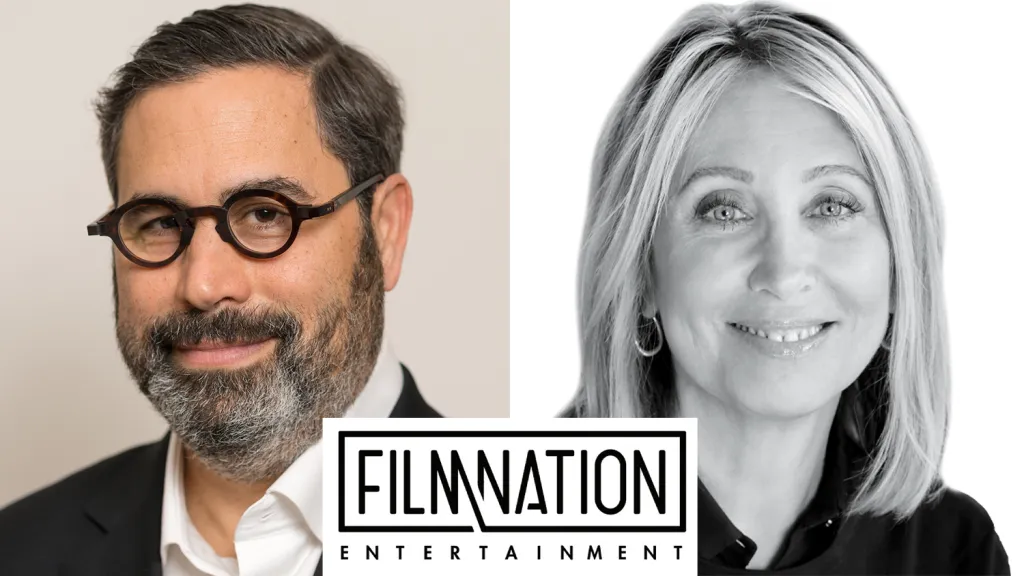
FilmNation‘s hire of former Universal, DreamWorks and Fox head Stacey Snider was a coup. But then again, FilmNation isn’t your average indie film and TV company. Glen Basner‘s blue-chip New York firm has been working on prestige and commercial hits for almost two decades: from Mud to Arrival and Conclave to Anora.
In a wide-ranging interview on the eve of the Cannes Film Festival and market, Deadline sat down with Snider and Basner to discuss their collaboration, new slate additions (including films with Richard Gere, Adrien Brody and Rachel Zegler and Jeremy Strong), the state of the business and what’s on the horizon.
I joined our call when the two were in the middle of a Jeff Nichols King Snake discussion…
DEADLINE: So how is it looking?
STACEY SNIDER: Real, authentic and spooky. They’re out at this remote location in Arkansas that feels like no one could hear you if you needed help…
DEADLINE: That’s probably what you want from a Jeff Nichols movie, right?
GLEN BASNER: I love that I get to see some actors from Mud that we made all those years ago, because not too many people are shooting in Little Rock, Arkansas. I’m seeing a lot of familiar faces that are taking me back to that film…
DEADLINE: So Stacey, how are you finding the rhythms of FilmNation?
SNIDER: I’m loving it. I feel like I’m really settling in. It’s been about five months, and it’s a great team, and we’re working on really great films. So I feel good and I feel motivated.
DEADLINE: There was a line in Mike Fleming Jr’s story about your hiring when he said that after your time at Sister that “this move seems a better fit for your skill set.” Do you agree with that?
SNIDER: I hope so. You have to ask Glen, but at least from my perspective it feels like a great fit. I love the movies that this company makes. I always have. They speak to me: They’ve gotten into the culture, they’re distinct. I think that’s what every executive and every producer wants to be a part of. It also speaks to me because I think there’s a need for what FilmNation does. Original movies matter, and they’re harder and harder to make. I felt that my taste overlaps with Glen’s and we’ve known each other for years. My experience and my drive can help these films be navigated toward production, so I felt like I could add value.
DEADLINE: How do you know each other?
SNIDER: We’re OG [laughs]. Glen can tell the story…
BASNER: When I was starting out as a young junior salesperson at Good Machine International, Stacey had the idea of buying the company and then taking the management team and merging it into USA Films to create what is now Focus Features. So it’s been, I don’t know, twentysomething years since Focus was created by Stacey and by James Schamus and David Linde, who were two of my mentors from the beginning of my career.
DEADLINE: And you got on well at that time?
SNIDER: We did. What was great about the studios during that time is there was a great variety of films that we could do. We were expected to do that. You were expected to present and distribute each year a variety of films from around the world. The bifurcation with specialty being its own thing was starting to happen, and I felt like we needed that at Universal. David and James and everything they built at Good Machine was a perfect candidate, and so my path crossed with Glen then. We made great movies at that time: The Pianist, Brokeback Mountain, Eternal Sunshine Of The Spotless Mind…But then all through the years, when I needed someone to really give me a sense of a film’s prospect and value and path to production, I would call Glenn at the various places that I was working at to be a touchstone…
L-R: Heath Ledger and Jake Gyllenhaal in ‘Brokeback Mountain’
Focus Films/Everett Collection
BASNER: I would add to that when we first became part of Universal and Focus was created, the initial instinct was a lot of nervousness and insecurity about what was going to mean for us and our indie credibility, but it was one of the great periods of my career where I learned so much and I became a fundamentally different executive through three years of working there. When I first thought of approaching Stacey about this role, it came at a time when things do feel challenged in the market and there isn’t a lot of certainty, except that I know that every day myself and this company we have to get better in a meaningful way every single day. That’s sort of what fueled my ambition to even approach Stacey about the role. But I’m a better executive today than I was the day before, and the experience, the creativity, the maturity and how to navigate complex situations…every day something happens where I’m like, ‘Oh, that’s a better way of doing something.’ That is really fueling all the optimism that we share as a company…
DEADLINE: How are you dovetailing?
SNIDER: Glen’s assembled a team of experts. As the Chief Creative Officer I’m keeping an eye on the film and TV productions, but we’re all engaged in Socratic decision making to be a nimble, decisive company. I’d say our skills complement one another, but they often overlap.
DEADLINE: This is clearly a creative role. Was there a strategic or financial design in mind when you made the hire, Glen?
BASNER: Stacey is leading the creative charge of FilmNation, but she’s run three studios. We have questions about things, and we have experience, but we don’t have that experience. So there’s no exclusionary like, ‘Okay, well, we’ll handle the strategy or the business’. We just work together as a team, and where Stacey can add value, and often does add value outside of a creative auspice, we’re fortunate to have it, and we’re definitely taking advantage of it every day. But it’s not part of sort of a grand plan of doing other types of businesses. It’s about doing what we’ve been doing really well for almost 18 years and saying ‘but really well isn’t well enough anymore. We need to do great’, and Stacey will lead us in that direction.
SNIDER: We both want to get stuff done, and the company is designed that way. It’s Glen’s personality to be decisive and want to get things done. There’s a real experience and bespoke attention to each step of the process so filmmakers can make the best version of their film.
DEADLINE: When the announcement was made, it probably took some people by surprise given your long studio background. Were there also conversations with studios at that time?
SNIDER: There were some conversations about what gig I might try for, but for the people that really know me, what I love is making movies. I think in this moment of consolidation, and even before that, during a time, when for understandable reasons, studios had abandoned the mid budget films and the variety of films, I’ve always been motivated by variety and originality and just getting stuff done.
DEADLINE: Have you started originating projects at the company? Any of the new projects announced for the Cannes market, for example?
SNIDER: Most of them have been in motion, and I feel really lucky to to be near them. But what I’m hoping for is that some of the filmmakers that I worked with at the studios will want to make original films…
BASNER: Our recently announced project Asymmetry by Ed Zwick is one we just agreed to co finance and produce and that came in from Stacey. She had worked with Ed making Legends of The Fall. That was a conversation I loved listening in on. ‘How can an Academy Award winner, a filmmaker that has made seminal movies in a lot of our lives, how can he go and make something just as great in the landscape that we face today?’ I think the combination of her creative instincts, but also her ability and relationship with Ed on a creative level, along with our ability to have a really flexible model and multiple models of how we can make something exist, is a really quick and straightforward example of something that we had imagined could come to bear and has happened really quickly.
So, Asymmetry I’m really excited about because it poses this real provocation of an asymmetrical age relationship and society’s viewpoint on that. But it gets to a really human place where it’s like, ‘well, who am I to tell somebody else who they can or can’t love, or should or should not love.’ At the same time, it’s entertaining. People are going to go see this, are going to have a real talking point, real fun afterwards with their partners and friends that they go see the movie with. But mostly they’re going to walk out smiling. They’re going to have a great time. And that has me really excited. And I could also say, Richard Gere. It’s the first time we have Richard Gere in a FilmNation movie, and that’s not a small thing to us. Richard Gere is an unbelievable actor, and again, like Ed, represents touch points in my growing up and learning about film. So to have Richard Gere in one of our movies is really fucking exciting.
SNIDER: Another example of stuff that gets me so excited is our film Passenger by Magnus Van Horn. I didn’t know his work but it has been so exciting to prep and learn about it.
DEADLINE: That one sounds like it has real awards potential. Jeremy, the subject matter, the director…When is it starting?
BASNER: Top of the year.
L-R: Adrien Brody, Rachel Zegler and Ben Platt
Getty/Courtesy/Getty
DEADLINE: You mentioned The Pianist earlier. It’s kind of a full circle moment then that you’re now making the movie after Adrien Brody’s second Oscar, for The Brutalist. Rachel Zeger will co-star and sing in it. Is the movie a musical?
BASNER: It’s not a musical, but it’s a film with a lot of music, because they’re on this cruise where Gloria Gaynor and disco are the best way to celebrate their lives and guard against what’s coming in the future. Ben Platt is writing some original songs for Rachel and Adrien.
Since we sent that out, I’ve been making dozens of calls and getting dozens of calls from distributors and I’m having the best time telling everyone my schmaltzy sales line. But I mean it. ‘This is not a feel good movie, it’s a feel great movie’. And that’s the sensation that I had when I was reading that script, and when I turn the pages and there are tears in my eyes, literally tears in my eyes. And I just feel on top of the world when a movie can do that for you and be about something. It’s it’s just the best.
DEADLINE: Looking at your slate, it feels like over the last few years FilmNation has stepped back from some of the $50-100M projects that you were involved in previously. There are fewer in the market in general but they still exist, but not really on the FilmNation slate. Has that been a conscious decision?
BASNER: It’s factual to say that that’s some aspect of where the market is and what the independent market can bring to bear. But at the moment, we just simply don’t think like that. It’s just not our starting point. We’re talking with storytellers, we’re reading screenplays, we’re reading books and articles, and we’re just looking to be inspired by something. It’s not more complicated than that. At the same time, it is fair to say that very expensive specialty movies feel very difficult for independent distributors in individual territories. There’s some price sensitivity because of the consolidation that’s happened in our business and in our industry. But there’s some talk that that’s a theatrical problem when it isn’t. It’s really more about the ancillary value, and in particular, pay and free TV.
DEADLINE: One of the ways companies can look to insulate themselves is through domestic distribution. There’s been talk for years you’re going down that road. What’s the latest there?
BASNER: Let me start by saying that at no point in time will this company ever think about ‘insulating’ itself. We want to be right there in front of it. We want to feel the edge, the pressure of the world, because that’s going to sharpen our instincts. That’s what’s going to allow us to maintain our ambition. The jet fuel is creative ambition, and we’re going to be just as daring as we always have been. It’s always been about finding a filmmaker who’s got a unique and singular story to tell, and then supporting them, often in multiple ways, to make sure that film can achieve the best version of itself.
In terms of distribution, everyone loves to talk about what other companies are doing. I’ve been called by journalists over the years to congratulate me on the sale of my company — a sale that never happened…
DEADLINE: Sure. But it’s a fact that you’ve discussed this as a company, that it has been part of the conversation…
BASNER: But not in the way you are suggesting. It’s been in our minds since we started producing movies. Because when you produce a movie and then you deliver it to the U.S. distributor, everything gets talked about as if it’s the U.S. distributor’s movie. And while you’re certainly happy to share that credit, there is an emotionality to that of like, ‘wait a minute, we made this movie, we want to be part of that recognition’. That’s always been something that I felt throughout the years, and it’s always something that we’ve talked about throughout the years. But it’s not the first and foremost thing what we’re looking to achieve right at this moment.
L-R: Margaret Qualley, Michael Shannon, Drew Starkey and Jeff Nichols
Getty Images/Juankr/Getty/Kyle Kaplan/Focus Features
But Neon just took King Snake for domestic in a partnership with us. That is actually a different structure to something we’ve done before. We didn’t need to start another distinct company to achieve it. FilmNation will share in the U.S. distribution risk with Neon. That’s a first for us in how we finance a film. It represents the confidence we have in our slate and will be part of our strategy going forward on 1-2 films per year.
DEADLINE: Do you still have the same backers as before at FilmNation?
BASNER: Yes, we have three partners the company: myself, a gentleman named Steven Samuels, who was has been my partner since the beginning (and he in turn has two partners), and then about ten years ago Roadshow distribution from Australia came in as a third partner and their investment was the capital with which we started financing movies.
DEADLINE: Any other parnters on the horizon?
BASNER: No
DEADLINE: You’re known as a blue chip film company: given that, what was the thinking behind taking on the controversial Melania documentary for international sales earlier this year? That raised some eyebrows. Was it a hard one to square with the team? Are there any other Trump adjacent projects on the horizon?
BASNER: Melania was a global release for Amazon. While we can’t comment further due to contractual obligations, we can say that we consistently work with a number of studios, streaming partners across many and varied film and TV titles to help them achieve best possible results.
DEADLINE: What’s the weighting right now at the company between film and TV?
SNIDER: I’m still getting my arms around our TV and film groups. Filmation is known as a film company. I’d probably say film is around 60 to 70% of my attention, but I’m loving what our U.S. and international TV teams are doing. The House Of The Spirits, our Spanish-language adaptation of Isabel Allende’s novel, was a great fit for us.
DEADLINE: Is it natural to assume that 30-40 percent TV will increase in coming years?
SNIDER: My hope is that our film talent can toggle between film and TV, which is what our TV head Courtney Saladino Gurney did on House Of The Spirits.
BASNER: Whether it’s a project for our production label Infrared for more mainstream films, or whether it’s a Graham Norton book Kirstie Macdonald has brought in for us in the UK or a project we’ve set up with MediaPro, we’re just focused on how we can do what we’ve done in the past, better. Our movie Skeletons for our Infrared label is one that we’re producing with JJ Abrams and Jack Heller and which we recently sold to Sony. It’s currently on the ground in Australia and they’re prepping that and doing the final casting now to join Brie Larson.
DEADLINE: You’ve both worked with so many great filmmakers. Can you each give me a name of someone you haven’t worked with that you would love to do so?
BASNER: Steven Spielberg.
SNIDER: Someone whose work I so admire, and who I’d love to find something for is Paul Thomas Anderson.
Paramount CEO David Ellison at CinemaCon 2026
Gilbert Flores/PMC
DEADLINE: Stacey, you’re well versed in the impact of major mergers and acquisitions from your time at the studios. What did your experiences teach you about the likely impact of a Warner Bros sale? What would you hope could come from it?
SNIDER: When I was at Universal and I worked for Ron Meyer and the studio was bought and sold four times, and in those situations, luckily, we weren’t bought by other studios. So the goal was to just keep our heads down to make great movies, deliver results financially, and I wanted to protect everyone’s jobs. When it comes to this type of consolidation, I’m hopeful that the commitment to theatrical and to volume and to keeping the studios separate, is true, because I think there’s a business reason and a cultural reason to do that. So, I’m hopeful that that is true, and and I feel for the people that are going through it because the uncertainty is just awful.
But even as optimistic as I am, I know that consolidation means fewer decision makers. You can commit to volume, you can up volume, you can commit to theatrical releases, but there’s just fewer decision makers and gatekeepers.
DEADLINE: Like many others, it sounds like you’d rather this deal wasn’t happening and the two studios could remain standalone…
SNIDER: For Glen and I this business is not just a business; it’s a vocation, it’s a passion, and I believe in variety. I know how motivated I was when I was at the studios by competition, and by an open market. I wanted to be as good as my competitors, and I wanted to beat them, and that made for a really vibrant creative and business culture. That’s what I believe in.
DEADLINE: Any advice for David Ellison as he navigates this tricky deal?
SNIDER: It would be presumptuous for me to do that. I’m here to be a thought partner to anyone in the business who is trying to wrangle through a difficult situation. And that’s why I wanted to join FilmNation, because you can only navigate difficult situations when you’ve got people whose values and tastes and interests align with yours.
>

Swedish climate activist Greta Thunberg has thrown her weight behind the Zurich-premiering My Home of Wind and Sand, an important and affecting documentary following a young woman’s fight for her community’s independence.
From Austrian filmmaker Patrick Wally, who shot the feature over a 10-year period, My Home of Wind and Sand is a portrait of Sahrawi activist Najla Mohamed Lamin. She was born and raised in the refugee camps near Tindouf, Algeria, and has devoted her adult life to campaigning for Western Sahara’s liberation from Moroccan sovereignty. We follow Lamin from her studies in the U.S. to representing the Sahrawi people at the United Nations, where she argues for peaceful resistance as a generation born in exile (Spain withdrew its occupation of the region in 1975) grows older and angrier without resolution.
When armed conflict resumes after decades of ceasefire, the convictions that have shaped Najla’s public life are tested. And then, toward the end of the doc, comes a kick to the gut: The UN Security Council adopts a US-sponsored resolution describing genuine autonomy under Moroccan sovereignty as the “most feasible solution” to the conflict.
Lamin and Wally, whose sweet and unlikely friendship anchors this depiction of the Sahrawi people’s fight for justice, were celebrated at the Zurich Film Festival premiere on Tuesday evening, where they urged attendees to spread the word about the issue.
And Thunberg, who in January 2025 visited the Sahrawi camps with Lamin accompanying and translating for her, spoke plainly about what must change and called out the media for its silence. “This movie is so much about betrayal,” said the young activist. “First, it is the occupation and the violence in itself that somehow becomes viewed as normal. […] It’s not attractive enough to gain any media attention or clicks, which is yet another betrayal. And then it’s the whole international community, all the international organizations that people are putting their entire trust to, but are being met with nothing but betrayal.”
She continued, asking the audience to take Lamin’s story with them: “We do not talk about Western Sahara — people don’t even know about Western Sahara, and there’s just this extreme hypocrisy that makes me so, so angry and upset. While this story is, of course, incredibly inspirational, it is about perseverance, steadfastness, and continuing the fight as a matter of duty. I am convinced that Najla [and her community] do not want thank-yous or applause, but action. It falls on every single one of us in this room, especially us privileged people who have a platform or access to resources, to actually take that moral obligation to amplify the Western Saharan struggles. […] We will spread the word, and do everything in our power to ensure global solidarity and justice. Because otherwise, we are nothing more than hypocrites ourselves.”
Lamin reflected on seeing a decade of her life up on screen and paid tribute to the thousands of people — including her late sister — who will never have their voices heard. She said at Zurich’s Kinokoni: “Standing in Europe, in Switzerland, I think it’s very easy for us to think that we are completely separate from each other as nations, as cultures, as activists, as women, as men. ‘Oh, she lives in Africa. She has nothing to do with me. I live in Switzerland. I have nothing to do with the person in Gaza or in Sudan or in Congo.’”
The campaigner added: “But when you really sit with yourself, you do a little bit of research, or just take the courage to be honest with yourself… We’re only one small planet, and we’re not separated. We’re not different. Morocco cannot do what it’s doing without the support of Europe and the U.S., and Israel cannot do what it’s doing to the Palestinian people without the support of Europe and the U.S. […] Free European citizens, you have a very, very big responsibility to look back at your privileges, to look back at your government, at your interests, and see where [you] can make a difference.”
The room erupted into raucous applause as Lamin spoke. All she is asking for, she added, is a referendum where her people can decide their own future. Wally added: “I was so astonished of her story and how she tells it, and even [at] the first meeting, everything she told me… It was eye-opening for me. She had so much knowledge, and I learned so much from her that I wouldn’t have expected. So that’s why I tried to make a film about her.”
Lightdox is handling worldwide sales on My Home of Wind and Sand, a WyFilm production. The 22nd Zurich Film Festival runs Sept. 24-Oct. 4.
>
It is equally as intriguing as it is concerning that so much of Alex Schulman’s debut feature, Adult Supervision, is inspired by real-life events.
Like his protagonist, Bill, the first-time filmmaker — also a famed author, journalist and podcaster in his native Sweden — chaperoned a school trip to the Stockholm Archipelago in a bid to reconnect with his daughter. “We had such a close, close relationship when she was a child, and then all of a sudden, I just noticed that as I got into her room, she left it,” Schulman tells The Hollywood Reporter outside Zurich‘s Hotel Ambassador this week. “It was the saddest thing, and then I said to my wife, ‘I’m going to go on the trip because I need to get her back.’”
Thankfully, now 17, Schulman’s daughter has resurfaced from under the choppy waters of teen angst and rediscovered that precious connection with her father. But the aforementioned class excursion had already left a profound impact on Schulman. It not only served as the basis for an entire film about the particularly chaotic trifecta of paternity, masculinity and childhood trauma, but would also make an Oscar hopeful out of the newly anointed director, whose Adult Supervision — premiering at the Zurich Film Festival this week — has been selected as Sweden’s official pick for best international feature at the Academy Awards.
It also gave him the irresistible opportunity to work once again with Gustaf Skarsgård (son of Stellan, brother of Alexander and Bill), with whom Schulman once had a complicated relationship. “We were very bad friends because I have a podcast, and we were making fun of him on this podcast,” he begins.
The long-running Alex & Sigges podcast is, according to Schulman, the biggest pod in Scandinavia. So when this particular member of the beloved Swedish acting dynasty released a rap song, Schulman’s mocking of the video played out pretty publicly in the press. “I get so angry, offended, proud and sad and a little murderous,” Skarsgård reportedly told Swedish press about Schulman and his co-host Sigge Eklund some years ago. “And then I think: ‘But what the hell, come on, laugh at yourself a little and have a little distance. [And] fuck those two.’”
Schulman smiles as he talks about it now. “Gustaf was very angry, so he went out publicly and [said] what he thought about us, and then we had a war for a couple of years,” he explains. But in 2022, Schulman had written a monologic stage show, Comfort Reports, and was directing it at Stockholm’s Royal Dramatic Theatre. He needed a heavyweight actor to lift the performance to the great heights he believed it could reach. “I thought, ‘There’s no one that can do it as good as Gustaf.’” But he couldn’t contact Skarsgård because the tension between them was so rife. “So I sent [the script] to the head of the theater, and Gustaf read it and liked it,” he says. “Then after being public enemies for so long, we met in this restaurant. I remember him coming in, and I rose from the table, and we just hugged. Then it was over.”
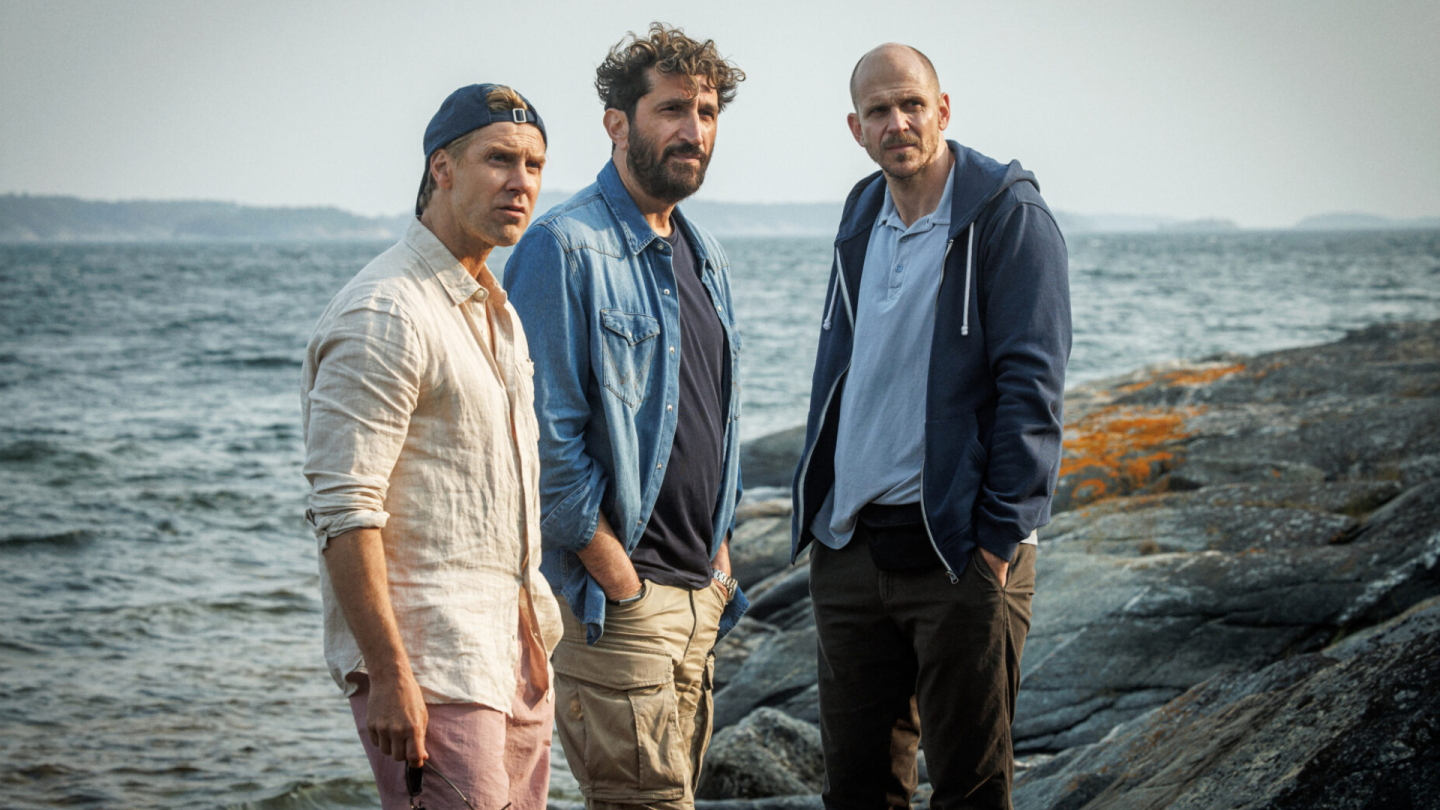
Adult Supervision marks Schulman and Skarsgård’s second collaboration. It follows Skarsgård as the anxiety-ridden Bill, who accompanies his daughter and her school friends on a remote trip, desperate to repair their icy relationship. He is joined by two fellow fathers: the secretly domineering Bobo (Fares Fares) and Pontus (Linus Wahlgren), who takes a fancy to one of the camp counsellors. The men believe themselves to be up for the task of handling an unruly class. But tensions quickly escalate and their grip on the situation begins to slip. As buried memories resurface, games turn into power struggles — and power into violence. Soon, no one can tell who’s in charge and who’s in danger.

From left: Director Alex Schulman with stars Gustaf Skarsgard, Linus Wahlgren and Fares Fares at the Zurich premiere of ‘Adult Supervision.’
Courtesy of Getty
Perhaps Schulman can do the best job at putting into perspective how authentic his script is: “You know the scene with the name [introduction] game, with the throw of the ball, and the students say, ‘I’m Leopold Dogfucker’? That actually happened.” Just as Bill does in the film, Schulman turned to his daughter and asked for the misbehaving kid’s name. “You can imagine that my daughter hated me. [She was] so embarrassed.”
It isn’t the only real-life event that Schulman wove into this deftly crafted portrait of authority, anarchy and the unpredictable nature of children. Adult Supervision opens with a school teacher showing parents anonymous screenshots from the kids’ Snapchat conversations, in which they hurl unfathomably vicious and antisemitic abuse at one another. Another scene on the trip depicts a student spraying an antiseptic cleaning bottle into his peer’s water, before Fares’ character comes and, in what he believes is an astute bit of discipline, slams his palm on the table so hard that the whole room stops. Many of these incidents were inspired by Schulman’s experience. “There were so many things happening on that trip,” he remembers. “And when I came home, I remember I was crying in my wife’s lap for hours. And then after a couple of weeks, I thought that this is a story that I want to tell.”
The director likens his own role on the trip to that of Bill, who is slowly driven to madness by worrying about a particular child, the class punching bag Kenneth (Olof Olingdahl). “I am very much like Bill in the movie. I’m not a conflict guy,” says Schulman. “And I always believe in discussing a conflict with kids, but that didn’t work.” He is admittedly relieved that Skarsgård was able to bring alive Bill’s gentle, yet neurotic nature. “It must be hard for an actor to play a person who’s struggling so much,” wonders the director. “And it’s a big challenge because he’s in almost every frame. It’s completely his movie […] and for me, I think it was obvious that [no one] in Sweden can do it as well as he did.”
Skarsgård’s performance completely anchors the gradual descent from decorum to disorder. He is a man acting out of parental responsibility, while carrying his own baggage from being bullied as a child himself. But Kenneth, to Bill’s dismay, is not your usual victim. “You see so many bullied boys and girls in movies that are just so one-dimensional,” says Schulman. “They’re bullied and they’re victims. But I know from being bullied when I was young, [that] I was also bullying. That’s how you survive, right? It’s very, very complex,” he continues. “I liked the idea of one thinking that this boy is a victim, but he’s also a perpetrator.”
The finished product is, oddly, very aesthetically pleasing. Schulman enlisted one of Joachim Trier’s most trusted cinematographers, Jakob Ihre, who also worked with Fares on HBO’s Chernobyl. Together, they came up with replacing bog-standard drone shots of the island with miniature models — fake trees and tiny cabins — which help evoke a sense of childlike play.
Adult Supervision has so far been described as a dark comedy, but it’s quite the mash-up of genres. Schulman blends light-heartedness and discomfort to create something of a thriller. Those moments of humor are, for Schulman, when all esteem for the art form went out the window. “When I write books, I can’t write comedy. I don’t know why. It’s so sad,” he explains. “Books are divine for me. I can’t soil them by writing comedy. When I started to write a movie script, I had no respect. So I could finally do the things that I wanted to do.” He did show the film to Ruben Östlund, he adds, who told him it was a relationship horror. That feels right for Schulman.
Perhaps a one-two with prolific auteur Östlund is standard practice for one of Sweden’s most famous journalists, but an ensuing Oscar campaign? Now that has stumped the self-assured Schulman. “I can’t even describe it,” he beams. “It’s crazy that I’m now going to L.A. to do screenings for Academy members.” He just about understands the hype: “It’s an arthouse movie, but it’s also quite commercial. It’s a perfect mix. And they test fun, those scenes. But almost all scenes are from my life in some way.”
Viewers will be relieved to know that the last few minutes — in which Schulman delivers us a shocking act of violence — are fiction. Producers weren’t immediately convinced, but the filmmaker was delighted to have final cut on his first feature and insisted that Adult Supervision had to go there.
And now, after its award-winning world premiere in the Next Wave competition at Fantastic Fest and a major screening at Zurich Film Festival, Schulman is slowly but surely relinquishing control. “I’m not nervous,” he says. “I love seeing the movie with other people, just to be there and to see where it works and [doesn’t]. But the last time I did it was in the test screenings, and then I could always go back to the editing room and fix things. And now I obviously can’t fix anything because it’s done.”
He has definitively caught the directing bug and has plans for a second feature (you might not be surprised to learn it’s another story inspired by a trip away for Schulman). With Adult Supervision, at least, this debut filmmaker has a whole nation behind him: “Now it’s the Oscars submission, I can go to festivals,” he grins. “And I might be able to do one more movie.”
>

Blame it on the rain? Broadway box office dropped by 11% last week as New York suffered a decidedly soggy Nor’easter weekend.
All but three of the 26 productions on the boards last week saw a drop in grosses from the previous week, with the total tally coming in at $24,093,388 (compared to $27,070,361 the previous week). Total attendance for the week ending September 27 was 209,194, also down 11% from the previous week.
Bucking the trend were School Girls; Or The African Mean Girls Play, which performed eight previews compared to the previous week’s seven (it opened last night to excellent reviews), grossing $322,044. That’s up $34,290 over the previous week.
Also up was Paranormal Activity, which had a largely comped gala performance the week before last, moving grosses for that week downward. For the week ending September 27, the spooky play grossed $871,364, a jump of $85,939 over the previous gala week.
But the biggest gain by far was made by Harry Potter and the Cursed Child, which saw the return of the ever-popular Tom Felton as Draco Malfoy after a week off. Grosses for his return week were $1,573,469, a jump over the previous week of $607,271.
Top earner for the week was, hands down, Hamilton, riding high with the return of original cast member Christopher Jackson in the role of George Washington (through January 3). The musical grossed a whopping $2,608,571, easily besting runner up The Lion King‘s $1,700,873. Rounding out the Top Five were Harry Potter, MJ ($1,544,512) and Oh, Mary! with Bowen Yang in the title role ($1,458,262).
Hamilton, as usual, carried the top average ticket price at $243.50, with Oh, Mary! second at $204.15. The overall average for the 26 shows was $115.17.
Only Hamilton and Oh, Mary! were sell-outs for the week, although Chicago (with Reece Weaver as Roxie), Hadestown, Paranormal Activity and The Book of Mormon came close, with attendance at 95% of capacity or more.
New to the roster was non-prof Roundabout’s The Imaginary Invalid starring Bill Irwin at the Haimes, filling 94% of seats for three previews for a take of $183,153. Opening night is October 22.
In the 18th week of the 2026-27 season, Broadway has grossed season-to-date $565,480,589, down about 7% from last year at this time, with total attendance of 4,680,491 down 2% year-to-year.
All figures courtesy of The Broadway League. For more box office information visit the League’s website.
>


Search For Canadian TV Actor Stewart McLean Now Homicide Investigation


These ’90s fashion trends are making a comeback in 2017
According to Dior Couture, this taboo fashion accessory is back
Model Jocelyn Chew’s Instagram is the best vacation you’ve ever had
Emily Ratajkowski channels back-to-school style
9 Celebrities who have spoken out about being photoshopped


Rurouni Kenshin: Hokkaido Arc Manga Takes 1-Issue Break – News


HIDIVE to Stream English Dubs for The World Is Dancing, The Forsaken Saintess and Her Foodie Roadtrip in Another World, The Dangers in My Heart: The Movie Anime – News