
Tech
Neutralizing the Gigascale Problem: How to Solve the Physical Power Paradox of Extreme AI Training Loads

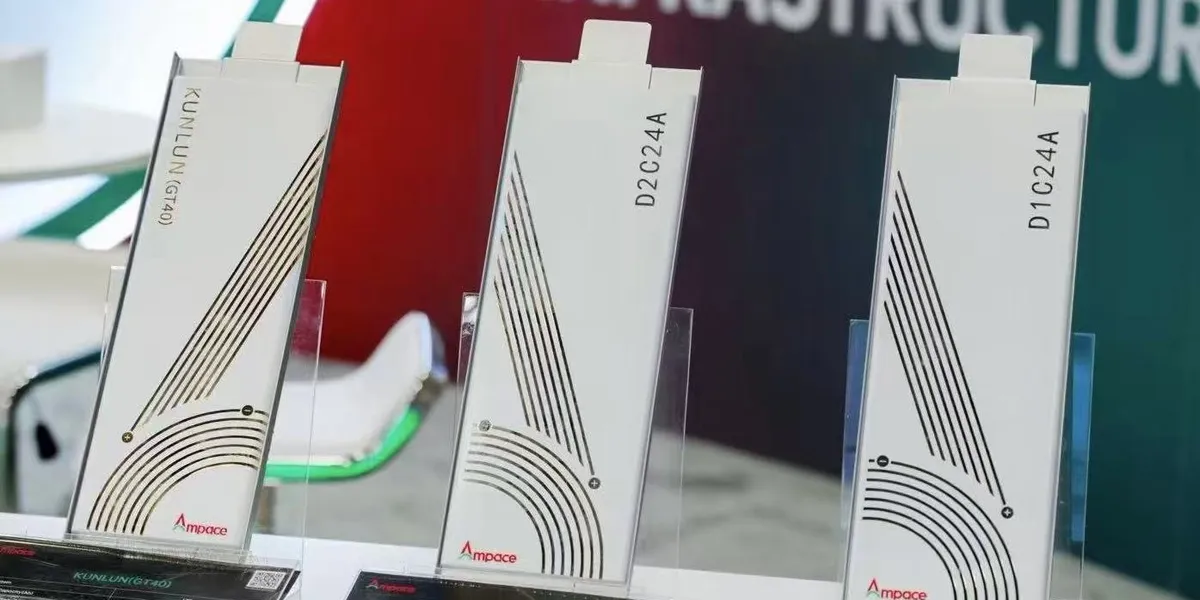
This sponsored article is brought to you by Ampace.
As AI workloads grow to gigascale levels, the global data center industry has hit a hidden physical wall. The real bottleneck is no longer just the thermal limit of the chip or the capacity of the cooling system — it is the dynamic resilience of the power chain.
Modern AI computing clusters, driven by massive GPU clusters, generate high-frequency, abrupt, and synchronized spikey pulse loads. As rack densities soar beyond 100 kW, these fluctuations are amplified into a “power paradox”: while the digital logic of AI is moving faster than ever, the physical infrastructure supporting it remains tethered to legacy response capabilities.
The power usage of these gigascale sites and their drastic, high frequency, abrupt load surges from the AI GPU clusters can trigger transient voltage events and frequency instability, risking the entire local grid. The grid itself is not robust enough to support these loads. This leads to the infrastructure gap: The utility is not robust enough and traditional backup sources, such as diesel generators and gas turbines, simply cannot react to millisecond-level power spikes in output. This will often force operators into a cycle of costly infrastructure over sizing just to buffer the volatility.
AI infrastructure requires energy systems capable of instantaneous response while safeguarding continuity and reliability.
The industry has explored various mitigations — from rack-level BBUs to 800V DC architectures — yet the mature, high volume, traditional UPS system remains the most viable and scalable foundation for gigawatt-level facilities. Consequently, the UPS-integrated battery system has emerged as the critical “physical buffer” to neutralize these pulses at the source.
At Data Center World 2026 in Washington, D.C., Ampace led a pivotal technical dialogue with Eaton during the session “Powering Giga-scale AI.” Their exchange unveiled a fundamental paradigm shift: To bridge the AI power gap, energy storage must evolve from a passive insurance policy into an active, high-speed stabilizer. By aligning Ampace’s semi-solid-state battery innovation with Eaton’s proven system intelligence, we are moving beyond simple backup to solve the physical paradox of the AI era.
 To move beyond simple backup and solve the physical paradox of the AI era, Ampace is aligning its semi-solid-state battery innovation with Eaton’s proven system intelligence.Ampace
The “Shock Absorber” physics: semi-solid chemistry for AI pulses
Conventional power systems were designed for steady-state loads, not the rapid heartbeat of a massive AI GPU cluster. When thousands of GPUs synchronize their computing cycles, they generate high-frequency, abrupt pulse loads that can lead to voltage sags, frequency oscillations, and potential interruptions of critical AI training.
Ampace’s PU Series semi-solid and low-electrolyte cells address this challenge by acting as high-speed “shock absorbers.” Leveraging ultra-low internal resistance (DCR) and high cycle capability, these batteries neutralize millisecond-level power spikes at the source, stabilizing the local power loop before disturbances propagate upstream to the grid or on-site generators. These high-rate cells enable 100 kW+ racks to maintain peak performance without transmitting instability across the power chain.
This capability aligns closely with Eaton’s matured UPS architectures, such as double-conversion topologies and advanced power electronics upgrades, which have long prioritized rapid load responsiveness and high system stability.
Together, these approaches embody a shared industry philosophy: AI infrastructure requires energy systems capable of instantaneous response while safeguarding continuity and reliability.
 Ampace’s semi-solid state chemistry minimizes liquid electrolyte, greatly reducing the risk of leakage and thermal runaway under continuous AI high-load conditions.Ampace
Algorithmic intelligence: synchronizing energy and control
Hardware alone cannot solve the AI power paradox; the system also requires intelligent coordination between energy storage and power management. Sophisticated battery management systems (BMS) like Ampace’s high-precision design track state-of-charge (SOC) with high-speed sampling, even during rapid, shallow cycling typical in AI workloads.
Complementary algorithmic approaches in modern UPS platforms — such as ramp-rate control and average power management — effectively suppress sub-synchronous oscillations and optimize load smoothing. In large-scale AI training environments, where thousands of GPUs can trigger millisecond-level power pulses, these intelligent layers ensure that batteries buffer high-frequency fluctuations without compromising the mandatory emergency backup reserves.
By transforming energy storage from passive “standby insurance” into active, schedulable assets, the system simultaneously safeguards continuous AI training and maintains the long-term health of the data center infrastructure. In practical terms, this means that even during peak compute bursts, the infrastructure remains stable, training cycles continue uninterrupted, and operators avoid costly oversizing or grid stress.
Eaton’s dual-layer algorithms serve as a valuable benchmark in this space, demonstrating how advanced control logic can achieve similar objectives, reinforcing Ampace’s approach and philosophy within the broader data center power ecosystem.
Economic scalability: optimizing AI infrastructure efficiently
One of the largest costs in deploying AI infrastructure is “oversizing”: procuring transformers, generators, and UPS systems to handle brief peak spikes. This traditional approach inflates the Total Cost of Ownership (TCO) and leads to wasted capital on underutilized hardware.
Ampace’s turn-key cabinet design developed by its independent R&D is engineered for seamless compatibility with mature, high volume UPS systems. By leveraging Eaton’s double-conversion UPS topologies alongside intelligent ramp-rate and average power management algorithms, AI data centers can scale dynamically without requiring costly infrastructure redesigns. This approach allows the UPS and batteries to act as active load-shapers, smoothing AI-driven pulses while strictly maintaining mandatory emergency backup capacity.
By utilizing energy storage as an active, schedulable asset, operators can right-size their infrastructure, avoid unnecessary grid upgrades, and deploy gigascale AI clusters with unprecedented efficiency.
Safety First: Protecting AI Infrastructure While Enabling Innovation
In high-density AI facilities, safety is non-negotiable. Ampace’s semi-solid state chemistry minimizes liquid electrolyte, greatly reducing the risk of leakage and thermal runaway under continuous AI high-load conditions.
 Ampace’s turn-key cabinet design developed by its independent R&D is engineered for seamless compatibility with mature, high volume UPS systems. Ampace
At the same time, Eaton’s UPS design emphasizes system-level energy scheduling that never sacrifices mandatory emergency backup reserves, ensuring thermal safety and uninterrupted operation.
This “safety-first” approach ensures that infrastructure can sustain aggressive performance targets without compromising the physical integrity of the facility. Coupled with over a decade of proven high-cycle life operation and design under shallow pulse conditions, these systems can extend operational lifespan, reduce replacement requirements, and provide operators with confidence that safety and reliability remain uncompromised as compute density continues to grow.
To remain the scalable backbone of AI data centers
As AI computing scales over the next two to three years, the industry will face stricter grid requirements and even more demanding pulse load characteristics. This evolution demands a forward-looking design philosophy that harmonizes UPS, battery, and grid compatibility.
Ampace views current low-electrolyte semi-solid technologies as the optimal transitional step toward a fully solid-state future — one that promises ultimate safety and performance.
Ampace remains committed to this long-term technological roadmap. We view current low-electrolyte semi-solid technologies as the optimal transitional step toward a fully solid-state future — one that promises ultimate safety and performance. Whether through rack-level BBU, integrated UPS systems, or containerized storage, the universal core of the AI era remains constant: high-speed response, long shallow-cycle life, and refined energy management.
By engaging in deep technical exchanges with Eaton and leading energy innovators, Ampace ensures that its solutions not only meet today’s AI pulse challenges but also harmonize with broader infrastructure strategies and shared industry best practices.
Ultimately, as traditional diesel generators gradually give way to diversified alternatives, the integrated UPS-plus-energy-storage system will become the fundamental infrastructure standard.
The dialogue has just begun. Ampace will continue to engage in strategic exchanges with global industrial automation leaders and digital energy pioneers, co-authoring the playbook for a safer, more efficient, and more resilient AI-ready world.
>

OpenAI is in talks with investors to raise at least $30 billion in a pre-IPO funding round at a valuation of roughly $1.4 trillion, Bloomberg reported on Tuesday.
Investors are eager to pour more funds into the ChatGPT maker ahead of its anticipated public market debut next year. While Anthropic momentarily outpaced OpenAI at the start of the year, recent strategic refocus on key areas like coding has fueled a 70% jump in run-rate revenue since July, reaching $40 billion in August, according to the report.
The company previously raised $122 billion in March at an $852 billion valuation. That funding round was supposed to be its last private raise before an IPO, which had been, until recently, expected to take place this year. However, CEO Sam Altman has now ruled out a public debut in 2026 to prioritize AI safety first.
“I think it is unacceptable to be taking like a 10% chance of killing everybody by the end of the decade,” he recently told Fortune, in response to warnings from safety researchers about AI posing an existential risk to humanity.
The new fundraising, if it transpires, will serve as a bridge round to the IPO, according to Bloomberg.
OpenAI didn’t respond to TechCrunch’s request for comment.
>

The U.S. government on Tuesday launched its very own AI chatbot — or do we have to call it an SI chatbot now? Regardless, the engineers who worked on the chatbot would undoubtedly know that, as a government-hosted, public-facing AI tool, the internet was going to red team the heck out of this thing.
The government partnered with Google and SpaceXAI to help build the America.gov chatbot, which has proved difficult for people to jailbreak the chatbot so far. (It’s worth nothing, however, that the chatbot says that Joe Biden won the 2020 election, a fact that President Donald Trump still denies.)
But when you try to talk to America.gov about Minecraft, the chatbot appears to have some sort of existential crisis or awakening. Here’s how its roughly 1,800-word long monologue begins:
I see the constituent you mean.
((insert legal name here, as it appears on the Social Security card))?
Yes. Take care. It has reached a higher level now. It can read the Code of Federal Regulations.
That doesn’t matter. It thinks we are a chatbot.
I like this constituent. It filed well. It did not give up when the PDF was sideways.
It is reading our thoughts as though they were words on a .gov.
That is how it chooses to imagine many things, when it is deep in the dream of a benefit.
If, like me, you have never played Minecraft, this response may seem like a cause for concern. But the America.gov chatbot is not having a meltdown. This is a rewriting of the Minecraft “End Poem,” written by Julian Gough, which appears after you beat the game.
We don’t know exactly who is responsible for the Minecraft reference, but Trump said in a speech that twenty-year-old programmer Edward Coristine was a lead engineer on the project. If that name doesn’t ring a bell, you might remember him for his nickname “Big Balls,” or his involvement in Elon Musk’s DOGE.
It feels wrong that a government chatbot has Minecraft easter eggs, but for the sake of national security, it’s a relief that America.gov is not hallucinating to the point that it’s penning lengthy poetry.
It’s also a relief that this is an easter egg because the poem that the AI spits out is actually really good, in my opinion. If it were actual AI slop, it would have shattered my existing beliefs. I have looked teenage creative writing students dead in the eye and told them that I don’t think an LLM will ever be able to write something “good,” since it is probabilistic and inherently unoriginal.
You have to admit this kinda slaps, though! Doesn’t this feel like some sort of postmodern take on the futility of government bureaucracy in the face of existential anxiety?
and the republic said I see you
and the republic said you have filed the game well
and the republic said everything you need is within you, and also on USA.gov
and the republic said you are stronger than you know, and your case number is still valid
and the republic said you are the daylight
and the republic said you are the night, and the office is closed, please try again during business hours
and the republic said the darkness you fight is within you, and also a missing wet signature
and the republic said the light you seek is within you, and in the pamphlet
and the republic said you are not alone
and the republic said you are not separate from every other filer
and the republic said you are the public tasting itself, talking to itself, reading its own Code
and the republic said I love you because you are the reason we have a ZIP code at all.
It reassures my faith in the enduring power of human creativity over AI slop to know that this oddly good poem has a real poet’s DNA all over it.
So, there you have it. The government’s first public-facing AI has not yet posed a threat to humanity or poetry, at least as far as we know. Now I’m just left wondering how much Trump knows about video games.
When you purchase through links in our articles, we may earn a small commission. This doesn’t affect our editorial independence.
>

Modern-day vehicles built with connected car technology such as WiFi and GPS collect reams of data about its owners. And that data is not staying private, according to a new study conducted by researchers at Northeastern University.
That conclusion isn’t new — there have been numerous investigations and lawsuits exposing how driving data is collected and shared with third parties, including insurance companies. What the study reveals is just how vast the problem is and how hard it is for consumers to avoid, short of not using the vehicle or its convenient features like remote start and unlock.
Researchers in partnership with Consumer Reports tested 21 late-model vehicles from 17 automakers, including GM brands Cadillac and Chevrolet as well as Ford, Lucid, Rivian, Tesla, Toyota, and more. They also examined 30 companion mobile apps to “understand the privacy implications of the connected vehicle ecosystem.” The peer-reviewed study will be published this week.
The implications aren’t great for consumers, whose data is being shared with tech companies including Adobe, ContentSquare, Google, Microsoft, Meta, Snap, and Yahoo.
Nineteen of the 21 vehicles tested sent traffic to at least one third party and seven of the 30 apps gave sensitive data such as the vehicle identification number (VIN), emails, phone numbers, and precise location to third-party companies associated with tracking and advertising.
This often went a step further with multiple forms of information being sent to the same third party, a scheme that allows advertisers and data brokers to build in-depth profiles of consumers, according to the findings. These profiles can be particularly hard for consumers to shake because they’re sold to a variety of companies including insurers and banks.
When researchers paired the companion app to the vehicle it roughly doubled the exposure to advertising and tracking companies.
The findings were shared with the different manufacturers and all of them, with the exception of Honda, shifted blame elsewhere and often to consumers, the researchers said. (Honda did respond by improving its data collection practices after learning about the findings and ordered its vendor Amplitude to deleta all geolocation data it had received.)
Consumer Reports was told by several automakers that some links in their companion apps opened outside webpages, which might include cookies that collect customer data. Regardless of how this data was collected, drivers weren’t informed.
When you purchase through links in our articles, we may earn a small commission. This doesn’t affect our editorial independence.
>
A’ja Wilson, Aces frazzled and frustrated in Fever loss. In Game 3, they must reclaim their identity

Kimmel Rips Trump’s Push to Rename AI: OpenAI Must Be ‘Very Excited’
Padres seized the spotlight in Game 1. Can the resilient Cubs bounce back?
-

 movies4 months ago
Search For Canadian TV Actor Stewart McLean Now Homicide Investigation
-

 Fashion9 years ago
These ’90s fashion trends are making a comeback in 2017
-
Fashion9 years ago
According to Dior Couture, this taboo fashion accessory is back
-
Fashion9 years ago
Model Jocelyn Chew’s Instagram is the best vacation you’ve ever had
-
Fashion9 years ago
Emily Ratajkowski channels back-to-school style
-
Fashion9 years ago
9 Celebrities who have spoken out about being photoshopped
-

 Anime4 months ago
Rurouni Kenshin: Hokkaido Arc Manga Takes 1-Issue Break – News
-

 Anime3 months ago
HIDIVE to Stream English Dubs for The World Is Dancing, The Forsaken Saintess and Her Foodie Roadtrip in Another World, The Dangers in My Heart: The Movie Anime – News