
Entertainment
‘Butterfly Jam’ Review: Barry Keoghan Culinary Family Drama Goes Stale

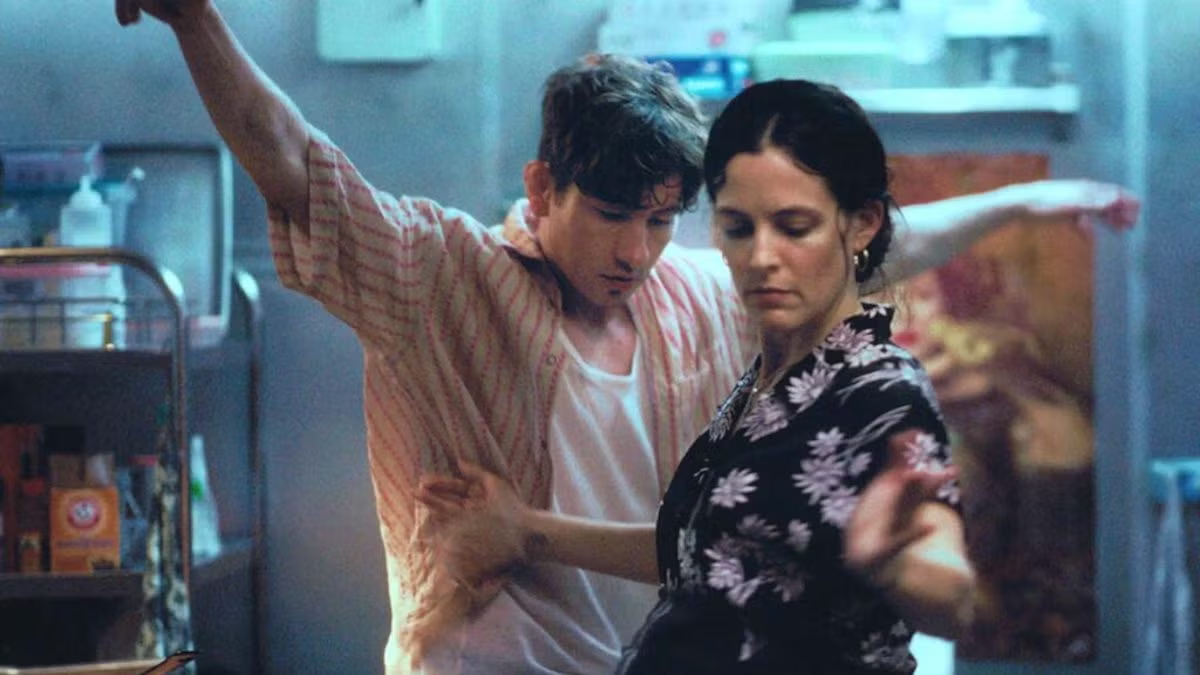
Whether or not you can stomach “Butterfly Jam” wholly depends on your taste for sinister whimsy, because that’s about all director Kantemir Balagov serves in his English-language debut, heaping it on in portions as heavy as the savory pie stuffed with potatoes, cheese and herbs known as a delen. You’ll certainly hear plenty about that particular delicacy as well; chances are, you’ll walk out craving both the dish and a feature just slightly more balanced.
Opening this year’s Directors’ Fortnight, the film tracks one of Cannes’ most familiar archetypes: The distinctly ethnic tri-state dirtbag, common across Safdie, Scorsese, Baker and Gray. Here, Balagov and Barry Keoghan imagine a version even more ‘touched’ than most: A Jersey ne’er-do-well who slurs and stumbles whenever he ventures beyond the family diner. He might have some kind of cognitive impairment, or he might just always be stoned.
Whatever the case, he is also doomed — a fate made clear from the film’s very first scene, which finds 16-year-old Temir (Talha Akdogan) announcing his father’s death. Yet, in the first of many red herrings and misdirects, that grim opening quickly fades once Balagov introduces line-cook Azik (Barry Keoghan) in something close to peak form. Perhaps ‘peak’ is overstating it for an oddball immigrant whose world rarely extends beyond a family-run diner and an equally insular social circle, but the hapless cook at least possesses a certain youthful exuberance.

Which is more than you can say for Azik’s American-born son Temir, whose relative proximity in age to the 33-year-old Keoghan hints at a backstory Balagov only vaguely sketches. In a film full of fantastical detours, the notion that Azik somehow survived this long as a single father may demand the audience’s greatest suspension of disbelief. He clearly didn’t get much help from his even more misfit bro Marat (Harry Melling) or his harried sister Zalya (Riley Keough), so chalk up the high schooler’s relative maturity as a real win for the Newark education system.
As a first-generation scion, Temir might be Going Places; Azik, however, is almost certainly not — and the anecdotal, rather ramshackle film borrows its structure from the father’s similarly directionless life. After mastering the delen, Azik receives effusive praise from a Circassian wheeler-dealer whose unopened restaurant already seems doomed. Naturally, the dough boy decides he too is a chef, giving the film’s first half its faintest semblance of narrative momentum as he begins half-assing his American dream. Stark violence changes the register for Act II, though often in unexpected ways. In this world, shock and grief offer no match for quirkiness.
Balagov first conceived the project in his native Nalchik before reimagining it around New Jersey’s Circassian diaspora after fleeing Russia himself — and the seams often show. The film never quite coheres as either a father-son drama or a saga of displacement; instead, it plays more like a jagged character study of a profoundly eccentric man. At its best and worst, “Butterfly Jam” unfolds as a chain of idiosyncratic details and bemused observations: a father who drags his son to a prostitute, then fixates on her houseplants; a man who keeps pelicans and makes butterfly jam; a figure marked for doom, whose end arrives as an arbitrary outcome in a world governed by sinister whimsy.
The 34-year-old filmmaker more deftly controls the film’s formal elements, alternating between stately, amber-hued compositions and more urgent handheld camerawork with shallow focus that reflects the characters’ own removal from the wider world. There’s an odd and fitting symmetry in following a master of one very specific round pastry as his life spins wildly in circles, yet at a certain point — in fact, early and often, all the way through to a closing cameo — the question becomes unavoidable: Why? Why this man, this tone, this story? Why this accumulation of idiosyncratic aimlessness and menacing make-believe?
The film never answers those questions, or really even tries to. Instead, Balagov opts for a kind of musical logic, establishing an unusual register, settling into an uncommon groove, then simply riffing within it. This is fine, though more than a bit cumbersome across nearly two hours. “Butterfly Jam,” in other words, is best served in small doses.

>
>

Chinese director Niu Niu’s Final Payment scooped the Best Film Award in the Fei Mu Awards of this year’s Pingyao International Film Festival (PYIFF), while Rafiki Fariala’s Congo Boy won Best Film in the festival’s Roberto Rossellini Awards.
Final Payment, which also won Best Actor for Niu Jianrong’s performance, revolves around a homeowner clashing with a contractor over the final payment following a set of renovations on his home. PYIFF’s competition jury stated: “Tearing through a very small rip, the film leads us into a reality and emotional landscape so expansive, where we sigh, lament, and reflect. The director’s approach is concise, unpretentious, and masterful, earning the wholehearted recognition of the entire jury.”
The Best Film award came with a cash prize of $150,000 (RMB1m) with half given to the director for the development of their next film, and half given to the distributor in China. Niu Niu previously directed Mr Junjun, which was awarded with the Jury Award and Youth Jury Award at PYIFF in 2023.
Also in the Fei Mu Awards, Xu Zao won Best Director for Light Pillar, while Best Actress went to Sun Yi for Wang Xiaozhen’s A Joke. The Jury Award was presented to Dong Jie’s Zoom In, Zoom Out, which had its world premiere in Venice Critics Week, while a special mention went to Cai Chengjie’s Suzhou Quartet.
The Fei Mu awards are focused on the festival’s Hidden Dragons section, which selects first, second and third films from emerging directors making Chinese-language films, while the Roberto Rossellini Awards focus on the Crouching Tigers section for emerging international directors.
Congo Boy, which took Best Film in the Roberto Rossellini Awards, also won Best Actor when it premiered in Un Certain Regard at this year’s Cannes film festival. The PYIFF award came with a cash prize of $20,000, with half given to the director for the development of their next film, and half given to the distributor in China.
The PYIFF jury stated: “The Jury unanimously has been moved by this autobiographical story, told in a simple style that echoes the great tradition of neorealism. For a film focusing on a character that confronts his world with optimism despite dark times and takes on his shoulders the destiny of his entire family.”
Also in this section, the Philippines’ Rafael Manuel won Best Director for Filipiñana, while the Jury Award went to Ben’imana, directed by Marie-Clémentine Dusabejambo, which won the Camera d’Or at this year’s Cannes. The jury also awarded Rakan Mayasi’s Yesterday The Eye Didn’t Sleep a Special Mention.
Hong Kong filmmaker Ann Hui received the Crouching Tiger Hidden Dragon East-West Award, shortly before she receives the Camellia Award at Busan International Film Festival next week.
Pingyao’s International Contribution To Chinese Cinema Award went to Marco Müller, who founded the festival with Chinese auteur Jia Zhangke and currently serves as Artistic Director of the Film Art Research Centre at Shanghai University, and veteran producer, director and former chairman of China Film Group Han Sanping. Hello Group chairman Tang Yan was presented with a 10th Anniversary Award.
This year’s PYIFF opened on September 24 with a screening of the 4K restoration of Fei Mu’s Spring In A Small Town; closed with Good Trip, co-directed by Hong Kong filmmakers Norris Wong and Hoi Wong, and also screened Jia’s short film Torino Shadow, which premiered at this year’s Cannes.
PINGYAO INTERNATIONAL FILM FESTIVAL 2026 AWARDS:
FEI MU AWARDS:
Best Film: Final Payment, dir: Niu Niu
Best Director: Xu Zao, Light Pillar
Best Actress: Sun Yi, A Joke, dir: Wang Xiaozhen
Best Actor: Niu Jianrong, Final Payment, dir: Niu Niu
Jury Award: Zoom In, Zoom Out, dir: Dong Jie
Special Mention: Suzhou Quartet, dir: Cai Chengjie
ROBERTO ROSSELLINI AWARDS:
Best Film: Congo Boy, dir: Rafiki Fariala
Best Director: Filipiñana, dir: Rafael Manuel
Jury Award: Ben’imana, dir: Marie-Clémentine Dusabejambo
Special Mention: Yesterday The Eye Didn’t Sleep, dir: Rakan Mayasi
>

Actor Chad Lowe and producer Kim Painter’s 13-year-old daughter, Fiona, has died, according to a statement from the teen’s family.
“We are deeply heartbroken by the loss of our beloved Fiona,” the Lowe family said in a statement to media Tuesday evening. As the family went on, they remembered Fiona as “a loving young girl who was smart, creative, and loved to dance.”
“She was adored by her sisters and she was deeply loved by her parents,” the family’s statement added. “In fact, she was the light of our lives.”
While a cause of death was not immediately shared, the Lowes alluded to Fiona’s mental health struggles, writing, “Her passing is devastating for our entire family and we ask for prayers and privacy at this time. If you or someone you know is struggling with mental health, please reach out to the 988 Suicide & Crisis Lifeline by calling or texting 988.”
More to come…
>

Man City guilty charges: Which transfers did Premier League ‘sham’ help secure?
Alexander-Arnold delivers the kind of moment only he can. But will it be enough for Tuchel?
Man City's 'sham contracts', spending breaches and 'disguised funding': Breaking down the findings
-

 movies4 months ago
Search For Canadian TV Actor Stewart McLean Now Homicide Investigation
-

 Fashion9 years ago
These ’90s fashion trends are making a comeback in 2017
-
Fashion9 years ago
According to Dior Couture, this taboo fashion accessory is back
-
Fashion9 years ago
Model Jocelyn Chew’s Instagram is the best vacation you’ve ever had
-
Fashion9 years ago
Emily Ratajkowski channels back-to-school style
-
Fashion9 years ago
9 Celebrities who have spoken out about being photoshopped
-

 Anime4 months ago
Rurouni Kenshin: Hokkaido Arc Manga Takes 1-Issue Break – News
-

 Anime3 months ago
HIDIVE to Stream English Dubs for The World Is Dancing, The Forsaken Saintess and Her Foodie Roadtrip in Another World, The Dangers in My Heart: The Movie Anime – News