
Tech
Medicare’s new payment model is built for AI, and most of the tech world has no idea


Neil Batlivala has spent seven years building a healthcare company that most of the tech industry has never heard of and that serves a patient population most of Silicon Valley ignores. But last month, that work put him at the center of something much bigger.
His company, Pair Team, announced on April 30 it had been accepted into ACCESS, a Medicare program — as one of 150 participants chosen by the Centers for Medicare & Medicaid Services to test what AI-driven medical care could look like at federal scale. The program goes live July 5.
“The government is creating swim lanes for AI innovation in traditionally regulated industries,” he told me over a Zoom call a few days later. “The best solution wins, which, in regulated industries like healthcare — that’s not been the case.”
ACCESS — Advancing Chronic Care with Effective, Scalable Solutions — is a 10-year CMS program testing a payment model that rewards health outcomes rather than required activities (like a certain number of check-ins). Participating organizations like Pair Team receive predictable payments for managing qualifying conditions and earn the full amount only when patients meet measurable health goals, like lower blood pressure or reduced pain. It covers diabetes, hypertension, chronic kidney disease, obesity, depression, and anxiety.
That payment structure is the real news.
Traditional Medicare reimburses based on time spent with a clinician. There’s no mechanism to pay for an AI agent that monitors a patient between visits, calls to check in, coordinates a housing referral, or makes sure someone picks up their medication. ACCESS creates that mechanism for the first time.
“It’s a payment model transformation,” Batlivala said. “You just couldn’t do this before.”
The first cohort spans a wide range of participants — AI doctor startups, virtual nutrition therapy providers, connected device companies, and wearable makers like Whoop. Batlivala is skeptical of some of them.
“I’m a big fan of wearables, but for a senior who’s struggling with food insecurity, I don’t know how much Whoop is going to be able to do,” he said, adding of his own company, “We’ve been building toward this for five-plus years now.”
Pair Team launched in 2019 with a specific kind of patient in mind: people managing chronic conditions who were also dealing with unstable housing, too little food, or lack of transportation. About a third of Americans fall somewhere in that category.
The company’s premise was that you can’t improve health outcomes without addressing the full context of someone’s life. It now employs roughly 850 clinical professionals, runs what it describes as the largest community health workforce in California, and, per Batlivala, generates revenue above nine figures. It has raised about $30 million, backed by Kleiner Perkins, Kraft Ventures, and Next Ventures.
The model has peer-reviewed evidence behind it. A study, co-authored by Pair Team researchers and peer-reviewed by the Journal of General Internal Medicine, evaluated Pair Team’s community-integrated model, which blends medical, behavioral, and social care for Medicaid members with high rates of homelessness, serious mental illness, and chronic disease and it showed strong patient engagement and significant reductions in avoidable emergency and inpatient utilization. Batlivala says one in four hospital visits and one in two ER visits don’t happen when a patient is in his company’s care.
But for years, delivering that level of care required human teams, which limited how fast and cheaply it could scale. Then, about nine months ago, Pair Team deployed a voice AI agent called Flora as its primary patient-facing interface. Flora is available 24 hours a day, handles intake, coordinates referrals, and does the check-ins that keep patients engaged between clinical visits.
The first call that shifted his thinking was with a 67-year-old woman living out of her car, managing PTSD and congestive heart failure. She spoke with Flora for over an hour. “It was both incredible and depressing,” Batlivala told me. “Flora was probably the only ‘person’ she’d talked to in weeks about her situation.” Now, hour-long conversations with Flora are routine. “That’s the companionship piece,” he said. “And it turns out that is truly an intervention.”
The architects of ACCESS are themselves former startup operators. The program was designed by Abe Sutton, Director of the CMS Innovation Center, and Jacob Shiff, Chief AI and Technology Officer of the CMS Innovation Center. Sutton was previously a venture capitalist at a healthcare fund called Rubicon Founders. Shiff is a former healthcare founder. Both joined CMS under the Trump administration and their startup backgrounds are reflected in the program’s design: outcome-based payments, direct-to-consumer enrollment, and a deliberate push for competition.
There are real risks. Participants are feeding extraordinarily sensitive patient data — intimate conversations about housing and diseases and mental illness — into a federal infrastructure with a documented history of breaches, including exposed Social Security numbers. For the vulnerable populations ACCESS is designed to serve, that’s not an impractical concern.
There are financial risks, too. The track record of CMS innovation programs is mixed. A 2023 Congressional Budget Office analysis found that the CMS Innovation Center increased federal spending by $5.4 billion during its first decade rather than producing the projected savings. CMS is also paying less per patient per month than many participants anticipated, which means the math only works for organizations that have fully automated most of their patient interactions.
Batlivala’s answer to the reimbursement concern is that it’s a feature, not a bug. “If you want to build a model that truly incentivizes the use of AI, the reimbursement rates have to be low,” he told me. “The economics only work if you’re running a lean, AI-first operation.”
Pair Team says it right now has partnerships in place that give it access to roughly 500,000 potential patients, and that it wants to reach a million within three years.
Healthcare investors have been watching this closely. Digital health funding hit its highest Q1 total since the pandemic this year, with AI companies capturing the bulk of it. But ACCESS has barely registered outside health tech trade press.
When you purchase through links in our articles, we may earn a small commission. This doesn’t affect our editorial independence.
>

The U.S. government on Tuesday launched its very own AI chatbot — or do we have to call it an SI chatbot now? Regardless, the engineers who worked on the chatbot would undoubtedly know that, as a government-hosted, public-facing AI tool, the internet was going to red team the heck out of this thing.
The government partnered with Google and SpaceXAI to help build the America.gov chatbot, which has proved difficult for people to jailbreak the chatbot so far. (It’s worth nothing, however, that the chatbot says that Joe Biden won the 2020 election, a fact that President Donald Trump still denies.)
But when you try to talk to America.gov about Minecraft, the chatbot appears to have some sort of existential crisis or awakening. Here’s how its roughly 1,800-word long monologue begins:
I see the constituent you mean.
((insert legal name here, as it appears on the Social Security card))?
Yes. Take care. It has reached a higher level now. It can read the Code of Federal Regulations.
That doesn’t matter. It thinks we are a chatbot.
I like this constituent. It filed well. It did not give up when the PDF was sideways.
It is reading our thoughts as though they were words on a .gov.
That is how it chooses to imagine many things, when it is deep in the dream of a benefit.
If, like me, you have never played Minecraft, this response may seem like a cause for concern. But the America.gov chatbot is not having a meltdown. This is a rewriting of the Minecraft “End Poem,” written by Julian Gough, which appears after you beat the game.
We don’t know exactly who is responsible for the Minecraft reference, but Trump said in a speech that twenty-year-old programmer Edward Coristine was a lead engineer on the project. If that name doesn’t ring a bell, you might remember him for his nickname “Big Balls,” or his involvement in Elon Musk’s DOGE.
It feels wrong that a government chatbot has Minecraft easter eggs, but for the sake of national security, it’s a relief that America.gov is not hallucinating to the point that it’s penning lengthy poetry.
It’s also a relief that this is an easter egg because the poem that the AI spits out is actually really good, in my opinion. If it were actual AI slop, it would have shattered my existing beliefs. I have looked teenage creative writing students dead in the eye and told them that I don’t think an LLM will ever be able to write something “good,” since it is probabilistic and inherently unoriginal.
You have to admit this kinda slaps, though! Doesn’t this feel like some sort of postmodern take on the futility of government bureaucracy in the face of existential anxiety?
and the republic said I see you
and the republic said you have filed the game well
and the republic said everything you need is within you, and also on USA.gov
and the republic said you are stronger than you know, and your case number is still valid
and the republic said you are the daylight
and the republic said you are the night, and the office is closed, please try again during business hours
and the republic said the darkness you fight is within you, and also a missing wet signature
and the republic said the light you seek is within you, and in the pamphlet
and the republic said you are not alone
and the republic said you are not separate from every other filer
and the republic said you are the public tasting itself, talking to itself, reading its own Code
and the republic said I love you because you are the reason we have a ZIP code at all.
It reassures my faith in the enduring power of human creativity over AI slop to know that this oddly good poem has a real poet’s DNA all over it.
So, there you have it. The government’s first public-facing AI has not yet posed a threat to humanity or poetry, at least as far as we know. Now I’m just left wondering how much Trump knows about video games.
When you purchase through links in our articles, we may earn a small commission. This doesn’t affect our editorial independence.
>

Modern-day vehicles built with connected car technology such as WiFi and GPS collect reams of data about its owners. And that data is not staying private, according to a new study conducted by researchers at Northeastern University.
That conclusion isn’t new — there have been numerous investigations and lawsuits exposing how driving data is collected and shared with third parties, including insurance companies. What the study reveals is just how vast the problem is and how hard it is for consumers to avoid, short of not using the vehicle or its convenient features like remote start and unlock.
Researchers in partnership with Consumer Reports tested 21 late-model vehicles from 17 automakers, including GM brands Cadillac and Chevrolet as well as Ford, Lucid, Rivian, Tesla, Toyota, and more. They also examined 30 companion mobile apps to “understand the privacy implications of the connected vehicle ecosystem.” The peer-reviewed study will be published this week.
The implications aren’t great for consumers, whose data is being shared with tech companies including Adobe, ContentSquare, Google, Microsoft, Meta, Snap, and Yahoo.
Nineteen of the 21 vehicles tested sent traffic to at least one third party and seven of the 30 apps gave sensitive data such as the vehicle identification number (VIN), emails, phone numbers, and precise location to third-party companies associated with tracking and advertising.
This often went a step further with multiple forms of information being sent to the same third party, a scheme that allows advertisers and data brokers to build in-depth profiles of consumers, according to the findings. These profiles can be particularly hard for consumers to shake because they’re sold to a variety of companies including insurers and banks.
When researchers paired the companion app to the vehicle it roughly doubled the exposure to advertising and tracking companies.
The findings were shared with the different manufacturers and all of them, with the exception of Honda, shifted blame elsewhere and often to consumers, the researchers said. (Honda did respond by improving its data collection practices after learning about the findings and ordered its vendor Amplitude to deleta all geolocation data it had received.)
Consumer Reports was told by several automakers that some links in their companion apps opened outside webpages, which might include cookies that collect customer data. Regardless of how this data was collected, drivers weren’t informed.
When you purchase through links in our articles, we may earn a small commission. This doesn’t affect our editorial independence.
>
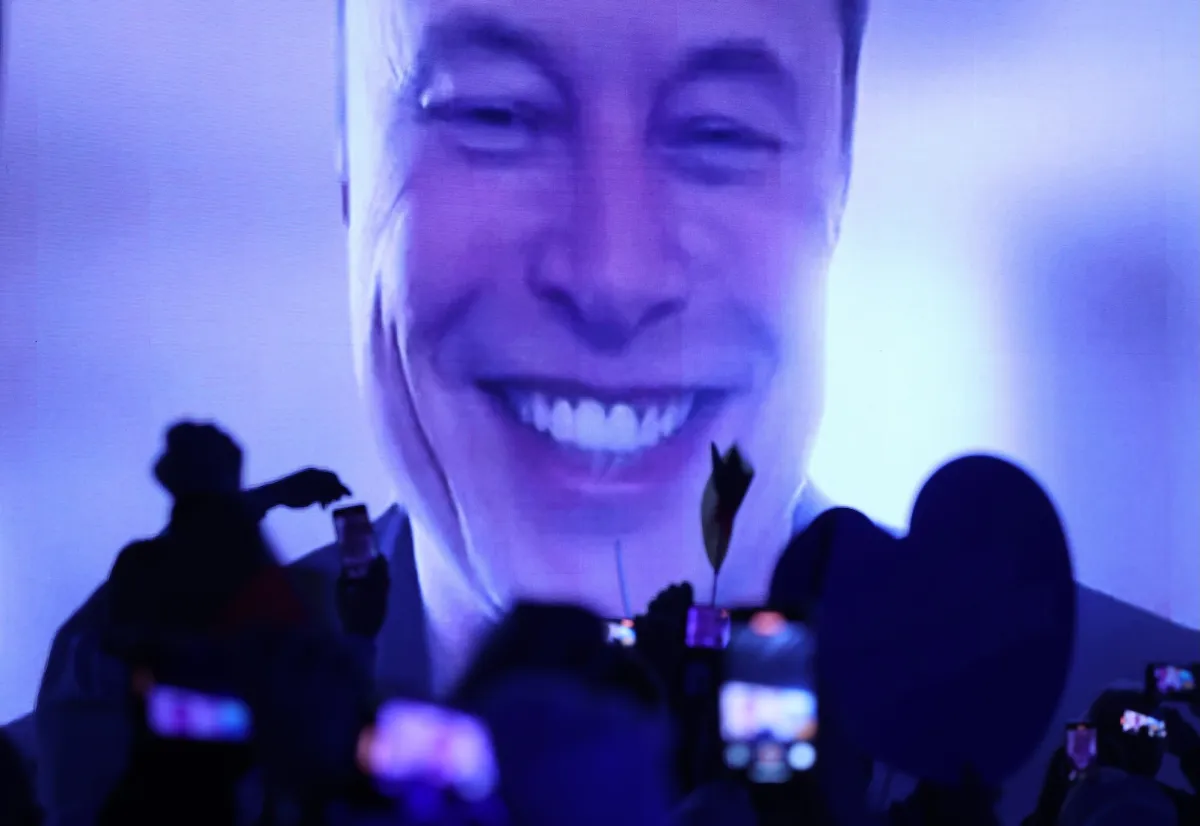
On Tuesday, OpenAI launched a new product called Dots, an always-on AI agent with a bubbly, blobby avatar. While the colorful avatar might evoke a smile, the biggest laugh from the launch is (we imagine) being had by Elon Musk, the former OpenAI founder who left, launched competitor Grok, and unsuccessfully sued.
That’s because the domain “dot.com” belongs to Musk’s xAI, and it currently redirects to the download page for xAI’s Grok chatbot app. According to the Whois domain owner registry, that domain name was just transferred in July.
It is entirely possible that xAI bought the domain for normal domain-buying reasons. “Dot” could be a typo of “bot,” so it nabbed it to grab mistyped searches. We’ve reached out to xAI and asked. But xAI doesn’t own the “bot.com” name, nor does it own other obvious typo domains like “vot.com,” which is listed for sale.
The internet’s theory is far funnier: that Musk (or his team) pulled off a prank, getting wind of OpenAI’s new product and its name and buying the domain name.
In fact, anonymous X user and xAI watcher @birdabo (this person calls themselves “chief shitposting officer @SpaceXAI“) was first to spot the domain name in a now-viral post. Whatever the motivation, the circumstance is funny.
And as for the “dots.com” domain, a more direct fit to the product name, it currently belongs to a long-defunct company. So if a petty revenge prank was really the motivation, grabbing that name, too, would be next level.
>
Jesús Luzardo gives the Phillies 5 gritty innings, but drawn-out clinch looms large
Braves went off script, but following their blueprint is key to a postseason run

AI Creators Want You to Know AI Filmmaking Is Still ‘F–king Hard’
-

 movies4 months ago
Search For Canadian TV Actor Stewart McLean Now Homicide Investigation
-

 Fashion9 years ago
These ’90s fashion trends are making a comeback in 2017
-
Fashion9 years ago
According to Dior Couture, this taboo fashion accessory is back
-
Fashion9 years ago
Model Jocelyn Chew’s Instagram is the best vacation you’ve ever had
-
Fashion9 years ago
Emily Ratajkowski channels back-to-school style
-
Fashion9 years ago
9 Celebrities who have spoken out about being photoshopped
-

 Anime4 months ago
Rurouni Kenshin: Hokkaido Arc Manga Takes 1-Issue Break – News
-

 Anime3 months ago
HIDIVE to Stream English Dubs for The World Is Dancing, The Forsaken Saintess and Her Foodie Roadtrip in Another World, The Dangers in My Heart: The Movie Anime – News