Politics
The House Article | Edtech Wars: Meet The Mums Fighting Screens In Classrooms

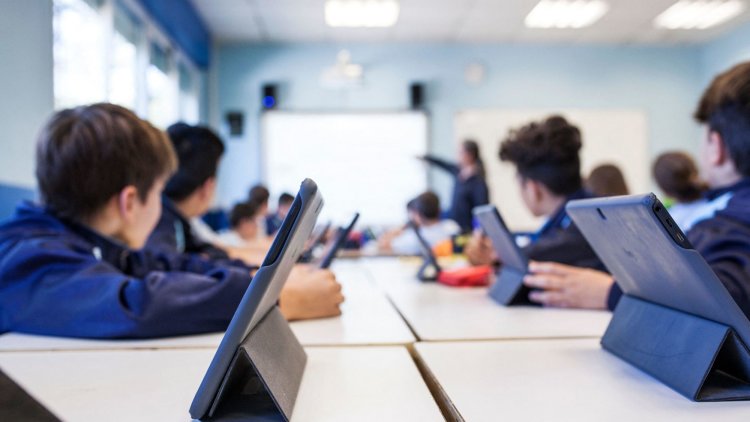
(David Fuentes/Alamy)


14 min read
As consensus grows around the need for social media and smartphone restrictions for under-16s, Sienna Rodgers reports that campaigner mums across the country are now bringing the fight to edtech
For Bridget Phillipson, Britain’s embrace of edtech – educational technology – is exciting.
“I’m so proud that the UK is an edtech powerhouse,” the Education Secretary declared in a speech in January. Announcing a £23m expansion of the government’s edtech pilot programme, she continued: “AI can deliver the biggest leap forward for learning in centuries – perhaps even since the invention of the printing press”.
As the Department for Education boasts that it is “heralding a digital revolution in education”, £187m has been put into a ‘TechFirst’ skills programme to bring AI into the classroom and a commitment has been made to roll out AI tutoring in schools for disadvantaged pupils.
For an increasingly vocal group of parents, however, edtech is an unwelcome development in their children’s education – one that is being foisted on them, both at school and at home, without their consent. They suspect that the government’s enthusiasm for edtech is based on the push for economic growth via tech investment, but believe that children’s education and attainment is being harmed in a way that will do little good for our economy in the long term.
Those parents have recently scored victories in other areas of education policy. The government has agreed, ahead of the results of its consultation on a ban, to put restrictions on the social media use of under-16s. And in March, it released new guidance urging parents to limit the screen time of under-5s – avoiding it altogether under two years, and no more than one hour a day for children aged two to five.
“Parents of young children are facing a constant battle with screens,” the press release unveiling the guidance empathetically states. Yet the guidance, while putting the onus on parents, does not apply to education settings – even though many parents complain that edtech is making that constant struggle over screen time harder.
“The next battlefield is in education,” confirms Arabella Skinner, policy director at Health Professionals for Safer Screens. She is delighted by the screen time guidance but says: “There is no point doing any of this work unless they look at it holistically across the whole day.”
Her group comprises thousands of concerned health professionals from paediatricians, psychiatrists and psychologists to speech and language, occupational and physical therapists, plus ophthalmologists, opticians, audiologists and hundreds of GPs.
“The conversation has been around the mental health of a 15-year-old – that’s where it got stuck,” she says, when in fact resulting health problems extend much further, in both age and conditions. One A&E consultant in her group recalls a child presenting with swollen legs: “You think it’s kidney failure. Turns out he’d been sitting for a week, pretty much, playing games, 17 hours a day with his legs up.”
Skinner is training health professionals to spot such signs, and wants questions around digital devices to become standard: “In the same way you ask people about how much alcohol they have, we should be thinking about asking about their screen time.”
“We came in here more worried about teens. We are now more worried about early years,” she adds. Recent research findings are stark.
The latest report by the 1001 Critical Days Foundation – an organisation founded by Andrea Leadsom to emphasise the importance of the period from pregnancy to two years old – found that more than two-thirds of under-2s use screens. According to their data, nearly 20 per cent of infants aged four to 11 months watch them for over an hour a day.
Ofcom data has identified that 98 per cent of British two-year-olds are watching TV or online videos, on average for more than two hours a day. And early years charity Kindred Squared found that 28 per cent of UK children starting primary school do not know how to use a book – with many attempting to swipe or tap on them, as they would on a tablet.
Education minister Baroness Smith has argued in the Lords that, when it comes to digital devices, “it is important not to conflate personal and educational use”. The contention of edtech advocates is that children must be taught digital literacy.
But critics question what skills young children are really building when they scroll YouTube shorts or play games on the iPad. Many of these apps look less like genuine learning and more like limbic capitalism – the term coined by historian David Courtwright to refer to products that exploit the brain’s pleasure centre to maximise profit through dopamine hits.
The House put out a call in one of the many WhatsApp groups for parents concerned about screens to hear first-hand experiences of edtech; a flood of eager responses soon came.
Ex-childminder Dimitriya, a mum of three girls who lives in the North West, recalls her eldest daughter coming back from school in reception – when the children are aged four to five – with a QR code for her maths homework. It linked to NumBots, a learning platform dedicated to addition and subtraction. The game allows users to choose a character and rewards them with stars when they answer questions correctly and quickly enough.
“We’ve experienced anger issues with our daughter that we haven’t seen before. She started throwing and hitting and screaming,” says Dimitriya. The behaviour left them confused. “Do we have a child that’s just naturally competitive and we haven’t noticed up until this moment, or is it something to do with the platform and what she’s experiencing?” they wondered. “I believe that it’s the platform – it’s the gamification of the learning process.”
She also noticed – as this House writer has found while visiting local state schools – that reception classrooms feature big interactive boards. “Massive tablets, basically,” she says. “I have tried to understand how long exactly they spend on that thing – nobody can tell me.”
At the start of every school year, Dimitriya now explains to the teachers that they have no one-to-one devices at home, and her kids won’t be using the apps for homework. Despite other parents at the school reporting similar stories, such as kids breaking iPads when they can’t do the required number of maths equations in 50 seconds, the school is pushing back.
“We’ve been told that if we don’t sign the user agreement for next year, our children will be left out from their computing lessons,” she reports. The headteacher has been firm: “She basically said to us, ‘If you don’t like the school and what we’re doing, you can leave.’” Unable to find schools nearby that take a screen-free approach, she is now seriously considering homeschooling.
Annaliese, a former primary school teacher who used to work for Westminster think tanks and now campaigns against smartphones in schools, has children of primary school and preschool ages.
“My main concern is that they are highly addictive,” she says of the homework apps. “You give the kids the device, and they’re doing this fun game, and they might be meant to do 10 minutes of it, but getting that device off them afterwards is incredibly difficult.”
Her children were told to use Times Table Rock Stars, another popular app promoted by schools but aimed at those aged six and above, for their maths homework. It similarly offers avatars and users are encouraged to collect virtual coins, allowing them to personalise their characters.
“It was with great trepidation that I would give over the laptop to do Times Table Rock Stars, because I knew that whilst the requirement was to do 10 minutes, it was going to take an hour out of that afternoon to wrangle that device off the child and then to put up with the inevitable tantrum meltdown afterwards,” says Annaliese.
It was not only behavioural consequences that worried her but also their effectiveness in terms of learning.
“I noticed that, with my daughter, she might actually be doing quite well with her times tables on an app, but if I asked her orally, she’d find it really difficult. It’s almost like she couldn’t transfer the learning into a different context. And it was at that point that I opted out of her using it.
“I created the analogue alternative, which was literally just to print out the Times Table Rock Stars worksheets and get her to do those with a timer that I bought for a fiver, and she’s doing really well.”
Kifah has encountered problems at an earlier age still. She is based in Scotland, where the use of edtech is even more intense than in England as a result of direct mandates by councils.
You think it’s kidney failure. Turns out he’d been sitting for a week, pretty much, playing games
When Kifah’s son started nursery part-time, she found he became disoriented and overstimulated. “We couldn’t work out for a really long time why he was so distressed; why he was so violent and dysregulated,” she says. Then she discovered they were handing iPads to the kids daily.
“I had asked them not to use screens with him, so I was in shock, obviously. I approached them, and their argument was that the council would withhold funding if they did not have technology as part of their curriculum. I said, ‘But he’s two?!’” Kifah recalls.
“We withdrew him, and all these behaviours stopped.” But at the next early years setting, she found they refused to stop showing them YouTube Kids. Next, she tried an outdoor nursery – but again found that council policy meant they had to use tech, so were giving her son a phone on which to select songs to play.
“It’s really been quite upsetting for us and really difficult. We’re trying to give our child the best start in life. A lot of what we do is evidence-based in our home, and we’re just getting told, ‘Well, this is how it’s done now.’ And that’s not really evidence,” she says. “We’re a one-income family now, which we never, ever expected to be.”
While Sweden, Denmark, Madrid and Los Angeles are rolling back digital learning, there has been a major push in Scotland for all primary and secondary pupils to have one-to-one devices. This has led to safeguarding problems, with pupils bypassing safety filters on school iPads to access violent and sexual content.

Politicians on the left often focus on equitable access to digital tools – and yet ironically, there is anecdotal evidence that parents who can afford fees are turning to private schools (such as the famous Heritage School in Cambridge) for screen-free education.
Private schools are not forced to undertake the reception baseline assessment, for example, to which the government introduced a digital element in 2025. This is the mandatory test that all reception pupils – aged four – must take in their first six weeks, designed to measure student progress between the start and end of primary school.
Dr Mandy Pierlejewski, a nursery and reception teacher turned academic, led a team that carried out a study on the assessment – first, looking at two schools in 2024; then, three schools in 2025, when a touchscreen aspect was brought in. Filming pupils from behind to preserve anonymity, they analysed their body language and found signs of stress in some of the 2024 children and every one of the 17 children studied last year when they were given a tablet for a 20-minute test.
“A lot of the children didn’t have the digital literacy they needed to complete that test,” she recalls. “Not all children, for instance, realise that you could diagonally drag and drop.” The test asked the four-year-olds to move three pictures into boxes above, in the correct order, to make a story. Many got it wrong – but not because they didn’t understand sequencing.
“Some children really didn’t have the digital skills needed at all. They were tapping on things multiple times. Some of them kept shutting the iPad down by pressing the Home button, and they had to be all started up again.”
In 2024, the maths questions involved moving concrete materials. For subtraction, they were presented with six little plastic bears, told to take two away, then asked how many were left.
The 2025 digital version was more abstract: presented with a picture on the screen of a tree with four leaves on, the teacher says “three leaves fall to the floor – how many leaves are left?” Of the 17 children the study watched, 16 incorrectly counted “1, 2, 3, 4”, not realising they had to move three leaves on the screen themselves before counting.
“The last thing they heard was, ‘how many leaves are left on the tree?’, so they just counted all the leaves. Now, for 16 out of 17 children to get that wrong, there is something wrong with that question,” Pierlejewski says. “I teach primary school teachers mathematical development.
We’ve experienced anger issues with our daughter that we haven’t seen before. She started throwing and hitting and screaming
You start with concrete materials, then you proceed to pictorial representations of the concrete thing, then you move to abstract. It has to go in that order, because that’s how children’s brains develop.”
She predicts that the latest cohort’s results will be worse than previous years. There is no mention of testing digital skills – the assessment is still supposed to be focused on numeracy and literacy only – yet Pierlejewski’s study suggests otherwise. It raises questions about the purpose of edtech and whether it is being used with intention.
Skinner, of Health Professionals for Safer Screens, concludes: “They need to separate educational technology that frees up teachers’ time to be able to teach – because nothing is better than a teacher who’s inspired and delivering it – versus technology that is in front of the student, and takes them away from proper teaching.”
SafeScreens co-founder Jane Rowland, who provides resources to help parents fighting schools to opt out, argues: “What parents are repeatedly being told by schools is ‘we’re preparing the children for a digital workplace’, which, to me, is just nonsense. A digital workplace doesn’t use gamified applications for their employees.”
She is asking government to pause edtech, conduct a review and establish certification for platforms that are shown to be educationally beneficial for children.
Her demands are echoed by the Conservatives, who put forward amendments to the Schools Bill to protect pen-and-paper exams, give parents the right to opt out of screen-based homework, and ensure children would not be required to complete the reception baseline assessment on screens. Although ministers have agreed to introduce a legal ban on smartphones in schools and deliver age restrictions on social media, they have not so far changed course on edtech.
“The government really need to get a grip on the screen creep happening in our classrooms,” shadow education secretary Laura Trott tells The House. “When it comes to screens in schools, we should be guided by the evidence. Research shows that writing by hand supports memory and deeper learning in a way that screens simply don’t.”
“We need to pause and review the evidence before driving any more technology into our schools,” she adds. “We need to end this uncontrolled experiment on our children. Until there is clear evidence that screens improve learning, the focus should be back on books, not devices.”
A Department for Education spokesperson said: “Technology plays an important role in broad, rich learning experiences in classrooms across the country, and it is essential that children learn to use technology confidently and safely, so they can gain the skills they’ll need as they move through life.
“Equally, we understand concerns about excessive screen time and that unmonitored or unlimited personal use can carry risks and recognise that we must get the balance right.
That’s why we are supporting children and young people to develop healthy relationships with technology, including through our new guidance to help families build good screen habits from a young age, banning mobile phones in schools and consulting on the next measures on online safety for children.”

>