
‘Ben’Imana’
Courtesy of Mostafa El Kashef


The Cannes Film Festival has built a reputation as a discovery platform for African cinema, and not just from South Africa and Nigeria’s Nollywood. The 2026 edition of the world’s biggest film festival is again showcasing works from African auteurs, both from established and new cinematic voices. And some of the stories may well surprise you.
Not only cineasts will be on the lookout for hidden gems in Cannes. The global entertainment industry has taken note of the appeal of and appetite for African cinema at a time when the likes of Afrobeats have made a splash on the global music scene.
That said, Akunna Cook’s Next Narrative Africa Fund, in a recent report produced in partnership with Parrot Analytics, highlighted that global demand for African and diaspora film and TV has outpaced supply over the past five years. Their findings also dispelled doubts that African stories can travel, highlighting that the U.S. is the single largest market for African and diaspora content, accounting for 8.5 percent of global demand, with the U.K., Canada, France, Brazil, China, Belgium and Portugal also among the top-consuming territories.
Plus, the continent’s demographic trends, such as the fact that more than 60 percent of Africans are under the age of 25, further make Africa a treasure trove of stories that the world seems more ready to pay attention to than ever before, the fund has emphasized.
At Cannes 2025, African films included the likes of Akinola Davies Jr.‘s My Father’s Shadow, the first Nigerian-backed film in the fest’s Un Certain Regard section, which earned a special mention for the Caméra d’Or best first feature award.
The Cannes 2026 offerings of new African cinema, mostly featured in the Un Certain Regard section, range from the first film by a Rwandan director to world premiere in Cannes’ Official Selection, a landmark co-production by the Democratic Republic of the Congo (DRC) and the Central African Republic (CAR), a Moroccan auteur’s story about seasonal fruit pickers in Spain, and the star-studded sophomore feature from Nigerian-born twin brothers.
Cannes artistic director Thierry Frémaux, during his 2026 lineup press conference, emphasized the French festival and film establishment’s commitment to African film after highlighting that DRC filmmaker Dieudo Hamadi (Kinshasa Makambo, Downstream to Kinshasa) was a member of the competition jury last year. “He said, ‘I’ll go back to my country, and I’ll try to create a national center of cinema in [the capital] Kinshasa,’” Frémaux shared. “And we went to visit him and supported him. The project is underway. And it’s a good thing how the French ecosystem and the French are committing themselves to world cinema and deliver this kind of inspiration.”
But a chattering bird builds no nest! So, drum roll, please, for THR‘s closer look at African films in Cannes this year.
Ben’Imana, directed by Marie-Clémentine Dusabejambo
Un Certain Regard
International sales: MK2 Films
‘Ben’Imana’
Courtesy of Mostafa El Kashef
This film is a triple debut! It is not only a world premiere and Dusabejambo’s first feature, but also marks the Cannes Official Selection debut for a director from Rwanda. The movie from producers Ejo Cine in Rwanda and Princesse M Productions in Gabon, in co-production with Les Films du Bilboquet in France and DuoFilm in Norway, has been a decade in the making.
Ben’Imana, which director Dusabejambo wrote with French scribe Delphine Agut (Souleymane’s Story), tells the story of Vénéranda, a survivor of the 1994 genocide against the Tutsi in Rwanda who urges everyone around her to exercise forgiveness at a time that people’s courts are meant to bring justice, healing and reconciliation. But when she learns of her teenage daughter’s unexpected pregnancy, her past trauma resurfaces, testing the limits of forgiveness within her family.
Dusabejambo has previously created such shorts as Icyasha, about an effeminate soccer-loving boy who tries to join a neighborhood team but gets bullied, A Place for Myself, about an albino girl, and Lyiza, whose story of a girl living with the traumatic memory of her parents’ murder during the genocide in Rwanda explored themes that are also in focus in Ben’Imana.
Her feature-length cinematic exploration of intergenerational trauma, which Frémaux in his Cannes 2026 press event lauded as “an amazing work of cinema,” stars a cast of mostly non-professional actors, including Clémentine U. Nyirinkindi, Kesia Kelly Nishimwe, Leocadie Uwabeza, Antoinette Uwamahoro, and Aime Valens Tuyisenge, as well as Rwandan actress Isabelle Kabano, known for the likes of Mauritanian director Abderrahmane Sissako’s Black Tea.
“Ben’Imana” means “the people of God” or “the children of God.” Dusabejambo tells THR: “We all shared the same language in Rwanda before this division. It is the same language and the same culture, and not many countries have that. We have the same mother tongue. And this means we came from the same father, which is God. So it’s ‘the people of God,’ but translating the title beyond that, it is ‘the lucky ones,’ because we have all this in common. They say that God spends the day outside of Rwanda, but he comes to sleep in Rwanda.”
Division and genocide have weighed on the country’s people, and the trauma isn’t always expressed directly. “We see the weight of the silence between our parents and us, and I took a journey to really be able to understand people’s body language, because sometimes they are telling you a horrible thing, but they do it with a smile,” the director tells THR. “So I really wanted to capture that weight.”
Ben’Imana features different people dealing with past trauma in different ways – some look for revenge, while others want to move on. “That’s actually the duality of life today,” highlights Dusabejambo. “I had to rely on public money, so every time we pitched the film, they asked: ‘Why [focus on] this time? People have moved on!’ But we are all different. And I wanted to really talk about the genocide and its aftermath, … [when] there is this process of coexisting that really requires that we all work together so that we can make the future possible.”
For Dusabejambo, there is a key underlying message of the film. “What I really want for the public to come and see in the film is the resilient spirit of Rwanda,” she explains. “The soul of Rwanda may have been broken by the genocide, but not the spirit. And in this film, I was really looking to [allow audiences] to meet the mothers’ heartbeat, because it is those women who are coming together every morning and going beyond their brokenness to find that identity of being a mother. A mother is someone who cares. A mother is someone who brings [people] together. … There is always light in the darkness, and that is what we are all looking for in a way.”
She also hopes that Ben’Imana can serve as a role model for other films made in her country and beyond. “There is a challenge for getting films financed in Africa. What is very important is that the film is a co-production, where Rwanda and Gabon have the majority, economically,” the filmmaker tells THR. “We can do this. It’s not always that the European countries must have that. There’s a new wave of African filmmakers coming up, and we really wanted to keep this sovereignty. France and Norway are minority producers. It has been a really fantastic journey for us.”
Clarissa, directed by Arie and Chuko Esiri
Directors’ Fortnight
International sales: Neon International
‘Clarissa,’ courtesy of Neon
Courtesy of Neon
Nigerian-born brothers Arie and Chuko Esiri return for their sophomore feature after turning heads with their debut film Eyimofe (This Is My Desire), which followed two complete strangers trying to scrape by in the sprawling metropolis of Lagos, Africa’s largest city.
The movie features a starry cast, including Sophie Okonedo, David Oyelowo, Ayo Edebiri and Nikki Amuka-Bird, and has already been acquired by Neon for U.S. distribution and international sales duties.
The reimagining of Virginia Woolf’s Mrs. Dalloway, set in modern-day Nigeria, was shot on 35mm in Lagos and Delta State, Nigeria. It follows Lagos socialite Clarissa, who hosts a party where old friends reunite. As the night unfolds, the party crowd revisits past loves, secrets, and lost dreams. Expect a heartfelt reckoning!
Produced by the Esiri brothers and Theresa Park of Per Capita Productions and Nicholas Weinstock of Invention Studios, the co-producers are Nina Gold and Thomas Bassett. Okonedo, Dolly Omodolapo Kola-Balogun, Osahon Okunbo, and Jason Reif are credited as executive producers.
Clarissa is “a much more ambitious project than the first one,” Chuko Esiri tells THR. And for the duo of Nigerian filmmakers, there was a key challenge. “We met with a number of financiers and producers and studios that have an impression, or have an idea, actually, it’s a bias, of what films from Africa should be or should look like, or what stories you should be telling.” But the brothers found “wonderful” partners “who did understand and who were very protective of the vision and of it being a truly authentic Nigerian piece.” Adds Arie Esiri: “The festival [also] sees the merits of the film and understands what it was we were trying to achieve with the film and its ambitions. So that was also very encouraging, as well as validating.”
How’s the work of the Esiris different? “I had an English teacher when I was 12 in the U.K. who once said to me…: ‘When I close my eyes and think of Africa, I can’t see anything other than Safari images,’” recalls Arie. “And even at that age, I understood that that’s not really his fault. That’s all the media gives you. Even from that age, I felt I needed to somehow share images of what Africa really is in contemporary times.”
Explains Chuko: “We’re interested in telling Nigerian stories. I know Nollywood is a big thing, but there’s also a big debate about whether Nollywood is a genre or an industry. I personally believe it’s a genre and not in an industry, because an industry incorporates many things, many different voices, many different tales. For us, it’s just marching along that road of wanting to make these types of films for Nigerians and for the world.”
The brothers clearly love and admire Mrs. Dalloway, and they are bringing their Nigerian lens on the story to the world. “There are things that are happening, structurally, in the book, that are very applicable to a Nigerian context,” explains Arie. For example, the post-First World War challenges, including the trauma and mental health issues experienced by a soldier in the novel, allow the filmmakers to “talk about the insurgency in our country” by jihadist militant group Boko Haram and “how much of a stronghold the military still has on Nigeria even post a military regime.” But there are also “the human aspects of the book, which are wonderful and translatable to any culture at any time” since they are timeless. Highlights Chuko: “For us, it’s about the old saying that humanity is banal. Everybody understands what it is to love and not be loved back, everybody understands what it is like to have a dream or ambition for your life and maybe not quite make it. So, these are the themes of the novel and the characters that translate to home,” and the world.
The brothers also highlight that Clarissa showcases Nigeria, including sides that audiences may not have seen or experienced before. After all, it was shot in three distinct parts of the country, namely the countryside, the desert and the bustling metropolis of Lagos. And the film showcases great talent. How was it to cast all sorts of big stars in Clarissa? “It was surreal,” recalls Chuko. “One of the first people to come on board was Nina Gold, who did the casting. That just gave us a big, big stamp of validation that this is something you should pay attention to. … A dream of ours, or an ambition, has always been, and will continue to be, to work with Africans in the diaspora and tell stories at home.” Concludes Arie: “A lot of these actors who are of Nigerian heritage are all very curious about their heritage and about Nigeria and the speed at which the arts are progressing back home. So much has changed over the last 15 years.”
Strawberries (La más dulce), directed by Laïla Marrakchi
Un Certain Regard
International sales: Lucky Number
‘Strawberries’
Courtesy of Lucky Number
Thousands of women leave their native Morocco every year to work the season picking strawberries in Andalusia, Spain, in the hope of money for a better life for their families back home. Strawberries, inspired by real-life stories, takes us into their experience, which turns out to have more than one dark side. After all, the road to reaping the fruits of their hard labour turns out to be paved with the foulness of harsh living conditions, abuse, sexual harassment and prostitution. With the help of a female lawyer, the fruit pickers mount a court case against their deep-pocketed and organized agricultural exploiters.
Viewers can expect this tale of neocolonialism with echoes of #MeToo to leave a sour taste in their mouths. Paris-based Moroccan filmmaker Marrakchi (Marock, Rock the Casbah) wrote the script with Delphine Agut, whom we just mentioned as a co-writer of the previous entry. The story is inspired by real-life reports of exploitation and abuse of Moroccan women who go to Spain for seasonal work and actual court cases.
The cast features Nisrin Erradi (Everybody Loves Touda, Adam), Hajar Graigaa, Hind Braik, Fatima Attif, Larbi Mohammed Ajbar and Itsaso Arana. The film’s producer is Juliette Schrameck (Coward, Sentimental Value, The Worst Person in the World) via her company Lumen, with Morocco’s Mont Fleuri Production, Spain’s Fasten Films and Belgium’s Mirage Films.
Marrakchi, who has also directed episodes of such TV series as French spy thriller The Bureau and Damien Chazelle’s The Eddy, returns to Cannes’ Un Certain Regard program, where her 2005 feature debut Marock, about a Muslim-Jewish romance in Casablanca, also premiered.
The filmmaker sees the Croisette as a great place to exhibit African and other world cinema. “Cannes is really the place for directors from all over the world,” she tells THR. “It’s a good showcase. And it can change everything for the journey of a film.”
In her research for Strawberries, “I met lots of women working in the strawberry fields who had the experience of bad conditions and [abuse], but there were also some who went to Spain, had a good experience and went back to Morocco with money. They had the opportunity to have a better life in Morocco. So, there are many stories, and they depend on the [specific] experience.”
Marrakchi chose for her film to tell “this story, about the problems of harassment, of prostitution,” she says. “And I try to show how difficult the work is and the conditions are. These women go there for a good reason, because they want to follow a dream, but then there is the reality of the work that no Spanish people want to do.”
Strawberries also highlights the various challenges that foreign fruit pickers have encountered in real-life trials, from language barriers and religious and cultural differences to the fear of being stigmatized back home. “For these Moroccan women, it’s difficult to speak up and speak out, because they can lose everything in Spain and in their [home] country,” explains Marrakchi. “What I show in my film is really not simple at all. Speaking out is a privilege.”
Concludes Marrakchi about the big business bringing in foreign fruit pickers: “It’s a sad form of new colonialism.” And the hard-working women at the center of Strawberries represent much broader issues and conflicts. Says the filmmaker: “This is also a film about the relationship now between the Western world and the [Global] South.”
Congo Boy, directed by Rafiki Fariala
Un Certain Regard
International sales: The Party Film Sales
‘Congo Boy’
Courtesy of ‘Congo Boy’ – Makongo Films/Unité/Kiripifilms/Karta Film/Canal+
How’s this for a plot?! Robert is a 17-year-old Congolese refugee in Bangui, the capital of the Central African Republic (CAR). After his parents are imprisoned, he cares for his four younger siblings while trying to become a musician.
Congo Boy‘s cast includes Bradley Fiomona Dembeasset, Christy Djomanda Louba, Pétruche Mbomba, Rosiana Kotozia, Gloria Ambacko and Dieufera Sana.
The autobiographical film – Fariala is the son of Congolese parents, based in the CAR and a self-taught musician – previously made the 2022 documentary We, Students!, in which he turned the camera on himself and his friends to capture everyday student life at Bangui University.
Congo Boy is a production of Mahongo Films in the CAR, co-produced by Hamadi’s Kiripifilms in the Democratic Republic of the Congo and France’s Unité.
You may wonder just how autobiographical the movie is. “It is really my own story, told through Robert, played by Bradley,” Fariala tells THR via a translator. “When you see in the film that Robert is shot at, I was actually shot at.” The same is true for Robert’s stay with a colonel and his participation in a talent show, co-organized by UNICEF, among other things.
The filmmaker sees his experience as a refugee as something that reflects the lives of many people around the world and is showcased in the film. “My family fled the Congo because there was war there, and when we got to the Central African Republic, war started there, too,” explains Fariala. “They wanted to be in a country that was more at peace to protect their family. So they were thinking of going to Benin and then on to Europe to have some stability for our future. But unfortunately, they had passports and their refugee card that showed a different country, so they got arrested.”
After We, Students! was censored in the CAR, he had to go into exile in France, again as a refugee. “We often speak about refugees who want to go to Europe, but there are a lot of people who are refugees within different countries of Africa,” as the film shows, notes the director. “And I want to convey that refugees are not beggars. They have to leave their home because this world is really crazy because of human destruction. But the young ones still want to fight; they still have hopes and dreams. I am proud to be a refugee.”
How did the director find his cast to tell a very personal story? “We did some street casting,” he recalls, highlighting that he added a French casting director to his Central African Republic crew to find the lead actor. “He’s my double,” emphasizes Fariala. “It took months. I started looking into young singers on the music scene, but they lacked charisma. So I went to look for Congolese refugees, and we went to cultural centers in different neighborhoods. At this school at 6 a.m., we auditioned 50 young boys, including Bradley, and he was so different from the others. He was reserved and smiling, but he had something in common with me. He liked to sing and rap, but only in his bedroom, because his father didn’t want to hear anything about art. His father just wanted his son to do well in school, like mine. So I gave him an improv exercise about failing his high school degree, and it was very different from the others.”
Fariala was convinced that the young man was the right person to play the lead role. “But I had to talk to his parents, who didn’t agree at first,” he shares with THR. “So I had to be very persuasive.” The rest of the cast is also made up of non-professional actors. And many portray their real-life experience, such as soldiers appearing in the film as soldiers, and Fariala’s aunt playing herself. That plays into the filmmaker’s interest in both documentary and fiction, and in mixing the two in his films. “I started out in documentary, but I always like to add a layer of fiction into my documentaries,” he tells THR. And Congo Boy is a fictionalized version of his own life, with the reliance on a non-professional cast adding another layer of documentary vibe, he notes.
How does Fariala feel about screening Congo Boy in Cannes? “I’m really happy,” he says. “It’s an amazing opportunity as a young African filmmaker, or as a filmmaker period. It’s a dream and a great showcase.”
>

EXCLUSIVE: It’s a Sin star Callum Scott Howells and Gabrielle Creevy (Black Doves) are leading an adaptation of Vanessa Savage’s romantic thriller The Night They Vanished for BBC Studios and Channel 4.
Cameras have rolled in Wales on the six-part series that tells the story of Anna (Creevy), whose world is blown apart when she discovers her childhood house listed on a true-crime website as the scene of her family’s future deaths. Intriguing blind date Cai (Scott Howells) runs the true-crime site but swears he didn’t post it. The police say it’s a hoax, but Anna’s family have vanished.
Angharad Elen (The Light In The Hall) and Hannah Daniel (Mudtown) are adapting Savage’s novel, her third thriller. BBC Studios’ new label CliffEdge Entertainment, which has just been unveiled to Deadline by scripted boss Jamie Hall, is producing and selling worldwide. Channel 4 has pre-bought the drama while we understand a deal with a U.S. buyer is close.
Additional cast includes Tamzin Outhwaite (The Wives, Ridley Road, The Tower) as Anna’s stepmum Jo and Steffan Rhodri (Gavin & Stacey) as Idris, Anna’s father, along with Matthew Gravelle (Mudtown), Lisa Victoria (Pobol y Cwm), Jack Quick (Pobol y Cwm), Andrew Lennon (Death Valley), Callum Hymers (The Pact), and Bella Shewan.
Scott Howells is best known for Russell T. Davies’ It’s a Sin and is starring in Deadpoint, another BBC Studios thriller for Channel 4. Creevy plays Eleanor in Netflix hit Black Doves, which will soon launch Season 2.
Creevy said: “Anna is a firecracker – sharp, loyal and carrying more hurt than she lets on. The moment her past comes roaring back, she’s forced into a nightmare she thought she’d escaped. It’s a gift of a role and I can’t wait for audiences to unravel the truth with her.”
Scott Howells added: “Cai is charming, complicated and never quite what he seems. He could be the love of Anna’s life… or the centre of a terrifying conspiracy. Playing someone who keeps you guessing is exactly the kind of challenge I love.”
The Night They Vanished has been pre-bought by Polly Scates, Channel 4 Head of Acquisitions and Felix Jones, Acquisitions Manager. EPs are Sarah Creasey, Sathe, Elen, and Branwen Williams for BBC Studios. Series producer is Sian Elen John and the Director is Geraint Todd.
>

EXCLUSIVE: BBC Studios’ scripted chief has laid out his strategy for future indie and talent investments that will shy away from “going out and spending £20M ($26.5M) on a production company.”
Speaking exclusively with Deadline for his first interview since taking on the Scripted MD role, Jamie Hall said his plan for the Doctor Who, Baby Reindeer and Sherwood maker is instead to strike smaller but more regular deals with top talent and “build creative hubs.” In this vein, Hall said BBC Studios scripted will “move slightly closer” to the strategy of soon-to-be-independent rival ITV Studios.
Hall came to our interview clutching receipts in the shape of two new labels led by the producers behind Strike and The Detection Club, along with early-stage plans for a label that will focus on digital spin-offs of existing brands.
BBC Studios runs hefty in-house drama and comedy teams along with majority-owning big beasts of the UK production world like Baby Reindeer maker Clerkenwell Films, Sherwood producer House Productions, Lookout Point and Steve Coogan’s Baby Cow.
Hall joined earlier this year, three decades on from his first stint at the BBC (he met his wife working on Our Friends in the North) from Vice Studios/Pulse Films, where he oversaw the likes of Gangs Of London. At BBC Studios, his remit is to give a shot in the arm to the drama and comedy offering and unearth the next generation of IP at a time when the public service BBC is desperate for funding. His desire echoes that of his boss, BBC Studios Productions chief Zai Bennett, which is to invest in around two to three of these new-look talent labels per year. Other examples include tie-ups with Barbie star Jamie Demetriou, The Ballad of Wallis Island writer Tom Basden, Ted Lasso alum Nick Mohammed and Cunk on Earth creator Diane Morgan.
“I inherited a group of great production companies that had been acquired in the way production companies were acquired at the time,” Hall told Deadline from BBC Studios’ Soho outpost. “But I don’t think the market can support that anymore – or, at least, it can only do so very rarely. We’re not going to spend £20 million buying a production company. Instead, we’re building an amazing service at the center of the studio, then creating creative hubs that can tap into our brilliant lawyers, HR, finance and other support functions.”
He recalled a recent conversation with Joel Wilson, the just-departed co-founder of Sex Education producer Eleven, who told him: “Towards the end of running the company I came to dread the pressure of running a business.”
“All [Eleven] wanted to do was build great shows,” added Hall.
Hall didn’t completely rule out stumping up big bucks to buy an indie outright in the future, but added: “The reality is that I can set up creative pods or labels at a much lower price point, and that feels right.” He said the scripted supremo role at BBC Studios had attracted him because, “I wasn’t simply coming in to mind the wheel. There was a creative renewal that needed to happen – some wiring and plumbing that needed fixing.”
Backing up his strategy, Hall unveiled Bristol-based Landed Productions led by Strike and Possession producer Jenny Van Der Lande, who is leaving her role as Big Talk’s creative director of drama to helm BBC Studios’ first scripted label outside London.
Landed Productions will make “premium genre pieces” and Van Der Lande has multiple writers in mind with whom she wants to develop shows. “Jenny said in our conversations that she doesn’t want to run a production company,” explained Hall. “She wants to work with amazing writers she already has relationships with, then partner up when she gets a greenlight.”
Hall’s new-look team, which consists of the likes of CFO Jennifer Dickson, legal chief Anna Beese and production director Alison Loose, has also been busy working on the digital spin-offs label that follows big digital successes for franchises like Dancing with the Stars and EastEnders. This one, which doesn’t yet have a name, will be led by BBC Studios Drama digital chief Katy Karger. “Scripted is probably the hardest area to crack [in digital], so we’re setting up a central digital capability,” said Hall. “When someone pitches a conventional piece of television, we can also pitch to buyers a digital component.”
Hall also unveiled CliffEdge Entertainment, led by “real grafter” Deborah Sathe, who is moving across from her role as Senior Creative Director at the in-house BBC Studios Drama Productions. CliffEdge will take some shows off Drama Productions’ hands such as The Detection Club, Silent Witness, Father Brown and Shakespeare and Hathaway, while the Kate Oates-run Drama Productions will continue making soaps and continuing drama. Some staff will move over to CliffEdge.
“When I came in, I spent a lot of time getting to know all the creatives in the business and Deb Sathe was one of the people who really impressed me with her energy and what she was building,” added Hall. “She’s a real grafter, but is also incredibly disciplined about making shows at a certain price point. It felt natural for her to have her own entity to run.”
CliffEdge comes replete with a greenlight: an adaptation of Vanessa Savage’s gripping thriller The Night They Vanished starring It’s a Sin’s Callum Scott Howells and Gabrielle Creevy (Black Doves). That one has been pre-bought by Channel 4 and follows Anna (Creevy), whose world is blown apart when she discovers her childhood house listed on a true crime website as the scene of her family’s future deaths. Intriguing blind date Cai (Scott Howells) runs the true-crime site, but he swears he didn’t post it.
“I’ve done the rounds of most of the agencies”
The Night They Vanished speaks to what Hall believes BBC Studios can do with big IP.
He says he has “done the rounds of most of the agencies to remind them that we’re open” – the day after he chats with Deadline he has a meeting in the diary with Curtis Brown – and is in talks over “a number of pieces of IP that are coming through which are quite interesting.”
Driven by the success of Sky and AMC’s Gangs of London, for which he says Pulse was “a bit ahead of the curve,” Hall is chatting to rightsholders about the possibility of revamping in-vogue gaming IP for the small screen. This follows big successes for the likes of HBO’s The Last of Us.
Although none of these examples are necessarily franchise-able in the vein of a Gangs of London or Doctor Who, Hall reels off a list of upcoming BBC Studios shows he is buzzing for, including the BBC’s Killing Eve origin story Honey, Netflix surfing drama Breakers and a second season of Disney+ rom-com Alice and Steve.
Another hit dominating ratings at the moment is Diane Morgan’s comedy Ann Droid, which poignantly taps into societal paranoia about AI but in an oh-so-gentle way. Having yesterday become the BBC’s biggest new scripted comedy since Ludwig Season 1, Hall reveals there is “real interest” in Ann Droid from American buyers, who are familiar with Morgan from her work as comedy creation Philomena Cunk and could either buy finished tape or commission their own unique version.
Hall has plenty experience working for American behemoths and will soon sit down with BBC Studios’ new L.A. chief Ryan O’Dowd to figure out “how we can be better joined up, because inevitably our producers [in the UK] want access to the U.S. market.”
This comes at a time when Hall says the co-pro market is “picking up a bit” from the lows of 2025, although he acknowledges it is “nowhere near what it was in the past and there is still quite a big oversupply in the market of producers and projects.” “If we’re designing a show and the budget is at a [higher] level then we need to start thinking about [co-pros] much earlier in the process,” he added. “What has happened in the past is you develop a show for [BBC drama boss] Lindsay [Salt] and she says she wants it and then you go, ‘Oh crap we can’t finance it with just Lindsay and the tax credit, we need co-pro’. But by then the show has been developed in such a distinct way.”
He hopes his experience in the belly of the beast at Vice can help but is so far loving being part of a public service machine, which Hall labels the fourth biggest brand in the world. “Our ultimate owner is the epitome of patient money,” he said. “Whereas when I was at Vice it was owned by three American banks and if we didn’t hit our numbers each quarter we were in trouble.”
This unique BBC model helps in the current landscape, Hall reckons, coming as the Banijay-All3Media mega-merger marches on.
“I imagine that if you’ve got a super-indie with 130 production companies, the amount of facetime you’re going to have with the boss is quite minimal,” he added. “What I really lean into is the way we’re structured. Zai [Bennett] and I sit opposite each other, across a bank of desks. We don’t have to wait for L.A. to wake up before we make a decision; we can just get on with things.”
“Just getting on with things” is a crucial mantra for a BBC Studios scripted operation that is feeling more and more pressure to return funds to the cash-strapped 100-year-old national broadcaster.
Is Hall feeling the pressure?
“There’s no denying that any headwinds the BBC faces will come and hit us,” he added. “All I can do is manage that and focus on where we can grow our business outside of that [traditional BBC funding] route to help compensate. The BBC gets beat up so much. What we can do inside the studio is really help it and support it.”
>
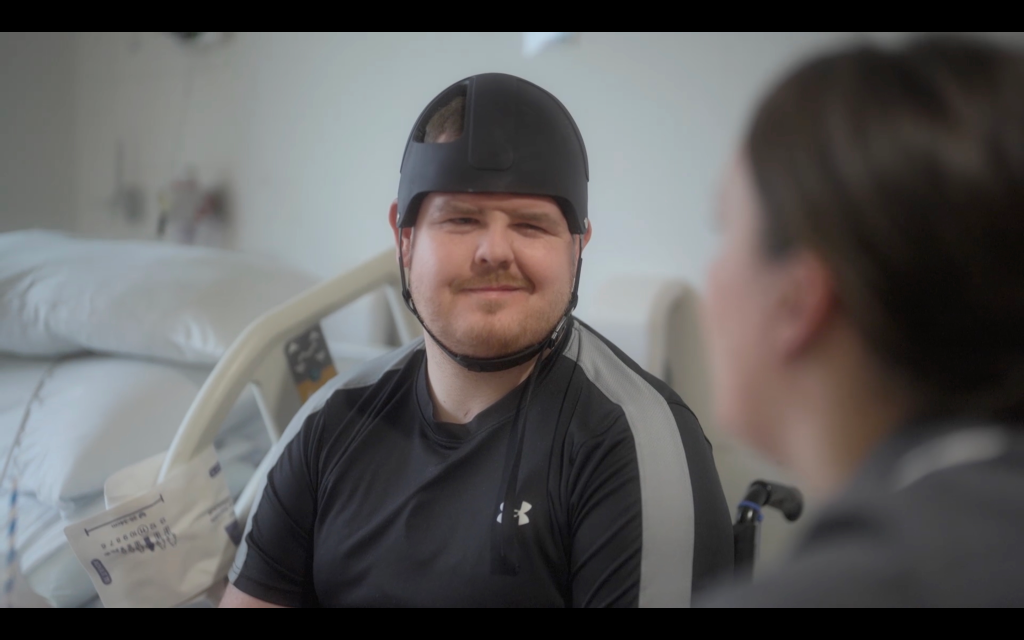
EXCLUSIVE: Channel 4 is teaming with the Stroke Association on a documentary sereis looking at young people living with the aftermath of a stroke.
Trauma: My Broken Brain follows three young survivors through the most frightening days of their lives and the grueling journey back to independence.
Every five minutes someone in the UK suffers a stroke – there are 1.4 million stroke survivors living in the UK today – but the aim of the doc is to show that this is only the beginning of recovery. Filmed over seven months with access to these young adults at the most terrifying and testing moments of their lives, the series meets Dan (28), a dancer left confined to a wheelchair, barely able to speak following emergency brain surgery; Saskia (22), a self-described social butterfly left bedbound after a brain bleed so severe her family feared she would not survive; and Dec (20), who collapsed just four months into a new relationship and spent weeks in a coma, his family and girlfriend unsure if he would survive.
Channel 4 has taken the rare step of teaming with a charity on the doc. It is being produced by Stream Media Group, which was also behind the same network’s Anna Richardson: Love, Loss and Dementia, made with the Alzheimer’s Society.
Channel 4 commissoning exec Simon Lee said: “This is an ambitious and important series that challenges perceptions and gives a voice to young people whose lives have been transformed by stroke, as they embark on the long road that begins after survival.”
Stream’s Victoria Noble added: “What struck us throughout filming was how little people understand about stroke. Survival is often seen as the end of the story, when in reality, it is only the beginning. By sharing their journeys with such honesty and courage, Dec, Dan and Saskia revealed the reality of rebuilding a life after stroke, and the truth behind the long and unforgiving journey to reclaim the right to live an independent life. Alongside the extraordinary support of their families, their stories offer a powerful insight into resilience, determination and hope. It’s been a privilege to tell their stories.”
Noble is EP with Ben Padfield and producer is Laura Hooper. Series director is Storm Theunissen and production executive is Fiona Ridgers. The show was filmed with access to The Walton Centre NHS Foundation Trust and Clatterbridge Rehabilitation Centre, and Wirral University Teaching Hospital NHS Foundation Trust.
>


Search For Canadian TV Actor Stewart McLean Now Homicide Investigation


These ’90s fashion trends are making a comeback in 2017
According to Dior Couture, this taboo fashion accessory is back
Model Jocelyn Chew’s Instagram is the best vacation you’ve ever had
Emily Ratajkowski channels back-to-school style
9 Celebrities who have spoken out about being photoshopped


Rurouni Kenshin: Hokkaido Arc Manga Takes 1-Issue Break – News


HIDIVE to Stream English Dubs for The World Is Dancing, The Forsaken Saintess and Her Foodie Roadtrip in Another World, The Dangers in My Heart: The Movie Anime – News