
Garner, Safai, Kaplan and Togrove at the Toronto International Film Festival in September 2026.
Courtesy of Toronto International Film Festival


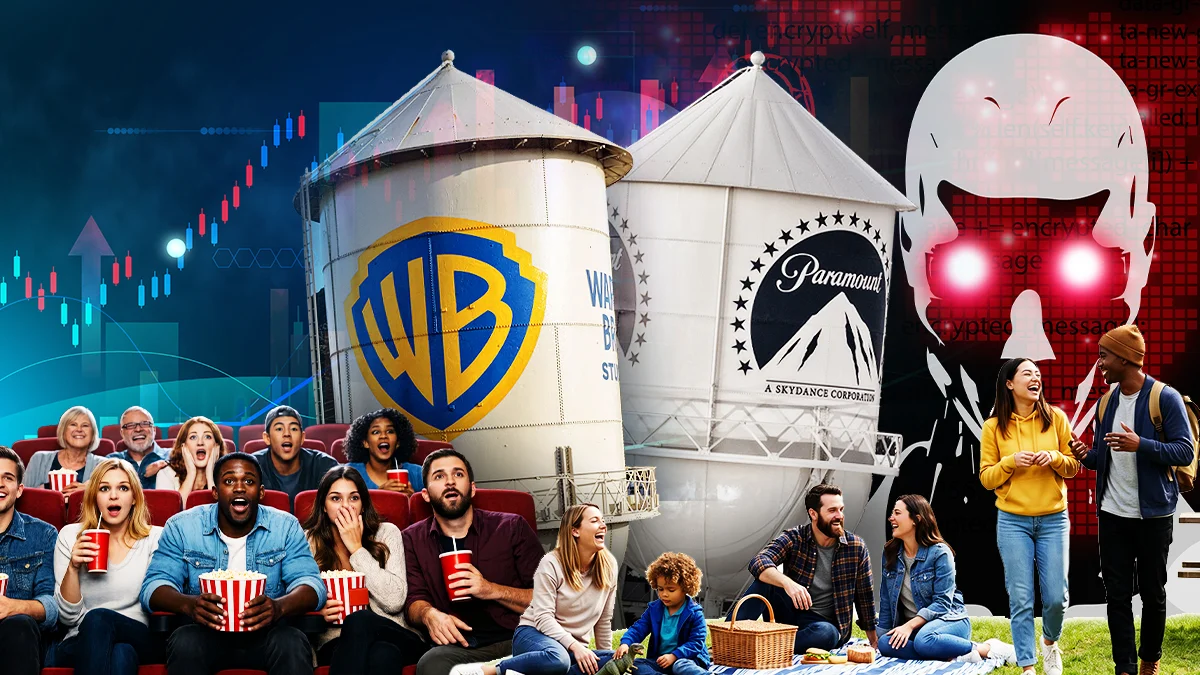
With all of the major media and tech companies finished reporting their March quarterly results, it’s time to take stock of where the entertainment industry stands.
It’s an industry that’s still on shaky ground. Between the pending merger between Paramount and Warner Bros. Discovery — which still faces resistance — the rise of artificial intelligence, mounting layoffs, political instability with a war in Iran and fights with the Trump administration at home and continued declines in linear TV, volatility is the new norm.
But throughout the nearly two dozen earnings reports and conference calls, some common themes started to stand out. They’re enough to give a sense of how the industry is doing now and where it’s headed in the coming months.
Here are the biggest takeaways:
Paramount’s pending acquisition of Warner Bros. could be felt in a number of places.
The deal is slated to close by the end of the third quarter, and while Paramount CEO David Ellison and Warner Bros. Discovery CEO David Zaslav said little about it during their respective calls, both expressed confidence it would close.
But there’s been a growing sense that the process wouldn’t be as smooth as expected. Hollywood has gotten more vocal about the dangers the merger presents, and are calling for the state attorneys general, led by California AG Rob Bonta, to step in. Bonta previously told TheWrap that “red flags are everywhere when you have a merger of this type” and that the states are prepared to “act timely,” but declined to provide a specific timeline for when a decision could be made.

Warner Bros., meanwhile, paid the price of switching suitors when it posted a net loss of $2.92 billion, much of it due to the $2.8 billion break-up fee it paid to Netflix. Paramount will reimburse shareholders when the deal is closed, and it drew on its own credit facility to get the funds ready.
The recipient of that breakup fee, Netflix, could go on its own shopping spree. Fresh off of their agreement falling through, it bought Ben Affleck’s InterPositive in a deal that could reach $600 million.
“We’ve learned so much about deal execution, about early integration, but mostly, we really built our M&A muscle. And the most important benefit of this entire exercise was that we tested our investment discipline,” co-CEO Ted Sarandos said on Netflix’s earnings call.
Few other companies directly addressed the deal, with AMC Theatres CEO Adam Aron being an exception and reiterating his support — a stance that stands in contrast to the rest of the exhibitors.
“We have the sincerest trust in the leadership under David at Paramount and we fully believe he is sincere in the promise he made and confident in his ability to pull it off,” Aron said.

This quarter also cemented the fact that the streaming services, which were largely loss leaders designed to amass huge customer bases, are now growth engines in their own right. As we laid out in our breakdown of how the streamers stacked up this quarter, all but Peacock reported a profit.
WBD saw its streaming revenue grow 9% to $2.9 billion, while profits surged 29% to $438 million.
In a rare comment about the deal, WBD’s Zaslav noted that HBO Max’s turnaround should be a “huge benefit” to Paramount once the two companies combine.

Disney+ and Hulu also grew their combined profit 88% to $582 million and is on track to deliver a streaming operating margin of at least 10% in 2026. The company does not disclose profits for ESPN+.
What’s driving those profits have been consistent price hikes and driving customers to the cheaper ad-based tiers, where advertising revenue helps bolster the bottom line.
The only exception is Peacock, which is the only major streamer still in the red despite seeing revenue grow 12% to $2.1 billion, clearing that mark for the first time. The combination of HBO Max and Paramount+ puts it nearly on par with Netflix and Disney+-Hulu on a subscriber basis, leaving the gap between the top three players and Peacock even wider.
Peacock executives said they see the service approaching profitability in the second quarter, so there’s at least one ray of hope.

While Peacock celebrates passing $2 billion in revenue for the first time, the Big Tech companies are dropping nearly ten times as much on capital investment in artificial intelligence — and getting rewarded by shareholders for it.
As noted in my analysis, companies like Google parent Alphabet and Microsoft are spending upwards of $190 billion — each! — on infrastructure to build out their AI models. Amazon is in for a cool $200 million. The only Big Tech company not all-in is Apple, which is “conservatively” spending an estimated $14 billion this year.
It’s the biggest case of FOMO you’ll ever see, with companies going all-in on making sure it stays on top in the AI arms race.

“If you’re a hyperscaler like Google, Amazon or Microsoft, the insane price of AI infrastructure is a rational investment, because you’re selling that compute at a profit,” said Avi Greengart, an analyst at Techsponential. “There’s a risk of overinvestment, but given the potential — and health of their underlying businesses — it would be worse to underinvest if the bull case for AI is true, and then never be able to catch up to demand and lose to rivals who did.”
But AI talk wasn’t just left to the tech players. Both Paramount CEO Ellison and new Walt Disney Co. CEO Josh D’Amaro called tech an “accelerant” to their businesses, and talked up the notion of AI to speed up work flows, and in Disney’s case, improve the customer experience. That includes creating a single “super app,” presumably based on Disney+, that would handle everything from shows and movies to access to the parks.

Another trend that popped up across multiple companies was the increased value of real-life experiences. A study from National Research Group in collaboration with The Wrap published earlier this year found audiences of all ages (but especially Gen Z and Gen Alpha) expressing a desire to reconnect with reality as a response to how isolated technology has made society. We saw some of that play out in the results.
Disney’s experiences division saw record growth in the second quarter, with revenue rising 7% to $9.49 billion and profits growing 5% to $2.62 billion. Comcast’s Epic Universe park drove theme park revenue up 24% to $2.3 billion and profit up 33% to $551 million.
Comcast co-CEO Mike Cavanagh talked up the investment in additional parks this year, including a new ride at Universal Studios Hollywood themed to “Fast and the Furious,” a Frisco, Texas park aimed at children and a new park in the U.K.

Neither Disney nor Comcast executives said the higher cost of gas was affecting attendance, although warned that could change if the conflict in Iran — and affect on fuel prices — drags on.
While AMC and Cinemark each reported losses in the March quarter, strong revenue growth from a healthy slate of films in the second quarter through summer has executives from both theater chains feeling optimistic.
“So much has been breaking our way of late,” Aron said.
“Our first quarter results marked our strongest first quarter since the onset of the pandemic across all revenue categories and Adjusted EBITDA, with meaningful top-line growth and margin expansion,” said Sean Gamble, president and CEO of Cinemark.
AMC took the live events theme further, announcing a partnership with Arena One to show special performances that are livestreamed from a custom stage to hundreds of AMC theaters at the same time. The company teased that artists performing will be able to see the responses of audiences in real time, although didn’t go into detail about how that would work.
As much as the industry would like to move on to streaming, a bulk of its revenue still comes from linear TV, which continues to fall off a cliff.
WBD saw its revenue fall 8% to $4.38 billion as profit fell 9% to $1.63 billion. Paramount’s TV Media segment saw revenue fall 6% to $3.7 billion. Disney reshuffled its reporting structure so its linear business lives within its Entertainment division, but the company has acknowledged a shrinking audience there as people migrate to streaming.
For many of these larger media companies, the linear drag will just keep getting worse, meaning there’s a ticking clock on making sure those streaming services are firing on all cylinders.

>

Netflix is returning the inmates to the Lock Upp jail.
A second season of the ‘captive reality’ series, whose full title is Lock Upp: Sach Yaa Sazaa has been ordered following Season 1’s breakout summer, where it placed number one of Netflix’s TV shows list within two days of the premiere and remained in the top ten for seven straight weeks.
The response to the show was so strong that five weekly episodes were expanded to six to satisfy demand, Netflix has said. It eventually amassed 50 million hours viewed in a month.
The show sees Indian celebrities thrown together in a jail cell, where they compete in challenges. What broke through with audiences was some of the more divisive characters discussing their public perception and confronting narratives that have surrounded them.
Netflix said Season 2 “build on that world, bringing audiences back inside the jail for another chapter where personalities collide, dynamics shift, and every secret has the potential to change the game.”
Riteish Deshmukh and Farah Khan return as hosts, with Balaji Telefilms producing. Show creator Ekta Kapoor is producing alongside Shobha Kapoor and Manisha Sharma, with Malaya Pradhan the showrunner.
“Lock Upp: Sach Yaa Sazaa became appointment viewing overnight,” said Monika Shergill, VP of Content at Netflix India. “Viewers invested, debated, and kept coming back. It captured the zeitgeist — not just as entertainment, but also as a space where celebrities talked about topics they rarely do, owned their choices and confronted past trauma.
“Ekta’s bold homegrown idea and the scaled adaptation on Netflix led to entertainment maxxing. Season 2 will be about recreating the same Netflix effect with many new surprises for our audiences.”
Ekta Kapoor, Jjoint Managing Director at Balaji, added: “Lock Upp: Sach Ya Sazaa on Netflix went far beyond what we imagined. The conversations, the inmates, and their most memorable moments continued to live with audiences even after the finale. That’s what makes the return of Lock Upp so exciting.
“The next season will take audiences back into a world they know, but with an entirely new set of stories, personalities, and surprises. And Farah and Riteish will continue to helm the Lock Upp as the formidable jailer duo, bringing their own energy, unpredictability, and dynamic to the next chapter.”
Lock Upp originally launched on ALTBalaji and MX Player in 2022, but was rebooted for Netflix.
>

New representation is raining on Ryan Kwanten. The veteran actor and producer has inked with Rain for management representation.
Kwanten started acting young, with his first credits coming in the early 1990s. He worked steadily and caught an early break on the Australian television soap opera Home and Away. He segued to Summerland before catching another break on the role that he is perhaps best known for, playing Jason Stackhouse across seven seasons on HBO‘s hit True Blood, which ran for 81 episodes from 2008-14.
Kwanten’s other credits span genres and the big and small screens, including work opposite J.K. Simmons in Glorious, which he also executive produced, Nicolas Cage in Kill Chain and Anthony Hopkins in Kidnapping Mr. Heineken. He lent his voice to Zack Snyder’s Legend of the Guardians: The Owls of Ga’Hoole alongside Helen Mirren, Abbie Cornish, Joel Edgerton, Sam Neill, Hugo Weaving, Jim Sturgess and Geoffrey Rush.
His more recent credits include The Oath, which he starred in and produced alongside Curtis “50 Cent” Jackson, Them, Kindred, Head Count, The Portrait, Primitive War and the recently completed Seven Snipers with Tim Roth, Ioan Gruffudd and Radha Mitchell. He can next be seen in the post-apocalyptic werewolf thriller Dead Howling.
Kwanten continues to be repped by RGM Artists.
>

A trio of animated shorts set around the Christmas holiday and powered by artificial intelligence is in the works and poised to debut before the end of the year — for free.
The projects got unveiled at a panel discussion during the recent Toronto International Film Festival directly by the collaborators: Massive Studios co-founder Reza Sixo Safai, The Garfield Movie scribes Paul A. Kaplan and Mark Torgove, and veteran Hollywood producer Todd Garner. The three short films come from Massive Studios in partnership with content creation platform CapCut, and are being developed simultaneously using artificial intelligence tools like Video Studio and AI video generation model Seedance 2.5.
Garner, Safai, Kaplan and Togrove at the Toronto International Film Festival in September 2026.
Courtesy of Toronto International Film Festival
Safai, a co-founder at Massive Studios — a firm described as a “filmmaker-led” studio that develops film, TV, animation and branded entertainment using AI tools alongside traditional filmmaking ones — will direct the shorts from scripts by Kaplan and Torgove with Garner handling producing duties.
They provided a timeline, too: a trailer will debut Thanksgiving weekend in November, and the final films will be made available free of charge on Christmas Eve. There are some details yet to be announced like a streaming or distribution partner and some creative elements like titles, voice cast, creative collaborators and more.
That said, in statements provided to The Hollywood Reporter, the collaborators insist that the short films are creative-led animated projects that began as hand-drawn designs created by artists. The works will be combined with actor performances to establish the characters’ “proportions, expressions, costumes, textures and personalities before the technology is used to help bring them into motion.”
The team is also expected to include character artists, animators, editors, composers, sound designers, colorists and other creative collaborators. They also see their collaboration as a way to “demystify” new AI filmmaking tools, which can either be the focus of an enthusiastic or thorny conversation in town depending on which circle one is standing in.
Per the backstory, Garner came up with the original concept and brought it to Safai and the writers as a way to resuscitate the genre. “I grew up with Christmas specials, and I miss that tradition,” said Garner, the Broken Road Productions principal who has had a hand in 170 projects over the years including Runner, franchises like Mortal Kombat, Paul Blart: Mall Cop, Vacation Friends, Zookeeper, Jack and Jill and more. “There is something wonderful about families discovering these stories together and then coming back to them every year. We wanted to make something new that could have that same feeling.”
Safai said the tools they are using should help them deliver something that feels “emotionally handmade” rather than artificial. He added, “For me, handcrafted doesn’t mean pretending technology wasn’t involved. It means you can still feel the human decisions in the work. The drawings, the performances, the writing, the imperfections, the choices. What matters to me is that you can still feel the people behind every frame.”
Both Safai and Garner noted how the process is allowing them to make something on a budget. “This is no different than any movie I’ve made. You come up with an idea, you find the right people, and you see how the audience responds. To me, it’s all about the artists, the story and the imagination behind it. The technology just gives us another way to get there,” said Garner.
Safai added: “The exciting thing isn’t simply that the tools can make production faster. It’s what becomes creatively and economically possible. We’re interested in using technology to make films possible that otherwise might never get made.”
Kaplan and Torgove previously worked on The Late Bloomer, Dr. Ken, Outsourced, George Lopez, Play Dates, Just Shoot Me! and Spin City.
>


Search For Canadian TV Actor Stewart McLean Now Homicide Investigation


These ’90s fashion trends are making a comeback in 2017
According to Dior Couture, this taboo fashion accessory is back
Model Jocelyn Chew’s Instagram is the best vacation you’ve ever had
Emily Ratajkowski channels back-to-school style
9 Celebrities who have spoken out about being photoshopped


Rurouni Kenshin: Hokkaido Arc Manga Takes 1-Issue Break – News


HIDIVE to Stream English Dubs for The World Is Dancing, The Forsaken Saintess and Her Foodie Roadtrip in Another World, The Dangers in My Heart: The Movie Anime – News