
Entertainment
Cannes Day 3: ‘Sex and Death,’ More AI and ‘Fatherland’


It’s Thursday and we’re fully in the swing of the Cannes Film Festival. Wednesday saw the debut of one of the festival’s most anticipated features — a follow-up from “I Saw the TV Glow” auteur Jane Schoenbrun. Plus, there was more talk about artificial intelligence’s impact on the industry and craft. Catch it below.
“Teenage Sex and Death” debuts
Schoenbrun’s highly anticipated “Teenage Sex and Death at Camp Miasma” debuted on Wednesday night in the Un Certain Regard section to a rapturous response (in the room, at least). Schoenbrun, who directed A24’s “Buffy the Vampire Slayer”-indebted “I Saw the TV Glow,” wrote and directed this new feature, which will be released by Mubi later this summer. Described as a love letter to 1980s slasher movies and an introspective portrait of the trans experience, the film stars Hannah Einbinder and Gillian Anderson, along with “Sorry Baby” breakout Eva Victor, Zach Cherry, Sarah Sherman, Jasmin Savoy Brown and Jack Haven.
Our reviewer was utterly enraptured by the movie, which follows a filmmaker (Einbinder) who is hired to direct a remake of a long-running series called “Camp Miasma” and looking to secure a reclusive star (Anderson) to participate. (She played the “final girl” from the original movie, so maybe it’s less remake than legacy sequel?)

“It’s hard to totally accept, let alone fully digest, a new gospel when you first encounter it, but the gift of work like Schoenbrun’s is that, above all else, it is characterized by a charitable spirit of invitation. Settle into their assured and madcap wavelength and watch the scales fall from your eyes,” wrote Zachary Lee from Cannes.
And the love was definitely felt on the ground, with some reporting that the standing ovation lasted for a whopping nine minutes. Apparently Einbinder attempted to thank the cast and crew over a three-minute period during that ovation. Anderson and Schoenbrun were also in attendance and introduced the movie earlier in the evening.
But speaking of those standing ovations …
Enough already
Our own Steve Pond writes that it’s time to do away with the effusive standing ovations that accompany nearly every Cannes Film Festival premiere (even the really dodgy ones).
“Once upon a time, the essential tools for a reporter or critic covering a premiere at the Cannes Film Festival were a notebook and a pen. These days, though, there’s a necessary but regrettable addition to the list: the stopwatch app on an iPhone,” Pond laments.

While, yes, this could be interpreted as an instance of an old man yelling at a cloud, Pond asserts that the compulsion to stand up and clap for a movie has altered the entire dynamic of the festival. He writes: “It’s gotten to the point where a four-minute standing ovation is a sign of weakness; if members of the audience aren’t on their feet for at least five or six minutes, the knee-jerk conclusion is that they didn’t really love the movie they’d just seen.”
But who’s to blame?
In Pond’s estimation, for the most part, it’s the media’s fault.
“It’s almost laughable, sitting in one of the press rows in Lumière and watching fellow reporters whip out their phones and start their timers as soon as a movie ends, gathering intel that’s of questionable significance beyond the inevitable stories,” Pond writes, pointing to articles that are routinely written about how a performer or filmmaker is responding to the overly generous standing ovations.
Terry Gilliam once expressed a similar sentiment to Pond after the 15-minute-plus standing ovation that greeted the Cannes premiere of his troubled “The Man Who Killed Don Quixote,” a movie that he tried for years to make and, when he finally did, barely anybody acknowledged. Except, of course, for that Cannes crowd.

“The problem was, I was standing there saying thank you and all this bulls–t, and thinking, Why are we getting that response?” Gilliam said. “Was it because it’s a really good film, or was it about my endurance? I was only interested in: Did they like the film? That’s what I wanted to know. But I had to stand there and smile, and then wave, and then turn to the cast … I just made a fool of myself. It was absurd.”
A rights-first AI platform debuts
Conversation has flitted around Cannes — in press conferences, while bumping into industry people getting coffee at a local café — about the arrival of AI and what it means for the industry. So it makes sense that a company called Flawless took to the festival to unveil what they are describing as “the industry’s first rights-first AI platform for filmmaking,” which they say will “position the company at the center of a rapidly evolving debate over how AI should enter cinema.”
Flawless, which calls itself “Hollywood’s leading ethical AI company,” is expanding “from pioneering studio-grade AI editing tools into a broader end-to-end platform designed to help filmmakers, performers, studios and technology companies adopt AI responsibly, transparently and at scale.”
They claim that the platform was built in collaboration with Hollywood guilds and major studios, which remain unnamed, “to ethically integrate transformative AI tools into professional production workflows while safeguarding the human rights, creative ownership, and consent structures that underpin the entertainment industry. “

According to Flawless, the new platform “unifies filmmakers, performers, studios and third-party AI technologies into a secure, rights-based ecosystem designed to protect artists, ensure consent and enable transparent, copyright-compliant AI workflows through Flawless’s Artistic Rights Treasury (A.R.T.).” Hey, it’s worth a shot.
“Human creativity is the backbone of the film industry, and it’s always been our goal to empower that creativity, not replace it,” said Flawless Co-CEOs Scott Mann and Amit Kapur in a joint statement. “This Assistive AI platform represents a major expansion of Flawless’ offerings, from a collection of separate tools to a comprehensive ecosystem rooted in artist rights, security, and scalability. We believe AI can unlock enormous growth in filmmaking and storytelling, but only if artists remain at the center of the system.”
As for why the company’s new platform is debuting at Cannes, the official statement said that as Cannes “increasingly becomes a focal point for conversations around the future of storytelling and artificial intelligence, Flawless is positioning itself not simply as another AI company, but as the trusted infrastructure layer for the next generation of filmmaking, one built around artist rights, transparency and creative partnership.”
Just don’t tell Guillermo del Toro.
More reviews!
Want some piping hot reviews? Because we’ve got them!
Steve Pond reviewed Charline Bourgeois-Tacquet’s “A Woman’s Life,” which is playing in the Main Competition track of the festival. Pond enjoyed it although wondered about its chances going up against some of the heavier hitters at the festival, especially in competition, remarking that it “feels pleasurable but perhaps too slight to survive the onslaught of auteur-driven films to come. There’s much to admire in its embrace of a thorny character, its judicious use of music and its control of pace and mood, but it rarely prompts the passion on display in its opening image.” (The opening image, by the way, is a woman having an orgasm, with the shot so tight that you can’t even tell what part of her body you’re looking at.)

Pond also reviewed Pawel Pawlikowski’s latest “Fatherland,” which is also in competition. The director of such modern classics as “Ida” and “Cold War” returns to the velvety black-and-white and boxy aspect ratio of his earlier films and to the thorny moral grey area that he loves so much. His latest film follows “German writer Thomas Mann and his daughter Erika as they travel across a fractured Germany in 1949, when the defeated country had been partitioned into East and West and become a central battleground in the Cold War,” according to Pond.
But did he like it?
“As usual for Pawlikowski and his regular cinematographer, Łukasz Żal, the artful style of the film comes in its framing. A typical Pawlikowski/Żal image positions the characters in the bottom half of the nearly square frame; the opposite of panoramic shots, they are dominated by the space that hangs over the characters’ heads, physically and psychically,” Pond wrote.
We’re excited to see it. Mubi will be handling its domestic release later this year.
This year’s Cannes Film Festival is an unusually animation-heavy one, with nine animated feature films playing. Chase Hutchinson reviewed “We Are Aliens,” calling it a “remarkably crafted, deeply painful, coming-of-age portrait” and “the animation discovery of the festival thus far.” We’ll take it!

>
EXCLUSIVE: AI firm Promise, whose backers include Peter Chernin and Google, is developing a psychological horror feature film based on the “dead internet theory.”
Dave Clark, a noted AI creator and filmmaker as well as Promise’s chief creative officer, is directing the project, which is titled Touch Grass. Backrooms executive producer Chris White and Bloody Disgusting founder Brad Miska are aboard as producers.
Backrooms has vividly illustrated the vast potential of mining grassroots genre material. The film, which has taken in $395 million at the global box office, has its origins as a property on 4chan and later blossomed on YouTube and TikTok before becoming the top-grossing title ever released by A24. Chernin became a producer of Backrooms after White helped bring the online videos made by visual effects artist Kane Parsons to wider attention. Atomic Monster also was a producer of Backrooms.
Touch Grass is not acquired IP. It is based on Clark’s original idea, which he brought to White and Miska. It explores the dead internet theory is a once-obscure belief that the internet is controlled by bots, AI content and fake personalities. The theory was developed several years ago but has gained legitimacy as AI has achieved greater scale and prominence in industry and society.
Per Promise’s logline, the film follows a young woman who designs AI personalities for a mysterious tech company . When she discovers a hidden world beneath the internet known as The Feed, she uncovers a terrifying secret: copies of people are being built from their deepest desires.
While Promise specializes in AI, it has also emphasized practical locations and virtual production in its work. Touch Grass will be produced via a hybrid production model that combines live-action actor performances, practical effects, traditional visual effects, and generative AI.
Miska will produce on behalf of Be Afraid Media, the horror media company behind Dread Central. He previously founded the influential genre brand Bloody Disgusting and co-developed the hit found-footage franchise V/H/S. Miska has helped bring more than 100 horror films to the screen, and the effectiveness of Bloody Disgusting’s imprimatur and community was driven home by the runaway success of the Terrifier franchise. Terrifier 3, released by Bloody Disgusting’s current parent company Cineverse, grossed $90 million worldwide in 2024, a huge multiple of its seven-figure production budget.
Clark is an award-winning filmmaker oversees the studio’s film and television slate alongside fellow Promise co-founders George Strompolos and Jamie Byrne. All three are executive producers of Touch Grass.
The film “taps into the fear that we can no longer trust what is real,” Clark said in a statement. “We leave behind digital versions of ourselves every day through our searches, conversations, and behavior online. This timely story asks what happens when those fragments become something far more powerful and dangerous.”
White said horror at its best “takes familiar ideas and pushes them just beyond the edge of plausibility. Touch Grass explores one of the defining technologies of our time through a story that’s both thought-provoking and deeply unsettling.”
Miska said, “Original horror thrives on fresh mythology and timely ideas. Touch Grass combines both, creating a psychological thriller that feels uniquely of this moment.”
>
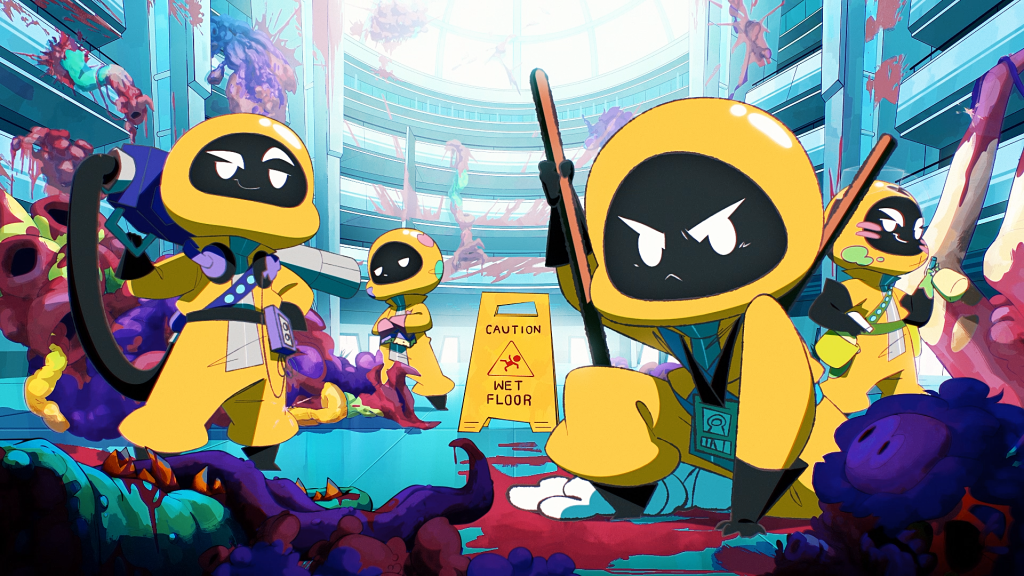
EXCLUSIVE: Misfit janitors in a mysterious research facility are the subject of Doomsweepers, an animated comedy-horror series out of Australia.
Monkie Kid series director Sarah Harper has created the “horror-action-comedy” show with Sydney 2D animation studio Flying Bark onboard as producer. Also attached are Lightfold, Olan Rogers’ comics and animation studio aimed at creators. We can reveal today that L.A. publishing house Gungnir has also boarded the project.
A crowdfunder round held in collaboration with Lightfold has launched to raise further financing. A first-look trailer has dropped on YouTube to support the raise. You can see that above.
Last week, Flying Bark and Lightfold dropped a teaser for the project, but no key details were dropped at the time. We’ve now got word on the fun-looking antics it could provide.
Here’s the Doomsweepers synopsis: “Set in a mysterious research facility, Doomsweepers follows a team of misfit janitors who go from cleaning the staff room one day, to saving the world the next, and in doing so they unravel the facility’s best kept secret.”
Producers say the “candy-coloured art direction brings a unique, vibrant energy to the show that provides a visual point of difference from traditional dark, dystopian, apocalyptic content.”
Flying Bark is a 2D animation specialist based in Australia, with studio locations in Sydney, L.A. and Madrid. Recent productions include Netflix’s Stranger Things: Tales From ’85, Paramount’s Avatar Aang: The Last Airbender and original series Shaun Tan’s Tales from Outer Suburbia.
Lightfold, meanwhile, launched in 2023 to develop animated projects that have a direct connection to fans. Final Space creator Rogers and producer Forrester Kane created the biz, with the former’s crowdfunded animation pilot Godspeed its debut project. It launched on YouTube three years ago and has received more than 2.2 million views.
Gungnir is known primarily as a counter-culture comics publisher, but has struck a series of deals to develop properties as TV shows and films, and vice-versa. In December 2025, it launched Gungnir Animation Studio to become “the Cartoon Network of the digital era.”
Harper – a writer, director and showrunner known for work on Lego’s Monkie Kid franchise and Nickelodeon’s Glitch Techs and Rise of the Teenage Mutant Ninja Turtles – developed the “deeply personal project inspired by unsung heroes.”
She added: “The idea for Doomsweepers was born in 2019, when Australia was battling catastrophic bushfires, only to be hit by a global pandemic soon after. In those moments of uncertainty, I found myself drawn to the stories of everyday people who stepped up when it mattered most.
“The Doomsweepers aren’t your typical heroes: they’re janitors in a tech facility, overlooked and underestimated. But when chaos erupts, they rise to the occasion, proving that courage can come from the most unexpected places.”
Here are a further selection of images.


>

It’s an epic story being told on an epic stage. The critics are having their say on George R. R. Martin’s Game of Thrones: The Mad King, the UK stage adaptation of the hit novels and series.
The sold-out show’s reviews embargo finally lifted after previews began a couple of weeks ago at the Royal Shakespeare Company’s home of Stratford Upon Avon. The ambitious production has drawn a number of strong notices. First look images courtesy of the RSC are below. This after multiple early shows were cancelled, much to fan ire.
Whatsonstage gave the star a glowing five-star review, calling it “a triumph; a soaring, surging spectacle and a latter-day history play, both serious and popular…It is a remarkable achievement, wonderfully directed by [Dominic] Cooke and superbly acted by every member of the 35-strong ensemble. The result is a brilliant exhibition of how theatre can create magic.”
The Guardian gave the show 4/5 stars, calling “an action-packed saga of dry ice and fire…this prequel to the TV series has one joust after another, spectacular stagecraft and plenty of modern resonance.”
Metro also gave the show 4/5 stars, writing: “As a stand-alone piece of theatre, The Mad King scrapes through. But as an extension of the Game of Thrones world, it scores well, shifting the narrative to the stage with suitably theatrical thrust.”
The Independent was also a fan, noting in its 4/5 star review, that the “stellar stage show has all the thrillingly staged battles, gory deaths and, yes, dragons that the most bloodthirsty fan could hope for… there’s also a surprising amount of heart – of the warm, still-beating kind – as it lingers on the faces of its fallen.”
The Daily Mail lauded the show but was one of many to acknowledge the challengingly long running time: “The first half of Cooke’s superbly staged, spectacular production has the feel of a dynamic Bayeux Tapestry: a stunning pageant of medieval stop-motion animation. But after the interval, the plot takes off. Sparks fly romantically and dramatically, which is just as well because, at three hours 45 minutes, it’s almost as long as Hamlet.”
The Telegraph had similar things to say in its largely positive review: “At almost four hours, it’s a long evening, sometimes too dense with detail, and it lacks the grit and gore (not to mention the nudity) of the TV series…Still, it capably serves newbies and devotees, and speaks in a timely fashion to our age of unruly leaders…It’s not up there, yet, with the Harry Potter or Stranger Things prequels but, on balance, the Game of Thrones franchise has yet another worthwhile and lucrative spin-off on its hands.”
The Times was one of the few dissenting voices, claiming that while the play “gives hardcore GoT fans a chance to go hunting for ‘Easter eggs’, it seldom comes close to matching the grim aura of the TV series…Duncan Macmillan’s script is sorely lacking in poetry. Events plod forward, one after the other, and although Michael Shaeffer is a thoroughly compelling presence as the cruel and chronically unstable monarch Aerys, other performances seem nuance-free. Too many lines are simply shouted. You expect better of the RSC.”
Game of Thrones creator Martin is said to have been heavily involved in the play, having a representative in rehearsals at all times, and he attended the opening night in Stratford on Saturday.
The Mad King is a stage prequel that, according to its official synopsis, is set in Harrenhal as a long winter begins to thaw. “At a lavish banquet on the eve of a jousting tournament,” the synopsis reads, “lovers meet and revelers speculate about who will contend. But in the shadows, amid growing unease at the bloodthirsty actions of the realm’s merciless Mad King, dissenters from his inner circle anxiously advance a treasonous plot. Far away, the drums of battle sound. Family bonds, ancient prophecies, and the sacred line of succession will be tested in a dangerous campaign for power. Who will survive? Who will rise?”
The play is inspired by the “Robert’s Rebellion” lore of Martin’s sprawling book series, in which the married Prince Rhaegar Targaryen, son of the Mad King Aerys, falls in love with, and runs off with, Lyanna Stark. This leads to a rebellion led by Robert Baratheon, who is engaged to Lyanna. Successfully deposing the Mad King, The Rebellion leads to the downfall of House Targaryen.


>
Promise AI Developing Horror Feature ‘Touch Grass’ With ‘Backrooms’ EP Chris White Producing

Chiyo from The Elder Sister-Like One has been turned into a 1/6-scale figure! Pre-orders begin on Friday, July 17th!

Pietra Tordin is silly and serious, scoring a hat trick for Portland: ‘A true professional’
-

 movies3 months ago
Search For Canadian TV Actor Stewart McLean Now Homicide Investigation
-

 Fashion9 years ago
These ’90s fashion trends are making a comeback in 2017
-
Fashion9 years ago
According to Dior Couture, this taboo fashion accessory is back
-
Fashion9 years ago
Model Jocelyn Chew’s Instagram is the best vacation you’ve ever had
-
Fashion9 years ago
Your comprehensive guide to this fall’s biggest trends
-
Fashion9 years ago
9 Celebrities who have spoken out about being photoshopped
-
Fashion9 years ago
Emily Ratajkowski channels back-to-school style
-
Fashion9 years ago
A photo diary of the nightlife scene from LA To Ibiza