
Entertainment
Parallel Tales Review: Asghar Farhadi’s New Movie Is Voyeuristic


Director Asghar Farhadi’s “Parallel Tales (Histoires Parallèles)” features plenty of rear window spying and voyeuristic uses of audio equipment, but despite easy comparisons to the works of Hitchcock, Coppola, and De Palma, the Iranian director has crafted a treatise uniquely his own about the messy entanglement of unspoken fantasy and embodied life.
It’s a story about people who speculate about the lives of the people around them and, by feeding those conceits back into the world in the form of the written word and sound, are able to alter the course of reality itself. But despite being impressively acted and thematically compelling, it avoids wholehearted recommendation due to its uneven repetition of sequences and ideas that make this feel more lugubrious than cohesive.
The catalyst (critically, not the origin) of the relational, psychological and sexual mischief that follows is thanks to Isabelle Huppert’s recluse writer character, Sylvie. Huppert plays Sylvie with the curmudgeonly charm we’d come to expect of this archetype (in one sequence in the absence of a working lighter, she uses the toaster to ignite her cigarette) and it’s evident that while her house may be in disarray, much to the chagrin of her niece, Laurence (India Hair), it’s in service of her imagination, which is sharp and teeming.
As part of her ritual, she spies on the trio of sound engineers across from her house — Nita (Virginie Efira), Théo (Pierre Niney), and Nicolas (Vincent Cassel) — and develops her latest story about their dynamic. She imagines that Nita (named Anna in her story) and Théo (named Christophe) are in a relationship, but that Nita and Nicolas (named Pierre) begin to have an affair, threatening not only their professional but also their personal lives as a vengeful and unstable Christophe plans his revenge.
At her niece’s insistence, Sylvie accepts help around the house from Adam (Adam Bessa), whom Laurence encountered by chance when he stopped a pickpocket from stealing her wallet. As Adam helps clean the clutter, he develops a kinship with Sylvie and finds himself enthralled by the story she has written about their neighbors. Taking up her telescope for himself, he too begins to spy on the trio and becomes obsessed with finding out whether there might be any truth to Sylvie’s speculation about their interactions or if it is all truly just fantasy.
Of course, at least at the start, the truth is much less interesting than fiction: Théo and Nicolas are brothers, Nita is not a prurient muse but a worn-down worker who barely has time to eat lunch during intense work days, and the most she’s allowed to exert her autonomy is through her journal entries. Still, there’s a tantalizing power to projection, and as Adam pushes himself further into their orbit, it becomes clear that there may be more truth to Sylvie’s stories than was on the surface.
Given the film’s protracted runtime and that Farhadi indulges in repeating certain beats to underscore the synergy with earlier scenes, it can feel tedious to go through since we know which characters hold secrets, and the film takes its time to bridge that gap.
Most of the performers assembled have the opportunity to play more than one character due to Farhadi’s crosscutting of the action, which shows what’s going on in the real world with reenactments of Sylvie’s words. Farhadi trusts the ensemble he’s crafted, and that faith is felt most in the moments where the perspective switches to a handheld camera and he documents his actors’ natural reactions to exposed secrets and hidden revelations. Each performer holds pregnant silence strikingly, showcasing how hurt and shame aren’t interior emotions but feelings that brand themselves in the flicker of our eyes or the wrinkles on our brow.
Farhadi also makes interesting parallels between the vocation of the sound engineer and the power of the writer. As we witness the trio work, from Nita crunching and stroking celery to mimic the sounds of these animals eating to Théo slapping a bowl of water whenever the animals on screen stomp through a puddle, they’re creating sounds and passing them off as other audio. They make associations and connections between things that have nothing to do with each other, not unlike the imaginative work of writers.
In many ways, Farhadi is dealing with himself as a creative, and what it means to steward the lives of those we know, those we meet in passing and also those whom we may never see. From writers who take anecdotes and spin them into novels to sound engineers who take one sound and overlay it on another, these characters are all adults playing telephone. The result isn’t just a wrong sentence but a changed life.
While there’s an intoxicating draw in filling new details into the contours of people we barely know, Farhadi seems to understand that this needs to be done responsibly. As Nita, Théo, and Nicolas’ lives begin to more and more resemble what Sylvie has written, it’s an apt reminder: art imitates life, but how we live our one precious and wild lives is often inspired by art. We ought to be mindful of the stories and sounds we put out into the world.
>

EXCLUSIVE: DreamLab Films has boarded sales on satirical Iranian picture Head to Head (Sar beh Sar) about a film production in which the male cast members are subjected to the strict dress rules applied to women in Iran, ahead of its world premiere at TIFF.
Blending dark comedy with sharp social observation, the Iran-Germany co-production marks Ghasideh Golmakani’s first feature after a string of internationally screened short films exploring gender, power and social taboos in Iran.
Set in contemporary Iran, Head to Head follows an acclaimed female writer-director who makes the radical choice to require men to wear skirts and headscarves for her latest film. As the men struggle with heat, restrictions, and wounded pride, tension swells and Bahar’s hopes for success are met with growing resistance.
The film stars Mehrnoosh Satari, Saeed Naderi, Ebrahim Azizi (It Was Just an Accident), Amir Hajimohammadi, Elaheh Farazmand and Lili Farhadpour (My Favorite Cake).
Golmakani also wrote and produced the feature, with David M. Lorenz serving as associate producer and Saba M. Rezaei as executive producer. Cinematography is by Amin Jafari, sound design by Alireza Alavian, production design by Melody Esmaeili and original music by Yoones Eskandari.
The director, who holds a PhD from the Sorbonne on Iranian women filmmakers before and after the Revolution, said the film grew out of years of reflecting on the place of women in Iranian cinema.
“Head to Head is rooted in years of observing the challenges women face in Iranian cinema. It is not only a reflection on the situation experienced by women, but also an invitation to male colleagues to reflect on what women have had and still have to endure in order to continue existing on the cinema screen,” she said
Paris-based DreamLab Films is handling worldwide sales and festival strategy.
>
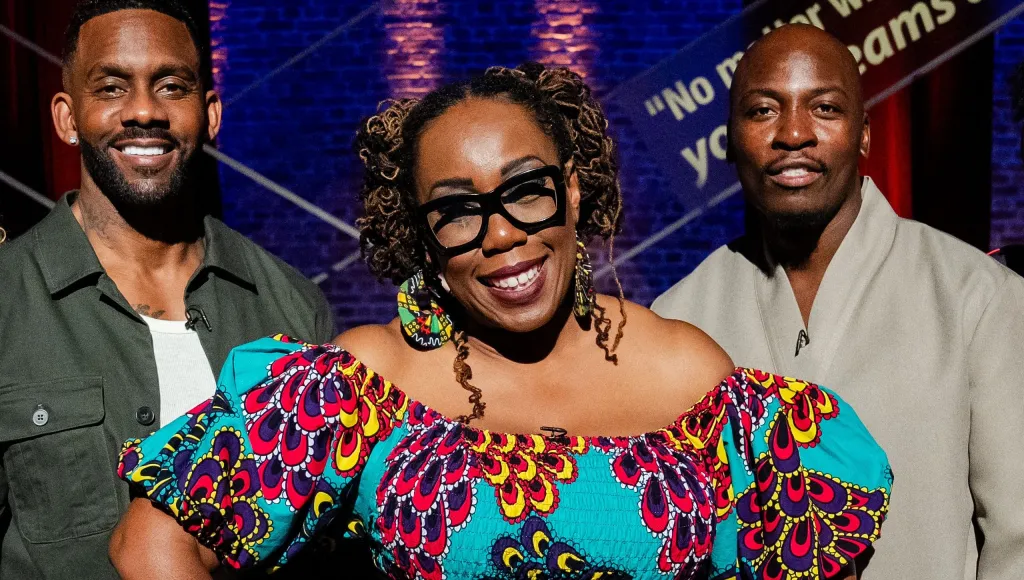
EXCLUSIVE: Sorry, I Didn’t Know is again extending its record-breaking run on ITV, and this time it appears to have set another high bar.
The British comedy panel show has been renewed for a seventh season, a decade after UK commercial network ITV first commissioned it from TriForce Productions. The re-order extends Sorry, I Didn’t Know‘s record as the longest-running show from a Black-led production company.
Reps for the show say today’s news means it has now also broken the record for the longest-running Black TV show in British history, passing classic Channel 4 sitcom Desmond’s, which ran for six seasons between 1989 and 1994, and BBC Two’s The Real McCoy, which ran on BBC Two between 1991 and 1996 for five seasons and a special ‘Best of’ clip series. Verifying such records is complicated, but both ITV and TriForce are certain it is the case.
Host Chizzy Akudolu will return for Season 7, which will hit screens later this year on ITV1 and streamer ITV. Team captains Richard Blackwood and Eddie Kadi will also return. The show sees Blackwood, Kadi and guests compete in a quiz on Black history. Akudolu was initially a team captain, but replaced Jimmy Akingbola as host for the sixth season.
Filming is taking place this summer in front of a live studio audience in London. Previous guest talent includes Adjoa Andoh, Susan Wokoma, Munya Chawawa, Stephen K Amos, Marcus Brigstocke, Angellica Bell, Richie Anderson, Oti Mabuse, Jordan Stephens, JB Gill, Babatunde Aléshé, Colin Jackson, Seann Walshe and Jamelia. No word on talent for Season 7 just yet.
“We’re so excited Chizzy is taking her place again as queen of the show,” said Fraser Ayers, exec producer for TriForce. “At 10 years and the seventh season, it’s an incredibly special one, and having been in every episode since the pilot in 2016 she’s the perfect host to shepherd us into this next chapter.
“With lots of surprises planned for this series, it’s going to be a special one. We thank ITV for the support they give us to keep making this ground-breaking show, as it seems like a little bit of knowledge, and a lot of laughs, is needed now more than ever.”
The Season 7 order came from ITV’s Director of Entertainment & Daytime Commissioning, Katie Rawcliffe and Entertainment Commissioner Gemma John-Lewis. Ayres, Minnie Ayres and Akingbola exec produce for TriForce. The series editor is Delia Williams.
>

TIFF on Monday unveiled its selection for its first-ever international financing and project market.
Among the highlights is an animated feature with an all-star voice cast, including Keke Palmer, Alan Cumming, Common, and Regina Hall attached; a collaboration between acclaimed Indian-Canadian director Deepa Mehta (Fire, Earth, Water) and Oscar-winning actor Jeremy Irons; and a drama headlined by Oscar-winner Marlee Matlin (CODA, Children of a Lesser God) and Jacob Tremblay (Room, Wonder).
The lineup also boasts a new documentary featuring Booker Prize winner Marlon James (Underground Railroad) and a host of projects from Toronto Film Fest alums, including filmmakers Elle-Máijá Tailfeathers, Shasha Nakhai, Karen Chapman, Darlene Naponse, and Tyler Hagan.
The 51 projects — 40 features, six series, and five innovative or immersive works — all looking for production and financing partners, will be presented at the inaugural TIFF industry market.
“The projects, the award-winning talent, and the enthusiasm amongst key decision makers all reflect the emphasis we’ve placed on closing the loop between the ideas and the investments that fuel our global industry,” said the head of the TIFF market, Charles Tremblay. “When projects find the right champions, opportunities become reality and exceptional stories continue to be developed, financed, produced, and shared with audiences across the globe.”
The projects represent a cross-section of genres, from dramas and documentaries to animation, with a global reach, featuring producers from Canada to Australia, Brazil to India, the U.S. to Zimbabwe.
After years of informal dealmaking in Toronto, TIFF will launch its first fully fledged content market at next month’s event. TIFF: The Market runs alongside the festival from Sept. 10-16.
>

Insights from Twins’ trade deadline: Ability to add payroll a game changer

DreamLab Films Boards Satirical Iranian TIFF Title ‘Head to Head’

Rangers chair Andrew Cavenagh expects up to five more signings
-

 movies3 months ago
Search For Canadian TV Actor Stewart McLean Now Homicide Investigation
-

 Fashion9 years ago
These ’90s fashion trends are making a comeback in 2017
-
Fashion9 years ago
According to Dior Couture, this taboo fashion accessory is back
-
Fashion9 years ago
Model Jocelyn Chew’s Instagram is the best vacation you’ve ever had
-
Fashion9 years ago
Your comprehensive guide to this fall’s biggest trends
-
Fashion9 years ago
9 Celebrities who have spoken out about being photoshopped
-
Fashion9 years ago
Emily Ratajkowski channels back-to-school style
-
Fashion9 years ago
A photo diary of the nightlife scene from LA To Ibiza