
(L-R) Journalist Zoë Schiffer, who appears in the ‘Musk’ documentary, director Alex Gibney, and Ashley St. Clair, Musk’s former romantic partner, at the Venice premiere of ‘Musk’ on September 8, 2026.
Andreas Rentz/Getty Images


Ron Howard will always be best known for narrative films like “Apollo 13,” “A Beautiful Mind,” “Cocoon” and “Frost/Nixon,” but in the past decade he’s turned more and more to a string of valuable documentaries, from the music docs “The Beatles: Eight Days a Week” and “Pavarotti” to “Rebuilding Paradise,” We Feed People” and “Jim Henson Idea Man.” In fact, the seven nonfiction films he’s made since 2016 outnumber his six narrative features, which include the yet-to-be-released “Alone at Dawn.”
Howard’s docs always give you the sense that he made them because he’s passionate about the subject (the Beatles, Pavarotti, Jose Andres, Jim Henson) or fascinated by the subject matter (“Rebuilding Paradise”). And they make up an exemplary body of work; Howard may not be looking to break new ground in nonfiction filmmaking, but he tells you what you want to know, supplies insights and knows how to deliver a good story.
You can say all of that about “Avedon,” Howard’s film about photographer Richard Avedon that premiered on Sunday at the Cannes Film Festival. In fact, Avedon seems to be a subject who appealed to Howard because the filmmaker is passionate about his work and because he’s fascinated by how he did it.

In fact, the how and why takes up much of the opening stretch of the film, when a doc would normally be delivering a capsule summary of what its subject accomplished. Howard focuses this part of the film on Avedon’s approach, his themes and his obsessions, and only incidentally his life. In some ways, this feels like a straightforward doc – talking heads, behind-the-scenes footage, interviews with the subject – but it’s a biographical film that’s organized around artistry rather than biography.
The artistry, though, is plenty wide-ranging enough to make that work. “I follow no rules,” Avedon says early in the film, later adding, “I’m instinctual…. But I can see like a son of a bitch.”
And so he could. In an estimated 16,000 photo shoots from his beginnings as a fashion photographer post-World War II to his death while on a shoot in New Mexico in 2004, Avedon made a plain white background, harsh light and close-up framing iconic, whether he was shooting fashion models, stars, politicians or construction workers. “It’s almost like I’m writing my own autobiography with the people I photograph,” he says in the film.
Of course, Howard couldn’t do his own interviews with Avedon, who died more than two decades ago, but he makes liberal use of past interviews to create a first-person audio narration. (For the most part, the sources of those interviews are not identified in the body of “Avedon.”) The story is filled out by recent interviews with Isabella Rossellini, Lauren Hutton, writer Adam Gopnik, New Yorker editor Tina Brown, who made him that magazine’s first-ever staff photographer, and others.

In a way, Avedon’s story runs from the deliberate illusion of fashion photography to the uncomfortable reality of his portraits of Vietnam generals, iconic political figures like Ronald and Nancy Reagan (who was livid that he didn’t retouch her hands in a famous portrait) and the regular people he found in a landmark chronicle of the American West.
The fashion work was stylized and dazzling, but in many ways Avedon found his voice (or his gaze) in the starker photos in which he eschewed beautiful lighting and wanted “the existential white…where the only thing you see is the architecture of the face.”
The film slowly eases into more traditional biographical approach once it gets past the opening half hour, but it remains one of two Cannes docs that are powered largely by their subjects’ thoughts about artistry, fame and creativity, the other being Steven Soderbergh’s “John Lennon: The Last Interview.”
At times Avedon was deeply troubled, haunted by the mental illness and early death of his sister, whom he felt was overburdened by the expectations that came from her great beauty. And when a New York Times review said one of his first major non-fashion shows was a case of photographing poor people for the perusal of an affluent audience, he was so shaken that it took him a year to go back to work. The film also gets into his conflicted relationship with his father, with whom he didn’t really reconcile until the last years of his father’s life. (Curiously, it sidesteps much of Avedon’s personal life, mentioning his two marriages but never addressing the constantly rumors of his bisexuality.)

Above all, “Avedon” is about the images its subject created, which are spectacular, at times revealing and at other times damning. And that means that the movie is wall-to-wall photography, though Howard is skilled at filling in the stories around the photos and putting what we see in the context of a life and in the context of the second half of the 20th century. It’s enlightening and it’s a hell of a lot of fun to look at, which is essentially what you’d want from an Avedon doc.
“What makes him a good photographer is not his technique, it’s the mind behind the camera,” is the last line you hear in the movie, but there are lots of pictures after that. And while Ron Howard probably wouldn’t argue with the old adage that a picture is worth 1,000 words, his movie is aware that sometimes you need the words to explain the pictures and the man who takes them.
>
For the first time in over a month, there’s a new streaming title atop the Samba Weekly Wrap Report Top 10.
“Monster,” the Netflix anthology series that offers fictionalized biographical accounts of famous murderers’ upbringings, hacks its way into the top spot after debuting in second place last week. The current season, “The Lizzie Borden Story,” focuses on the young woman in 1890s Massachusetts who allegedly murdered her parents with an ax. It’s perfect timing for Netflix as viewers start planning their Halloween costumes.
Hanging on to second place this week is “Neagley” on Amazon Prime Video. The show, which follows a private investigator who uncovers a conspiracy, is a spinoff from Amazon’s hit series “Reacher.” Astute Weekly Wrap Report readers will know that “Reacher” held the top spot on our chart for six consecutive weeks before vacating the top spot this week.
But don’t write off “Reacher,” as the detective series sticks around in ninth place despite ending its fourth season the previous week. The entire first season of “Neagley” was added to Amazon’s library on Sept. 16, meaning that both shows’ chart positions are due to sustained viewership, without the aid of new episodes. Clearly, Amazon has found a winning formula in its extended “Reacher” universe.
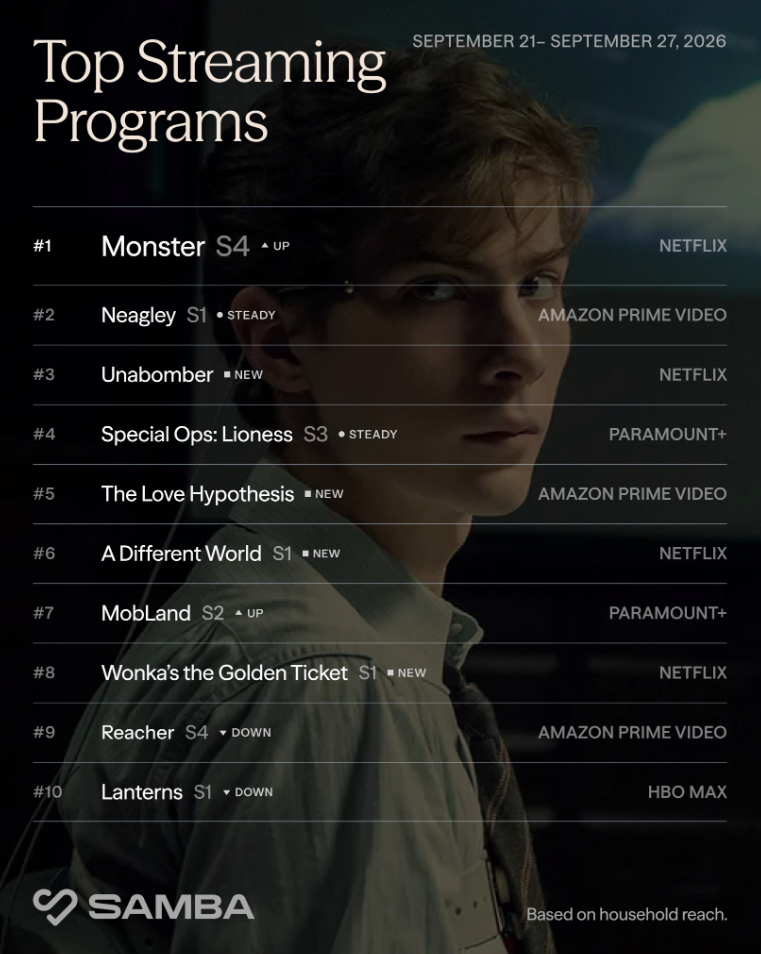
The Wrap Report provides an exclusive first look at the most-watched movies and TV series from the past week across both streaming and linear television, sourced from viewership trends collected from Samba’s panel of more than 3 million households, balanced to the U.S. Census.
Netflix takes third place this week, again with a scripted biographical look at a famous killer. This time it’s “Unabomber,” which tells the story of the terrorist mail bomber Ted Kaczynski. A star cast with Russell Crowe, Jacob Tremblay, Annabelle Wallis and Shailene Woodley likely added to the film’s appeal.
“Special Ops: Lioness” lands in fourth place this week as the spy thriller ended its third season. Despite being one of the biggest Paramount+ hits to date, the show has not yet been renewed for a fourth season.

“The Love Hypothesis,” a new romcom on Amazon, debuts in fifth this week. The film is a modern twist on the Shakespearean “enemies to lovers” premise, set in a university research lab. Interesting fact: the film is an adaptation of a popular romance novel, which itself started out as Star Wars fanfiction.
We have another Netflix chart debut in sixth with “A Different World.” The sitcom is a sequel to the 1980s series of the same name (itself a spinoff of “The Cosby Show”). Similar to the source material, the sequel follows the stories of students arriving at a prestigious HBCU.
In seventh is Paramount+’s “Mobland,” as the star-filled gangster series moves up one slot in its second week on the chart.
“Wonka’s the Golden Ticket,” a reality competition based on the Roald Dahl book and hit films, is in eighth this week. The new Netflix series finds contestants looking to win a huge cash prize by competing in challenges on a set that replicates the famous Wonka chocolate factory, complete with a chocolate river.
Sliding down to 10th this week is “Lanterns.” The HBO Max superhero drama had a strong start near the top of the chart, but hits its lowest point now, following its penultimate episode.
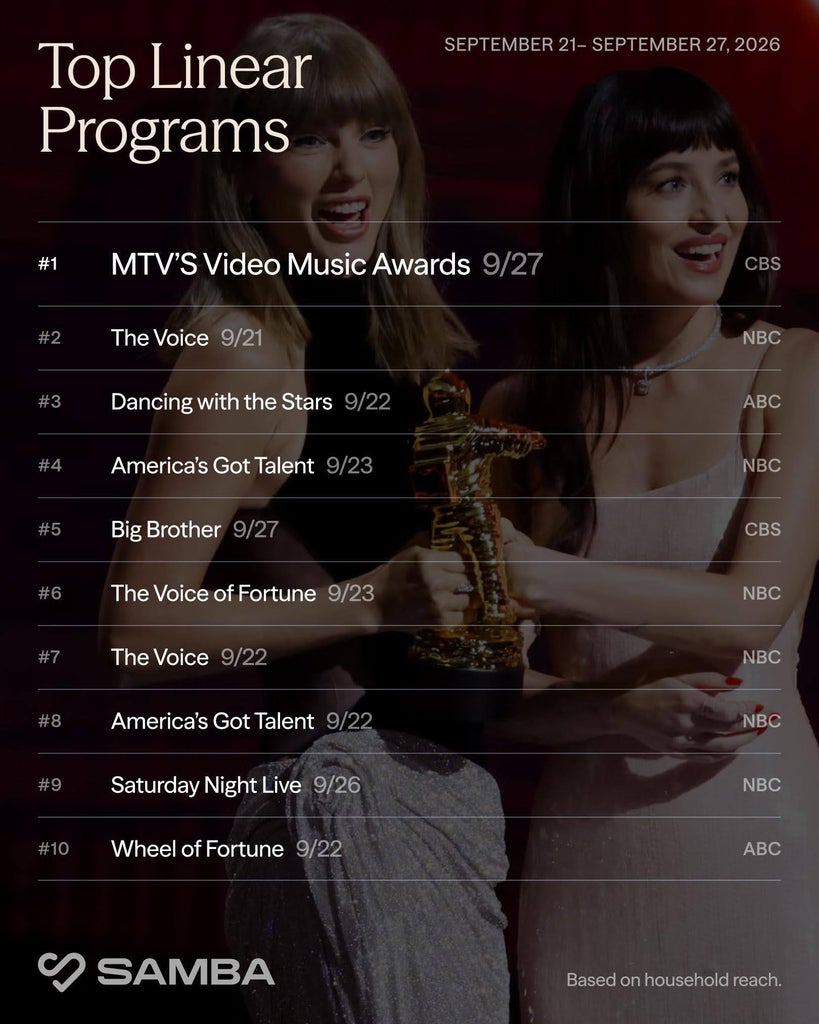
Meanwhile, the megapopular singing competition “The Voice” returned to NBC for its 30th season with three episodes that all make the chart this week, the highest placing second.
That pushes the once-again culturally relevant new season of “Dancing With the Stars” down a spot this week, to third.
All of this action at the top of the chart is unfortunate news for “America’s Got Talent,” which dominated a desolate linear chart throughout the summer. The competition’s 21st season concluded with a two-part finale this week, landing in fourth and eighth place.
The 28th season of “Big Brother” has winnowed down to its final three contestants, putting it in fifth place this week. Meanwhile, “Saturday Night Live” returned for its 52nd season on NBC, hosted by the New York Knicks’ Jalen Brunson.
Finally, it wouldn’t be a linear chart without “Wheel of Fortune.” The classic game show closes us out this week in 10th place.

>

When the world’s richest man threatens to sue you, it’s enough to get your attention.
That’s the situation filmmaker Alex Gibney finds himself in with the imminent release of his documentary Musk, an unflattering portrait of tech mogul and investor Elon Musk.
“He is well funded,” Gibney notes in conversation with Deadline. “Let’s just be honest for a moment and say that with our legal system, money talks in court in a way that it shouldn’t. It’s not like everyone is equal under the law. He’s got a bucketload of money — more money, on paper, than anybody on the planet.”
(L-R) Journalist Zoë Schiffer, who appears in the ‘Musk’ documentary, director Alex Gibney, and Ashley St. Clair, Musk’s former romantic partner, at the Venice premiere of ‘Musk’ on September 8, 2026.
Andreas Rentz/Getty Images
Through his attorney Alex Spiro, Musk raised the prospect of a defamation suit over part of the film relating to the 2024 presidential election. In that sequence, Musk’s former girlfriend, Ashley St. Clair, says Musk told her before election day that he would “unleash an anomaly in the matrix” to ensure his preferred candidate, Donald Trump, came out victorious.
“Is it a concern when braggadocious Alex Spiro fires a broadside and threatens to sue? Yeah, it’s always a concern,” Gibney admits. But he detects an upside.
“The danger of suing, as I discovered long ago when I did a film on Henry Kissinger,” Gibney observes, “is that you open yourself up to discovery.”
Elon Musk with a Tesla.
Courtesy of Gregg Segal
The discovery process would allow Gibney and his own legal team to dig into many of the darkest areas in the documentary – for instance, whether Musk exaggerated the autopilot capacity of Tesla vehicles, with fatal consequences. The film alleges Tesla hid data stored on a Tesla S model that ran through a T-intersection in Florida in 2019, killing a 22-year-old woman and it cites other examples where Teslas being driven on autopilot were involved in deadly accidents. And here’s another area ripe for exploration: how did Musk leverage the opportunity to run DOGE at the start of the second Trump administration?
“One of the things I’d want to pursue in discovery is… what about the data obtained from DOGE? — or should I say, did he obtain, did they take [data]? We know that the DOGE boys had access to all of our data,” Gibney comments. “So, the question is, is that data sitting on hard drives at SpaceX and what are they doing with it now? So, there’d be a lot of fun questions to ask in discovery.”
Pres. Trump and Elon Musk in the Oval Office on May 30, 2025.
Getty Images
For the record, Gibney says the threat from Musk’s attorney to sue him is based on a faulty premise.
“What was interesting about that threat is that they cooked up something that we said when we didn’t say it. All we did was to show [Musk’s] texts to Ashley. He was the one who started talking about ‘lasers in space.’ He was the one who said there’s an ‘anomaly in the matrix,’” Gibney insists. “The film doesn’t say he did this to manipulate the election. The film shows that he was texting to his lover, suggesting to her that he manipulated the election. So, was he lying to her? Was he telling the truth? We don’t know. That’s why you put it in the movie and it’s up to the viewer to find out.”
We spoke with Gibney at the Camden International Film Festival in Maine, where he took the Musk documentary after its North American premiere at the Toronto Film Festival and world premiere in Venice. Bleecker Street opens the documentary theatrically in New York and Los Angeles on October 9 before expanding nationwide.
Shortly after the Venice premiere, Musk used his X/Twitter platform to attack the filmmaker, calling him a “horrible human” with “zero integrity,” adding for good measure that he’s a “bitter old man who lost the plot long ago.” But in the war of words, Gibney gives as good as he gets.
“He’s a bullshitter,” Gibney tells me over coffee, sitting in sunshine near the harbor in Rockland, ME. He says Musk has serially inflated his role at Tesla and SpaceX.
“He didn’t invent Tesla, he didn’t invent the technology, didn’t invent the business plan. He invented a mission and he invested. I mean, he was willing to roll in and invest all his money. Good for him. But it was the mission that attracted all of these talented engineers,” Gibney asserts. “It’s not like he sat there in a room and said, ‘The wheelbase will be this.’ He’s an investor and that’s his genius, is pumping the stock. But all these people say, ‘Elon this and Elon that.’ Elon didn’t launch every rocket [at SpaceX]. Once again, there’s a mission at that company that attracts a tremendous number of talented engineers… He’s the front man with the story that he’s responsible for everything.”
When I suggest Musk isn’t “under the hood with a wrench,” Gibney replies. “He’s not… He’s not working the rivet gun. It’s not like, ‘Oh, he worked the wrench on car number 759 and that really saved the operation.’ No… Honestly, he’s a storyteller. And in that sense, he sort of follows in the footsteps of [Steve] Jobs, but Jobs, unlike Musk, was really dedicated to making [Apple] products better. And I think the products at Tesla and SpaceX succeed despite him, not because of him.”
Elizabeth Holmes in ‘You Can See Everything.’
A24 /Courtesy Everett Collection
Our conversation at the Camden festival turned to another billionaire – well, former billionaire: Elizabeth Holmes. Gibney examined the rise and fall of the Theranos founder in his 2019 documentary The Inventor: Out for Blood in Silicon Valley. A week after Musk hits theaters, a new documentary about Holmes opens theatrically – You Can See Everything, directed by Nathan Fielder and Lance Oppenheim. That film created a sensation when it premiered as a super-secret screening at the Telluride Film Festival on September 5.
“I saw the teaser-trailer that dropped, and that’s the Holmes that I recognize from The Inventor,” Gibney notes. “It’s like there’s some figures that just generate a tremendous amount of interest and there are a bunch of different stories on it. Good. I feel like we did our thing and now Oppenheim and Fielder can do their thing… I’m going to watch it because she didn’t talk to us, right? I had to rely on her talking to [filmmaker] Errol Morris, all that material that I got, because it was all owned by Theranos. But I have a pretty good sense of who she is, and our producer talked to her.”
Holmes and her romantic partner and baby daddy Billy Evans granted full access to directors Fielder and Oppenheim in the weeks before she reported to federal prison to begin serving an 11-year sentence following her conviction for defrauding Theranos investors. It was a “nothing’s off the table” kind of offer – hence the film’s title, You Can See Everything. The couple’s goal seems to have been to publicize their intention to revive Theranos, the Silicon Valley startup built on the promise that it would revolutionize the lucrative blood testing industry through new technology.
“I’m excited to see it,” Gibney says. “It’s about a curious person who seems to be determined to perpetuate her fantasy no matter what the odds. And in that, I suppose, she shares certain characteristics with Elon Musk, but Musk has been much more effective at selling his dream. ‘Let me sell you a dream.’”
As far as Musk goes, Gibney says, “If I’m to be impressed by something he did, he’s kept a lot of this kind of Oz-like fiction about himself for a long time. And people still buy it. People go on Squawk Box all the time and say, ‘Oh yeah, his thing is going to be worth $125 trillion. Better buy.’”
Gibney, for one, isn’t buying it.
>

>


Search For Canadian TV Actor Stewart McLean Now Homicide Investigation


These ’90s fashion trends are making a comeback in 2017
According to Dior Couture, this taboo fashion accessory is back
Model Jocelyn Chew’s Instagram is the best vacation you’ve ever had
Emily Ratajkowski channels back-to-school style
9 Celebrities who have spoken out about being photoshopped


Rurouni Kenshin: Hokkaido Arc Manga Takes 1-Issue Break – News


HIDIVE to Stream English Dubs for The World Is Dancing, The Forsaken Saintess and Her Foodie Roadtrip in Another World, The Dangers in My Heart: The Movie Anime – News