
Callum Turner and Monica Barbaro at the One Night Only premiere on Monday.
Roy Rochlin/Getty Images for Universal Pictures



Korean filmmaker Yeon Sang-ho has been busy over the past few years. In addition to directing zombie thriller Colony – which premiered in Midnight Screenings here in Cannes – he directed two other movies last year, The Ugly and Revelations, and was a showrunner on a Japanese series that will soon drop on Netflix.
Colony, which Korean studio Showbox has already sold to more than 124 territories, is part of a long-overdue return to Cannes official selection for Korean cinema – along with Na Hong-jin’s Hope in competition and July Jung’s Dora in Directors Fortnight.
The film stars Gianna Jun (Kingdom: Ashin Of The North) as a professor attending a biotech conference when a viral outbreak starts transforming the attendees into Yeon’s trademark fast-moving zombies. However, in a departure from Yeon’s previous films, the infected can share information, operating with a hive mind that enables them to collectively track down fresh victims, rather than shuffling around aimlessly. Go Soo (The Fortress), Ji Chang-wook (Revolver), Kim Shin-rock (Hellbound) and Koo Kyo-hwan (Parasyte: The Grey) also head the ensemble cast.
Although Yeon started his career working in animation, he says he used minimal CGI to create his new generation zombies, instead relying on physical movements and special effects. “I have nothing against CGI and used it heavily in Hellbound and Parasyte: The Grey, but for this movie I only wanted to use it at the end to create the greatest number of zombies,” says Yeon, sitting down with Deadline in Cannes. “For most of the movie, we relied on choreographers, dancers, a stunt team and of course also the actors. We had some of the best contemporary dancers in Korea working on the film.”
By the same token, Yeon says he also didn’t use any AI technology while making the film, although he’s open to seeing what it can do in the future. He also feels that the story of Colony indirectly touches on this (currently contentious) topic because the idea of a collective hive mind is one of the biggest fears that humans have about AI.
“I was wondering what the greatest fear of our time is, and I think it’s the extreme high-speed exchange of communication, because technology is now connecting all of our thoughts and AI is only going to accelerate that process,” says Yeon. “If we try to define AI, it’s a kind of sum or universality of thought, and it’s developing very rapidly, but to the detriment of the originality or individuality of people.”
He also feels that AI is making us, once again, question what art is; recalling his experiences as a Fine Arts student, when Marcel Duchamp’s The Fountain (an artwork consisting of a porcelain urinal) sparked a debate over whether a readymade object can be classed as art.
“The world of cinema is very concerned with this question now. AI is generating new images, but the sum of these images is universal, and what defines art is originality, something that is personal to the artist or the individual, not universality. But at the same time, the big debate in fine arts over The Fountain ended up enriching the industry of art, so I think we’re at a similar crossroads now.”
Not surprisingly in such a high-tech nation, South Korea’s film industry has already started embracing AI filmmaking – CJ ENM recently released AI-human hybrid feature The House in cinemas – but ironically it’s been good old-fashioned human movies that have recently revived Korean cinema at the local box office following a prolonged slump, not technical wizardry. Showbox, the studio behind Colony, recently had a massive box office hit with historical drama The King’s Warden, which has pulled in $108M to become the highest-grossing Korean film of all time.
Yeon has famously worked across both theatrical and streaming content. His earlier zombie films – Train To Busan and Peninsula – were big hits in Korea and across the region. But he also directed the movie Revelations for Netflix, along with series Hellbound and Parasyte: The Grey, the latter an adaptation of a popular Japanese horror manga.
“A lot of people said Korean cinema was going through a crisis, but I never thought of it that way, I just thought it was going through a transformation,” says Yeon, who last year also directed mystery thriller The Ugly, which was released in cinemas partly as an experiment to see if low-budget filmmaking was a solution for Korean cinema.
“Streaming grew very quickly in Korea, especially during Covid, and then we had a situation where young people were watching short clips and had a hard time enjoying long-form content.
“But now we have the phenomenon where young people have started going back to the movie theatres,” Yeon continues. “Another interesting trend is the rise in popularity of GVs [guest visits]; in-person question and answer sessions with the director and other talents after the movie has screened. It started at film festivals, but we’re now seeing a lot of this during a film’s theatrical release – audiences are demanding a lot of GVs.”
Of course, Colony will have no problem reaching theatres. Following its Cannes premiere, the film will receive its North American premiere as the opening film of New York Asian Film Festival, ahead of a North American theatrical release. But Yeon says he’s also interested in working with international collaborators to make content that can travel, either theatrically or on streaming platforms.
Wow Point, the Seoul-based production company that Yeon founded with producer Yoomin Hailey Yang, is developing a slate of projects with international partners, some of which he will direct, while on others he will serve as producer or writer. These include sci-fi crime thriller Human Vapor, based on a 1960 tokusatsu, directed by Shinzo Katayama and written and executive produced by Yeon. A co-production between Wow Point and Japan’s Toho Studios, the series will stream on Netflix from July 2.
“With Human Vapor, I was really attracted by the theme and the setting in Japan,” says Yeon. “We talked a lot with the Japanese director and producer and about the differences in the ways that Japanese and Korean audiences receive information. It was a refreshing experience and I’m really looking forward to working on more projects like this.”
He says that Alfonso Cuaron, who works between Mexico and Hollywood, had a similar experience when he came on board Revelations as an executive producer: “He said it was interesting to learn about the cultural differences. It’s a story set in Korea but his viewpoint is very much reflected in the movie. So I think its always an enriching experience to work with foreign artists.”
As for other foreign filmmakers Yeon would like to work with – he drops one name that will have genre fans drooling: “Indonesia’s Joko Anwar is one director that I would love to work with one day.”
Colony is produced by Wow Point, Smilegate, Midnight Studio and Showbox, which is handling international sales. The film plays at NYAFF along with a 4K restoration of Train To Busan, both of which are being released theatrically by WellGo USA following the festival. Train To Busan will open August 14, followed by Colony on August 28.
>

Ever since the official trailer dropped for the Callum Turner–Monica Barbaro rom-com One Night Only, quickly racking up millions of views on its way to its nearly 40 million total, internet commentators have had a lot of questions about the film’s central premise in which premarital sex is illegal apart from one 12-hour period a year.
How is this law enforced? Are people breaking the law? How did this legislation pass? What counts as “sex” under this new mandate? Are marriage (and divorce) rates skyrocketing? What about affairs?
Rest assured: Some of those questions are answered in the movie, and explanations are starting to trickle out online for those unconcerned about spoilers. Beyond that, One Night Only writer, Travis Braun, who saw his screenplay top the 2024 Black List, has answers, but they’re not all in the Will Gluck-directed Universal movie now in theaters.
“I set out to write a movie about the circus that is modern dating, and I thought how fun if we could set that all in one night, and I have answers to those questions, and some of them are in the movie,” Braun told The Hollywood Reporter at the One Night Only premiere earlier this week in New York.
Braun said he definitely thought about the specific rules of the film’s alternate reality, framed as three years on from the no-sex act being passed, but didn’t want to get too deep into the politics of the world of the movie.
“There’s a big mythology that I’ve built out and then as you develop a movie you start to pare down and you go: What does an audience really care about, and what are they showing up to see? For me the answer is always a love story, romance,” he told THR. “I hope they can come in and we’ll show them how this world functions, and then they can just enjoy the movie and have fun. The whole focus of this was love story and romance first, and the world-building obviously has to make sense and has to be there, but ultimately we weren’t interested in getting into the politics of it. We wanted to tell a story about these two incredible people trying to find love on this crazy night.”
Producer Jacqueline Monetta, who brought Braun’s script to Gluck, said they didn’t want moviegoers to have all of the answers.
“I had a million questions. I was like, ‘What does this mean? What does this world look like? How do people communicate? What’s different?’ And that’s I think what’s so smart about it,” she said of One Night Only‘s “big idea, high-concept” premise. “We don’t answer every question in the movie, purposefully, because we want those questions to be had on the car ride home. We want people to keep talking about it and really think about what would this mean for our world, what does it mean for our world now. But I think Will and I were really specific on what questions we wanted to answer.”
In a recent Reddit AMA, Gluck also detailed how he and his team approached the world building of the movie while not wanting it to be all about the mandate and offered prospective moviegoers hints for where to find the answers to their questions.
“We spent a lot of time talking about the rules of the world, and if you’ve seen the movie, or when you see the movie, you’ll see that the rules of the world and the world building are all in the background,” he said. “It’s on TVs, signage, in thrown-away lines, because we didn’t want to give the world short shrift, but we didn’t want the movie to be about that. It’s another way I want people to see this. If they see it more than once, they’ll pick up so many more rules of the world in the background. A lot of the questions that I’ve been getting after people have seen the movie are actually answered in the movie, which is by design because I want people maybe not to know them. So, yes, it was a tricky tightrope to have them there, but not for the movie to be about it.”
Turner meanwhile echoes Braun’s advice for curious prospective moviegoers: “Go see the film!”
“You’ll realize pretty quickly what the realm is that you’re working within and it’s a comedy,” Turner says of what inquisitive filmgoers will find. “There are no great political undertones, I don’t think. This is just a place where you can escape for an hour and a half, two hours and enjoy and laugh your head off.”
One Night Only is now in theaters.
Callum Turner and Monica Barbaro at the One Night Only premiere on Monday.
Roy Rochlin/Getty Images for Universal Pictures
>

Although the live-action remake of Moana hasn’t quite been able to catch a wave at the box office, Dwayne Johnson is proud of what they made.
The Golden Globe nominee said the Disney movie’s negative reviews, which currently sit at 32% on Rotten Tomatoes, are “just the way it goes” in the entertainment industry, and what “really mattered” was that “the culture really stood up” in the Polynesian-inspired tale.
“Our first two reviews came out. I’ll never forget it… They were amazing. I was like, wow,” he told People, noting the reviews then “went another way, as sometimes happens.”
“That’s just the way it goes because we’re in this business,” added Johnson.
A decade after he voiced the demigod Maui in Disney’s animated film Moana, Johnson reprised the role in the Thomas Kail-helmed live-action adaptation.

“The challenge was, okay, let’s remember, though, what’s going to be beyond this opening weekend. Let’s remember what’s happening right now and the noise that’s happening right now,” said Johnson. “If you love it, great. If you don’t, no problem.”
Following Moana‘s July 10 premiere, the movie has gone on to make $266M at the global box office. Disney CEO Josh D’Amaro addressed the low turnout in a letter to shareholders.
“Even when our franchise films don’t meet our box office expectations, as with The Mandalorian and Grogu and the live-action Moana, our investments in these core properties fuel other parts of our company,” said D’Amaro, noting that Moana is “expected to be a strong title on Disney+, building on the success of the original film, which is one of the most streamed movies of all time.”
>
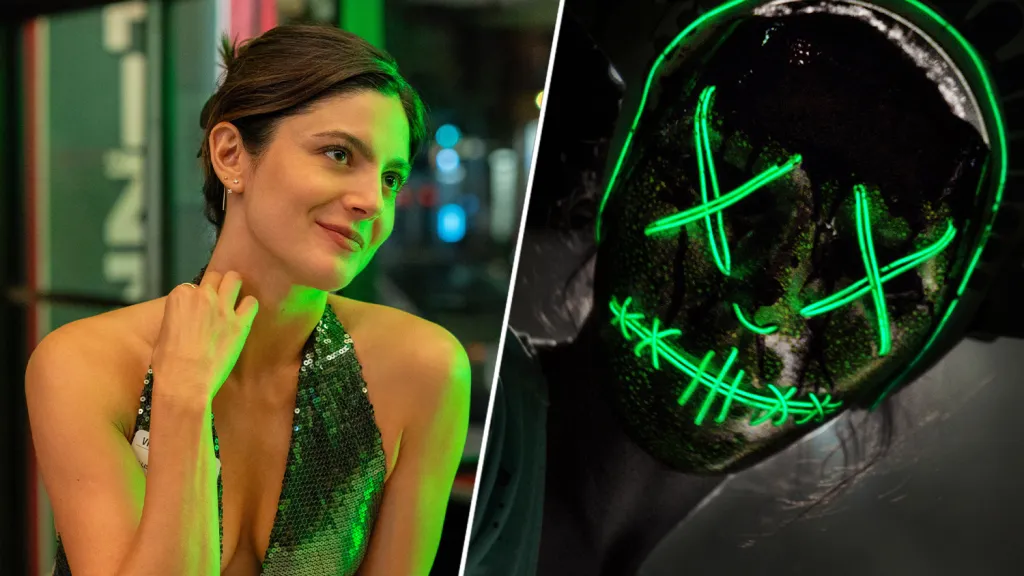
While One Night Only is intended as a romantic-comedy, there are some obvious dystopian undertones that audiences can’t ignore.
Director Will Gluck recently addressed online comparisons between the Purge franchise and his new Universal rom-com, which is now in theaters, about two New Yorkers (Monica Barbaro and Callum Turner) who meet on the one night a year premarital sex is legal.
“I am very aware of the online discourse about this world and this movie being the ‘sex Purge,’ and rightfully so,” he told SlashFilm. “But I don’t want this movie to be about that. And I know I get some blowback going, ‘How could you make a movie about this not being about that?’ Because I love exploring characters and situations.
Gluck added, “Whenever us humans get put in situations, no matter how or why the situation happens, we still have to be humans and get through the day. And that’s what interests me. So we didn’t want it to overwhelm. We wanted to explain it. We didn’t want to take a side. We wanted to show both sides, but we wanted it to be about these two people going through this crazy night.”
With five movies and a TV series expanding on the universe since The Purge premiered in 2013, the Blumhouse franchise is set in an alternate reality where all crime, including murder, is legal one night a year for 12 hours.

In a similarly dystopian fascist universe, albeit with a much lighter mood, One Night Only follows recently dumped pizzeria owner Owen (Turner) and singer Allie (Barbaro) meet on the one night of the year premarital sex is legal under the United States’ “chastity mandate.”
>


Search For Canadian TV Actor Stewart McLean Now Homicide Investigation


These ’90s fashion trends are making a comeback in 2017
According to Dior Couture, this taboo fashion accessory is back
Model Jocelyn Chew’s Instagram is the best vacation you’ve ever had
Your comprehensive guide to this fall’s biggest trends
9 Celebrities who have spoken out about being photoshopped
Emily Ratajkowski channels back-to-school style
A photo diary of the nightlife scene from LA To Ibiza