
Callum Turner and Monica Barbaro at the One Night Only premiere on Monday.
Roy Rochlin/Getty Images for Universal Pictures


There was a time when it seemed like the comedy website CollegeHumor would fade away into a distant memory of 2000s and 2010s internet history. But one of its longest tenured talents, Sam Reich, wouldn’t let it die, and now it has evolved into one of this decade’s fastest growing boutique streaming services: Dropout.
Driven by its flagship improv show “Game Changer,” which just launched its eighth season, Dropout is a comedy-focused boutique streamer that passed 1 million subscribers last October, marking a 31% growth year-over-year at a price point of $6.99/month with a recently launched $129/year “Superfan” tier that was created because, as Reich explained in the video announcing the tier, fans were begging for ways to give them more money.
But more than the raw numbers, Dropout has built a name for itself as a showcase for the brightest rising stars in the Los Angeles comedy scene, its growth driven by carving out the funniest moments from its shows for short-form sharing on TikTok and YouTube. The dedicated YouTube shorts channel for “Game Changer,” where Reich leads three comedians in a game show where the game changes every episode, has 2.46 million subscribers.
Other shows on the channel include the improv show “Make Some Noise,” also hosted by Reich, “Dimension 20,” a “Dungeons & Dragons”-based comedy show hosted by dungeon master Brennan Lee Mulligan, and “Very Important People,” a show in which comedians are transformed into bizarre characters by Dropout’s makeup department and must invent a character around their new look for a talk show interview with the show’s host, Vic Michaelis.
And while Dropout may not have mainstream notoriety, some of its most popular regulars have landed some major jobs in network comedy, including recent “Saturday Night Live” cast addition Jeremy Culhane and “Jimmy Kimmel Live!” show announcer Lou Wilson, whose infamous “Joker Car” from an episode of “Game Changer” got a callout from Kimmel himself.
Dropout’s CEO from Cambridge, Massachusetts sat down with TheWrap’s Office With a View to talk about how Dropout builds its fanbase without sharing too much of their shows, responsibly growing the scale of shows like “Game Changer,” and how his father, former U.S. Labor Secretary Robert Reich, inspired him to build a company that empowers its employees.
You hit 1 million subscribers last fall, so now that we’re on the verge of a new season of “Game Changer,” is there any big news over the last few months on how the service has grown?
We promised ourselves we would stop talking about our subscriber numbers after a million, at least until we hit some other very exciting milestone. So I won’t give you an exact number. We continue to do pretty well. Superfan is doing maybe better than you would expect for a tier of subscription where the proposition value is mostly “pay us more.” And as I’ve been sitting here, we passed the million mark with “Game Changer: Home Edition” on Kickstarter within the first couple of hours, which was very exciting to see. So, you know, everything is trending in the right direction. You try not to ride the highs too high, because then it gives you permission not to ride the lows too low.
For most people, Dropout is probably discovered through your TikTok and YouTube channels. Where is that line where you’re trying to avoid sharing too much of your shows? Because there are some episodes of “Make Some Noise” and “Game Changer” that you can watch entirely by stringing together those clips.
We’re counting on people having not very good editing skills! I think that, look, it depends a bit on the show. The algorithm isn’t going to feed the same person every “Make Some Noise” clip from every episode, even if we were to release the whole episode on social, which we don’t.
Then there’s the whole experience of watching it on Dropout or on your television, as opposed to on your phone, which is vertical, right? There’s like 66% of the show that you’re not seeing because it’s been verticalized. And in terms of sheer amount of content, I think the most we ever release on socials is close to half [of an episode] depending on the show.

Even as we’re creating shows, we aren’t always optimizing exclusively for socials. Some shows like “Make Some Noise” naturally lend themselves a little better to socials than other shows, and in our mind, that’s fine. Not every show has to be a bona fide social media hit to make sense for us to do. But we are conscious of it, and we do a bit of reverse engineering for it, because organic social is the way that the lion’s share of people, meaning probably like 85% of people, find out about Dropout.
When you announced the Superfan tier, you talked about wanting to add scripted and animated shows to Dropout, and the production value of “Game Changer” grows with every new season. You’ve also talked about wanting your 40 or so employees to share in the increased revenue for Dropout. How do you balance all of these goals as the streamer grows?
I think firstly, it’s fair to say that we exist in a bit of a no person’s land, budgetarily, where, if you compare us to most video podcasting, we’re outrageously expensive, and if you compare us to most television we’re outrageously cheap. No one makes content in the zone that we do, which can be a little bit uncomfortable, because there’s just no one to compare ourselves to.
We probably have a “cable budget from the 90s” look as we start to make more ambitious content. We’re also very conscious of that content not being so ambitious that Dropout is trying to achieve small scale Netflix. We want to do “Better Internet,” not worse streamer. We made that mistake at the beginning. We produced a few shows where we were really trying to imitate a traditional, premium streamed show, and it didn’t make a whole lot of sense for us. So creatively, we need to differentiate ourselves, because Dropout needs to be very distinct in terms of its brand and its proposition value to appeal to customers and also for budget reasons. So even the stuff that’s scripted and even the stuff that’s animated have a kind of a unique approach that only we would do, and I think that’s super, super important. It’s important because it’s responsible financially. It’s also important because it makes Dropout distinct from its, quote unquote, “competitors.”
And as you’ve started developing scripted and animated programming, are you able to take any ideas from how YouTube and indie companies like Glitch have developed their own followings on a budget, even though, as you said, Dropout is unique in the space?
For sure. I mean, none of that is to say that we aren’t open to collaboration. “The Amazing Digital Circus” is a really interesting example because as they became more successful, they simply started to produce more of the show. They would have these chasmic sort of gaps in between episodes when they first started and then as they’ve gone on, they’ve released episodes more and more often, which is an interesting strategy.
Our development mechanism has become meaningfully more sophisticated in the last year and a half, and largely the fruits of those efforts have yet to be seen on the platform. But we’re now taking meetings, just as you would expect, with outside animators, indie animators, YouTube creators, projects that are being shopped around to other networks because we’re exploring what our options are. We’ll still only pursue creatively what feels like us or where we want to go. But we’ll leverage any industry related route that you can imagine to get there.
We talked about scaling up Dropout. Let’s talk about scaling up “Game Changer.” Last season you were very famously pranked by your entire company who made you the sole player in the most elaborate and budget-intensive episode of the show yet and even made fake financial reports to hide that the episode was being kept secret from you. When working on season 8, were there ideas for “Game Changer” that you thought might have been too ambitious for the budget or the crew’s bandwidth that suddenly were back on the table when you saw the episode that had been made without you knowing?
I don’t know that “Samalamadingdong” was the episode that broke the camel’s back. But the dance that you’re describing is a dance that we do with “Game Changer” every season, which is to say we’re always pushing it. And then what we do is we narrow it down to, like, 15 ideas that we’re excited about, and some of those ideas are more ambitious or less ambitious, and then as it becomes clear what we can and can’t afford, some ideas get pushed off to a future season. That is why I’m never transparent about ideas that have hit the cutting room floor, because in the back of my mind, I’m like, “We’ll get to them eventually.”
The “Escape the Greenroom” episode was one that we first came up with two seasons before we actually did it, and this season has in it, I think, at least three ideas that had been punted from other seasons. As we’re in the writers room for next season — which is a live writers room, we’re in it right now — there’s already ideas where I’m like, “I bet we can’t afford to do this yet, not with everything else we want to do too.”
“You know, “Game Changer,” if not Dropout in general, is in an era of AI-driven content and hyper premium content. You know, shows that cost $25 million per episode. We’re a little rough about around the edges. We’re a little bit of a garage band operation. And I like that about us. I’m not trying to polish the rough edges of “Game Changer” anytime soon. I like that you see the crew. I like that you see the edges of the stage. We’re always making a lot with a little. That’s kind of the spirit of the show. We were just pushing it ever a little farther creatively, I think, and budget-wise as well. The first episode of this season, there’s kind of an albatross on stage that joins us, something mechanical that we could have never done three seasons ago. And that kind of thing is just like, really fun and fulfilling to be able to dream up.
Something that strikes me most about Dropout is how so many people who have been on the show and work there talk about what a great place it is to work. There was a tweet where Erika Ishii talked about how she has such trust in your team and loved how you do right by your workers. Is that something that you were always conscious of, even during the time when it seemed like Dropout wasn’t going to make it?
To be very honest with you, I’ve never been very conscious of it, and it’s always been surprising. In other words, this feedback has always been a bit surprising. I think it has to do with a few things. One of them is circumstantial, which is to say, there’s no one above me, which is really rare in a company, by which I mean to say there’s no public shareholders, there’s no private equity, there’s literally no one to please but me. I have two out of three board seats. It’s like I have complete control.
What that means is — and because I’m not a sociopath, I really do want to underline that too — it’s not that I am in any way somehow, like, morally advanced. People give us a huge amount of credit for profit share but…I am simultaneously getting rich! This is still a capitalist operation! But I really do want to see everyone involved in Dropout be very comfortable and happy and do very well.
The mission statement of Dropout is to create a unique ecosystem in which art can thrive. If art is going to thrive, it needs to be supported, not just with economic levers, but also with a high EQ. And I think I’m a sensitive soul, and I think I’ve surrounded myself by a lot of with a lot of sensitive people too. So, you know, I’ve said this a broken record amount of times, but we get a huge amount of credit for being like a progressive company and a talent forward company, when I think, in fact, all we are is just uncomplicated and decent. And I think that it says something about the world of work that we live in, that that is so rare.
But I think what also makes your approach to running Dropout so interesting is where you come from. Your father, Robert Reich, was Bill Clinton’s labor secretary and has built his own presence online talking about inequality. Has your father influenced who you are as a CEO?
There have definitely been times where I’ve turned to my dad for guidance. But believe it or not, those have historically had less to do with running the company, which is not actually something that my dad has a lot of experience with. He is, as you know, an educator and an author and a politician, but has not done this before.
I think his advice has been more to do with being a public person, which is something he has a lot of experience with that I’ve needed a crash course in in the last handful of years. But his values, particularly his public values, of course, have have rubbed off on me. It’s impossible to be the son of my father and not have a lot of his same POV about just work period and about workers. My dad has spent his career wanting to empower a workforce. And I think, in a way, I have that same passion. He wants to enable people, particularly as Secretary of Labor, and in his more economic leaning work to feel more empowered in their lives. And I very much have that relationship with creative people. If I could spend the rest of my life simply empowering creative people to feel more like they could do their work and feel honored for their work, that would be a life well spent.

>

Ever since the official trailer dropped for the Callum Turner–Monica Barbaro rom-com One Night Only, quickly racking up millions of views on its way to its nearly 40 million total, internet commentators have had a lot of questions about the film’s central premise in which premarital sex is illegal apart from one 12-hour period a year.
How is this law enforced? Are people breaking the law? How did this legislation pass? What counts as “sex” under this new mandate? Are marriage (and divorce) rates skyrocketing? What about affairs?
Rest assured: Some of those questions are answered in the movie, and explanations are starting to trickle out online for those unconcerned about spoilers. Beyond that, One Night Only writer, Travis Braun, who saw his screenplay top the 2024 Black List, has answers, but they’re not all in the Will Gluck-directed Universal movie now in theaters.
“I set out to write a movie about the circus that is modern dating, and I thought how fun if we could set that all in one night, and I have answers to those questions, and some of them are in the movie,” Braun told The Hollywood Reporter at the One Night Only premiere earlier this week in New York.
Braun said he definitely thought about the specific rules of the film’s alternate reality, framed as three years on from the no-sex act being passed, but didn’t want to get too deep into the politics of the world of the movie.
“There’s a big mythology that I’ve built out and then as you develop a movie you start to pare down and you go: What does an audience really care about, and what are they showing up to see? For me the answer is always a love story, romance,” he told THR. “I hope they can come in and we’ll show them how this world functions, and then they can just enjoy the movie and have fun. The whole focus of this was love story and romance first, and the world-building obviously has to make sense and has to be there, but ultimately we weren’t interested in getting into the politics of it. We wanted to tell a story about these two incredible people trying to find love on this crazy night.”
Producer Jacqueline Monetta, who brought Braun’s script to Gluck, said they didn’t want moviegoers to have all of the answers.
“I had a million questions. I was like, ‘What does this mean? What does this world look like? How do people communicate? What’s different?’ And that’s I think what’s so smart about it,” she said of One Night Only‘s “big idea, high-concept” premise. “We don’t answer every question in the movie, purposefully, because we want those questions to be had on the car ride home. We want people to keep talking about it and really think about what would this mean for our world, what does it mean for our world now. But I think Will and I were really specific on what questions we wanted to answer.”
In a recent Reddit AMA, Gluck also detailed how he and his team approached the world building of the movie while not wanting it to be all about the mandate and offered prospective moviegoers hints for where to find the answers to their questions.
“We spent a lot of time talking about the rules of the world, and if you’ve seen the movie, or when you see the movie, you’ll see that the rules of the world and the world building are all in the background,” he said. “It’s on TVs, signage, in thrown-away lines, because we didn’t want to give the world short shrift, but we didn’t want the movie to be about that. It’s another way I want people to see this. If they see it more than once, they’ll pick up so many more rules of the world in the background. A lot of the questions that I’ve been getting after people have seen the movie are actually answered in the movie, which is by design because I want people maybe not to know them. So, yes, it was a tricky tightrope to have them there, but not for the movie to be about it.”
Turner meanwhile echoes Braun’s advice for curious prospective moviegoers: “Go see the film!”
“You’ll realize pretty quickly what the realm is that you’re working within and it’s a comedy,” Turner says of what inquisitive filmgoers will find. “There are no great political undertones, I don’t think. This is just a place where you can escape for an hour and a half, two hours and enjoy and laugh your head off.”
One Night Only is now in theaters.
Callum Turner and Monica Barbaro at the One Night Only premiere on Monday.
Roy Rochlin/Getty Images for Universal Pictures
>

Although the live-action remake of Moana hasn’t quite been able to catch a wave at the box office, Dwayne Johnson is proud of what they made.
The Golden Globe nominee said the Disney movie’s negative reviews, which currently sit at 32% on Rotten Tomatoes, are “just the way it goes” in the entertainment industry, and what “really mattered” was that “the culture really stood up” in the Polynesian-inspired tale.
“Our first two reviews came out. I’ll never forget it… They were amazing. I was like, wow,” he told People, noting the reviews then “went another way, as sometimes happens.”
“That’s just the way it goes because we’re in this business,” added Johnson.
A decade after he voiced the demigod Maui in Disney’s animated film Moana, Johnson reprised the role in the Thomas Kail-helmed live-action adaptation.

“The challenge was, okay, let’s remember, though, what’s going to be beyond this opening weekend. Let’s remember what’s happening right now and the noise that’s happening right now,” said Johnson. “If you love it, great. If you don’t, no problem.”
Following Moana‘s July 10 premiere, the movie has gone on to make $266M at the global box office. Disney CEO Josh D’Amaro addressed the low turnout in a letter to shareholders.
“Even when our franchise films don’t meet our box office expectations, as with The Mandalorian and Grogu and the live-action Moana, our investments in these core properties fuel other parts of our company,” said D’Amaro, noting that Moana is “expected to be a strong title on Disney+, building on the success of the original film, which is one of the most streamed movies of all time.”
>
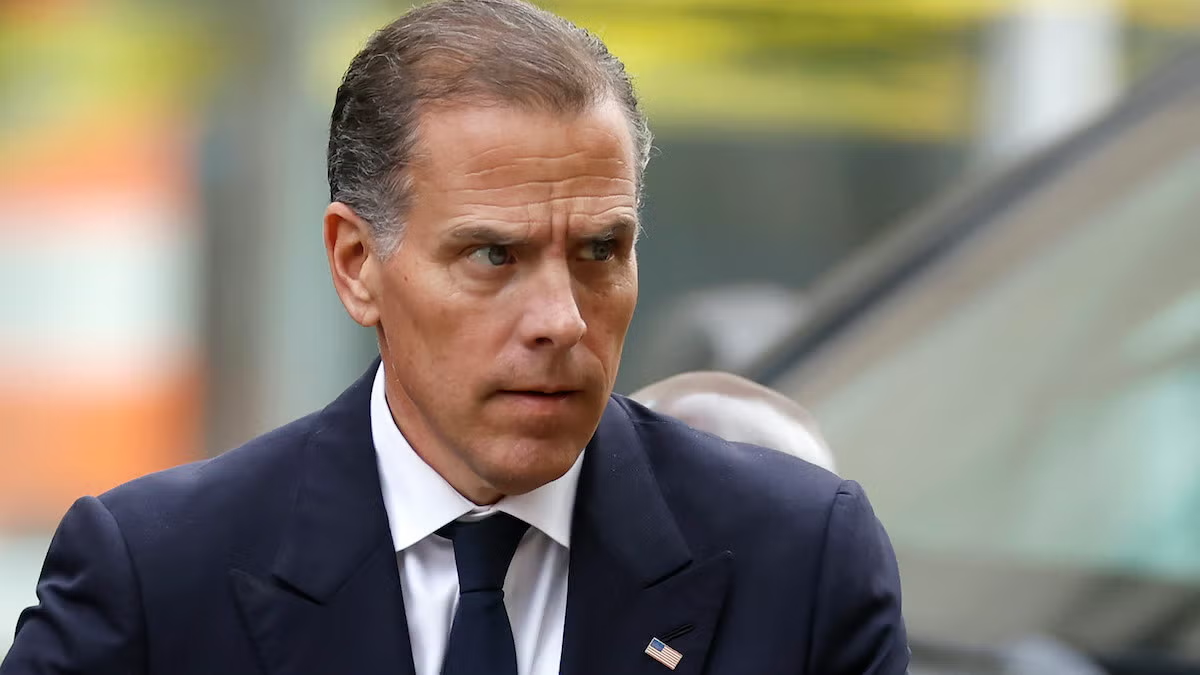
Hunter Biden doesn’t have plans of running for office himself, but he still has some strong opinions when it comes to the presidency. In fact, President Joe Biden’s son just called President Donald Trump “the singular existential threat” to planet Earth.
During his wide-ranging interview with BBC Newsnight’s Paddy O’Connell on Friday, the 56-year-old artist opened up about receiving a pardon from his father during his last weeks in office back in December 2024 — and how Trump’s behavior may have impacted the decision.
“I am the most privileged person, as it relates to that, that there could possibly be. I was one of one, and I am eternally grateful for it,” Hunter shared. “I am eternally grateful for it because I think that Donald Trump has proven to be exactly who my dad thought he was going to be, as it relates to the revenge and retribution that he would seek on his political enemies.”
“Was it good for our Constitution? Was it good for the American people? Was it good for my dad’s legacy? No, on all counts,” he further admitted.
President Biden pardoned his son just weeks ahead of his sentencing on tax evasion and federal gun charges. At the time, Trump called the act “an abuse and miscarriage of justice.” A year and half later, Hunter remains equally unimpressed by his father’s successor (who was also, notably, his predecessor).
“I’m not going to stop talking about Donald Trump,” he concluded. “Donald Trump is the singular existential threat to this globe. Donald Trump is, literally, a greater threat than we have faced in any of our lifetimes.”
Elsewhere in his interview, Hunter fought tears while sharing a painful update on his father’s prostate cancer metastasizing to his bones: “My dad is, to this day, remains the center of our family. Not just because of who he is as the the public person, but completely because of who he is to each one of us. It’s really, really hard and it’s really sad to watch.”

>


Search For Canadian TV Actor Stewart McLean Now Homicide Investigation


These ’90s fashion trends are making a comeback in 2017
According to Dior Couture, this taboo fashion accessory is back
Model Jocelyn Chew’s Instagram is the best vacation you’ve ever had
Your comprehensive guide to this fall’s biggest trends
9 Celebrities who have spoken out about being photoshopped
Emily Ratajkowski channels back-to-school style
A photo diary of the nightlife scene from LA To Ibiza