
‘All the Lovers in the Night’
Bitters End


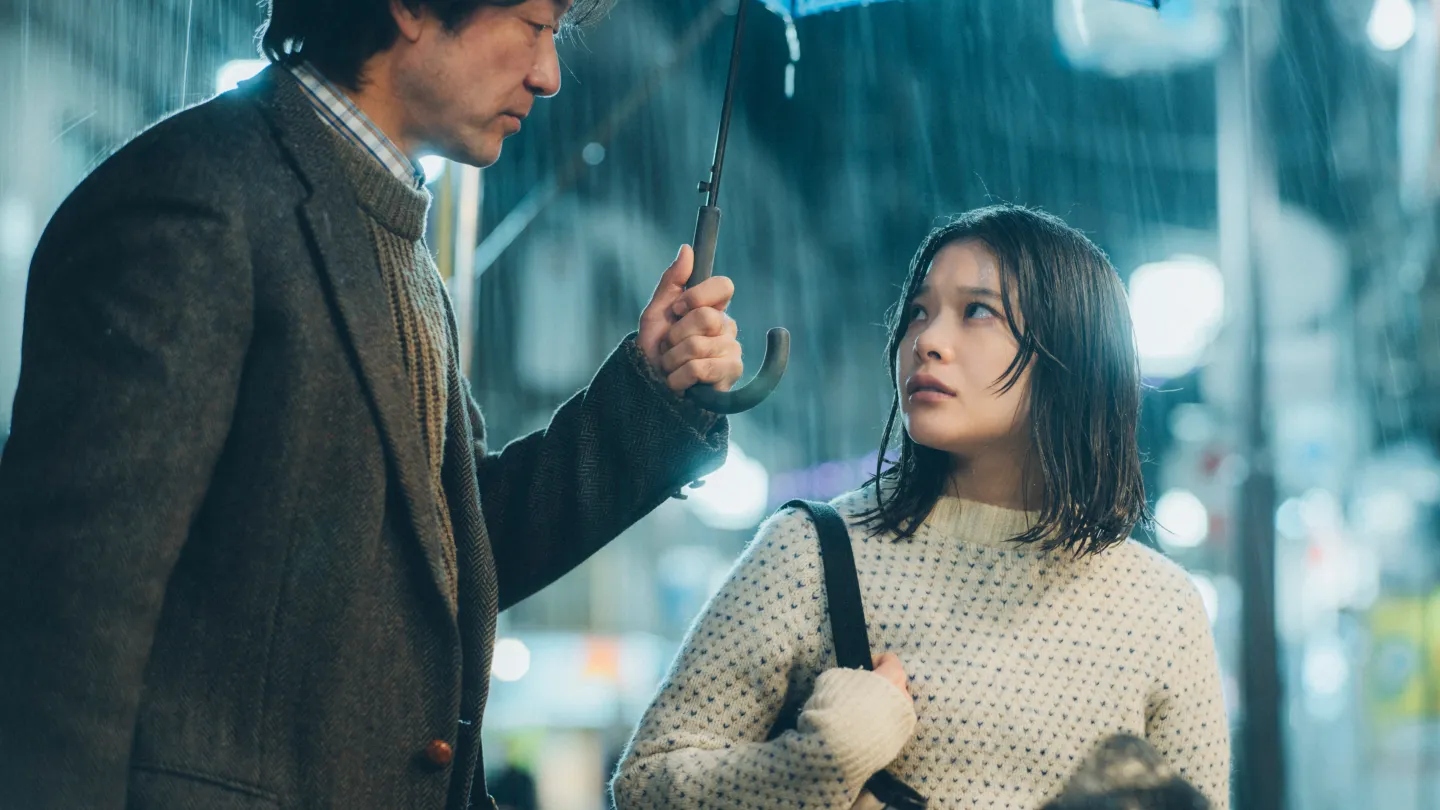
For a film preoccupied with the mechanics of light, Yukiko Sode’s All the Lovers in the Night unfolds mostly in shadow — in the muted glow of a Tokyo apartment window at sunrise or in empty city streets walked at midnight on a birthday no one else celebrates. Adapted from Mieko Kawakami’s celebrated novel, the Japanese filmmaker’s quietly transfixing fourth feature uses the halting rhythms of a first, awkward romance to pose expansive philosophical questions: how does the self become visible, and how much of what we feel is genuinely our own?
Premiering in Cannes’ Un Certain Regard sidebar, All the Lovers in the Night came to Sode by way of her producer, who handed her Kawakami’s book — her first encounter with this particular novel, despite being a longtime fan of the author’s work.
“My interpretation of the book was that it was about light,” Sode tells The Hollywood Reporter. “And of course, as a filmmaker, light being a motif was an irresistible challenge. How could I not make it?”
The story follows Fuyuko (Yukino Kishii), a freelance proofreader who lives a near-monastic life of urban anonymity: long days of solitary work in her quiet apartment, occasional outings with her one outgoing colleague, Hijiri (Misato Morita), and a single, annual self-indulgence — a midnight walk through the city on her birthday. But Fuyuko’s inner life is not nearly as placid as her self-effacing exterior suggests, and the cracks begin to show when she mysteriously takes up the habit of heavy, surreptitious day drinking. The subtle sea change in her life begins to build when she meets Mitsutsuka (Shōgun star Tadanobu Asano), a reserved high school physics teacher, at a local culture center, where she’s considering taking a class. He speaks in a gentle, almost cryptic register, responding to her questions about the subject he teaches with gnomic musings on the counterintuitive mechanics of light. A series of hesitant café meetings ensues — but even as a genuine connection begins to take shape, each carries secrets they don’t know how to reckon with and reveal.
‘All the Lovers in the Night’
Bitters End
Kawakami — whose All the Lovers in the Night was the first Japanese novel shortlisted for the U.S. National Book Critics Circle Award — granted Sode and her team complete creative freedom, declining to submit notes or requests at any stage. “She basically said, it’s in your hands,” Sode recalls. The novelist offered just one observation when the two first met to discuss the screenplay: that the book was a decade old and could require at least a little updating for verisimilitude — thus, Sode inserted a passing reference to AI and its potential impact on the plight of the professional proofreader.
What she preserved, most of all, was the novel’s philosophical undercurrent. Light, as Mitsutsuka gently expounds, becomes visible only when it strikes against an object. So too, the film suggests, do our deepest selves. “You have yourself, you have the object of your affection,” Sode says. “But truly to get close to them — what does that mean?” Fuyuko, meanwhile, is haunted by a question close to that of any artist: are her thoughts and feelings genuinely her own, or are they merely quotations of things she has already read, already absorbed? Amid her quiet desperation, she justifies her withdrawal from social life by believing that it’s at least a form of authenticity — call it the Anxiety of Influence as daily living practice.
Sode says this theme also exhilarated her as she was drafting the screenplay of the adaptation, which came out relatively effortlessly.
“This motif also felt so familiar to me as a filmmaker,” she notes. “Whenever you’re shooting a film, you’re not quite sure if you’re drawing on some accumulation of the cinema that came before you, or if you’ve actually struck upon something original.”
These twin preoccupations — light and authenticity — guided Sode’s formal choices for the film. She was adamant about shooting on 16mm, and her producers, budgetary concerns notwithstanding, eventually relented after the film’s entire cast and crew joined in her appeals for clearance to use the analog format.
“When you shoot on film, you can capture light on physical film as is,” Sode explains, “whereas if you’re using digital, it might become too washed out, or you lose that quality of feeling that you really see it.”
The 16mm choice also reinforced what she calls the film’s “analog” ethos — a quality embodied in her proofreader characters, whose finicky, intensive labor sits in contrast to the vacuous convenience of the AI age. Cinematographer Yasuyuki Sasaki, who also shot Kiyoshi Kurosawa’s visually accomplished, Cannes-premiering latest Kokurojo: The Samurai and the Prisoner, renders Tokyo in painterly half-light: lambent neon, late-afternoon spaces, smudgy city stoplights.
Sode’s visual strategy also extended to the way her camera translates Fuyuko’s anxious interiority from Kawakami’s first-person novel.
“Apart from Mitsutsuka, you see her with other male characters always sitting sideways, or not really sitting face forward — which, of course, means that she’s holding herself back and not engaging with them 100 percent,” she explains. With Mitsutsuka, the framing across the cut-backs of their conversations gradually tightens and shifts to eye level — formalizing Fuyuko’s slow opening-up, as she inches toward vulnerability.
The film’s delicate thematic architecture is anchored by two standout performances from its stars. Kishii — who broke through internationally as a deaf boxer in Sho Miyake’s Berlinale favorite Small, Slow But Steady — plays Fuyuko with an exquisite, wary inwardness. Asano, the Japanese arthouse favorite whose recent Golden Globe win for Shōgun introduced him to broader Western audiences, brings his usual appealing peculiarity to Mitsutsuka, working from a character backstory he constructed on his own. “Boy, was it unexpected,” Sode says of the original story Asano created for Mitsutsuka as part of his method. “I’m afraid I really don’t think I should share what it was,” she adds, laughing.
Threaded through All the Lovers in the Night is a portrait of a particular contemporary Tokyo type, Sode says — the solitary thirty- or forty-something urbanite who has built a life of emotional self-protection so well fortified that it precludes the usual, natural desires for romance or family-making.
“The metropolis allows people to blend in and to disappear within it,” she says. “If you choose not to associate with anybody and just live your life, that means there’s less possibility that you’ll be hurt. But at the same time, we as people, as humanity, cannot exist without others — and so there is that yearning, that longing as well.”
For all the film’s quiet sorrow, Sode insists Fuyuko’s arc resolves into something like grace. Her solitude was always a private mythology of specialness — and what she trades by the end is self-defense for a more authentic identity.
“Whether her love has been fruitful or not,” Sode says, “Fuyuko, by virtue of having experienced a romance, is able to say she is one of the many, many people around the world who have experienced a great love. So in a way, she’s found nakama — companionship — in a community where everybody feels a little bit alone.”
>
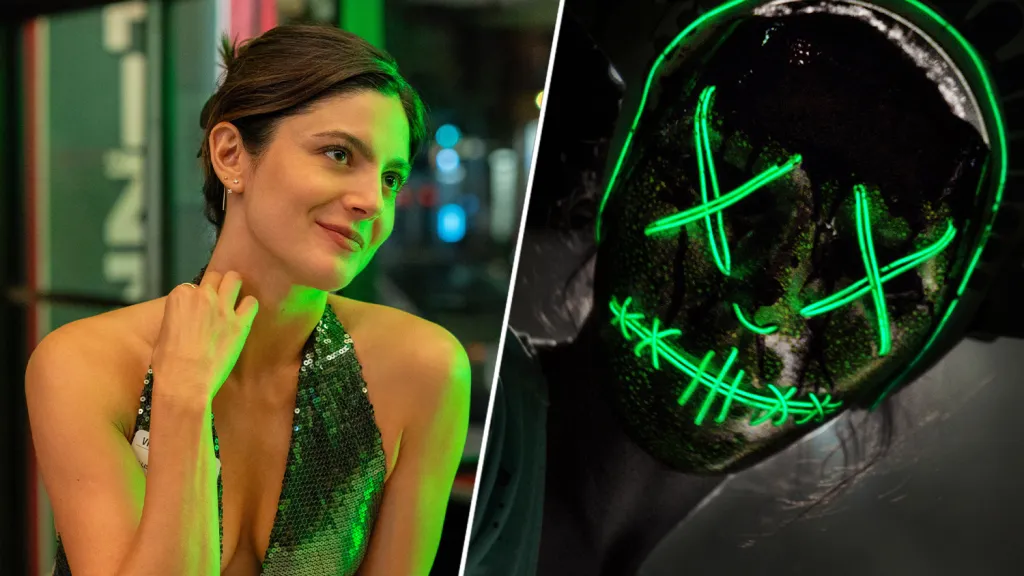
While One Night Only is intended as a romantic-comedy, there are some obvious dystopian undertones that audiences can’t ignore.
Director Will Gluck recently addressed online comparisons between the Purge franchise and his new Universal rom-com, which is now in theaters, about two New Yorkers (Monica Barbaro and Callum Turner) who meet on the one night a year premarital sex is legal.
“I am very aware of the online discourse about this world and this movie being the ‘sex Purge,’ and rightfully so,” he told SlashFilm. “But I don’t want this movie to be about that. And I know I get some blowback going, ‘How could you make a movie about this not being about that?’ Because I love exploring characters and situations.
Gluck added, “Whenever us humans get put in situations, no matter how or why the situation happens, we still have to be humans and get through the day. And that’s what interests me. So we didn’t want it to overwhelm. We wanted to explain it. We didn’t want to take a side. We wanted to show both sides, but we wanted it to be about these two people going through this crazy night.”
With five movies and a TV series expanding on the universe since The Purge premiered in 2013, the Blumhouse franchise is set in an alternate reality where all crime, including murder, is legal one night a year for 12 hours.

In a similarly dystopian fascist universe, albeit with a much lighter mood, One Night Only follows recently dumped pizzeria owner Owen (Turner) and singer Allie (Barbaro) meet on the one night of the year premarital sex is legal under the United States’ “chastity mandate.”
>

HBO’s new documentary series Monsters of God abounds with colorful creatures – and those are just the humans.
The five-parter from Tiger King co-director Eric Goode features reptile dealers with a fondness for creepy crawlies and a loose connection to ethical and legal mores. There’s Tom Crutchfield, who loves women with the ardor of Pepé Le Pew but spends most of his time not in pursuit of the ladies but of exotic snakes, lizards, alligators, turtles and whatnot. His arch rival: Hank Molt (aptly named, given that snakes molt), a man who pioneered the shady trade of importing rare and often endangered reptiles to the United States (HBO calls it a “billion-dollar criminal enterprise.”).

Another key Monsters of God character: Anson Wong, a Malaysian “exporter” (to use a polite term) perhaps as cold-blooded as the creatures he rounds up and dispatches around the world. His nickname – “the Pablo Escobar of reptiles.”
The template for the series is supplied by the 2008 book The Lizard King: The True Crimes and Passions of the World’s Greatest Reptile Smugglers, written by Bryan Christy. The author, who appears in the series and serves as a consulting producer, took part in a panel discussion of Monsters of God Thursday night after HBO screened episode 1 at Vidiots in Los Angeles. He praised Goode and fellow producers for wrangling the reptilian importers, typically a wary group.

“I know what it took to run these people down, to get people to say ‘yes’ to you coming in their place,” Christy told the moderator, the actor Jason Segel. “And with a camera. I just had a pencil… It’s amazing what they brought together. And they’re celebrating the animals in a way that I hope gets people to care more about this sort of maligned species.”
Goode needed no persuading about the beauty of animals like New Caledonian geckos, African bush vipers, Caribbean rock iguanas, and similar Cyclura. He’s been an avid collector since childhood.

“I have a confession to make,” he said at the Q&A, alluding to his collecting urge. “I’ve been an addict for over 50 years and now I’m still not sober, sorry to say.”
The challenge of convincing reptile dealers to appear on camera became evident during the panel discussion, which included Crutchfield and Mike Van Nostrand, both Florida men who have served time behind bars for their activities (in 2022, Van Nostrand was convicted in a scheme to smuggle “illegally-harvested Florida turtles out of the United States and into China, Japan, and other places,” per the Department of Justice).
“I didn’t like the Tiger King,” Van Nostrand stated flatly. “Eric was a little tricky one.”
For his part, Crutchfield called Tiger King “one of the weirdest movies I’ve ever seen.”

Along with Tiger King, Goode also directed the 2024 HBO documentary series Chimp Crazy about people obsessed with raising chimpanzees as essentially human children. At the Q&A, he addressed contrasts between Tiger King, Chimp Crazy, and Monsters of God.
“Right now, a lot of people are thinking I’m trying to take down the reptile world,” Goode said of Monsters of God. “Yes, I didn’t like people keeping chimpanzees in Chimp Crazy. I wanted laws changed so you couldn’t do that. I didn’t want people having 200 tigers in their backyard [in Tiger King]. Reptiles are different. It’s nuanced. And as Mike [Van Nostrand] says, if people were breeding more reptiles that may take pressure off of the poachers. And so there’s a lot of gray in this story and it’s not painting anyone with one brush. Law enforcement made a lot of mistakes. We’ve made mistakes. The zoos made big mistakes and we’re all complicit.”

Zoos are complicit, the series makes clear, by paying dealers like Molt and Crutchfield to supply them with exotic reptiles knowing full well the wranglers were violating U.S. and international law. Federal officials with the U.S. Fish and Wildlife Service don’t seem to come off much better, to judge from episode 1. Nobody’s motives seem 100 percent pure in Monsters of God, self-assessments notwithstanding.
“What I really want people to get out of my complete performance from the very beginning to the end,” Crutchfield asserted at the Q&A, “is my great passion and my great love, and more importantly, my great respect for all of these monsters of God that you’re going to see.”
Van Nostrand chimed in sardonically, “Are you saying money had nothing to do with it?”
“So far,” Crutchfield replied.
Fresh episodes of Monsters of God will debut on HBO the next four Thursdays, and stream on HBO Max. Audiences may get hooked, mirroring the obsessional quality of true lizard people. Jason Segel, for one, pronounced himself a fan of the series.
“At times it feels like Goodfellas. It feels like Scarface sometimes,” Segel enthused at the Q&A. “I watched every episode over two days and was mesmerized. I can’t wait for all of you guys to see it.”
>
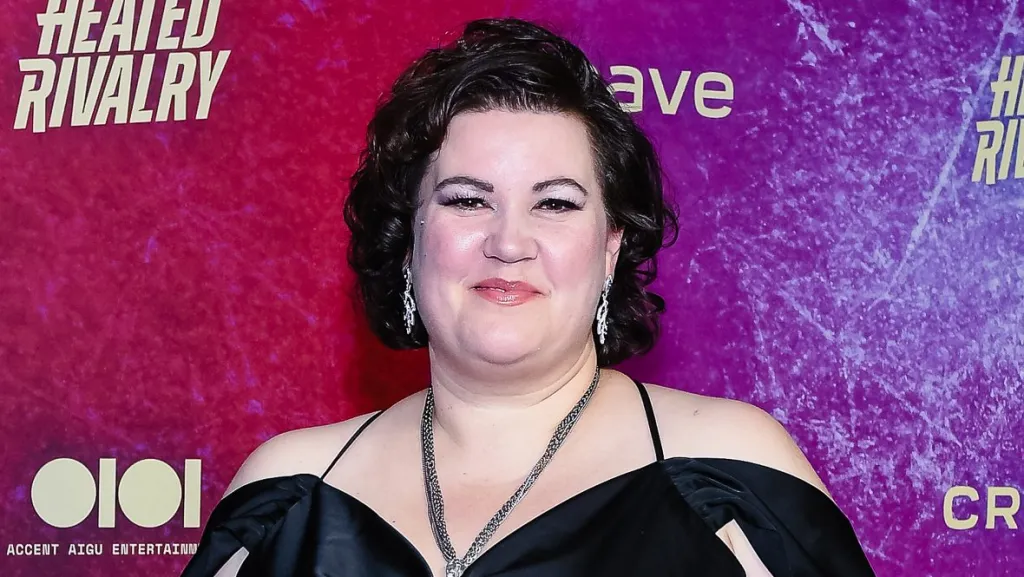
As Heated Rivalry hits the ice for another season with some new teammates, there’s bound to be some opinions about the casting choices for the book series’ beloved characters.
Following the news that Justice Smith and Charlie Gillespie have been cast in Season 2, author Rachel Reid appeared to respond to negative online reactions to the news that the actors will portray Harris Drover and Troy Barrett, respectively, the couple from Role Model, the fifth book in her bestselling Game Changer series.
“Thinking about all the people last summer who told me the casting for llya and Shane was wrong and bad…” wrote Reid on her Instagram Story with a side-eye selfie.
Based on the second book in the series, Season 1 of Heated Rivalry became an overnight hit largely due to Connor Storrie and Hudson Williams’ steamy performances as Ilya Rozanov and Shane Hollander, launching the actors’ profiles in Hollywood as well.
On Friday, Deadline reported that Smith and Gillespie have been cast as leads in Season 2 of the Crave Original, which is set to premiere in spring 2027. Production began on the sophomore season in Canada earlier this week.

In the Role Model book, Troy Barrett is a hockey player on Ilya’s team with a history of bullying, while Harris Drover is the team’s cheerful social media manager.
“Rachel Reid has given us two beautifully layered characters in Harris and Troy who you can’t help but root for,” said series creator Jacob Tierney and fellow executive producer Brendan Brady. “From the start of the casting process, we knew we were looking for actors who could create something truly special together and bring that same depth and heart to the screen. Justice and Charlie do exactly that. They immediately connected with the vulnerability and resilience at the core of these characters, bringing an instinctive understanding of who Harris and Troy are.”
>




Search For Canadian TV Actor Stewart McLean Now Homicide Investigation


These ’90s fashion trends are making a comeback in 2017
According to Dior Couture, this taboo fashion accessory is back
Model Jocelyn Chew’s Instagram is the best vacation you’ve ever had
Your comprehensive guide to this fall’s biggest trends
9 Celebrities who have spoken out about being photoshopped
Emily Ratajkowski channels back-to-school style
A photo diary of the nightlife scene from LA To Ibiza