
Entertainment
A Man of His Time Review: Cannes Docudrama Explores Fascism


Hannah Arendt’s old adage about evil has grown banal from overuse, though it finds interesting new ripples in Emmanuel Marre’s “A Man of His Time.” Not that the central anti-hero is particularly malevolent — he’s simply a middle-aged mediocrity who turns to Vichy collaboration to reboot a stalled career. More ignominious still, he barely gets far, stalling out again at lower middle-management, just another interchangeable cog in a maachine that doesn’t need him, will go on without him and will crush him all the same.
Premiering in Cannes’ competition, this odd-duck docudrama marks a decided change of pace for a filmmaker whose previous study in anomie was titled “Zero Fucks Given.” Here, one senses that Marre cares an awful lot — and carries no small burden — following a character based on his own great-grandfather.
Henri Marre (Swann Arlaud) stumbles into the film already slightly soused. France has fallen, and a new government is coalescing in the spa town of Vichy under the octogenarian Maréchal Pétain. There’s work to be had for unscrupulous men — even those coming off a recently collapsed business venture that ended in professional disgrace. Unfortunately for Henri, there is rather less work for ideologues, as dyed-in-the-wool Pétainistes raise eyebrows in a government born of defeat and staffed by cynics who prefer the reliability of fellow rogues. Not five minutes in, our awkward arriviste has badly overplayed his hand.

Henri’s great-grandson, though, has already got us hooked — tracking his protagonist as he poorly works the room with visual language that feels wildly discordant with the period. (For clarity’s sake, we’ll use the first name for the character and the surname for the filmmaker.) Marre follows Henri like a nightclub photographer, using a handheld camera and harsh on-camera flash, subjects washed out in its immediate glare and swallowed by pools of shadow. The aesthetic calls to mind early-2000s party shoots, or the deep seediness of Girls Gone Wild, and it comes as part of the filmmaker’s wider plan to bridge the eight decades separating the two Marres.
In certain key respects, the film employs a similar logic to “The Zone of Interest,” collapsing then-and-now with an aesthetic far removed from the standard historical drama. Whereas Jonathan Glazer used eerie distancing to accent alienation, Marre wants his viewers to recognize something all too familiar — especially because the film’s many discourses about appeasement and fascist rapprochement are hardly limited to the past. (A wink the film’s English subtitles make toward international viewers with a line about “making France great again” that doesn’t quite match the French dialogue spoken on-screen.)
Much of that dialogue was improvised on the spot, as Marre apparently wrote a detailed script then forbade his actors from learning much of it. Running 155 minutes, the film plays as a grim picaresque, following Henri from Vichy — where the new government has overtaken the local thermal baths, giving gray bureaucrats the chance to plot new trade routes from the shvitz — then to Paris, and ultimately to Limoges, where he is made sub-prefect for a politico already on the outs, at a ministry of, shall we say, secondary importance.
Less rise-and-fall than lurch-and-plant, the film uses its caught-on-the-fly quality to accent the mundane. The gears of fascism were turned by unexceptional stiffs just punching the clock, and even within these systems there were winners and losers.
But even the hapless can feed atrocity — a fact that crystallizes through the film’s extended middle section following Henri at work. He sits behind his desk placing calls, issuing orders, and competently administrating what we gradually come to realize is the transport of people. That Marre shoots his bumbling middle-manager with an extraordinarily familiar shorthand of handheld cameras and rapid zooms only sharpens the film’s ironic bite. This is “The Office: Genocide.”
“A Man of His Time” relays a dark subject with a playful spirit, leaning into anachronistic music cues setting archival footage against Opus’ “Live is Life,” or having characters break into dance to “Popcorn” by Hot Butter. But it turns mournful when focusing on Henri’s domestic life. He has four children and a wife — played by Sandrine Blancke — who lets us into her emotional life through a series of letters, read in voiceover and drawn from the real family archive. For all his limited political talent, Henri leaves his mark on the world all the same, with a moral stain that has outlasted everything else about him, and a uniquely marred legacy.

>

EXCLUSIVE: DreamLab Films has boarded sales on satirical Iranian picture Head to Head (Sar beh Sar) about a film production in which the male cast members are subjected to the strict dress rules applied to women in Iran, ahead of its world premiere at TIFF.
Blending dark comedy with sharp social observation, the Iran-Germany co-production marks Ghasideh Golmakani’s first feature after a string of internationally screened short films exploring gender, power and social taboos in Iran.
Set in contemporary Iran, Head to Head follows an acclaimed female writer-director who makes the radical choice to require men to wear skirts and headscarves for her latest film. As the men struggle with heat, restrictions, and wounded pride, tension swells and Bahar’s hopes for success are met with growing resistance.
The film stars Mehrnoosh Satari, Saeed Naderi, Ebrahim Azizi (It Was Just an Accident), Amir Hajimohammadi, Elaheh Farazmand and Lili Farhadpour (My Favorite Cake).
Golmakani also wrote and produced the feature, with David M. Lorenz serving as associate producer and Saba M. Rezaei as executive producer. Cinematography is by Amin Jafari, sound design by Alireza Alavian, production design by Melody Esmaeili and original music by Yoones Eskandari.
The director, who holds a PhD from the Sorbonne on Iranian women filmmakers before and after the Revolution, said the film grew out of years of reflecting on the place of women in Iranian cinema.
“Head to Head is rooted in years of observing the challenges women face in Iranian cinema. It is not only a reflection on the situation experienced by women, but also an invitation to male colleagues to reflect on what women have had and still have to endure in order to continue existing on the cinema screen,” she said
Paris-based DreamLab Films is handling worldwide sales and festival strategy.
>
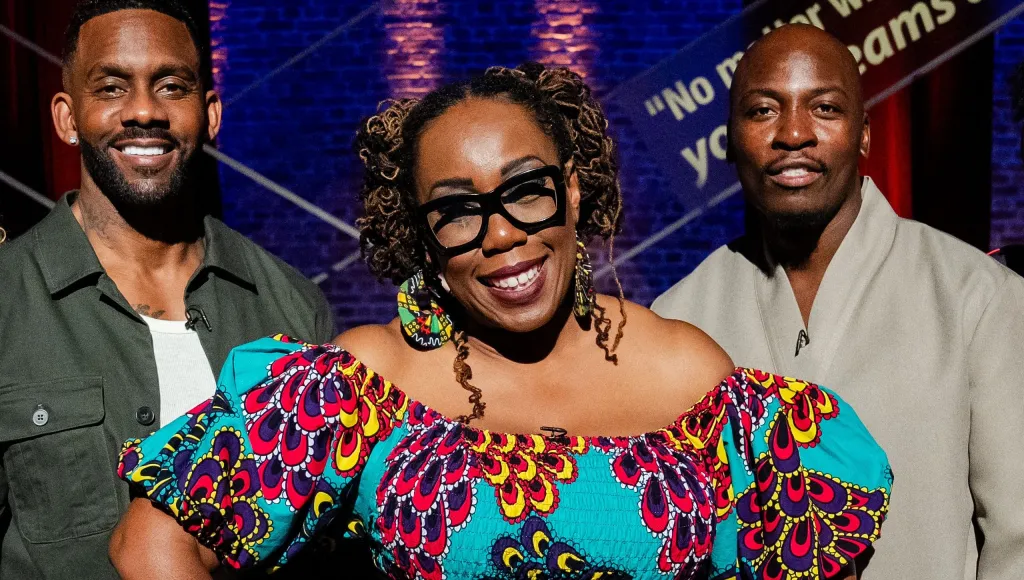
EXCLUSIVE: Sorry, I Didn’t Know is again extending its record-breaking run on ITV, and this time it appears to have set another high bar.
The British comedy panel show has been renewed for a seventh season, a decade after UK commercial network ITV first commissioned it from TriForce Productions. The re-order extends Sorry, I Didn’t Know‘s record as the longest-running show from a Black-led production company.
Reps for the show say today’s news means it has now also broken the record for the longest-running Black TV show in British history, passing classic Channel 4 sitcom Desmond’s, which ran for six seasons between 1989 and 1994, and BBC Two’s The Real McCoy, which ran on BBC Two between 1991 and 1996 for five seasons and a special ‘Best of’ clip series. Verifying such records is complicated, but both ITV and TriForce are certain it is the case.
Host Chizzy Akudolu will return for Season 7, which will hit screens later this year on ITV1 and streamer ITV. Team captains Richard Blackwood and Eddie Kadi will also return. The show sees Blackwood, Kadi and guests compete in a quiz on Black history. Akudolu was initially a team captain, but replaced Jimmy Akingbola as host for the sixth season.
Filming is taking place this summer in front of a live studio audience in London. Previous guest talent includes Adjoa Andoh, Susan Wokoma, Munya Chawawa, Stephen K Amos, Marcus Brigstocke, Angellica Bell, Richie Anderson, Oti Mabuse, Jordan Stephens, JB Gill, Babatunde Aléshé, Colin Jackson, Seann Walshe and Jamelia. No word on talent for Season 7 just yet.
“We’re so excited Chizzy is taking her place again as queen of the show,” said Fraser Ayers, exec producer for TriForce. “At 10 years and the seventh season, it’s an incredibly special one, and having been in every episode since the pilot in 2016 she’s the perfect host to shepherd us into this next chapter.
“With lots of surprises planned for this series, it’s going to be a special one. We thank ITV for the support they give us to keep making this ground-breaking show, as it seems like a little bit of knowledge, and a lot of laughs, is needed now more than ever.”
The Season 7 order came from ITV’s Director of Entertainment & Daytime Commissioning, Katie Rawcliffe and Entertainment Commissioner Gemma John-Lewis. Ayres, Minnie Ayres and Akingbola exec produce for TriForce. The series editor is Delia Williams.
>

TIFF on Monday unveiled its selection for its first-ever international financing and project market.
Among the highlights is an animated feature with an all-star voice cast, including Keke Palmer, Alan Cumming, Common, and Regina Hall attached; a collaboration between acclaimed Indian-Canadian director Deepa Mehta (Fire, Earth, Water) and Oscar-winning actor Jeremy Irons; and a drama headlined by Oscar-winner Marlee Matlin (CODA, Children of a Lesser God) and Jacob Tremblay (Room, Wonder).
The lineup also boasts a new documentary featuring Booker Prize winner Marlon James (Underground Railroad) and a host of projects from Toronto Film Fest alums, including filmmakers Elle-Máijá Tailfeathers, Shasha Nakhai, Karen Chapman, Darlene Naponse, and Tyler Hagan.
The 51 projects — 40 features, six series, and five innovative or immersive works — all looking for production and financing partners, will be presented at the inaugural TIFF industry market.
“The projects, the award-winning talent, and the enthusiasm amongst key decision makers all reflect the emphasis we’ve placed on closing the loop between the ideas and the investments that fuel our global industry,” said the head of the TIFF market, Charles Tremblay. “When projects find the right champions, opportunities become reality and exceptional stories continue to be developed, financed, produced, and shared with audiences across the globe.”
The projects represent a cross-section of genres, from dramas and documentaries to animation, with a global reach, featuring producers from Canada to Australia, Brazil to India, the U.S. to Zimbabwe.
After years of informal dealmaking in Toronto, TIFF will launch its first fully fledged content market at next month’s event. TIFF: The Market runs alongside the festival from Sept. 10-16.
>

DreamLab Films Boards Satirical Iranian TIFF Title ‘Head to Head’

Rangers chair Andrew Cavenagh expects up to five more signings

Discovered Materials is playing AI whack-a-mole to hunt cooler chips
-

 movies3 months ago
Search For Canadian TV Actor Stewart McLean Now Homicide Investigation
-

 Fashion9 years ago
These ’90s fashion trends are making a comeback in 2017
-
Fashion9 years ago
According to Dior Couture, this taboo fashion accessory is back
-
Fashion9 years ago
Model Jocelyn Chew’s Instagram is the best vacation you’ve ever had
-
Fashion9 years ago
Your comprehensive guide to this fall’s biggest trends
-
Fashion9 years ago
9 Celebrities who have spoken out about being photoshopped
-
Fashion9 years ago
Emily Ratajkowski channels back-to-school style
-
Fashion9 years ago
A photo diary of the nightlife scene from LA To Ibiza