
Entertainment
Kimmel Tells Elon Musk to ‘Stay in Your Lane’ After Odyssey Casting Meltdown

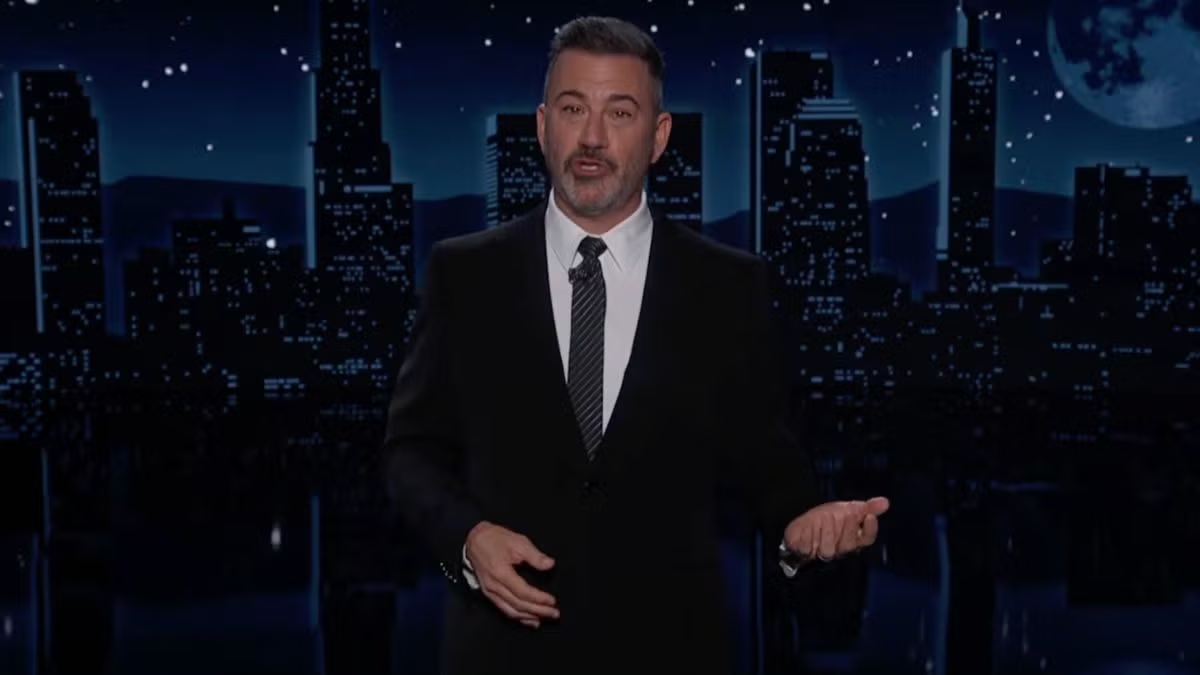
Jimmy Kimmel torched Elon Musk after the Tesla CEO had a meltdown over Christopher Nolan casting Lupita Nyong’o as Helen of Troy in “The Odyssey.”
The comedian weighed in on Musk’s outrage during Tuesday’s monologue for “Jimmy Kimmel Live!,” where he suggested Musk “stay in [his] lane” after bemoaning the fact that Helen of Troy was being played by a Black woman.
“Elon Musk is now attacking Christopher Nolan, the film director, for the way he cast the movie ‘The Odyssey,’” Kimmel said. “He’s upset because Christopher Nolan hired Lupita Nyong’o to play a character he believes should be played by a white woman.”
Kimmel then read out Musk’s X post, in which he claimed Nolan “desecrated the Odyssey so that he would be eligible for an Academy Award.” As the late night host highlighted, Musk then followed this up with the following rant: “Who specifically is the a–hole who added DEI lies to Academy Awards eligibility instead of it just being about making the best movie?”

“That’s a good question. While we’re at it, who specifically is the a–hole who thought this was a cool design for a truck?” Kimmel hit back. “I mean, stay in your lane.”
As Kimmel went on, he noted that Musk wasn’t alone in his stance, as it had become “a thing now.”
“Rob Finnerty from Newsmax — this guy’s a beauty — he was so upset he devoted a whole segment to it,” Kimmel said before playing footage of Finnerty’s broadcast, in which he confidently declared “Helen of Troy was not Black.”
“Well, here’s something that might surprise you, Rob. Helen of Troy was also not real,” Kimmel ripped. “‘The Odyssey’ is a mythical poem. There was no Helen of Troy. She was mythical, like Santa Claus or election fraud … It doesn’t matter what color a myth is.”
He continued: “And if you really want to get into it, Helen of Troy was half bird. Helen was the daughter of Zeus — and these, Rob, are not photographs, these are drawings — who disguised himself as a swan so he could mate with a human woman who then laid an egg and out hatched Helen of Troy, who, again, was not a real person. This is not history. This is made up. She was pretend. So it makes no difference to anyone but crazy angry people what color she was.”
Before moving on, Kimmel joked that people should really be “mad at the loser they cast to play Odysseus,” referencing his decades-long “feud” with Matt Damon.
Watch Kimmel’s full monologue above.
“Jimmy Kimmel Live!” airs weeknights at 11:35 p.m. ET on ABC.

>

The Hollywood Reporter is a part of PMX Global, LLC, a subsidiary of Penske Media Corporation. © 2026 The Hollywood Reporter, LLC. All rights reserved.
THE HOLLYWOOD REPORTER is a registered trademark of The Hollywood Reporter, LLC.
>
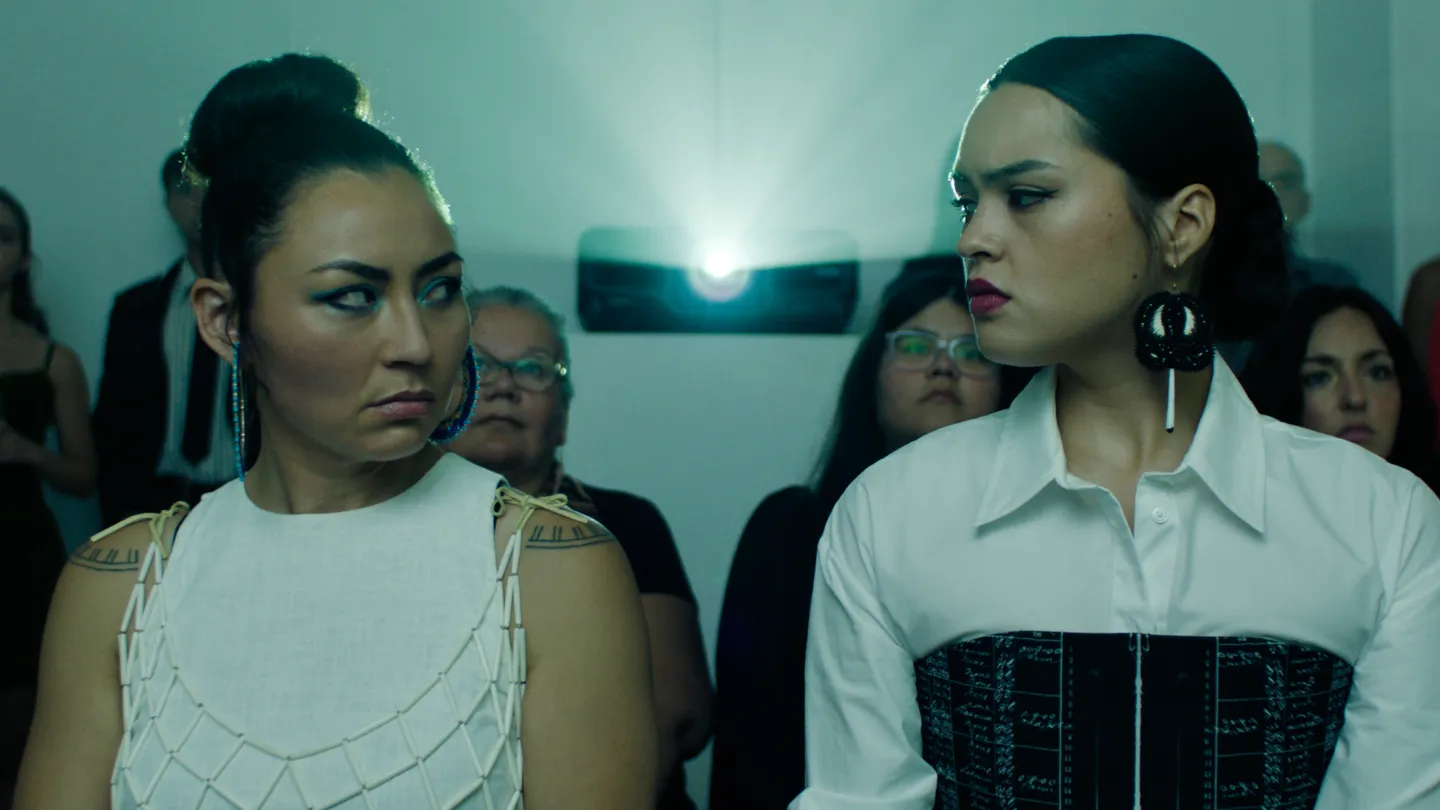
Nyla Innuksuk’s supernatural thriller In the Heart of the South is the latest Canadian indie aiming to reclaim indigenous storytelling and representation in movie theaters.
“From the outside world, we’ve been told who we are, constantly, and we’re sitting here, drowning, trying to be, ‘Please hear us!’” the Iqaluit-born Innuksuk tells The Hollywood Reporter from the Vancouver Film Festival, where her second feature that explores indigenous pain being exploited by a white-dominated entertainment industry is screening on Sunday.
In the Heart of the South centers on Yura Ivalu, a young Inuk artist played by Anna Lambe (True Detective) who takes Toronto’s art world by storm. But the offer of a big movie deal has Ivalu stuck between two worlds as an indie Canadian producer, The Quiet Loud, encourages her to dredge up a childhood trauma to boost future box office.
And Ivalu’s artistic ambitions only spiral out of control when an estranged childhood friend, Sesi, played by Zorga Qaunaq, shows up in Toronto to crash her glamorous party scene and movie ambitions. Innuksuk underlines the moral dilemma she and other indigenous filmmakers face as Ivalu, beset by deep-seated fears, has to choose between telling stories prized by the Canadian film industry around trauma and tragedy, or going beyond colonial stereotypes to represent her Inuit community and legends with authenticity and truth.
“For other people to be telling us what kind of story we should tell — give me a break. You’ve been telling our stories forever,” Innuksuk said of the wider film business. The moral quandary that underpins In the Heart of the South is aggravated by The Quiet Loud threatening to hijack Ivalu’s indigenous voice, and Sesi claiming Ivalu has stolen her truth about what happened when, together as children, they went missing in the cold and dark of an Iqaluit snowstorm.
“Sesi is just wanting (Ivalu) to finally tell her story in a way that is truthful, where she isn’t this perfect victim, or maybe this is just an evolution of her skills at being the perfect victim, and this is just another performance,” Innuksuk says of her sophomore feature that, like her first feature, Slash/Back, she co-wrote with Ryan Cavan. The irony of the overlapping traumas Ivalu and Sesi face is that Lambe and Qaunaq both star in the Netflix and CBC Inuit-led comedy North of North, a crowd-pleaser about an intimately connected Inuit community in Nunavut now headed to a second season.
But that’s comedy. With In the Heart of the South, the motivations of the thriller’s main characters, Ivalu and Sesi, spring from widespread trauma in communities like Nunavut and across Canada among its First Nations peoples. “Everyone has been affected in different ways by colonization, in particular the residential schools system,” Innuksuk explains.
Here, many Canadian indigenous movies are set against the background of the country’s infamous residential schools scandal, where around 150,000 First Nations kids — including Innuksuk’s own father — were taken from their families and compelled to live in schools run by the federal government and the Catholic church.
At a time when documented testimonies of 38,0000 Canadian residential school survivors are set to be destroyed in 2027 on privacy grounds, and there’s an upswing in residential school denialism, Innuksuk raises the possibility that indigenous history and truth could be lost.
She adds, however, that a movie that centers on the residential schools’ trauma is not for her as a filmmaker to tell. Instead, Innuksuk remains drawn to the horror genre for allowing her to use metaphors and monsters and darkness to put conversations about uncomfortable truths in front of audiences.
That also gets her away from expectations from the Canadian industry itself, as faced by Ivalu in her film. “When I work within institutions in Canada, I just got the sense they wanted to be able to say they were working with an Inuk director,” Innuksuk explains.
That’s in the tradition of Zacharias Kunuk’s 2001 Cannes Camera d’Or-winning feature Atanarjuat: The Fast Runner, which was written, directed and acted — including by Innuksuk’s father — entirely in the Inuktitut language and launched a global movement in indigenous film.
Kunuk lives in Igloolik, where Innuksuk grew up. “These are people I know and it was so great seeing Zach getting to tell his story in his way,” she recalls as Atanarjuat adapted an ancient Inuit legend. And as her genre filmmaking career evolves, Innuksuk, as she is widely supported by the Canadian film industry and its main funders, insists she too has had the luxury to express her artistic voice.
She argues, “The ability to tell something and not have it edited or be told that it’s too this or too that, it’s like freedom, to be able to speak and be heard.”
>

On Monday, Tom Cruise gamely signed autographs and posed for pictures outside The Directors Village for the Los Angeles premiere of “Digger,” flashing the confident smile that had made him a screen legend.
Yet, long before Cruise hit the red carpet alongside Warner Bros. film chiefs Michael De Luca and Pamela Abdy, who he praised for greenlighting “Digger” without needing to turn a page of its script, it was clear that the movie was going to flop. It was too dark, too weird, too critically excoriated. Opening weekend projections kept getting revised downward no matter what Cruise did to hawk the satire — dancing through Jennifer Hudson’s “spirit tunnel,” explaining the finer points of VistaVision to the Kelce brothers, or talking about aging in a completely normal way with GQ.


But few could have anticipated just how badly the film would bomb. Well, “Digger” is DOA, having opened to a disastrous $8 million this weekend. It debuted far below the weekend’s other new release, “Verity,” an adaptation of a Colleen Hoover novel that critics have lambasted en route to its $32.6 million opening, and was also outgrossed by holdovers like “Resident Evil” and “Primetime.” International audiences, which typically show up for Cruise flicks, also aren’t buying tickets. It grossed $12 million from 74 markets to bring the global haul to a pallid $20 million. The only hope here is that “Digger” can reemerge as an awards contender, an improbable outcome, but one that would provide greater cultural value.
As it stands “Digger,” which officially cost $125 million to produce (sources peg the true price tag at closer to $160 million), needs to make roughly $350 million theatrically to break even. Warner Bros., which backed the film with Legendary, has put the breakeven point at $300 million. That means “Digger” is staring at a loss of $150 million or more, according to two executives with knowledge of its finances. For context, theaters keep half of ticket sales and Warner Bros. spent tens of millions to market “Digger.”
The result is “Digger” will go down as one of the biggest, if not the biggest flops of Cruise’s career. He’s had a few — “The Mummy,” for instance, lost $95 million and killed Universal’s Dark Universe ambitions in their cradle. The most recent Cruise film to open softer than “Digger,” the 2007 political thriller “Lions for Lambs,” was another disappointment, though it only cost $35 million to make. The film itself is a historic bomb, keeping company with the likes of “John Carter,” “Cutthroat Island,” and “The Lone Ranger.”
As for De Luca and Abdy, they’re still on the Warners lot, but they won’t be for long. The studio’s new owner, David Ellison, let them know Friday after it had already been widely reported in the trades that they wouldn’t continue in their roles after Skydance assumes control and merges the company with Paramount. And the film’s massive losses will justify a pivot that felt inevitable as soon as word broke that Ellison was making a play for Warner Bros. — fewer “Diggers,” more “Days of Thunder 2’s.”
Sadly, the mogul may be right from a financial perspective. De Luca and Abdy were the most auteur-friendly of studio chiefs, giving Paul Thomas Anderson, Maggie Gyllenhaal, Ryan Coogler, and Alejandro González Iñárritu the kind of budgets they would have struggled to secure elsewhere.
Sometimes, their bets paid off. Few would question the wisdom of the “Sinners” deal they made with Coogler returning the film’s copyright, though they did initially. After all, “Sinners” was a huge hit. More recently, De Luca and Abdy’s ambitious gambits have failed to reap profits. Gyllenhaal’s “The Bride!” and Iñárritu’s “Digger” are among the decade’s biggest money losers, while Anderson’s “One Battle After Another” was an Oscar-winning write-down. When “One Battle After Another” swept the Academy Awards, a Paramount executive reminded me of their different mandate. “We don’t lose $100 million to win Best Picture,” the exec scoffed.
That may be good news for Skydance’s shareholders, who are understandably worried about how Ellison is going to operate two entertainment giants while paying down $80 billion in debt, but it won’t be great for cinephiles. Love it or hate it, “Digger” is a bold swing. Iñárritu’s dark look at corporate greed and climate change arrives with lots of big ideas to unpack, and Cruise gives the kind of go-for-broke performance that he largely abandoned to play an action hero. It may be a while before moviegoers see him in this mode again.
As for Cruise, he may have praised De Luca and Abdy’s chutzpah, but he also is very familiar with Ellison, having made “Top Gun: Maverick” and several “Mission: Impossible” films with Skydance. He’s already given the merger his blessing, telling Pat McAfee that bringing together Warner Bros. and Paramount will lead to “abundance.”
“They’re going to deliver 30 movies. It’s a community to me. It’s not an industry. The people in these studios are not just people in the studios, they’re my family,” Cruise told McAfee. “I know we’re going to get those 30 movies. I want us all to come together as a community to help make those 30 movies. It’s not just going to be Paramount doing it. Everyone’s going to need all the help of every artist to be able to do it.”
According to a report in TheWrap, when Abdy and De Luca got the call from Ellison telling them that they were out of the family, they had a tart response.
“Good luck to you,” Abdy told Ellison with some bitterness. “I left you 39 movies.”
But is it a slate filled with more “Sinners” than “Diggers”?
>
Fantasy football Week 4 sleepers: Geno Smith, Marvin Harrison and 3 more sneaky plays

Manchuria Opium Squad Manga Gets Anime – News

Shenzhen Open: Wu Yize wins first ranking title since he became world champion with 10-5 victory over Yuan Sijun
-

 movies4 months ago
Search For Canadian TV Actor Stewart McLean Now Homicide Investigation
-

 Fashion9 years ago
These ’90s fashion trends are making a comeback in 2017
-
Fashion9 years ago
According to Dior Couture, this taboo fashion accessory is back
-
Fashion9 years ago
Model Jocelyn Chew’s Instagram is the best vacation you’ve ever had
-
Fashion9 years ago
Emily Ratajkowski channels back-to-school style
-
Fashion9 years ago
9 Celebrities who have spoken out about being photoshopped
-

 Anime4 months ago
Rurouni Kenshin: Hokkaido Arc Manga Takes 1-Issue Break – News
-

 Anime3 months ago
HIDIVE to Stream English Dubs for The World Is Dancing, The Forsaken Saintess and Her Foodie Roadtrip in Another World, The Dangers in My Heart: The Movie Anime – News