
Callum Turner and Monica Barbaro at the One Night Only premiere on Monday.
Roy Rochlin/Getty Images for Universal Pictures


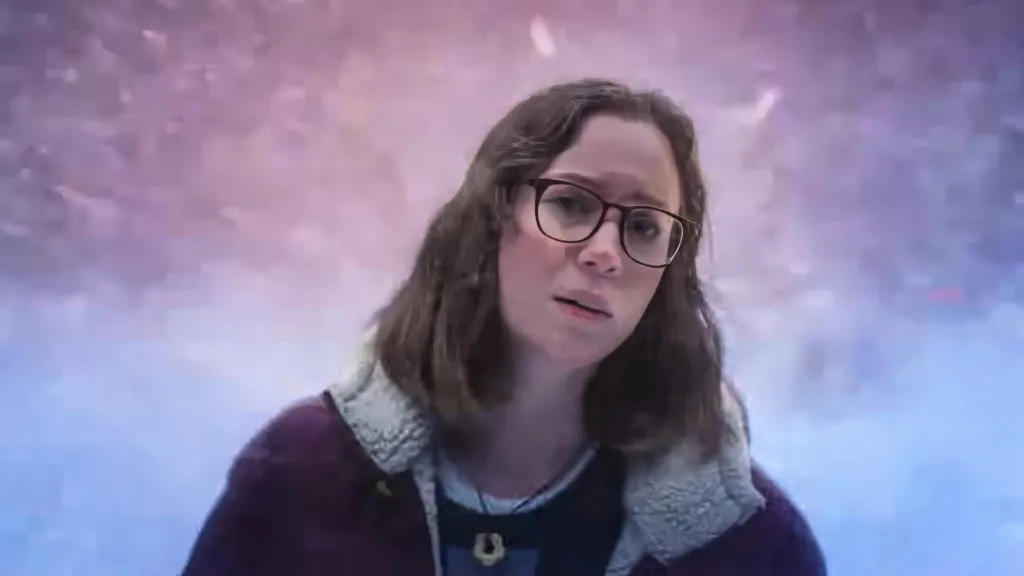
Paula is slammed. Her boss is dangling a promotion in the hopes of stretching her 40-hour workweek to new, unhealthy limits. Her ex-husband is suing her for custody of their adolescent daughter, with the intention of moving them both from Queens, New York to Boise, Idaho. She just got a new apartment that needs to be furnished and decorated before her kid can sleep over, and her to-do list is still overrun with school drop-offs and pick-ups, soccer practices (which need a new coach), and bake sale treats (which need, you know, baking).
So can you blame her for spending six minutes on herself? For a little fun? For a few brief seconds of pleasure? When we first meet Paula (Tatiana Maslany), she’s trying to set up her cable box, and decorate the apartment, and eat dinner, while squeezing in a video chat with a young man who sounds like an old friend. Trevor (Brandon Flynn) mocks Paula for remaining corded in a cord-cutting TV world, he goads her for hanging a painting of a goat on the wrong wall, and he reassures her that she’s doing everything she can, as well as she can do it.


“Beginnings are the hardest part,” Trevor says.
“No, endings are the hardest part,” Paula says. “Beginnings are full of promise. Like, maybe just this one time instead of getting fisted by the giant puppeteer in the sky, I’ll find love or happiness, or maybe even just a $20 bill on the ground. But then, if this is the good, happy part of my life, I may as well just cut it short and take a bath with the toaster.”
As her unburdening reaches its fraught nadir, one more truth tumbles out: Trevor’s not an old friend. He’s not really a friend at all. He’s a cam boy, and the virtual boyfriend experience he’s providing Paula only lasts as long as she’s willing to feed the meter. When he warns her they’ve only got six minutes left, she chooses a quickie over re-upping for another hour.
Be that because she doesn’t have time to keep video-chatting or can’t afford to indulge in an extended session, “Maximum Pleasure Guaranteed” makes it clear Paula’s going to have to pay, one way or another, for whatever pleasure she can get. She’ll have to pay with the money she makes from one of the last salaried fact-checking jobs on the planet. She’ll have to pay with the time she could otherwise devote to her daughter, or her career, or her friends. She’ll have to pay with her lack of time and her lack of money, too, by squeezing her hard-won leisure hour into six minutes.
Ain’t that just the way of the world?
Before one of Paula’s few real-life friends can tell her to touch grass, her situation goes from identifiably overextended to overtly terrifying. During their next session, Trevor is attacked. The masked man who beats Trevor up on camera soon gains access to his files, which include recordings of his conversations with Paula, and threatens to expose them to the world if she doesn’t pay up. Considering that “frequenting a virtual sex worker” wouldn’t look too good on a court document, let alone in her daughter’s impressionable mind, Paula has a choice to make: back down or step up?
And, despite Paula’s jam-packed slate, what kind of thriller would “Maximum Pleasure Guaranteed” be if she chose the former?

David J. Rosen’s half-hour drama balances its two halves well — the heightened anxiety of living under a deluge of life-changing (or life-ending) catastrophes, and the peculiar persistence of “ordinary” activities. Relatively minor demands like editorial deadlines and laundry duty seem insane to focus on when you just found a dead body or are in the midst of unraveling a corporate conspiracy. But is doing so any more insane than punching the clock, picking up your dry cleaning, or whatever else you did during our most recent countdown to nuclear annihilation?
“Maximum Pleasure Guaranteed” serves as an exaggerated allegory for modern life slammed into a straightforward chronicle of it — and, as a hat-tip to the series’ accuracy, sometimes it’s hard to tell the two apart. Rosen, the former “Hunters” and “Citadel” writer, keeps the pace up and the preaching down, trusting an affable cast with a twisty, steadily expanding story, rather than forcing them to make big speeches about how hard it is to just have fun in 2026, even when it’s more necessary than ever, even if it’s just for six minutes.
We all need a break. More to the point, we all need help, and Paula’s not getting it from her ex, Karl (Jake Johnson), who’s so focused on building a new life with his co-worker turned romantic partner Mallory (Jessy Hodges), that he doesn’t want to consider the life his ex-wife is still living; she’s also not getting any help from her manipulative boss, Suzie (Tara Summers), although her fellow fact-checkers, Rudy (Charlie Hall) and Geri (Kiarra Hamagami), offer support when they can; and she’s certainly not getting any help from the social safety nets designed to keep innocent people from losing everything at the hands of evil, uncaring assholes. (I can’t get into who embodies the toxic reach of private equity without spoiling the season’s early twists, but you’ll know evil when you see it.)
Paula is, as she tells a callous cop looking to quickly close her case, “a regular fucking person” caught in an extraordinary situation. Getting scammed online may not make her unique, but blackmail, murder, and conspiracy elevate her nightmarish experience enough to capture the harrowing feeling of living through unprecedented times. Such a relatable perspective proves potent, as Paula’s deft (and not-so-deft) juggling of the actually serious and subjectively serious grows more and more panicked, her problems grow more and more dire, and her solutions grow further and further out of reach.
Lassoing them all together is Maslany, an actor whose Emmy-winning performance playing multiple clones in “Orphan Black” (and a larger-than-life lawyer in Marvel’s “She-Hulk”) highlights her chameleonic prowess and magnetic screen presence, while de-emphasizing her more traditional strengths as a dramatic actor: She listens attentively. She reacts appropriately. She can take a big speech and deliver it with a frankness that makes you believe she thought it all up on the spot, and she can hold a small silence with such dynamic emotion you can’t look away. Paula may be a regular person caught in an extraordinary situation, but Maslany never lets the latter overwhelm the former — she doesn’t try to make any moment bigger than it feels, and in doing so, she draws you into Paula’s plight with empathetic conviction.
At midseason, “Maximum Pleasure Guaranteed” can feel a bit stretched. Not every character gets the thoughtful unpacking they deserve, and it’s unclear if the premise is sustainable as a series. (I’m tempted to advise everyone to turn off Episode 10 before the last-second cliffhanger hits.). But the overall execution is solid (everything makes way more sense than recent “average folks do crime” shows like “Big Mistakes” and “Imperfect Women.”), the cast is charming (shout-out to Julia Louis-Dreyfus’ son, Charlie Hall, for escaping Ryan Murphy-land), and the parallels between Paula’s experience and our own prove unmistakable, persuasive, and cathartic. If buying a streaming subscription counts as paying for pleasure, your satisfaction with “MPG” is all but, well, you know.
“Maximum Pleasure Guaranteed’ premieres Wednesday, May 20 on Apple TV with two episodes. New episodes will be released weekly through the finale on July 15.
>
With their latest directorial outing, Jane Schoenbrun used subtle pieces of nostalgia to deconstruct the slasher genre.
The Teenage Sex and Death at Camp Miasma writer/director explained to Deadline that they wanted to create “a mindset where you can really enjoy something scary,” noting the frequent symbolism of candy and junk food as providing an atmosphere “that’s actually safe” while diving into a horror movie or exploring sexuality after trauma.
“There is this idea that if it gets too real, you can turn it off, that you’re exploring something dangerous, doing it in a way that’s actually safe,” said Schoenbrun, who is non-binary. “Which in my experience of coming into my sexual identity post-transition, kind of required some gummy candy on hand. What I mean by that is, even if we’re going to be exploring scary and vulnerable and potentially embarrassing, triggering parts of ourselves, we trust each other well enough to know that at any moment, we can be like, ‘Let’s stop, we gotta just eat some fucking gummies.’”
In Schoenbrun’s latest film, Hannah Einbinder stars as queer director Kris, who is tapped to helm a new installment of the long-running Camp Miasma horror franchise. While courting Billy Presley (Gillian Anderson), the actress who played the “final girl” in the original film, to reprise her role, the pair spirals into a psychosexual frenzy as the slasher’s killer, Little Death (Jack Haven), comes to life.
Acknowledging the problematic trans representation of horror films like Psycho (1960), Sleepaway Camp (1983), The Silence of the Lambs (1991) and Texas Chainsaw Massacre: The Next Generation (1995), Schoenbrun admitted the genre has been “catnip to me since I was 10 years old,” and they jumped at the chance to direct their own.

“So many slashers do have this sense of humor, and even if they’re not overtly meta like the Scream movies are, they’re so aware of their own tropes and the sort of rituals … And I just loved that from a young age and loved all of the little rituals within it, and so, getting to make my own is just like play and joy,” they explained.
“But it also felt like the perfect way to talk about sex and to talk about my experience as a trans person post-transition, learning how to come into a sexual identity that I could feel comfortable within, because so many of these movies are obviously deeply engaged in gender and sexual roles, and these movies have so much to say for better or for worse about deviants,” said Schoenbrun. “It is there in the DNA of the slasher genre that these movies are talking about fear and desire, gender and sexuality, normativity and deviance. And that’s all swimming in the toxic soup of the genre, so I wanted to remake it in my own language.”
Read on about Jane Schoenbrun’s love letter to the slasher genre with Teenage Sex and Death at Camp Miasma, now playing in theaters.
DEADLINE: It was really fun to see the slasher genre through your eyes. Tell me about finding inspiration in that genre and “final girls.”
JANE SCHOENBRUN: I mean, it was the easiest thing in the world because it’s just one of those genres that has been catnip to me since I was 10 years old. I just raided the horror section of the video store as a kid from an age when I really shouldn’t have been doing that, like in 5th grade, I watched in the span of about one week, every Nightmare on Elm Street movie. I think that I was always drawn to movies and really anything entertainment where it felt forbidden in some way, like the thing on the tape, how is that even allowed? And that’s the thing that I love about a lot of my favorite slashers. Don’t get me wrong, I love like brutal ones, like I love Texas Chainsaw, that’s a nasty movie at its core, and that’s what’s so special about it. But so many slashers do have this sense of humor, and even if they’re not overtly meta like the Scream movies are, they’re so aware of their own tropes and the sort of rituals of, OK, what’s the most outrageous way that like these like dumb kids can get killed? But watching it, it’s not about fear a lot of the time, it’s about joy and celebration. And I just loved that from a young age and loved all of the little rituals within it, and so, getting to make my own is just like play and joy. But it also felt like the perfect way to talk about sex and to talk about my experience as a trans person post-transition, learning how to come into a sexual identity that I could feel comfortable within, because so many of these movies are obviously deeply engaged in gender and sexual roles, and these movies have so much to say for better or for worse about deviants, whether that be Norman Bates or Buffalo Bill or Sleepway Camp or Jason, Michael Myers, Leatherface in drag. It is there in the DNA of the slasher genre that these movies are talking about fear and desire, gender and sexuality, normativity and deviance. And that’s all swimming in the toxic soup of the genre, so I wanted to remake it in my own language.

DEADLINE: I’m curious about the symbolism of all the processed junk food and the chandelier of wrappers.
SCHOENBRUN: The junk food in the movie, I forget when it found its way in there. It’s like so much of the movie is about, like I said, ritual, about being in a mindset where you can really enjoy something scary, whether that be Kris [Hannah Einbinder] in bed, with, you know, with Raisinets and the popcorn, watching a schlocky horror movie, or the two characters learning how to be present and enjoy sex after a lot of trauma. There is this idea that if it gets too real, you can turn it off, that you’re exploring something dangerous, doing it in a way that’s actually safe. Which in my experience of coming into my sexual identity post-transition, kind of required some gummy candy on hand. What I mean by that is, even if we’re going to be exploring scary and vulnerable and potentially embarrassing, triggering parts of ourselves, we trust each other well enough to know that at any moment, we can be like, “Let’s stop, we gotta just eat some fucking gummies.”
DEADLINE: And one thing I really love—I just feel like it’s a theme in your work—is how it depicts the way media and entertainment influence us. Why does that inspire you?
SCHOENBRUN: I think it comes from a fascination and sensitivity to the complex relationship between what we think of as fiction and what we think of as reality, which we tend to, as a society, think of as pointing in one direction. Like, reality dictates fiction, not vice-versa, but when you actually look at the way the world works, it’s like one echoes off the other. And I think a complicated, sometimes terrifying and sometimes beautiful way, where the fiction, the cultural norms, the things we grow up looking at on our screens, the roles that we’re told people play, they kind of inspire us to create reality. There’s something liberating when you start thinking in that way. I think it’s a way of thinking that we as a culture, could do a lot more of. To think about the idea of fiction inspiring reality just as much as reality is inspiring fiction, is a potential path to liberating us from this hellscape that they’re telling us is the only way the world can be.

DEADLINE: And I know you have the Secretary reading. Tell me what it’s been like prepping for that and why you all chose that movie.
SCHOENBRUN: I mean, that was such a huge influence on on Miasma. There just aren’t that many fun and funny movies about deviant sex. And just the way that movie is like feather light while talking about really raw and taboo things, it is just really inspiring to me. And the dynamic between those two main characters is definitely one that had a lot of influence on on Kris and Billy’s [Gillian Anderson] relationship in Miasma. And it’s already to me a very queer movie in its way, but having Gillian reading the James Spader part and Hannah reading the Maggie Gyllenhaal part, I think it’s just gonna be like a very unique joy. Honestly, we’ve been prepping a little bit, but I think it’s just gonna be about getting up there and feeling the chemistry of it all, and just letting these folks who we have all gotten to know each other really, really well, but we haven’t actually done anything wacky and creative like that in a while, like as a reunion, it’s gonna be a real blast, I think.
>
With their latest directorial outing, Jane Schoenbrun used subtle pieces of nostalgia to deconstruct the slasher genre.
The Teenage Sex and Death at Camp Miasma writer/director explained to Deadline that they wanted to create “a mindset where you can really enjoy something scary,” noting the frequent symbolism of candy and junk food as providing an atmosphere “that’s actually safe” while diving into a horror movie or exploring sexuality after trauma.
“There is this idea that if it gets too real, you can turn it off, that you’re exploring something dangerous, doing it in a way that’s actually safe,” said Schoenbrun, who is non-binary. “Which in my experience of coming into my sexual identity post-transition, kind of required some gummy candy on hand. What I mean by that is, even if we’re going to be exploring scary and vulnerable and potentially embarrassing, triggering parts of ourselves, we trust each other well enough to know that at any moment, we can be like, ‘Let’s stop, we gotta just eat some fucking gummies.’”
In Schoenbrun’s latest film, Hannah Einbinder stars as queer director Kris, who is tapped to helm a new installment of the long-running Camp Miasma horror franchise. While courting Billy Presley (Gillian Anderson), the actress who played the “final girl” in the original film, to reprise her role, the pair spirals into a psychosexual frenzy as the slasher’s killer, Little Death (Jack Haven), comes to life.
Acknowledging the problematic trans representation of horror films like Psycho (1960), Sleepaway Camp (1983), The Silence of the Lambs (1991) and Texas Chainsaw Massacre: The Next Generation (1995), Schoenbrun admitted the genre has been “catnip to me since I was 10 years old,” and they jumped at the chance to direct their own.
“So many slashers do have this sense of humor, and even if they’re not overtly meta like the Scream movies are, they’re so aware of their own tropes and the sort of rituals … And I just loved that from a young age and loved all of the little rituals within it, and so, getting to make my own is just like play and joy,” they explained.
“But it also felt like the perfect way to talk about sex and to talk about my experience as a trans person post-transition, learning how to come into a sexual identity that I could feel comfortable within, because so many of these movies are obviously deeply engaged in gender and sexual roles, and these movies have so much to say for better or for worse about deviants,” said Schoenbrun. “It is there in the DNA of the slasher genre that these movies are talking about fear and desire, gender and sexuality, normativity and deviance. And that’s all swimming in the toxic soup of the genre, so I wanted to remake it in my own language.”
Read on about Jane Schoenbrun’s love letter to the slasher genre with Teenage Sex and Death at Camp Miasma, now playing in theaters.
DEADLINE: It was really fun to see the slasher genre through your eyes. Tell me about finding inspiration in that genre and “final girls.”
JANE SCHOENBRUN: I mean, it was the easiest thing in the world because it’s just one of those genres that has been catnip to me since I was 10 years old. I just raided the horror section of the video store as a kid from an age when I really shouldn’t have been doing that, like in 5th grade, I watched in the span of about one week, every Nightmare on Elm Street movie. I think that I was always drawn to movies and really anything entertainment where it felt forbidden in some way, like the thing on the tape, how is that even allowed? And that’s the thing that I love about a lot of my favorite slashers. Don’t get me wrong, I love like brutal ones, like I love Texas Chainsaw, that’s a nasty movie at its core, and that’s what’s so special about it. But so many slashers do have this sense of humor, and even if they’re not overtly meta like the Scream movies are, they’re so aware of their own tropes and the sort of rituals of, OK, what’s the most outrageous way that like these like dumb kids can get killed? But watching it, it’s not about fear a lot of the time, it’s about joy and celebration. And I just loved that from a young age and loved all of the little rituals within it, and so, getting to make my own is just like play and joy. But it also felt like the perfect way to talk about sex and to talk about my experience as a trans person post-transition, learning how to come into a sexual identity that I could feel comfortable within, because so many of these movies are obviously deeply engaged in gender and sexual roles, and these movies have so much to say for better or for worse about deviants, whether that be Norman Bates or Buffalo Bill or Sleepway Camp or Jason, Michael Myers, Leatherface in drag. It is there in the DNA of the slasher genre that these movies are talking about fear and desire, gender and sexuality, normativity and deviance. And that’s all swimming in the toxic soup of the genre, so I wanted to remake it in my own language.
DEADLINE: I’m curious about the symbolism of all the processed junk food and the chandelier of wrappers.
SCHOENBRUN: The junk food in the movie, I forget when it found its way in there. It’s like so much of the movie is about, like I said, ritual, about being in a mindset where you can really enjoy something scary, whether that be Kris [Hannah Einbinder] in bed, with, you know, with Raisinets and the popcorn, watching a schlocky horror movie, or the two characters learning how to be present and enjoy sex after a lot of trauma. There is this idea that if it gets too real, you can turn it off, that you’re exploring something dangerous, doing it in a way that’s actually safe. Which in my experience of coming into my sexual identity post-transition, kind of required some gummy candy on hand. What I mean by that is, even if we’re going to be exploring scary and vulnerable and potentially embarrassing, triggering parts of ourselves, we trust each other well enough to know that at any moment, we can be like, “Let’s stop, we gotta just eat some fucking gummies.”
DEADLINE: And one thing I really love—I just feel like it’s a theme in your work—is how it depicts the way media and entertainment influence us. Why does that inspire you?
SCHOENBRUN: I think it comes from a fascination and sensitivity to the complex relationship between what we think of as fiction and what we think of as reality, which we tend to, as a society, think of as pointing in one direction. Like, reality dictates fiction, not vice-versa, but when you actually look at the way the world works, it’s like one echoes off the other. And I think a complicated, sometimes terrifying and sometimes beautiful way, where the fiction, the cultural norms, the things we grow up looking at on our screens, the roles that we’re told people play, they kind of inspire us to create reality. There’s something liberating when you start thinking in that way. I think it’s a way of thinking that we as a culture, could do a lot more of. To think about the idea of fiction inspiring reality just as much as reality is inspiring fiction, is a potential path to liberating us from this hellscape that they’re telling us is the only way the world can be.
DEADLINE: And I know you have the Secretary reading. Tell me what it’s been like prepping for that and why you all chose that movie.
SCHOENBRUN: I mean, that was such a huge influence on on Miasma. There just aren’t that many fun and funny movies about deviant sex. And just the way that movie is like feather light while talking about really raw and taboo things, it is just really inspiring to me. And the dynamic between those two main characters is definitely one that had a lot of influence on on Kris and Billy’s [Gillian Anderson] relationship in Miasma. And it’s already to me a very queer movie in its way, but having Gillian reading the James Spader part and Hannah reading the Maggie Gyllenhaal part, I think it’s just gonna be like a very unique joy. Honestly, we’ve been prepping a little bit, but I think it’s just gonna be about getting up there and feeling the chemistry of it all, and just letting these folks who we have all gotten to know each other really, really well, but we haven’t actually done anything wacky and creative like that in a while, like as a reunion, it’s gonna be a real blast, I think.
>

Ever since the official trailer dropped for the Callum Turner–Monica Barbaro rom-com One Night Only, quickly racking up millions of views on its way to its nearly 40 million total, internet commentators have had a lot of questions about the film’s central premise in which premarital sex is illegal apart from one 12-hour period a year.
How is this law enforced? Are people breaking the law? How did this legislation pass? What counts as “sex” under this new mandate? Are marriage (and divorce) rates skyrocketing? What about affairs?
Rest assured: Some of those questions are answered in the movie, and explanations are starting to trickle out online for those unconcerned about spoilers. Beyond that, One Night Only writer, Travis Braun, who saw his screenplay top the 2024 Black List, has answers, but they’re not all in the Will Gluck-directed Universal movie now in theaters.
“I set out to write a movie about the circus that is modern dating, and I thought how fun if we could set that all in one night, and I have answers to those questions, and some of them are in the movie,” Braun told The Hollywood Reporter at the One Night Only premiere earlier this week in New York.
Braun said he definitely thought about the specific rules of the film’s alternate reality, framed as three years on from the no-sex act being passed, but didn’t want to get too deep into the politics of the world of the movie.
“There’s a big mythology that I’ve built out and then as you develop a movie you start to pare down and you go: What does an audience really care about, and what are they showing up to see? For me the answer is always a love story, romance,” he told THR. “I hope they can come in and we’ll show them how this world functions, and then they can just enjoy the movie and have fun. The whole focus of this was love story and romance first, and the world-building obviously has to make sense and has to be there, but ultimately we weren’t interested in getting into the politics of it. We wanted to tell a story about these two incredible people trying to find love on this crazy night.”
Producer Jacqueline Monetta, who brought Braun’s script to Gluck, said they didn’t want moviegoers to have all of the answers.
“I had a million questions. I was like, ‘What does this mean? What does this world look like? How do people communicate? What’s different?’ And that’s I think what’s so smart about it,” she said of One Night Only‘s “big idea, high-concept” premise. “We don’t answer every question in the movie, purposefully, because we want those questions to be had on the car ride home. We want people to keep talking about it and really think about what would this mean for our world, what does it mean for our world now. But I think Will and I were really specific on what questions we wanted to answer.”
In a recent Reddit AMA, Gluck also detailed how he and his team approached the world building of the movie while not wanting it to be all about the mandate and offered prospective moviegoers hints for where to find the answers to their questions.
“We spent a lot of time talking about the rules of the world, and if you’ve seen the movie, or when you see the movie, you’ll see that the rules of the world and the world building are all in the background,” he said. “It’s on TVs, signage, in thrown-away lines, because we didn’t want to give the world short shrift, but we didn’t want the movie to be about that. It’s another way I want people to see this. If they see it more than once, they’ll pick up so many more rules of the world in the background. A lot of the questions that I’ve been getting after people have seen the movie are actually answered in the movie, which is by design because I want people maybe not to know them. So, yes, it was a tricky tightrope to have them there, but not for the movie to be about it.”
Turner meanwhile echoes Braun’s advice for curious prospective moviegoers: “Go see the film!”
“You’ll realize pretty quickly what the realm is that you’re working within and it’s a comedy,” Turner says of what inquisitive filmgoers will find. “There are no great political undertones, I don’t think. This is just a place where you can escape for an hour and a half, two hours and enjoy and laugh your head off.”
One Night Only is now in theaters.
Callum Turner and Monica Barbaro at the One Night Only premiere on Monday.
Roy Rochlin/Getty Images for Universal Pictures
>


Search For Canadian TV Actor Stewart McLean Now Homicide Investigation


These ’90s fashion trends are making a comeback in 2017
According to Dior Couture, this taboo fashion accessory is back
Model Jocelyn Chew’s Instagram is the best vacation you’ve ever had
Your comprehensive guide to this fall’s biggest trends
9 Celebrities who have spoken out about being photoshopped
Emily Ratajkowski channels back-to-school style
A photo diary of the nightlife scene from LA To Ibiza