
Tech
Startup Battlefield 200 applications close May 27

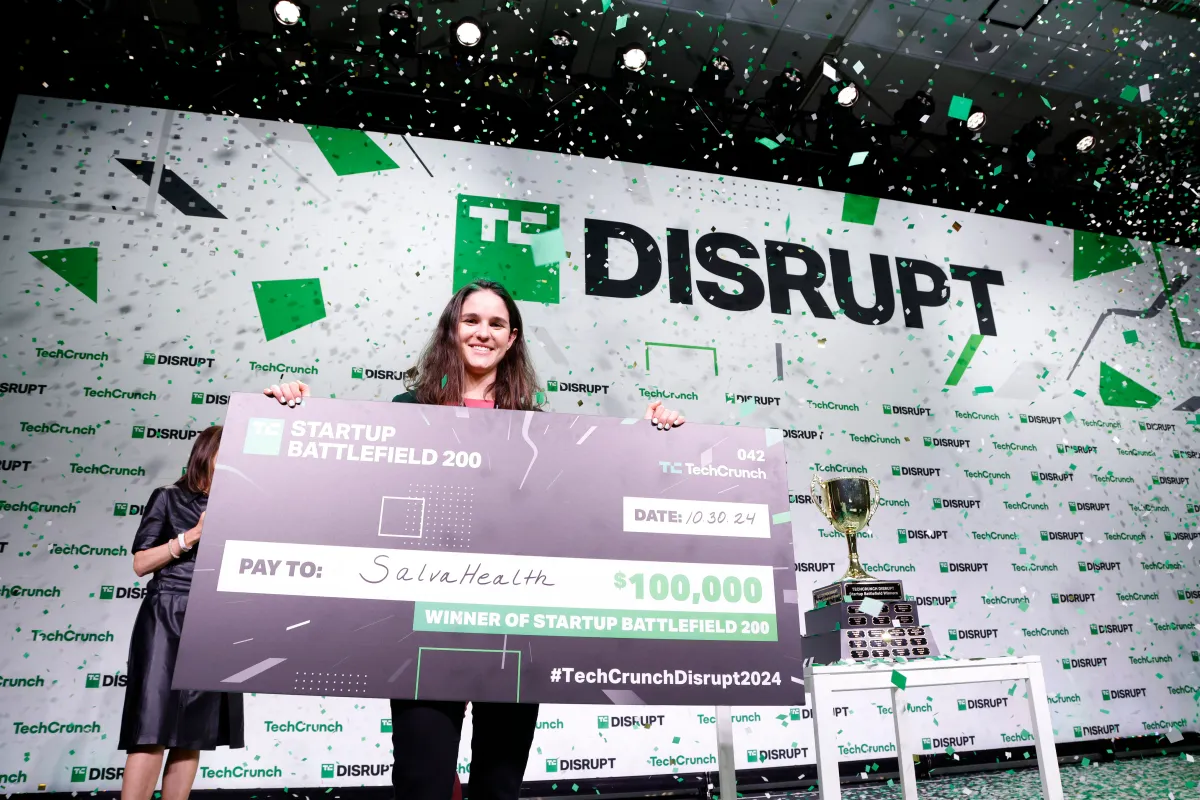
Your shot at VC access, global visibility, TechCrunch coverage, and $100,000 in equity-free funding is gone in a week.
Startup Battlefield 200 applications close May 27. If you’re building a breakout startup — or know a founder who is — this is the moment to act.
Apply today for the opportunity to take the stage at TechCrunch Disrupt 2026, taking place October 13-15, alongside 200 of the world’s most promising early-stage startups.

The clock is ticking for early-stage founders
Pre-Series A founders, consider this your final countdown reminder: The strongest startups are already entering the arena, and the application window is closing fast.
If your startup has already been nominated, don’t wait to complete your application. This final week moves quickly, and last-minute submissions risk getting buried as applications surge ahead of the deadline.
Know a startup that deserves the spotlight? Nominate them now so they still have time to apply before May 27.
The companies that define categories rarely start polished
Some of the most consequential companies in tech history didn’t launch with splashy fundraising announcements. They started with a pitch.
Dropbox demoed to a room full of skeptics. Cloudflare took the stage before most people understood what edge networking meant. Discord was still a scrappy gaming startup called Hammer & Chisel.

They all passed through the same crucible: Startup Battlefield 200. That’s not a coincidence — it’s a pattern. And it starts with an application.
Startup Battlefield 200 has never been a competition for the most polished companies. It’s a competition for the most promising ones. Pre-launch is fine. No revenue is fine. What matters is whether what you’re building genuinely changes something — not incrementally, but meaningfully.
If you or a founder you know is building something impactful, then the application itself becomes the first pitch. Apply before May 27.
More than a pitch competition
Startup Battlefield 200 is where breakout companies get discovered.
Selected startups will showcase live on the Disrupt Stage in front of 10,000+ attendees, leading VCs, global media, and the broader TechCrunch audience. This is your opportunity to gain investor exposure, receive direct VC feedback, and prove your company belongs among the next generation of category-defining startups.
Every one of the 200 selected companies receives:
- A fully funded three-day exhibition booth at Disrupt.
- Free passes for the team.
- Dedicated pitch training.
- Founder masterclasses with world-class VCs and operators.
- A featured startup profile in the event app.
- Press list access and lead-generation opportunities.
- Opportunities for TechCrunch editorial coverage, podcasts, and speaking appearances as the company grows.
And every selected company pitches, whether on the Disrupt Stage or the Pitch Showcase Stage. Both put founders in front of the investors, media, and partners who attend Disrupt specifically to find what’s next.
You don’t need to make the top 20 for this experience to change your trajectory. Get started by nominating and applying here.
The Startup Battlefield 200 track record speaks for itself
More than 1,700 companies have competed in Startup Battlefield 200. Together, they’ve raised over $32 billion and generated more than 250 exits, including acquisitions by Microsoft, Google, Salesforce, Uber, and Amazon.
The network runs so deep that alumni have even acquired each other: Dropbox acquired fellow Battlefield 200 alum DocSend in 2021.
This is also the same launchpad that helped accelerate companies like Fitbit, Trello, and Mint.
Behind every one of those outcomes was a founder willing to make a bet on themselves publicly, in front of people who were paying attention. Apply and learn more here.
Who should apply?
We’re looking for ambitious early-stage startups building innovative, potentially category-defining products.
Applications are open globally across all industries. Most selected companies are pre-Series A, though select Series A startups may qualify on a case-by-case basis.
To apply, startups should have:
- Founders with vision, execution, and real traction.
Thousands apply every year. Only 200 are selected. Just 20 finalists pitch live on the Disrupt Stage. One startup takes the crown and wins $100,000 in equity-free funding.
One week left to make your move
The founders who wait until they feel ready often wait too long. You do not need to be polished. You need to be promising.
If you’ve been sitting on this, here’s the reality: The worst outcome is you don’t get selected this cycle — and you come back next year with a stronger application because you went through the process.
The stage matters. The community lasts. The milestone is real. But the deadline is now one week away.
If you’re building something category-defining — or know a startup that deserves the spotlight — submit your nomination and complete your application before May 27.

When you purchase through links in our articles, we may earn a small commission. This doesn’t affect our editorial independence.
>

Situational Awareness may have had to sell off the majority of its public portfolio last month, but the AI-focused hedge fund is still making some big bets.
This week, the fund invested $400 million into Source Foundry, a startup founded by Stanford researchers aiming to make chip manufacturing faster and cheaper, according to The Wall Street Journal. That brings its total investment in Source Foundry to $500 million.
Situational Awareness was founded by Leopold Aschenbrenner, a former OpenAI researcher in his mid-twenties who had no trading experience when he launched the fund in 2024. Early returns were reportedly strong, but the fund faced steep losses in recent months amidst the decline in AI infrastructure stocks.
At the end of July, Situational Awareness sold off the majority of its public portfolio to Ken Griffin’s Citadel, although the fund held on to its Anthropic shares. Its assets under management reportedly fell from $20 billion to $10 billion.
On the bright side, Aschenbrenner didn’t let those setbacks get in the way of his wedding.
>

Programming with Claude Code will soon require even less human oversight, as Anthropic says it’s making auto mode the default for Pro, Max, and Team accounts, starting on August 14.
The company first unveiled a test version of auto mode in March, pitching it as a way to balance speed and control. As Anthropic explained in its announcement on Friday, when Claude Code is in auto mode, instead of presenting prompts asking for human approval at each step, it will proceed unless an action is determined to be “irreversible, destructive, or aimed outside your environment.”
Anthropic also said that in testing, auto mode proved safer than manual review — in a study with 1,053 paid testers, auto mode caught 89% of harmful actions, while human review only caught 13.6%. (Perhaps that’s because “manual review can become habitual: users approve 97% of permission prompts in Claude Code.”)
In a post on X, Claude Code Head Boris Cherny said, “The team and I use Auto mode exclusively, and have been for many months. I couldn’t imagine going back to permission prompts!”
The company also said it’s been adding new safety features like prompt injection screening and customizable hard deny rules to prevent things like data exfiltration.
>

Welcome back to TechCrunch Mobility, your hub for the future of transportation and now, more than ever, the role AI is playing in it. To get this in your inbox, sign up here for free — just click TechCrunch Mobility!
In just a few days, Amazon-owned Zoox will start charging for robotaxi rides. This might not seem like a big deal; the company’s custom-built robotaxis are already giving rides to passengers in Las Vegas and San Francisco, after all. And it’s opening up an early rider program in Miami and Austin too.
None of this matters — in a business sense — until the company can operate commercially.
And now it can, starting August 10, thanks to an exemption issued by the National Highway Traffic Safety Administration (NHTSA). Because Zoox vehicles lack many of the traditional controls required under federal law, such as a steering wheel and pedals, it needed an exemption from federal motor vehicle standards in order to operate. It had an exemption that allowed it to demonstrate the technology; this one allows Zoox to operate a fleet of up to 2,500 vehicles commercially for two years.
The exemption is a win for Zoox, but it also paves the way for any other autonomous vehicle developer that wants to launch a robotaxi that lacks a steering wheel, pedals, or other requirements that might not be needed in a vehicle with no human driver. For instance, a robotaxi really doesn’t need a rearview mirror; it already achieves that kind of visibility with sensors on the exterior of the vehicle.
Tesla is the obvious beneficiary here since it is developing its two-seater Cybercab. But there will be others as well.
In other news, you might have missed my comprehensive assessment of Uber’s autonomous vehicle empire. Check it out; it offers a complete rundown of every company that Uber has partnered with (and in some cases invested in). And I hear more are coming.
You might recall that the Financial Times did its own calculus of how much Uber was investing in AVs. The outlet determined it was about $10 billion. And what do you know? That is exactly the number Uber CEO Dara Khosrowshahi shared during the company’s earnings call. He said the company would commit $10 billion “over the coming years” to deploy 120,000 driverless vehicles.
Deals!

Moove started out as an African fintech company that provided vehicle financing for app drivers. While Moove remains in the mobility sector, it has evolved into a mega ride-hail fleet owner (42,000 vehicles and growing) across 13 countries.
It has also added a new business division focused on autonomous vehicles. Moove got an early win and is now the fleet operator for Waymo in Phoenix, Miami, and Las Vegas, and in the future, London. But co-CEO Ladi Delano clearly has grander ambitions for Moove — and now he has the fresh capital to try.
The startup, now based in Dubai, raised $250 million in a Series C round led by Mubadala Investment Company with Woven Capital and Ion Pacific as co-leads. Moove, which is now valued at $2.1 billion, plans to use the funds to scale its autonomous vehicle fleet management business, including hiring about 350 people.
One interesting item of note: Moove plans to buy Waymo robotaxis and already owns the robotaxi assets of another unnamed company.
Other deals that got my attention this week …
Accell Group Holding, the Dutch bike maker behind brands like Lapierre, Raleigh, and Sparta, was granted a suspension of payments, kicking off an insolvency process. In 2022, a consortium led by KKR bought the firm for 1.56 billion euros ($1.77 billion at the time).
Advanced Electric Machines Group, a U.K.-based manufacturer of rare earth and magnet-free electric motors, raised £16 million ($21.5 million) in a round led by Barclays Climate Ventures, PXN Ventures, Northstar Ventures, and the Low Carbon Innovation Fund. The funding round was complemented by loan support from Innovate UK.
Chargepoly, a French company specializing in the electrification of heavy-duty and commercial vehicle fleets, raised €23 million ($26 million) in a round led by Meridiam.
Hadrian, a defense tech company building automated manufacturing facilities, raised a $1.37 billion round at a valuation of $7.87 billion. The lead investors in the round include WCM Investment Management, Washington Harbour Partners, Valor Equity Partners, 137 Ventures, and Baillie Gifford.
Matel Motion & Energy Solutions, an India-based company developing energy-efficient motors, motor controllers, and integrated powertrains, raised INR 130 crore ($13.6 million) in a Series B funding round led by UC Impower.
River, the Indian electric vehicle startup, raised $120 million in a Series C funding round led by Elev8 Venture Partners and Claypond Capital. Other investors included Singularity AMC, Anicut Capital, 360 ONE Asset, JIF Capital, HDFC AMC, along with existing backers Yamaha Motors, Al-Futtaim Group, and Mitsui.
Notable reads and other tidbits

Ford has a name and a number for its new midsize EV. It will be called Fathom and will start at $28,350 when it goes on sale in 2027. TechCrunch climate tech reporter and long-time EV owner Tim De Chant argues that Ford needs another Taurus, and the Fathom isn’t it. What do you think?
Joby Aviation, the electric vertical takeoff and landing company, reported earnings this week. Revenue is up compared with the same quarter last year, thanks to its acquisition of Blade Air Mobility. Net losses shrank a bit to $245 million. One of the more interesting announcements this week, though, was Joby’s partnership with Atoms, Travis Kalanick’s AI and industrial automation startup. The partnership will develop and finance a network of transportation hubs serving air taxis and autonomous ground vehicles with an initial focus on Florida, New York, and Texas, as well as California, according to Joby.
Lucid Motors’ second-quarter earnings struck a somber it’s-time-to-get-down-to-business tone. And that comes with a cost. New CEO Silvio Napoli outlined four must-win priorities that include a $1.4 billion cost savings plan. It’s also banking on a successful robotaxi program with Uber and Nuro and launching its midsize Cosmos EV, which has now been delayed until the second half of 2027.
Nvidia has released its Alpamayo 2 Super for commercial use — an AI model designed for autonomous driving. The model is available on Hugging Face, and the open license covers commercial redistribution and derivative models that allow AV developers, automakers, and others to adapt Alpamayo to their own data, driving policies, and deployment strategies, the company said.
Teamsters California sued the California Department of Motor Vehicles, alleging that the agency did not properly study and disclose the economic impacts of allowing self-driving heavy-duty trucks on the state’s roads. I reached out to a few AV developers and all declined to comment. However, the Autonomous Vehicle Industry Association did issue a statement: “This lawsuit from the Teamsters sets a new standard in abusive and frivolous litigation and cannot be taken seriously.”
TechCrunch teamed up with New York-based financial research firm Hudson Labs again. This time to map what Elon Musk and Tesla’s other executives have spent the last seven years talking about on the company’s quarterly earnings calls. Check out the full story for graphs and complete findings. Here is a taste: Musk now speaks about artificial intelligence, along with robotaxis and Full Self-Driving software, nearly 50% of the time.
Speaking of Elon Musk, his companies had a newsy week. SpaceX reported its first earnings report as a publicly traded company. The TL;DR: The company doubled its revenue compared to last year, in large part thanks to the growth of its Starlink satellite internet service and deals it struck to rent out computing power to Anthropic and Google. And during the earnings call, Musk made some out-of-this-world claims about the company’s business and future prospects, while his fellow executives tried to bring his ideas closer to Earth.
Meanwhile, Tesla and SpaceX said that “Terafab,” the advanced chip factory they are jointly developing, will be built in Grimes County, Texas, outside Houston, and that they will make an initial investment of $16.8 billion in the project.
The New York Times published an investigation on Uber’s defense strategy against more than 4,000 lawsuits filed by passengers who allege the company failed to protect them from sexual violence.
Waymo dropped the waitlist for its robotaxi service in Dallas, opening it up to all residents and visitors.
One more thing …
Travis Kalanick, and his AI and industrial automation startup Atoms, is popping up everywhere these days (see that Joby partnership above). Kalanick isn’t just making deals — although remember he did just raise $1.7 billion. The former Uber CEO also appears to be getting the band back together and bringing on former engineers and executives he once worked with.
For instance, Gautam Gupta, the former finance chief under Kalanick, has joined Atoms as chief financial officer. Gupta spent more than four years at Uber until he left in July 2017, just a few weeks after Kalanick resigned as CEO.
When you purchase through links in our articles, we may earn a small commission. This doesn’t affect our editorial independence.
>

Let’s talk about some Freaks. Plus: A cursed round of golf

Pippa Harris & James WIlson To Headline LFF Industry Forum

The Seven Knights of the Marronnier Kingdom Anime’s Video Unveils Cast, October 3 Debut – News
-

 movies3 months ago
Search For Canadian TV Actor Stewart McLean Now Homicide Investigation
-

 Fashion9 years ago
These ’90s fashion trends are making a comeback in 2017
-
Fashion9 years ago
According to Dior Couture, this taboo fashion accessory is back
-
Fashion9 years ago
Model Jocelyn Chew’s Instagram is the best vacation you’ve ever had
-
Fashion9 years ago
Your comprehensive guide to this fall’s biggest trends
-
Fashion9 years ago
9 Celebrities who have spoken out about being photoshopped
-
Fashion9 years ago
Emily Ratajkowski channels back-to-school style
-
Fashion9 years ago
A photo diary of the nightlife scene from LA To Ibiza