This isn’t about six races. It’s about survival.
If it feels like the Thoroughbred Championship Series — a six-race competition announced jointly this week by Churchill Downs and the New York Racing Association — is a Hail Mary attempt to save horse racing from national extinction, well, it just might be true.
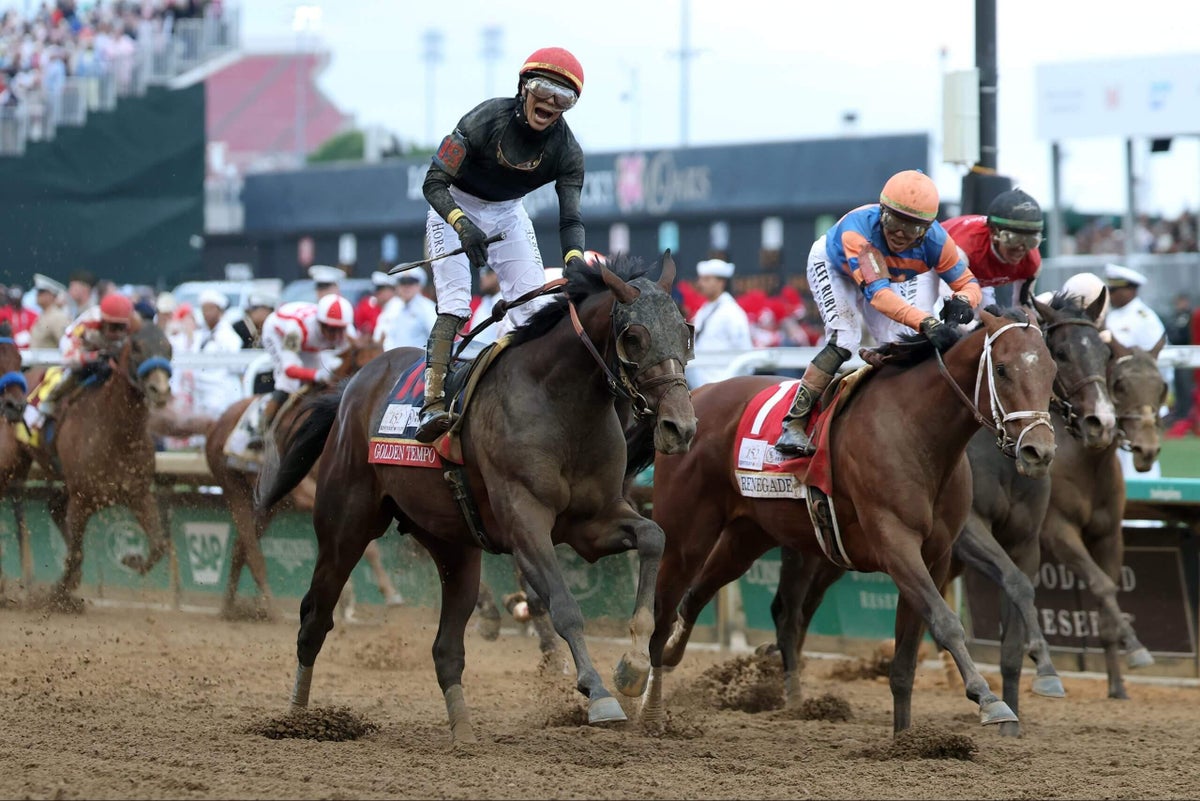
The Kentucky Derby has never been as popular as it was this year, but the overall health of the sport continues to lose its pulse. The 152nd running at Churchill Downs was watched by an average of 19.6 million viewers on NBC and Peacock, with a peak audience of more than 24 million during the final stretch. Those are record numbers, yet fairly equivalent to a regular-season “Sunday Night Football” telecast in the fall. The other 51 weeks, horse racing is mostly irrelevant.
No church can survive with full pews on Easter Sunday and empty rows the rest of the year, and so it is with horse racing, a sport with empty cathedrals and dwindling offering plates.
Is the Triple Crown dead?
Hannah Vanbiber
In 2025, the number of thoroughbred races fell below 30,000 for the first time since the 1950s, according to Equibase, the racing industry’s official database. The total handle fell to around $11 billion, down about $200 million from 2024.
There was a time when horses had the monopoly on gambling. One of the few ways to bet legally was at the track. That’s no longer true. The expansion of state lotteries, the spread of casinos across the country and the explosion in online gambling sites (including the recent rise of prediction markets) allow bettors to place wagers from their couches on any sport imaginable. The American Gaming Association projected a $30 billion handle in legal sports betting for the entire NFL season last year.
Horse tracks that once bustled with tens of thousands of bettors now sit mostly vacant. They are as useful now as pagers and rotary phones.
Hawthorne Race Course, Chicago’s last remaining operating track and Illinois’ oldest sporting venue, ceased operations last month after 135 years and likely faces permanent closure amid bankruptcy proceedings. Hawthorne follows three other parks that closed across Chicagoland over roughly the past decade. The same track deaths are occurring in various states around the country.
Aqueduct ceased live racing in Queens earlier this summer after 132 years of operation. It will remain open for simulcast betting for another month before permanently closing. Cal Expo closed last year in Sacramento, Calif., effectively ending regular harness racing in California. Major tracks across Michigan, Florida, Massachusetts, Maine and Oregon have all shuttered in recent years. Though Belmont Park is close to reopening after a multiyear renovation, few new tracks are under construction. The largest concept, a $550 million track for thoroughbred racing that would open in Las Vegas in 2029, faces significant obstacles with Nevada gaming laws.
Given the financial woes, coupled with the animal rights groups that continue to dent the sport’s economics, it’s fair to wonder what form horse racing will take in another 25 years.
Activists have not directly led to the demise of horse racing, but they have certainly accelerated the process by highlighting the sport’s doping scandals and amplifying images of animal mistreatment to a generation more sensitive to animal suffering for entertainment purposes.
Tracks that lack casino revenue or do not receive state subsidies will likely continue to struggle and eventually close unless there is drastic change.
The Thoroughbred Championship Series, set to begin next year, might be the last hope at stemming the tide if it’s not already too late. The six races for 3-year-olds will begin the first weekend in May and extend through September to better capture the market and mimic more popular American sports with standings, rivalries and storylines that fans can follow throughout the summer.
All of this remains a work in progress. The fact the series excluded the Preakness may inadvertently increase chances at future Triple Crowns.
Why are Kentucky Winners skipping the Preakness?
Hannah Vanbiber
Preakness officials have already countered their exclusion in the series by pushing back their date an extra eight days, giving horses three weeks to recover from the Derby and perhaps entice more trainers to enter.
It also inadvertently pressures the Belmont to delay its running an extra week or face the same time crunch the Preakness has endured for years. As it stands, trainers now will have only two weeks to prepare for the longer track in Elmont, N.Y., should they run in the Preakness. If the Belmont responds by delaying its race an extra week (there appears to be no logical reason it can’t), it will evenly distribute rest between all three races on the circuit with roughly three weeks in between each event.
Preakness officials should have done this years ago. The past two Derby winners, and four of the past six, bypassed running in the Preakness because of the quick turnaround, thereby ending any hope of a Triple Crown. The creation of this series, at minimum, seems to be rebalancing the calendar into a more palatable structure.
Can it save the industry? That’s a tougher ask. There are a lot of empty pews to fill.