What I wrote last week should inform each of these columns, whether pitching or hitting (the focus is hitting this week).
One big difference is that hitters control about two-thirds of hitter-versus-pitcher outcomes and, generally, this goes for offense versus defense in all sports. It’s a universal law. Now, of course, elite pitchers beat the base rate and control outcomes to a much higher degree — that’s why they’re great. The same goes for the handful of great defenses in, say, football.
The offenses that faced the 1985 Bears did not control two-thirds of outcomes based on how well they executed. Batters did not control two-thirds of outcomes against Sandy Koufax. I’m just speaking about averages, not exceptions. As it relates to hitting and this column, hitter stats are more bettable and less random than pitcher stats because — again, on average — the hitters are mostly in charge of how the pitcher performs. (This is why we pay more for hitting in fantasy, whether drafting or auctioning.)
For our purpose, we get weaker outliers in each direction (actual vs. expected performance) than we do in pitching. Hitting stats are always more stable, so luck plays less of a factor in them (though luck is still a factor).
The caveats I outlined last week for pitchers still apply: Expected stats are not predictions any more than or less than the actual stats would be. They speak to an alternate universe where we base our future expectations on past performance that has been earned rather than actualized. And to be honest, I think these expected radar-based stats via Statcast/Baseball Savant are better — meaning more predictive — than actual stats.
Statcast statistics in this article are as of Wednesday, May 20.
Unlucky hitters
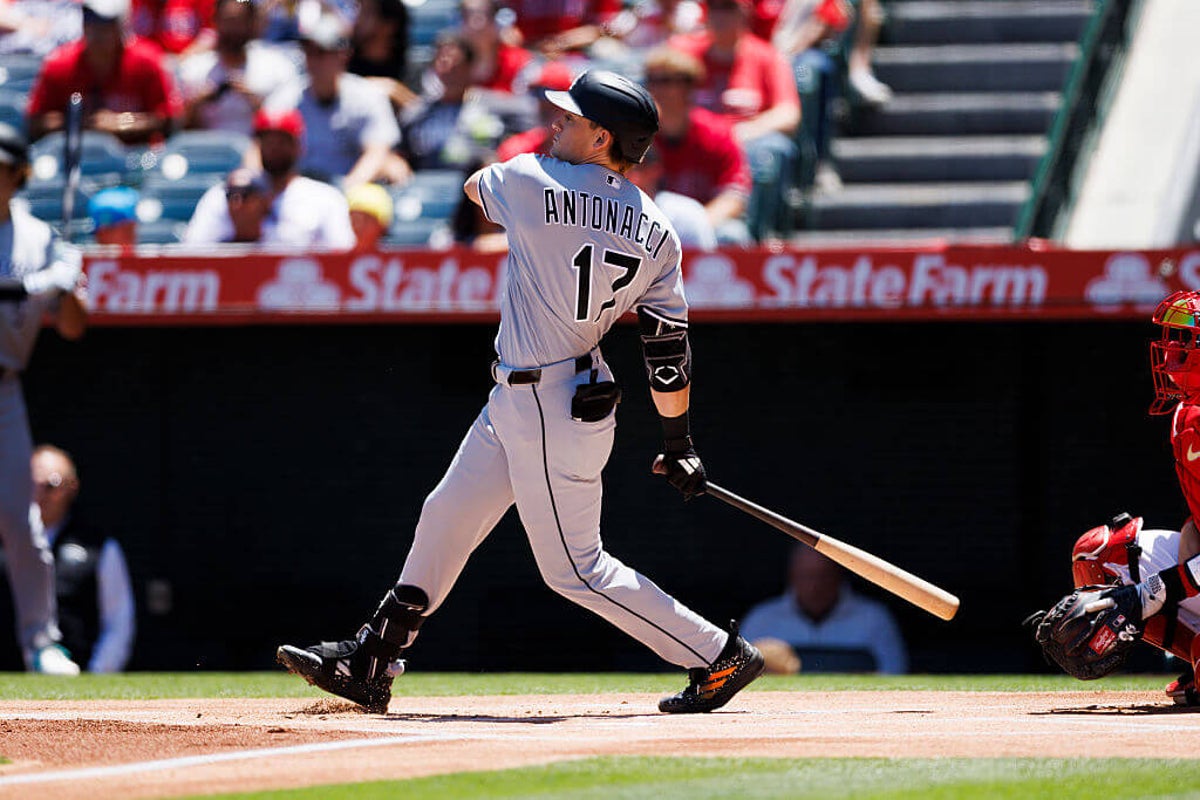
Sam Antonacci (CWS, OF): He may also qualify at 2B in your league. He’s been solid, but he should be great, given his profile. His expected batting average of .338 is the best in baseball. In shallow formats, you need him to steal bases more aggressively with his 77th-percentile sprint speed. Think of Antonacci as a faster Luis Arráez — an elite batting-average play.
Brandon Nimmo (TEX, OF): He’s not Antonacci, but he’s still a fine source of batting average. His trajectory is low, so he’s not been unlucky in homers despite the sterling hard-hit rate. Is he going to hit 10 homers for the balance of the year or 15? That’s the range. Five homers have decided some fantasy championships, of course. His speed is well above average, but he’s a very passive base stealer. Bottom line: He’s been a 65th-percentile hitter but should be about 85th, albeit with little category juice, but Nimmo’s certainly good enough to be a valuable mixed-league hitter.
Spencer Steer (CIN, 1B/OF): He has two more actual homers than expected, but that’s a park factor we should expect. His xBA is .289, with an xSLG also over the 90th percentile (.539). He’s hitting like a guy you’d happily draft in the fourth or fifth round. Given his raw speed, there’s the upside for a 25-HR/25-SB pace the rest of the way with solid averages in a top hitting park that should amplify expected performance (all expected stats are park neutral).
Curtis Mead (WAS, 1B): Mead is unlucky in batting average, according to Statcast, by about 30 points. You can say it’s because he’s a fly-ball hitter, but then he should have more homers. Mead walks more than he strikes out, the mark of a top hitter. He’s very valuable in formats that include batter Ks.
Mike Trout (LAA, OF): Maybe his fantasy manager is skeptical — he’s slowed down. But Statcast says he’s earned being a top-five overall hitter, pretty much in line with his MVP seasons. He certainly won’t cost you that in a trade. You’d have to deal with the injury risk, but Trout can translate his expected stats into actual ones, meaning you’d have a top-five fantasy hitter. His xBA is .258, but he’s gold in on-base formats given that 20% walk rate. I’d be aggressive in trying to get Trout. Sure, it can blow up in your face like you’re Wile E. Coyote, but it’s hard to win and, if Trout stays healthy, he’ll likely be a championship-level asset.
Lucky hitters
Mickey Moniak (COL, OF): He’s been a big asset for me in an important league. And overachieving his expected stats by about 70 points (wOBA vs. expected wOBA) is explained largely by his park, where he basically is in the conversation for the league’s best hitter. Now, of course, you have the other half of the games to deal with, and he’s been about an average hitter on the road. I’d hold him, but I have to note that he’s the biggest outlier in expected versus actual stats — and, again, that’s explained largely by the park.
Otto Lopez (MIA, SS/2B): Lopez is another favorite of mine, but he’s not as good as his stats suggest. He’s the reverse of Antonacci, as Lopez’s average should be about .290, yet he’s hitting .340. He has marginal power and should steal 20-30 bases. Going forward, if I had to guess, he’ll fall somewhere between his 2025 and 2026 seasons. Call it a .770 OPS with downside risk due to playing in a pitcher’s park. If you could get Antonacci and something more for Lopez and something less, that’s likely to be a great trade.
Xavier Edwards (MIA, 2B): Man, the Marlins have some surprising hitters. Catcher Liam Hicks is somehow leading the league in RBI. What were the odds of that? Like Lopez, Edwards is a good, not great, hitter who happens to be hitting great. Expect him to hit fewer homers and steal more bases going forward, based on his current pace. He should hit about .285 or so over the rest of the season, which is very good, but it’s a big step down from where he’s been.