
Son Suk-ku (L) and Moon Choi (R) arrive on the red carpet during the opening ceremony of the 31st Busan International Film Festival.


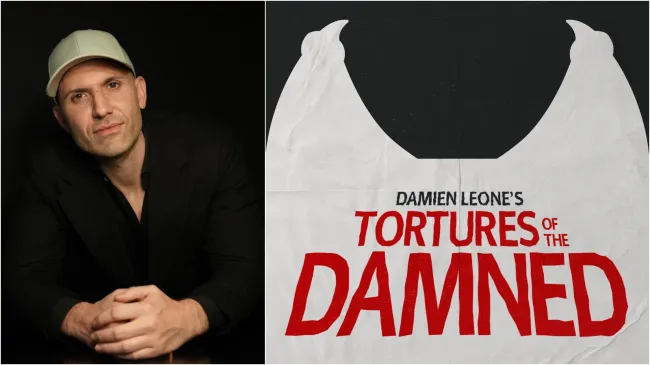
One of the bigger indie horror success stories in recent years is going to a major studio. Damien Leone, the director behind the box office darling “Terrifier” franchise, will make his next film at Lionsgate and is teaming with horror legend Sam Raimi to make it.
But rather than Lionsgate picking up the franchise or the next “Terrifier” film, it will be an original project called “Tortures of the Damned,” which Leone is writing, directing, and producing. Plot details are being kept under wraps.
“Tortures of the Damned” will be Leone’s next project after he completes “Terrifier 4,” which is currently in pre-production.
The “Terrifier” franchise follows the murderous Art the Clown in a series of ultra gory slasher films rife with sexual violence. The films are so gruesome that they’ve been released unrated by the MPA, so it’s a surprise that a major studio that needs to play by those rules would embrace the director’s next project.


But the box office is hard to ignore. The first “Terrifier” from 2016 made little impact at all, but the franchise became a cult smash when the second film opened from Cineverse in 2022, doing so with a very minimal marketing budget, and wound up grossing $15.8 million worldwide. The third film from 2024 blew the doors off and made $90 million worldwide.
Leone spoke to IndieWire back in October 2024 in response to accusations that his films were misogynistic in their depictions of violence against women. He’s defended himself against those accusations by pointing to the love fans have for the franchise’s final girl Sienna Shaw, as played by Lauren LaVera.” IndieWire also reported on a recent breach of contract suit filed against Leone by some of the franchise’s actresses as well as other disputes between artists who claim to have worked on the film or its promotional materials.
Raimi and Rob Tapert will produce through their Ghost House label alongside Leone. Scott O’Brien and Pavan Kalidindi will oversee for Lionsgate. Romel Adam and Jose Cañas will oversee the project for Ghost House and executive produce. The deals were negotiated for the studio by Dan Freedman.
Erin Westerman, president, Lionsgate Motion Picture Group, said in a statement, “We’re incredibly proud and excited to be partnering with Damien Leone on his first original film after the beloved ‘Terrifier’ series. I join the huge contingency of horror fans — and Damien fans — inside Lionsgate who have been following his work and cheering him on. Damien is a true genre auteur with a singular vision, and we’re thrilled to help bring this bold new project to the screen while continuing to build on the incredible connection he has with fans around the world.”
Leone is represented by WME and Zerner Law.
Raimi most recently directed the horror thriller “Send Help,” and he’s teaming with Lionsgate again on another horror remake of the film “Magic.” He is represented by CAA and Hansen, Jacobson, Teller.
>
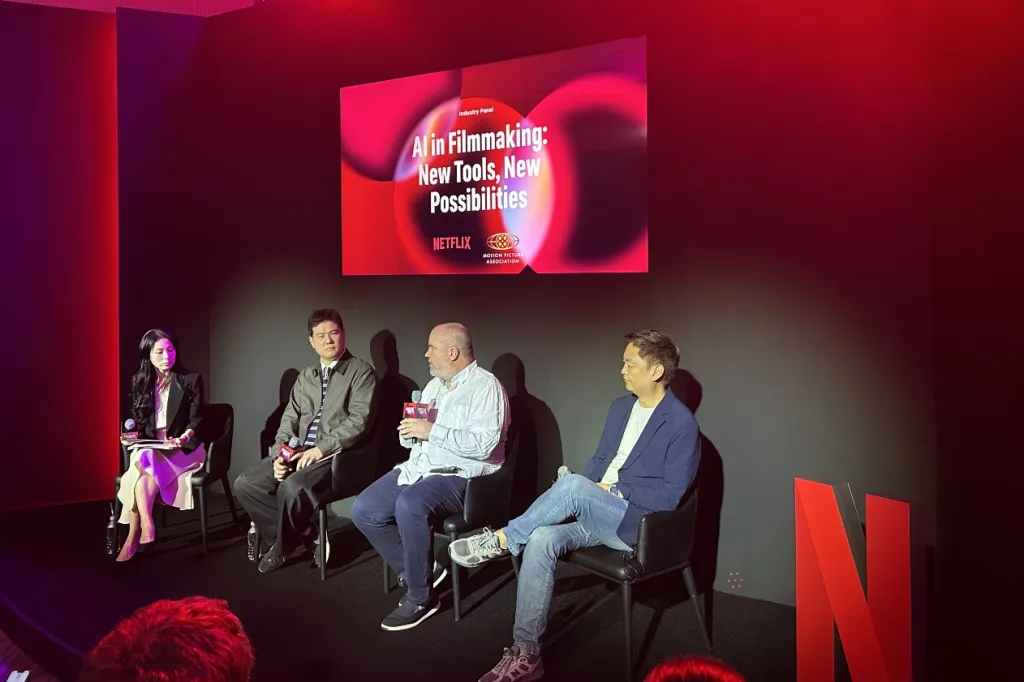
Kimball Thurston, Weta FX’s chief technology officer, Korean filmmaker Kang Yun-sung and Netflix’s APAC Senior Director, Production, Sung Q Lee, discussed the advantages and limitations of using AI tools in production workflows during Netflix’s Creative Asia day at Busan International Film Festival.
They agreed that AI is bringing a range of efficiencies to the production process – reducing budgets, speeding up workflows and helping filmmakers realize scenes that were previously impossible to achieve – but they also noted some of its limitations.
“We’ve been growing it at a measured pace; using using it for image clean-up; not necessarily for generating images; but generating the motion that goes into some of the crowd scenes; and beyond that we’re starting to see some other small use cases,” said Thurston. “But I think there’s still some problems that we have to solve.”
He noted that while the resolution issue is currently being solved – filmmakers can now output to 4K resolution in many cases – there are still issues around color volume: “There are still some some things that I hope that technology companies will come and collaborate with the creative industry on more than they have been historically,” Thurston said.
“There’s actually a number of color issues, not the resolution of the color, but the range of color volume. For example, if all your AI models have been trained on a certain set of video images, you might not be getting the right shade of red. I hope we can collaborate more so we can help these companies solve some of these problems.”
Thurston also noted that the way that creatives currently have to work with the technology is not so intuitive: “We need better interfaces – for a visual artists, a text-based prompt is not the best way to interact with this technology.”
All three speakers focused on the use of AI to provide filmmakers with more creative choices – more iterations of a sunset or battle scene, for example – rather than using fully AI-generated images or replacing actors. “Remember there are different forms of AI – it’s not just about image generation, there’s also assisted AI, it’s about using these tools to help the creative narrative,” Thurston said.
Netflix’s Sung said the streamer is using the technology for pre-visualization, editorial and VFX, and has often had discussions about other use cases, but stressed that the “human touch is always critical and necessary”.
After playing a showreel of work done by Netflix’s VFX subsidiary Eyeline Studios, Sung added: “We have strict guidelines within the company. We’re not just chasing after the use of AI for the sake of it – if it helps the viewer experience then we have an internal process and we work through that. We’re not trying to be the fastest by using AI.”
Sung also touched on sustainability issues when asked by an audience member, who quoted figures on AI technology’s use of water resources. “If we’re talking about sustainability, we need to talk about the bigger picture beyond just AI, to achieve net zero we need to look at a range of issues and make different attempts,” Sung said.
Kang, whose credits include Run To The West, South Korea’s first feature-length AI-assisted film, said that AI is enabling the Korean film industry to reach its full potential. “Incorporating AI into film is turning our imagination into reality. In the past, genre films were not able to be the biggest due to budget limitations, but AI can now extend creative possibilities.”
Kang also screened a teaser of Netflix’s upcoming Gulf Of Aden, a Korean-language action thriller that he is directing, and which is using AI tools to recreate scenes of war-torn African countries, battles with modern-day pirates and ships being hijacked. “Not just because of savings on CGI, but also because the shooting process was simplified and the production period shortened, we were able to make savings of 30-40% by using AI,” Kang said.
However, he added that he doesn’t believe AI can currently replace real life actors: “AI generated battle scenes may have better quality than what we can otherwise afford to achieve, but will the technology be able to convey real human emotions to the audience? We’re still in the transition phase, but right now, I don’t think so.”
Netflix’s Creative Asia day, which is aimed at local creatives and industry, also included masterclasses with The Blue Road director Han Jun-hee and Possible Love cinematographer Kim Ji-yong; an industry panel on New Voices in Filmmaking; and workshops on storytelling and understanding the perspective of buyers, among other sessions.
>

“It seems like the only way to look at the future these days is as dystopia,” said director Brad Bird at Deadline’s Contenders London this weekend. “And that’s fine. I love a lot of movies that take that thing, but there are other ways to look at the future too, and you can.”
Bird was talking about his new animated movie Ray Gunn, which features Sam Rockwell, Scarlett Johansson and Tom Waits in the voice cast. The Netflix and Skydance Animation production is set in Metropia, a gigantic city in the alternate future inhabited by aliens and humans as seen from a 1939 perspective. The story revolves around private eye Raymond Gunn (Rockwell), who is drawn into a case involving murder and a multimedia star named Venus Nova, voiced by Johansson.
“What interested me was having utopia, but also showing that characters are desperate,” said Bird. “They’re still lying. They’re still murdered…all those things are there, but it’s a little more interesting if you set it in an idealized setting. So, buildings are over a mile high, and aliens and humans are coexisting, and that kind of thing became very interesting to me.”
Bird, who was joined on stage by the film’s composer Michael Giacchino, talked about the film’s long journey to screen. Ray Gunn is a 35-year passion project from The Incredibles and Ratatouille director Bird.
“The easiest mistake is to make is to think we were working on it for 35 years, which makes us really idiotic,” quipped Bird. “It was not that. We tried to get it made a long time ago and, for whatever reason, the financing didn’t follow us, so we had to set it down. Basically, it went into a file, dust gathered and we had to move on with our lives. I made The Iron Giant and we worked on The Incredibles and Ratatouille and time went by and the opportunity arose to pull it out of the deep freeze, and I always believed in it and eventually reality agreed with me.”
Giacchino talked about his approach to scoring the film and noted that New Zealand singer-songwriter Kimbra wrote and produced all of the original songs for the character Venus Nova.
“She was so good at what she does,” he said. “She writes incredible music and she came on and delivered a few songs for Venus, which are just incredible. So, my part was just creating the world beyond that and filling in everything else and creating textures and themes and character stuff and just making sure the movie fit the glove it needed to fit.”
Giacchino added that he and the team used a raft of “old recording techniques”.
“We got microphones from the 1920s and 30s that we used here in Abbey Road. We had an 80-piece orchestra, so there’s a really organic score, but there are a few things layered in there, like weird vintage synthesizers that I use…but that’s not the focus of it. That’s just the decoration on it because the real emotional thing that you need, it’s got to fit the story.”
Check back on Monday for the panel video
>
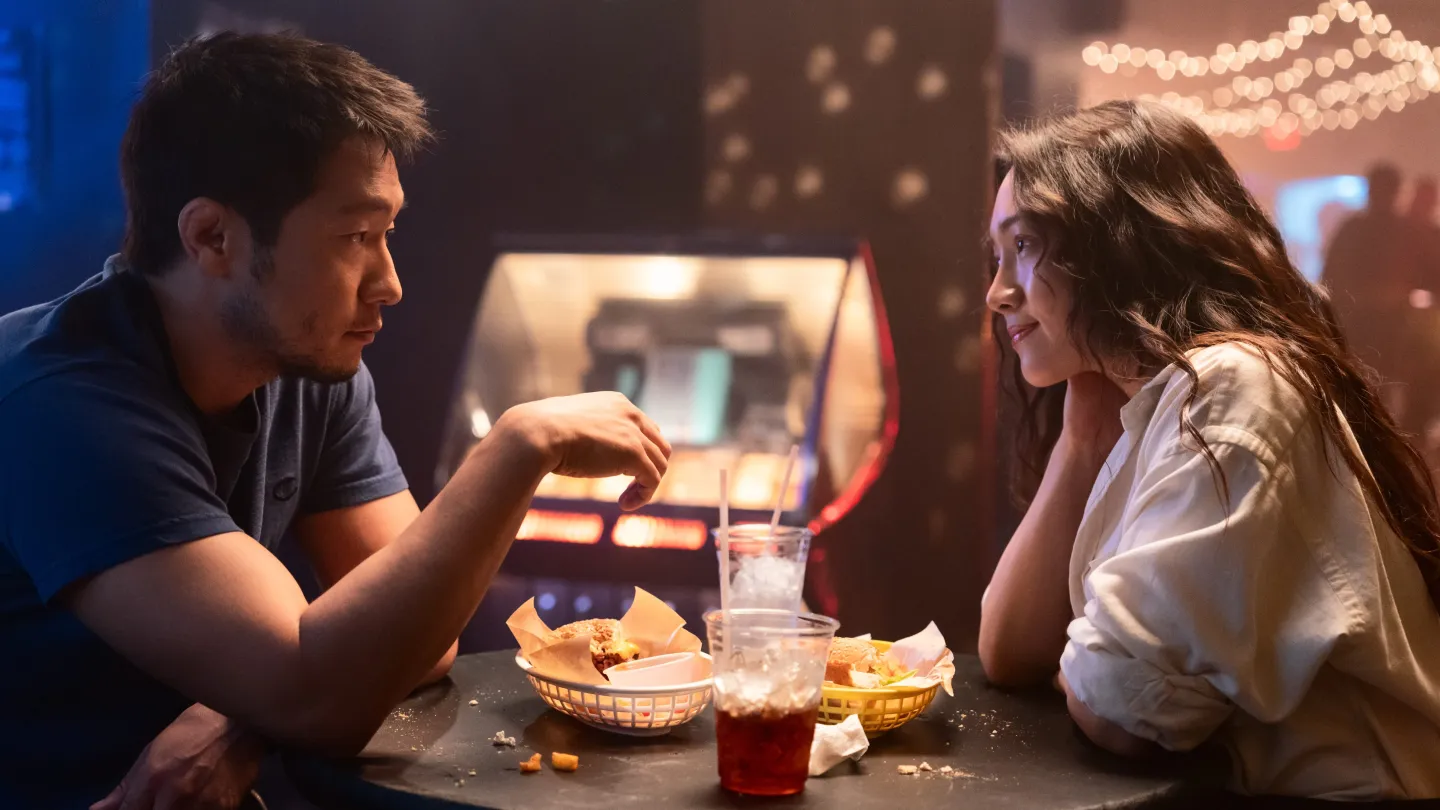
Indie drama Bedford Park might just prove to be Korean actress Moon Choi’s big break in the U.S. film industry — but she’s nonetheless a little apprehensive about how it will play for the fans who know her work best.
“Thinking about the Korean audience, I do get a bit nervous because I don’t know what to expect,” she tells The Hollywood Reporter. After winning an award at Sundance and earning strong reviews in Toronto, Bedford Park is finally meeting Korean moviegoers this week at the Busan International Film Festival — but her fans there will be seeing a rather different side of the star they met in K-dramas like Mistress (2018) or Now, We Are Breaking Up (2021).
Written and directed by first-time feature filmmaker Stephanie Ahn, Bedford Park stars Choi as Audrey, a 36-year-old Brooklyn physical therapist whose mother’s car accident summons her back to the suburban New Jersey home she has never quite escaped emotionally. The other driver is Eli (rising Korean star Son Sukku of The Roundup and D.P. fame), a prickly former wrestler and Korean adoptee raised by a neglectful white mother.
When Audrey visits Eli to share insurance info, the encounter descends into a heated argument over who was responsible for the crash. Their second meeting takes a harrowing turn when Audrey suffers a miscarriage on Eli’s doorstep. Soon, a bond begins to emerge between the two, as they glimpse a kindred spirit hidden beneath each other’s self-defenses. But their intimacy is messy and hard-won, more a meeting of two wounded Asian American survivors and strivers than the typical meet-cute of Korean romances.
Choi says she’s uncertain how the story’s milieu of immigrant struggle will resonate with the crowd in Busan, and she suspects “they’re going to be a little bit surprised by just how rated R it is.” Audrey is sexually forthright, self-destructive and resistant to her parents’ preferred version of success, unwilling to become the dutiful daughter they want, even as she feels indebted to their sacrifices. Eli’s fractured family history has left him similarly scarred.
But the underlying emotion, Choi believes, should travel.
“The film is primarily a family drama and a love story between two people who feel seen for the first time when they meet someone who shares a certain kind of struggle from the past,” she explains.
Going into the film’s Sundance premiere, she had wondered whether the characters’ emotional burdens might feel specifically Asian, or unique to immigrant life. But the overwhelmingly positive response from viewers in Park City with neither experience was a gratifying surprise.
“I saw so many in the audience crying at the end,” Choi recalls.
Busan is also welcoming her as a member of its main competition jury, led by Chinese master Zhang Yimou. For Choi, who has previously judged shorts, the prospect of assessing features alongside such company is both an honor and another exciting challenge (Bedford Park is screening in the festival’s noncompetitive Flash Forward section).
Feeling her way through unfamiliar worlds has been something of a lifelong predicament and opportunity for Choi. Born in Seoul, she moved to Japan at nine, following her father’s banking career. She attended a school in Osaka for ethnic Koreans where lessons were taught in Japanese, later returned to Seoul and eventually moved to New Jersey, where she learned English. Each relocation made her a fresh version of the outsider.
“As a kid, I always felt alienated, even when I was back in Korea,” she says. “In Osaka, I tried to fit in with my Japanese friends; back in Seoul, I was viewed as that girl from Japan. In New Jersey, I was trying to learn English and starting all over again.”
At around 11, she played the lead in a school production of the classic Korean play The Tale of Sim Cheong and found unexpected relief in the imaginary.
“I didn’t have to be Korean. I didn’t have to be Japanese. I just had to play the character,” she remembers. “So I felt very grounded, in a surprising way, and I felt like this was something that I would love to pursue.”
She later took acting classes in New Jersey and joined the theater club on her first day of university in Seoul, eventually starring in a series of plays. After an unsuccessful attempt to enter drama school in London, a friend persuaded the self-described theater kid to audition for her first Korean movie.
She was thrilled to instantly land a starring role in the girls’ weightlifting drama Lifting King Kong (2009) — but the transition from stage to set was bruising. Accustomed to only winning praise in the theater, Choi says she struggled with the harsh demands of Korean film sets of the time, often going home in tears after her director berated her for failing to deliver the performance he wanted. She also struggled with the unfamiliar aspects of filmmaking. “I didn’t know how to cry on cue; I didn’t know how to block; I didn’t really understand how to perform for a camera,” she says. But rather than retreating to the stage, she decided to seek out short films and independent productions to master the mechanics of movie acting.
Her breakthrough came in 2017 with the South Korean biographical period drama Anarchist From Colony, in which she played the real-life Japanese anarchist Kaneko Fumiko. For the first time, the role allowed her to leverage her blended identity and Japanese fluency as a professional asset. The next year, she earned Busan’s actor of the year award for her performance in Korean in Han Ka-ram’s acclaimed drama Our Body.
But despite her English abilities, auditioning in Hollywood never occurred to her as a viable possibility — perhaps because so few Korean stars have successfully crossed over to the U.S. industry, she says.
That changed in 2019, when her agent, on a whim, sent her Ahn’s screenplay, then titled Audrey Park. Choi usually prints scripts and settles at her desk to read them, but she opened this one on her phone and found herself so engrossed in Audrey’s story that she kept scrolling until the final page. She quickly filmed and sent off some self-tapes but didn’t expect much, assuming the director would have plenty of options among Korean American actors closer to home. Eventually, however, she was invited to New York to audition and landed the role.
“When I got the part, I was like, ‘Okay, this is it. This is my debut in Hollywood. I’m going to make it there now too,’” she recalls.
Son Suk-ku (L) and Moon Choi (R) arrive on the red carpet during the opening ceremony of the 31st Busan International Film Festival.
A few months later, the pandemic hit and the project was derailed as production shut down across the globe. After several years of waiting, Ahn and Choi made a proof-of-concept video to help attract new financing. They filmed the two lead characters’ contentious first encounter, with American actor Clayne Crawford as Eli, who was originally written to be a white guy. Back in Seoul, Choi showed the footage to film industry contacts. Among them was Son, a close friend and frequent stage collaborator whose career was in the process of exploding after his starring parts in the hit drama My Liberation Notes and action blockbuster The Roundup.
“This looks good — if the character were a Korean guy, I would love to do it,” she recalls him saying. Choi could instantly picture Son in the role: his physicality, his rough charisma and the familiarity they had developed over multiple stage projects. He had also lived in Chicago and was among the very few major male stars of his generation who spoke fluent English. She proposed to Ahn that Eli become a Korean American adoptee instead. Ahn watched Son’s work, met him over Zoom and agreed.
Son’s rising star power then proved vital in unlocking financing. Hyundai Motor Company agreed to back the project, making Bedford Park the automaker’s first investment in an independent feature (the company had previously collaborated with Son on a branded short). By 2025, the cameras were finally rolling, with Choi also serving as an executive producer.
The casting shift gave the love story a different cultural dynamic: two people connected to Korea in profoundly different ways, recognizing something in each other that neither could easily explain. For Choi, the project has also become another demonstration of what her own border-crossing background might make possible. Sony Pictures Classics will release Bedford Park in the U.S., with a rollout expected next year. Seoul-based distributor BY4M is planning a wide theatrical run in Korea in February or March.
In the meantime, Choi has returned — happily this time — to the theater. In September, she completed the New York run of Simon Stone’s Korean-language adaptation of Chekhov’s The Cherry Orchard at the Park Avenue Armory, with pioneering Korean screen icon Jeon Do-yeon playing her mother. For Choi, the play meant performing opposite an actress she has idolized since her youth. Jeon became the first Korean actress to win the Cannes Film Festival’s best actress prize in 2007 for Lee Chang-dong’s Secret Sunshine, and she is now back in the awards conversation with her widely acclaimed performance in the director’s Netflix-backed Oscar contender Possible Love.
“She was my hero and my role model. I grew up watching her films. I grew up watching Lee Chang-dong’s films,” Choi says.
After three years collaborating on international stagings of the play, Jeon offered some encouragement that Choi says she is still absorbing. On their final night, the veteran took her hand and urged her to recognize and embrace her own abilities — and to chase the rare opportunity that her unique background has opened up.
“The gist of it is that she told me to pursue this path that no one has ever walked before as a Korean actress, because I’m multilingual. That made me really emotional,” Choi says. “Saying it still makes me emotional right now.”
Choi now plans to audition in the U.S. while continuing to pursue projects in Korea, where she has another play scheduled for the spring. The goal is not to abandon one home for another, but to explore whether a balance between two industry bases is possible.
“For now, my focus is to find a powerful story like Bedford Park in the U.S. or Korea, whether it be a film or TV series or any kind of medium,” she says. “I don’t know what to expect. But I am open to this new journey.”
>


Search For Canadian TV Actor Stewart McLean Now Homicide Investigation


These ’90s fashion trends are making a comeback in 2017
According to Dior Couture, this taboo fashion accessory is back
Model Jocelyn Chew’s Instagram is the best vacation you’ve ever had
Emily Ratajkowski channels back-to-school style
9 Celebrities who have spoken out about being photoshopped


Rurouni Kenshin: Hokkaido Arc Manga Takes 1-Issue Break – News


HIDIVE to Stream English Dubs for The World Is Dancing, The Forsaken Saintess and Her Foodie Roadtrip in Another World, The Dangers in My Heart: The Movie Anime – News