They have achieved two successive promotions. They will play in Ligue 1 again next season after a 16-year absence. They also count a string of famous sportspeople — Novak Djokovic, Felipe Massa, Kevin Magnussen and Thibaut Courtois — as investors.
And their stadium is located at the Circuit de la Sarthe, host of the iconic Le Mans 24-hour race, one of the showpiece events in the motor racing calendar and held every June.
Welcome to Le Mans FC, the French side with lofty ambitions who have drawn similarities with Wrexham in the United Kingdom and Como 1907 in Italy.
“We want to build something meaningful,” Georgios Frangulis, investor and operating partner, tells The Athletic. “My main idea is, and it was from the beginning, is to make sure that Le Mans Football Club can be a big brand in the world of sports.”
Le Mans’ promotion to Ligue 1 was sealed on the final day of the season with a 2-0 victory away to already-relegated Bastia in Corsica. However, they were made to wait for confirmation for a few days after the game was abandoned in the 91st minute when furious home fans threw smoke bombs and flares on the pitch.
Their return to the top flight for the first time since the 2009-10 season came nine months after they were acquired by Brazilian investment firm OutField and Frangulis, founder and CEO of Oakberry, the acai bowl business, who is engaged to world No 1 women’s tennis player Aryna Sabalenka.
Having won promotion to Ligue 2 only last year, the new ownership group had initially planned to consolidate their place in the division before aiming for promotion within three years — so their early success came as a welcome surprise.

Le Mans’ French coach Patrick Videira looks on (Lou Benoist/AFP via Getty Images)
After exploring potential clubs in Spain and Portugal, they had selected Le Mans because of its sound financial footing under president Thierry Gomez, who has remained in his post, its famous name and handy location, only an hour by train to Paris — one of the biggest hotbeds of talent in world football.
Pedro Oliveira, lead investor and OutField founding partner, tells The Athletic they had three main objectives. The first involved the sporting side, the second was talent development, and the third is growing the Le Mans FC brand.
Frangulis, a self-confessed motorhead who was born and raised in Brazil, persuaded ex-Formula 1 drivers Massa and Magnussen to join the project, along with Djokovic, one of the greatest men’s tennis players of all time. In February, Courtois became the latest sportsperson to invest through his company NxtPlay Capital.
“They all understood that it makes a lot of sense for you to connect such a massive brand, which is Le Mans, because it’s one of the brands in sports that everybody knows,” says Frangulis, fresh from a workout, over video call from Miami. “You don’t have to be a motorsport enthusiast to know the name Le Mans. Everybody knows the name, and then football is the biggest sport in the world.
“With the infrastructure and the work that was already put into the club in the past 10 years by Thierry (Gomez), I just felt like: ‘OK, this is such a good opportunity on connecting these two worlds.’”
Massa, a friend of Frangulis’ and also a partner in Oakberry, recalls their initial conversation about Le Mans FC. “He came to me saying he had a nice idea for me to enter in, with a football team,” Massa tells The Athletic. “I said: ‘Are you completely crazy? I don’t believe that’s a good idea.’ And then he said: ‘Yeah, it is. You will see it is.’”

Felipe Massa supports Sao Paulo but has bought into Le Mans (Mark Thompson/Getty Images)
Massa, who supports Sao Paulo, was attracted by the connection between motorsport and football. He was also reassured by OutField’s previous experience of working in football. They have been controlling shareholders of Coritiba in Brazil since 2023. That club won promotion to the Brasileiro Serie A, the top tier of Brazilian football, in November 2025.
Massa, speaking to The Athletic over video call from Brazil and wearing a Le Mans FC shirt, sees his role as helping on the marketing side, trying to create the right image for the club and using his connections with people and sponsors around the world from his career in Formula 1 racing.
Oliveira thought Le Mans’ motorsport links offered ways to bring in new supporters — over five million people visit every year because of the motorsports events there — while always trying to build their local fanbase. Le Mans, a city in the Pays de la Loire region, is home to approximately 150,000 people, with around double that number living in the wider area.
According to the Ligue de Football Professionnel, last season the club’s average attendance was 12,027, the second highest in Ligue 2 behind only Saint-Etienne, a sleeping giant of French football with a huge fanbase, including Timothee Chalamet, whose own bid for promotion was snuffed out by OGC Nice in the play-offs on Friday.
In terms of their other famous sporting investors, Oliveira pointed to Djokovic being keen to play an active role in the mental-performance side of the project.
“How we prepare players, to be able to handle the pressure, to be ready for the big stages,” he explains. “Each one of the athletes who invested with us is involved in a specific topic, not on the day-to-day management of the club.”
Frangulis said all their sporting investors had sent messages of support to the players and spoken with head coach Patrick Videira, as Le Mans closed in on promotion towards the end of the season.

Aryna Sabalenka and Georgios Frangulis at the Laureus World Sports Awards in Madrid last month (Pablo Cuadra/Getty Images for Laureus)
With their famous investors, Le Mans have drawn comparisons with Wrexham, the club owned by Hollywood actors Ryan Reynolds and Rob McElhenney. They secured three consecutive promotions, but narrowly missed out on reaching the Championship play-offs this season just as the Premier League beckoned.
As well as their notable success on the pitch, Oliveira says he has been impressed by what Wrexham has achieved away from it.
“They did a lot of improvements in terms of infrastructure, the stadium and the training facility,” he says. “This is something that we also want to do, build a club for the long term.”
There have been enquiries from production companies exploring the possibility of a television documentary at the French club, but nothing that has worked out as yet. However, Le Mans remain open to the idea in the future.
“I think Wrexham is definitely a benchmark,” Frangulis adds. “I’d say Como is a big benchmark and even more relatable than Wrexham. The club is still the main role player in the whole situation and not the investors, not the owners.
“Como is also a place that is known worldwide for a different reason (its lake). The name of the city is a brand itself, just like Le Mans.”
This season, Como qualified for the Champions League for the first time in their history.

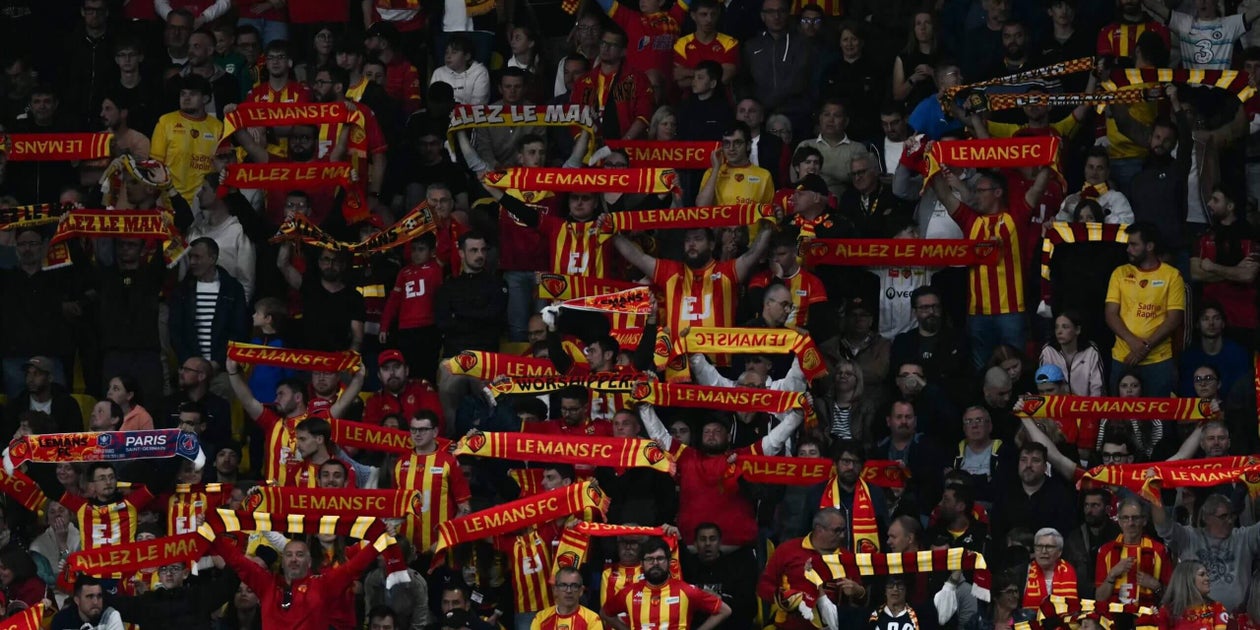
Le Mans fans cheer on their team (Lou Benoist/AFP via Getty Images)
One of the main objectives for Le Mans’ new owners is to build from scratch one of the top-10 youth academies in France after the previous youth system was scrapped in 2013. Le Mans went bankrupt that year and were demoted to the sixth tier as an amateur club. Theirs has been a long road back.
In terms of attracting young talent, Oliveira’s strategy is to target players in the Le Mans area — the suburban area around Paris — and then in west Africa. The club has links with countries in that region, such as Ivory Coast. Didier Drogba, the country’s greatest player, began his career at Le Mans while fellow Ivorian and ex-Arsenal forward Gervinho also played for the club.
As well as their plans for the academy, the goal is to improve the first-team training facilities. They have given themselves three years to put those plans into place.
In a previous interview with BBC Sport, Oliveira explained how they wanted to create a “horizontal model” between Le Mans and Coritiba, their club in Brazil. He stressed how it was not a typical multi-club model, such as the City Football Group where Manchester City are top of the chain, with feeder clubs below them.
“It’s not mandatory for the clubs to work together, or to exchange resources,” he says. “But we do want to incentivise them to have the relationship and to learn from one another. And, if in the future, there’s an opportunity for a player to go from Brazil to France or from France to Brazil, then it’s great. But it’s not something we are demanding from both teams to make happen.”
Having returned to Ligue 1, Le Mans’ owners are determined to stay there — although they know they face an uphill battle.
“It’s a big, big job,” Oliveira adds. “We won’t take it for granted. This will demand a lot of work.”