
Sports
The Soccer 100: Ronaldo — How Barcelona enjoyed the striker at his peak


As part of our buildup to the 2026 FIFA men’s World Cup in the United States, Canada and Mexico, we are publishing excerpted chapters from The Soccer 100, The Athletic’s definitive book on the 100 greatest players of all time, courtesy of HarperCollins Publishers.
The 10 players we will feature are the highest-ranked World Cup winners of our 100. Today, we look at one year in the glittering career of one of Brazil’s greatest strikers: Ronaldo’s single season with Barcelona.
When you picture Ronaldo, it probably isn’t in a Barcelona shirt.
He exists in the broader public consciousness in the white of Real Madrid, or the yellow of Brazil, or even the black and blue of Inter. You think of him scoring twice in the 2002 World Cup final or that hat-trick for Madrid against Manchester United in the following year’s Champions League. Or perhaps even some of his darker moments; his face contorted in agony after his second knee injury at Inter, or looking spaced-out before the 1998 World Cup final.
But his one season at Barcelona, 1996–97, was his peak.
Arguably, it was the peak of centre-forwards, full stop. It was where he recorded his biggest single-season goal tally. It was where he announced himself as a true world great. It was where he did things that made people who had seen it all in football admit they had never seen anything quite like him.
The January 1997 edition of World Soccer magazine had Ronaldo on its cover under the headline “Best Ever?” It was a big question to ask about a 20-year-old halfway through his first season in one of Europe’s top leagues, but they weren’t wrong.
Most of the players in this book justified their inclusion through a whole career of excellence — or at least an extended spell. Ronaldo does, too, but even if we were to forget the other 17 seasons of his career — the club trophies, the World Cup, the Golden Boot, the many cabinets of individual awards, the 305 goals for Cruzeiro, PSV, Inter, Madrid, Milan and Corinthians — and just concentrated on that single year in Catalonia, he would still qualify as one of the greats.
At the start, Josep Lluís Núñez wasn’t sure. Barcelona’s club president had asked Bobby Robson, appointed as their manager in the summer of 1996, for his preference as a new striker. Robson suggested Alan Shearer, but was told in no uncertain terms by Blackburn Rovers that his fellow Englishman was not for sale… a few weeks before selling him to Newcastle United.
Robson’s other option was Ronaldo.

A young Ronaldo playing for PSV against Ajax in January 1995 (Clive Mason/Allsport/Getty Images)
Just about to turn 20 at the time, the Brazilian had scored a bagful of goals in two seasons at PSV, although a knee injury — which would turn out to be a ticking time bomb — had curtailed his second year in the Netherlands.
Robson thought he could be signed for $10million, but Núñez went back to PSV over and over, incrementally increasing his bids and, after each rejected offer, returned to Robson to ask if he was certain about this kid. “At one point, Núñez wagged his finger at me and warned, ‘Bobby, you know your job depends on this?’,” Robson wrote in his autobiography.
Eventually, the deal was done for $20million, an extraordinary sum at the time, the world transfer record (albeit one broken shortly afterwards by Shearer’s move to Newcastle), and a particular gamble given Ronaldo’s youth and relative lack of pedigree. But Robson was sure.
Ronaldo’s first goal came five minutes into his debut, in the Spanish Super Cup against Atlético Madrid. The first league goal was scored against Racing Santander three weeks later. Then he got two in the next game against Real Sociedad. Then another two against Real Zaragoza.
By that point, his new team-mates were convinced, too.
“I’d seen him on television at PSV and thought: ‘Wow’,” then Barca midfielder Luis Enrique told FourFourTwo magazine in 2017. “Then he came to Barcelona. He’s the most spectacular player I’ve ever seen. He did things I’d never seen before. We’re now used to seeing (Lionel) Messi dribble past six players, but not then.”

Barcelona enjoyed Ronaldo at his peak (Shaun Botterill/Allsport/Getty Images/Hulton Archive)
The seventh league game of the season came at Compostela, a small, relatively unremarkable side who have only spent four seasons in the Spanish top flight in their history. They haven’t had many former players or managers of particular note. They’ve never won a major trophy. At the risk of being insulting or patronising, what happened on October 12, 1996, might be the most notable event in the club’s history.
This was the goal. The Goal. The most remarkable goal you will perhaps ever see.
It starts before Ronaldo even touches the ball, his mere presence making two Compostela defenders crash into each other near the halfway line, like slapstick cartoon henchmen. Midfielder Saïd Chiba gives up on trying to tackle him and grabs a big handful of his jersey, but it’s of absolutely no use. Ronaldo breaks away and the only shame is that Chiba isn’t just left standing there with a ripped piece of shirt in his hand as his opponent speeds off into the distance.
Ronaldo then accelerates past two defenders and into the area, at which point the angle to the goal appears to have narrowed a little too much. So he cuts inside and his feet become a blur, whipping the ball back and forth at a speed that is difficult to pick up with the naked eye.
Briefly, Ronaldo seems to lose control of the ball. But no matter, he reacts to it before anyone else can. He sweeps a finish into the corner. Everyone in the stadium recognises that they’ve seen something unforgettable.

Bobby Robson and Ronaldo lift the UEFA Cup Winners’ Cup in Rotterdam (ANP/AFP via Getty Images)
On the touchline, Robson leaps to his feet, throws his hands in the air, and then clasps them to his head like a pilgrim overcome with religious fervour upon seeing a holy icon or relic. “You won’t find a player who can score goals like that,” he told the media after the game. “Can anybody, anywhere, show me a better player?”
No, they could not.
Ronaldo finished that season with 47 goals in 49 games. He scored the only goal, a penalty amid another mesmerising performance, in the UEFA Cup Winners’ Cup final against Paris Saint-Germain. Barcelona missed the league title by two points, broadly due to a 2-1 loss to Hércules in the closing weeks, a game Ronaldo missed while on international duty. Later in 1997, he became the youngest player to win the Ballon d’Or.
In 2017, Óscar García, who was in that Barcelona squad and later became a coach at the club, was asked by the journalist Graham Hunter for a Bleacher Report piece to compare a couple of the greats that he encountered in his time at the Camp Nou.
“I’ve worked around Barcelona while Leo Messi’s been there and at his best. I’ve never seen anything like Ronaldo,” he said.
Here’s the weird thing about Ronaldo’s season at Barcelona: By the latter stages of it, he wasn’t really that popular with the supporters.
He annoyed some of them by swapping shirts with countryman Roberto Carlos after a Clásico in which he had scored the opener in a 3-2 Barca win. He missed crucial games toward the end of the campaign while playing for Brazil. His agents became minor public enemies as talk of him wanting to leave grew. He agreed to a nine-year contract with Barcelona before he and/or his representatives reneged on it and ultimately engineered a move to Inter.
But one of the main reasons he was not as popular as you would think in Barcelona was his habit of taking frequent trips back to his homeland.
The perception was that these were jollies — unprofessional transatlantic jaunts that were distracting him from the job at hand. While he did frequently visit his girlfriend Susana Werner, and pictures of him fully and enthusiastically enjoying the Rio Carnival hardly helped, these trips did serve another purpose. Ronaldo was visiting a specialist named Nilton Petrone about his increasingly troublesome knee.
The warning lights had been flashing about that knee since his PSV days. The big problem was that it was not just one problem. He had been diagnosed with Osgood-Schlatter disease, a condition that causes inflammation in the knee and is common in young people who are still growing. He also had a condition called trochlear dysplasia, a problem that, as Dr Petrone explained in an interview with FourFourTwo magazine in 2018, causes the kneecap to “dance on the femur”.
Furthermore, they were both problems that were exacerbated by twisting and turning at speed and neither could, at the time at least, be corrected with surgery. They just had to be monitored closely in the hope that nothing too serious went wrong.

Ronaldo, Brazil’s No 9 (Antonio Scorza/AFP via Getty Images)
His first knee injury at Inter, while playing against Lecce in November 1999, was serious but looked like a relatively routine ligament tear. He was able to walk — well, limp — off the pitch on that occasion, and it took a scan to reveal what was actually wrong.
The second was much more, for want of a more elegant description, spectacular. He was six minutes into his return, against Lazio in April 2000, when his foot stopped in the turf and the rest of his body continued to move forward, prompting him to scream in pain. “He ripped the kneecap tendon completely,” Petrone told FourFourTwo. “His kneecap actually exploded and it ended up in the middle of his thigh.”
After that, Ronaldo was never quite the same again. The explosiveness was dulled. The pace a few clicks down. But it tells you how good he was that he could lose all of that and still be among the greatest players in the world.
He was just a genius now, rather than an alien.
Ronaldo is unquestionably one of the greats, a footballer of extraordinary physical and technical gifts, perhaps the one who combined those two elements to the most devastating effect of them all.
But he does raise an interesting debate about what qualifies a player for a place among the pantheon. Is ability enough, or does one require longevity? And if the answer to that is yes, then for how long? What is the minimum length of time that a genius has to be at their peak to qualify?
Ronaldo arguably only stayed at the summit for two and a half years — the season at Barcelona and his first 18 months in Italy, the time between him joining an elite club and his first serious knee injury. From that point, he wasn’t the same, so it’s not particularly controversial to say that his best years were gone by the time he was only just 23.
But if we are to accept that his feats before that injury were enough to qualify him as one of the greatest, then we have to consider whether we would think the same if he had not played another game after it. Had his career stopped in 1999, would he be in this book? If he had not played for Madrid or helped win Brazil the World Cup in 2002? If he had not been around for a few years afterwards, being merely one of the best strikers in the world rather than a glorious freak of nature?
Probably not.
Those latter years gave us two things. First are the tangible achievements, most notably those goals in that World Cup co-hosted by Japan and South Korea. Ronaldo was the tournament’s top scorer with eight, finding the net in every game apart from the quarter-final against England. He scored the only goal in the semi-final against Turkey and the only two in the final against Germany. It wasn’t quite “Diego Maradona in 1986” levels of a player winning the World Cup on his own, but it was not far off.

Ronaldo wheels away after scoring Brazil’s second in the 2002 World Cup final against Germany (Damien Meyer/AFP via Getty Images)
Second is the physical reminder of his greatness. Had he disappeared completely after that 1999 injury, then we would not have been able to watch a version of what he could have become. Even though he wasn’t at his absolute peak in those years, he was close enough to keep him in our collective consciousness, to make us think, ‘If this guy is this good after his knee collapsed, then imagine what he could have been like’.
“Ronaldo copied the classic journey of the mythological local hero who descends into Hell then comes back to change history,” wrote Luis Fernando Verissimo in the Brazilian newspaper O Globo.
The thing that is always said about Ronaldo, the unanswerable hypothetical, is: what could he have been were it not for the injuries?
But do we need to wonder? Do we need another six or seven years to appreciate how special he was?
It would have been wonderful, but the time he was that good, particularly in the Barcelona season — the things he showed us then that we had not seen before and really haven’t seen since — are surely enough.
Excerpted from The Soccer 100 by Oliver Kay & James Horncastle with The Athletic Soccer Staff, published by William Morrow. Copyright © 2025 by The Athletic Media Company. Reprinted courtesy of HarperCollins Publishers.
>
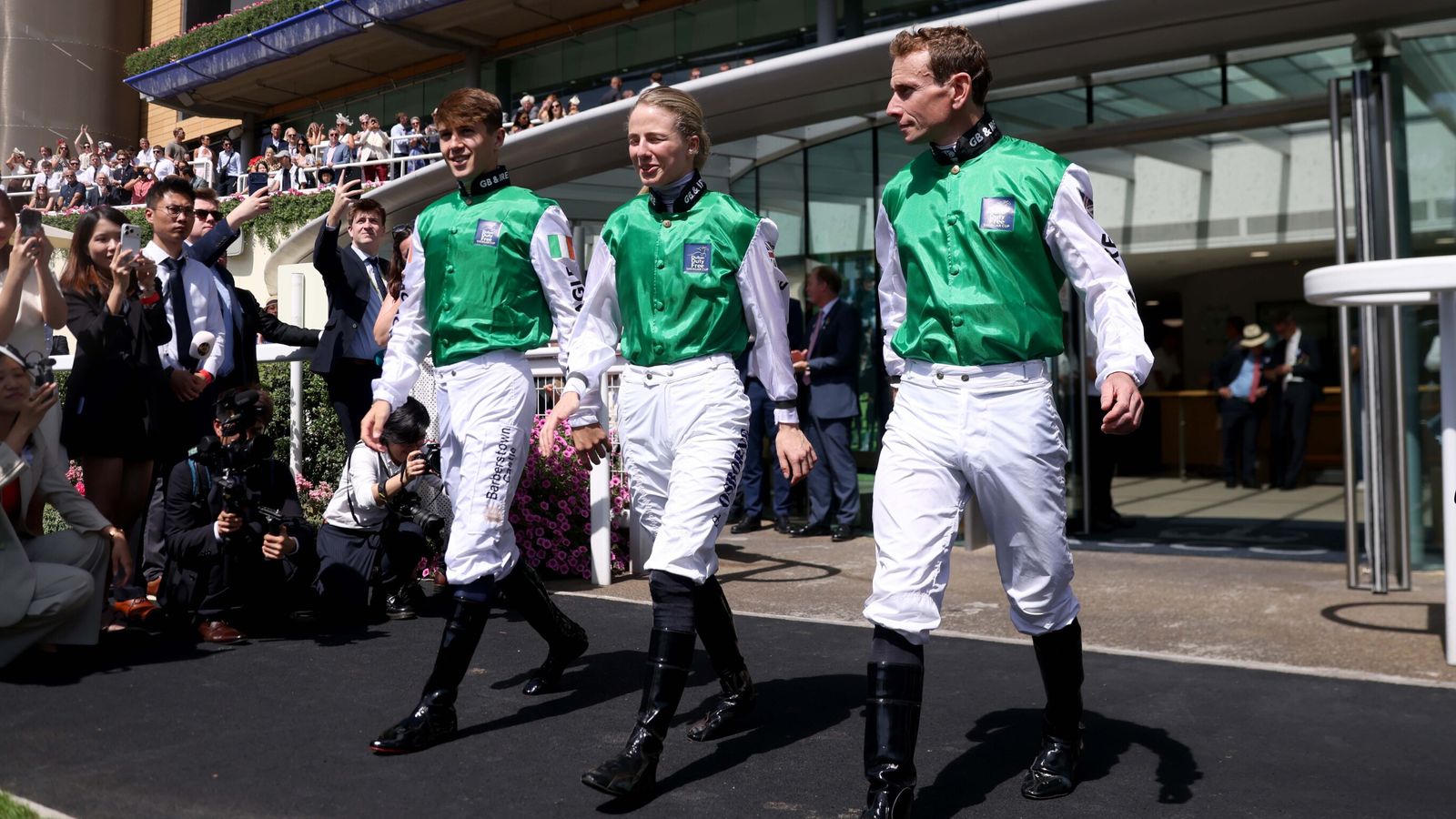
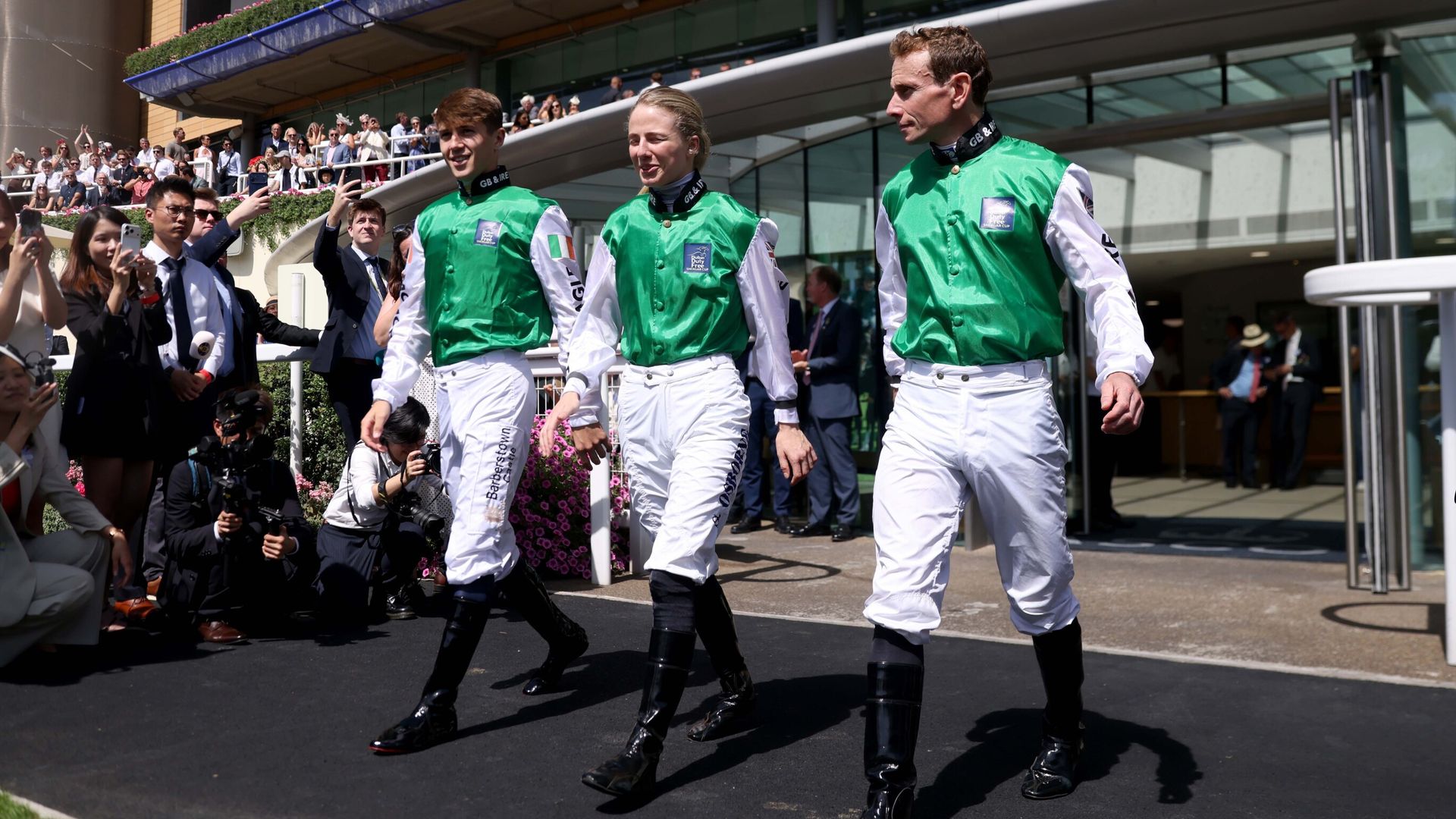
Ryan Moore bagged a Shergar Cup double on his return to the competition following a 20-year absence to help his Great Britain and Ireland team win the team event while he was also crowned leading rider over the six races.
Winner of the Silver Saddle on his last appearance at the team-based meeting in 2006, Moore has usually been required to ride on a Group One card in Ireland.
But with that meeting put back 24 hours he was free to attend and delighted the Ascot crowd.
Team Great Britain and Ireland topped the standings on 81 points from Team Hong Kong in second on 62, with Moore’s individual haul of 47 enough to take the Silver Saddle.
He first struck on Dylan Cunha’s Asgard’s Captain (13-2) who stuck to his task gamely to win the Dubai Duty Free Shergar Cup Challenge by a length and a quarter from Yutake Take on Sportingsilvermine for the Rest of the World.
Moore said: “Dylan did say he could be a little bit lazy, but he has an uncomplicated attitude and to just help him through it and it was straightforward, really.
“It’s great to get Dylan a winner here today and the owners will be delighted as they were all looking forward to it, so it’s a good job the horse has performed today.”
In the penultimate Dubai Duty Free Shergar Cup Classic, he gave Marco Botti’s Archers Bay (5-2) a textbook ride coming home three-and-a-quarter lengths clear of Christophe Lemaire on King Of Berkshire for Team Europe.
Having run in the Italian Derby earlier in the season, he looked the class act and so it proved.
In the closing Dubai Duty Free Shergar Cup Mile, Moore finished third on Ozat behind the Frida Valle Skar-ridden Crown Board (10-1), but her Team Europe were not in contention for top honours by then.
Saffie Osborne thrives in the team environment and got her name on the scoresheet when Tim Easterby’s Red Spells Danger justified 2-1 favouritism in the Dubai Duty Free Shergar Cup Sprint.
Osborne was leading rider in the Racing League on three occasions and is captaining Moore and Dylan Browne McMonagle in Team Great Britain and Ireland.
She said: “I heard a few people knocking this horse today but I thought the track would really suit and it has. I’m just glad I pulled my finger out.
“Looking at the standard of jockeys here today, it’s amazing – look at our team with Ryan Moore and Ireland’s champion jockey.
“The win for me today is that I made Ryan laugh a couple of times, so I’m quite happy with that!”
Team Hong Kong had earlier set the pace winning the first two races.
Jerry Chau gave them the perfect start when partnering Tuco Salamanca to a clear-cut victory in the Dubai Duty Free Shergar Cup Dash.
Representing a team making its Shergar Cup debut, Chau, 26, gave Ollie Sangster’s four-year-old the perfect ride, taking a lead into the final furlong before a gap opened up seamlessly.
Tuco Salamanca (4-1) quickened impressively to beat Gold Star Hero, ridden by Chau’s team-mate Vincent Ho, by a length and a half.
Fandom and Suraj Narredu were third for the Rest of the World.
Chau told Sky Sports Racing: “It felt amazing when I hit the line.
“No words can describe riding a winner at Ascot. I grew up watching Ryan Moore on YouTube. I watched him as much as I could.”
Luke Ferraris did not have to wait long to play his part for Team Hong Kong as after an opening race one-two from his team-mates, he drove home Dancing In Paris to win the Dubai Duty Free Shergar Cup Stayers.
Riding the Ian Williams-trained 17-2 shot, Ferraris came with a late run to collar Moore on Andrew Balding’s Shrimp Shady to win by a length.
Mountain Road was third for Yutake Take and the Rest of the World.
Ferraris said: “That’s phenomenal, he’s a lot fitter than me! He was turned out in great order.
“He didn’t settle as good as he should have, but he still produced a great turn of foot.
“I think I’ve only ridden in one two-mile race in recent years, so it was a bit of a change.
“We’ve a good group of young riders representing Hong Kong, so let’s hope it continues.”
>

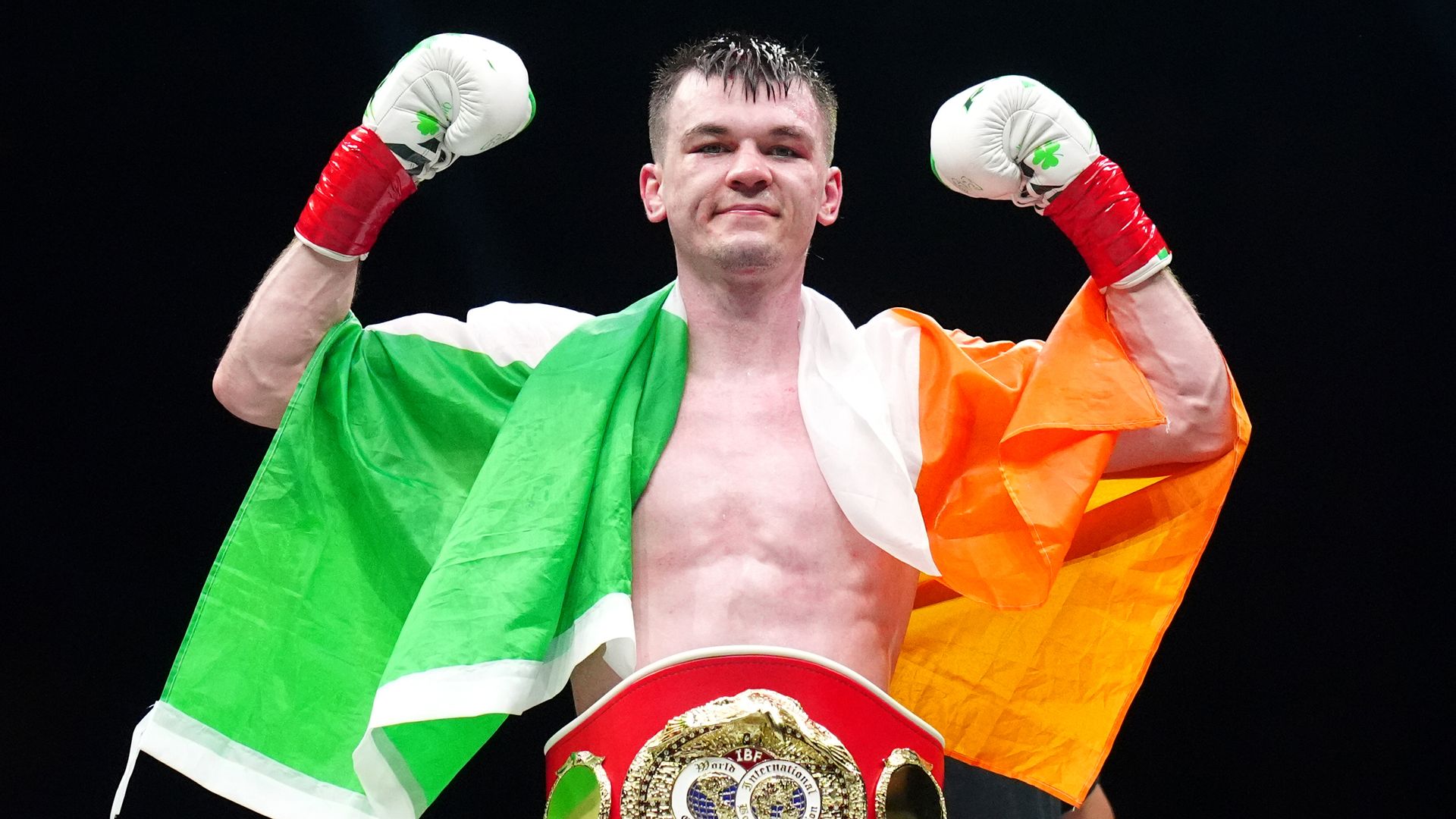
'There's no hiding'- IBF champ McKenna puts middleweight division on notice
>
Sports
Carabao Cup: Burnley edge win on penalties, West Ham, Norwich & Watford through | Football News
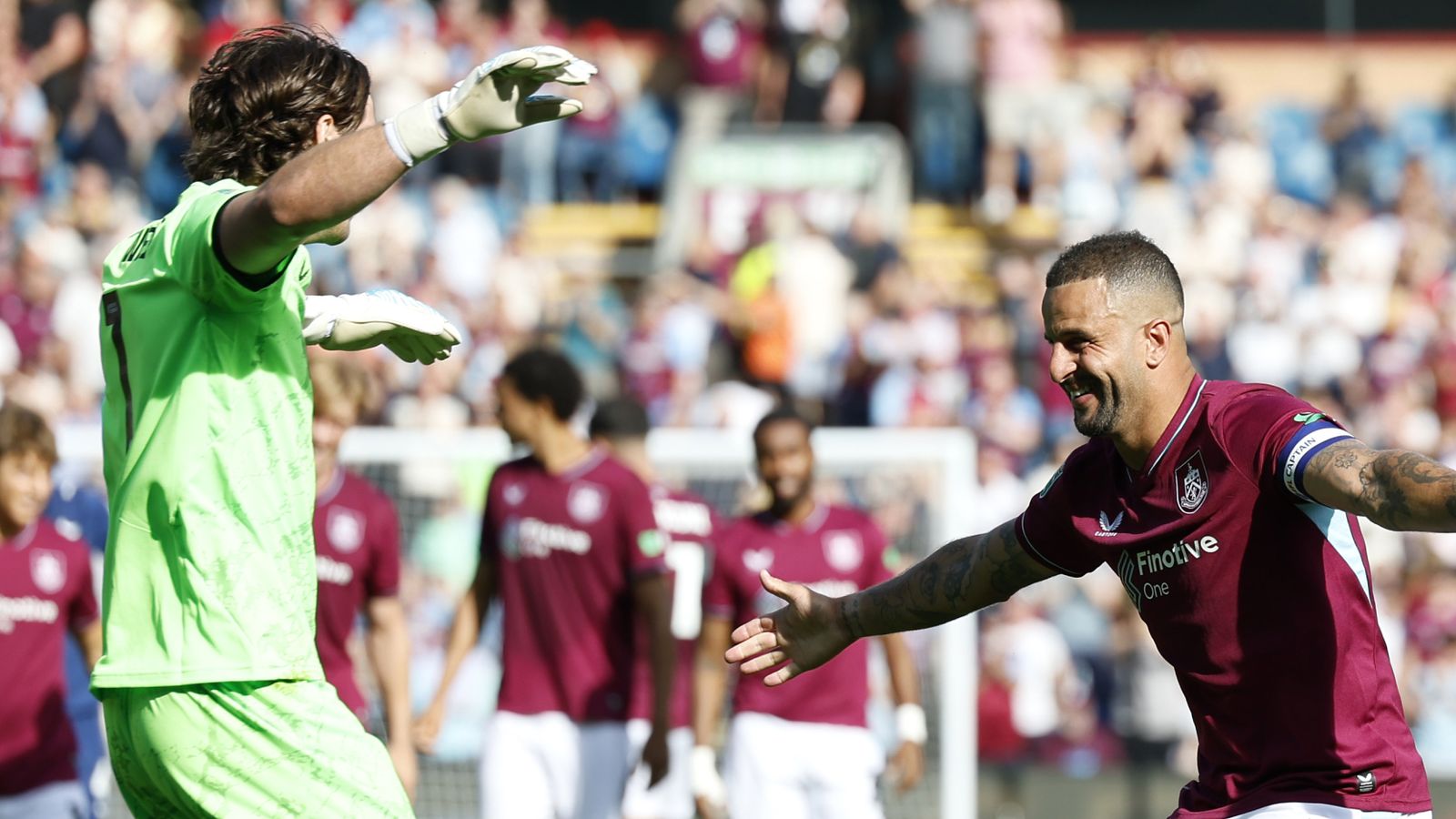
Kyle Walker struck the winning penalty as Burnley edged out Notts County 4-3 in a shoot-out to reach the Carabao Cup second round after a 1-1 draw at Turf Moor.
Newly-promoted County, League Two play-off final winners over Salford in May, led through Callum Roberts at half-time before Zian Flemming equalised early in the second period for the Clarets.
Walker struck the winning penalty after Burnley goalkeeper Max Weiss had saved efforts from Notts pair Emile Acquah and Jacob Bedeau in the shoot-out.
West Ham came from behind to beat Portsmouth 3-1 at the London Stadium in their first match following relegation from the Premier League.
The Hammers fell behind to Adrian Segecic’s first-half opener, but turned it round before the break with Taty Castellanos and Jarrod Bowen on target, before the former notched his second in the second half.
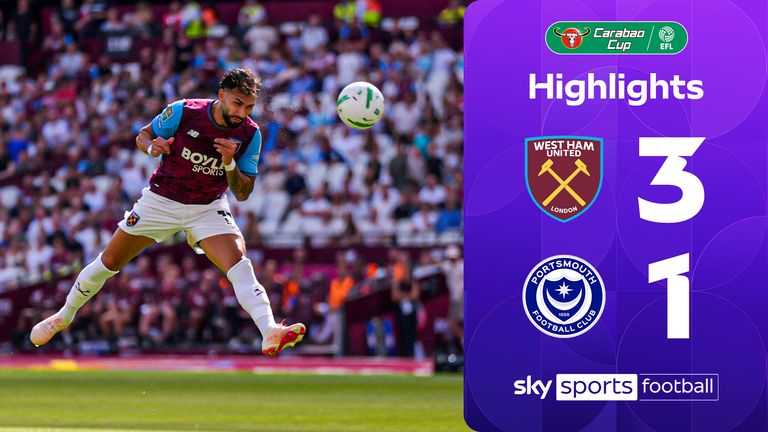
Highlights of the Carabao Cup first round match between West Ham United and Portsmouth.
Substitute Jamal Lowe struck the only goal as Sheffield Wednesday beat 10-man Bolton 1-0 at Hillsborough.
Lowe scored midway through the second half after Bolton’s Xavier Simons was sent off for punching Owls’ on-loan Leeds striker Harry Gray in retaliation having been pulled back.
Millwall goalkeeper Lukas Jensen saved all four of QPR’s penalties as the Lions won 2-0 in a shoot-out at Loftus Road after the game ended 1-1 after 90 minutes.
Luke Cundle had given Millwall a second-half lead after a goalkeeper error before the Hoops hit back through a late own goal from Mark Sykes.
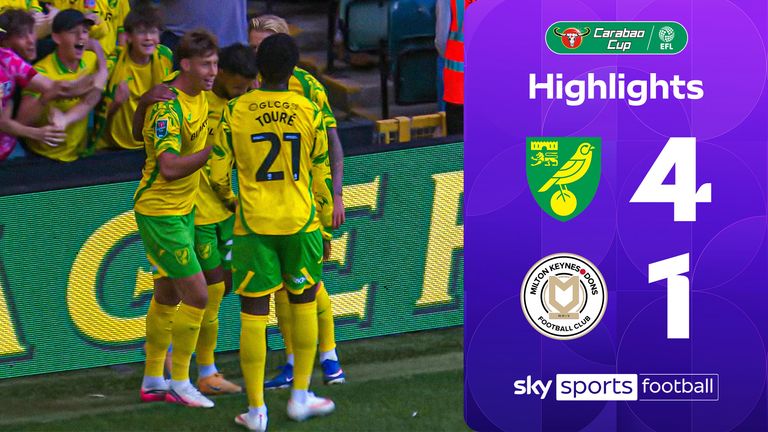
Highlights of Norwich City’s clash with MK Dons in the first round of the Carabao Cup.
Norwich debutant Andre Brooks was on target as the Canaries cruised to a 4-1 win against MK Dons at Carrow Road.
Cardiff substitute Jack Moylan also scored on his debut, firing the winner as the Bluebirds won 3-2 against Swindon, for whom James Debayo was sent off for two yellow cards in the final six minutes.
August Priske’s first-half finish sealed Birmingham a 1-0 win at Swansea and Marc Bola’s stunning long-range strike deep in added time clinched Watford victory over Crawley by the same score.
Late goals from substitutes Andri Gudjohnsen and Jayden Fevrier secured Blackburn a 2-1 win at Burton.
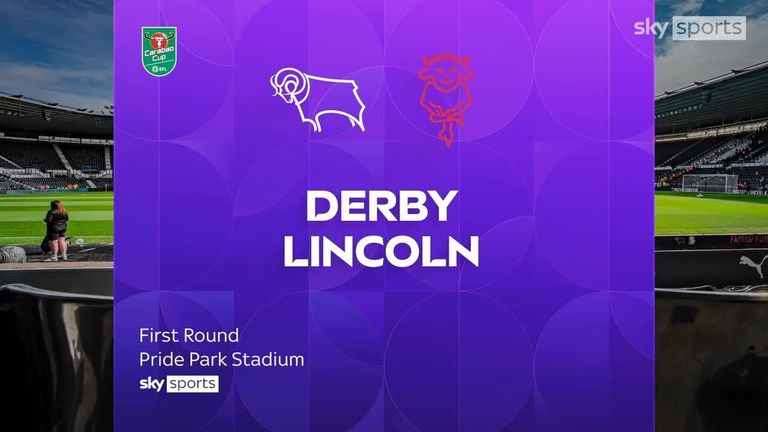
Highlights of the Carabao Cup first round tie between Derby and Lincoln.
Newly-promoted Lincoln picked up where they left off last season, winning 2-1 at Derby thanks to first-half goals from Ben House and Dom Jefferies before Sammie Szmodics pulled one back for the Rams.
Ollie Norburn’s own goal and Robert Bozenik’s late effort secured Stoke a 2-0 win against Oldham at the bet365 Stadium and Bradford pair Will Swan and Aden Baldwin earned their side a 2-0 home win against Rochdale.
Fleetwood captain Ched Evans’ first-half effort sealed his side a 1-0 home win against Chesterfield and Cambridge hit back to beat Barnet 2-1 through second-half goals from Ben Knight and Isaac Heath.
AFC Wimbledon, Barnsley and Reading progressed after winning on penalties against Newport, Wigan and Bromley respectively, while Preston, Shrewsbury and Doncaster came through respective shoot-outs against Huddersfield, Salford and Stockport.
Luca Moore’s late goal sealed Crewe a 2-1 victory against Accrington at Gresty Road and late goals from Demetri Mitchell and Idris El Mizouni secured Leyton Orient a 2-0 home win against Oxford.
Peterborough, Luton and Blackpool all won on the road, at Bristol Rovers, Gillingham and Grimsby respectively, and Caleb Okoli’s header secured Leicester a 1-0 home win against Northampton.
In the evening kick-offs, there was a 2-0 victory for Southampton as Cyle Larin and Romeo Akachukwu scored their goals at Colchester.
While West Brom won 4-1 at Rotherham and Charlton secured a 3-1 victory at Cheltenham.
When is the second round draw?
The draw for the second round of the 2026/27 Carabao Cup will be made live on Sky Sports Football on Monday August 10, during the build-up to the tie between Plymouth and Exeter.
The draw will feature all first-round winners, as well as the 11 Premier League clubs not participating in European competition.
All Saturday’s results
- Cambridge 2-1 Barnet
- QPR 1-1 Millwall (0-2 pens)
- AFC Wimbledon 1-1 Newport (5-4 pens)
- Barnsley 1-1 Wigan (6-5 pens)
- Bradford 2-0 Rochdale
- Bristol Rovers 0-1 Peterborough
- Bromley 1-1 Reading (4-5 pens)
- Burnley 1-1 Notts County (4-3 pens)
- Burton 1-2 Blackburn
- Cardiff 3-2 Swindon
- Crewe 2-1 Accrington
- Derby 1-2 Lincoln
- Fleetwood 1-0 Chesterfield
- Gillingham 1-3 Blackpool
- Leicester 1-0 Northampton
- Leyton Orient 2-0 Oxford
- Norwich 4-1 MK Dons
- Preston 1-1 Huddersfield (4-3 pens)
- Salford 1-1 Shrewsbury (3-4 pens)
- Sheff Wed 1-0 Bolton
- Stockport 1-1 Doncaster (4-5 pens)
- Stoke 2-0 Oldham
- Swansea 0-1 Birmingham
- Watford 1-0 Crawley
- West Ham 3-1 Portsmouth
- Cheltenham 1-3 Charlton
- Colchester 0-2 Southampton
- Rotherham 1-4 West Brom
>

Shergar Cup: Ryan Moore helps Great Britain and Ireland to Ascot crown | Racing News

'There's no hiding'- IBF champ McKenna puts middleweight division on notice

Carabao Cup: Burnley edge win on penalties, West Ham, Norwich & Watford through | Football News
-

 movies3 months ago
Search For Canadian TV Actor Stewart McLean Now Homicide Investigation
-

 Fashion9 years ago
These ’90s fashion trends are making a comeback in 2017
-
Fashion9 years ago
According to Dior Couture, this taboo fashion accessory is back
-
Fashion9 years ago
Model Jocelyn Chew’s Instagram is the best vacation you’ve ever had
-
Fashion9 years ago
Your comprehensive guide to this fall’s biggest trends
-
Fashion9 years ago
9 Celebrities who have spoken out about being photoshopped
-
Fashion9 years ago
Emily Ratajkowski channels back-to-school style
-
Fashion9 years ago
A photo diary of the nightlife scene from LA To Ibiza