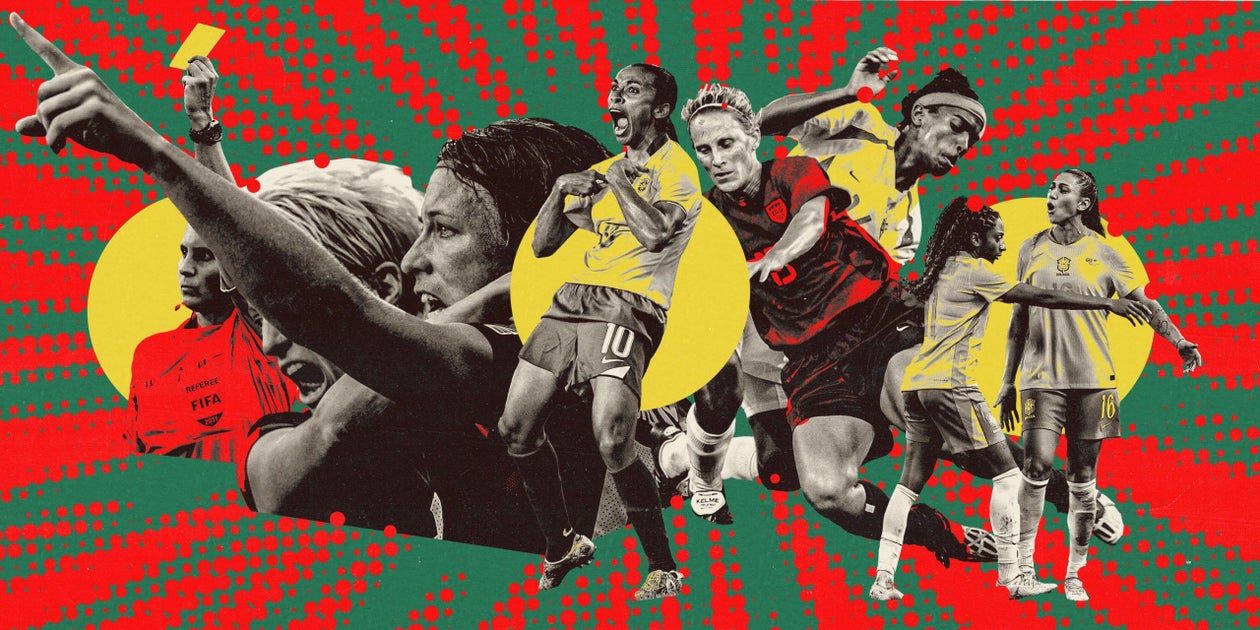
The 2027 FIFA Women’s World Cup is still too far out to know when, or if, the U.S. women’s national team and Brazil will face off on the global stage — but it almost doesn’t matter.
After what transpired on Tuesday night in Brazil’s northeastern region of Fortaleza — with one goal, eight red cards and 55,000 fans — the standard bearers of women’s football in North and South America wrote another fraught chapter to their decades-long history.
Whether a preparatory international friendly or a World Cup knockout stage game, any notion of peaceful relations built on mutual respect has gone out the window between these cross-continental rivals. It is always about winning with these two, but now their clashes are a matter of pride and wrestling for control of the narrative.
Who deserves to have the last word between the U.S. with four triumphant stars above its crest, and Brazil whose heart beneath beats for the beautiful game?
Historically, that privilege has been awarded to the former, despite losing to Brazil 4-0 at the 2007 World Cup semifinals in China. Overall, the USWNT has a 35-5-5 record against the South American champions, but a closer look at their recent meetings — and where those meetings tend to take place — brings more parity to their relationship.

The U.S. beat Brazil in Brazil for the first time since 1997 on Tuesday. (Brad Smith / Getty Images)
The U.S. have long enjoyed a home field advantage against most of their opponents, but they’ve faltered against Brazil of late even when they’ve played in the U.S. Last year, the two split results in Los Angeles and San Jose, California, with the USWNT taking the first clash with a 2-0 victory before falling to Brazil in the second, a last-minute 2-1 thriller.
They’ve also struggled when competing on Brazilian soil. Before this international window, they were 2-2-2 as the visiting side in Brazil, and that split remains essentially unchanged on the other side of it after the two have split results on June 6 and 9.
“That’s why I keep leaning into the fact that sometimes we create too many perfect conditions,” Hayes said after the June 6 loss. “We’ve created a culture in our football world in the United States that’s, ‘Well, do we need to do as much of that? Do we do less of this?’
“We have got to be tougher in lots of things, and we have got to be more durable, and we’ve got to expose ourselves to the elements of the game.”
Last Saturday night, 31,336 people filled the Neo Química Arena and were entertained by a Brazilian comeback victory that was dictated by the utmost physicality and game management tactics that furrowed the eyebrows, but also beautiful moments of football.
Tuesday was a different beast: it was larger and louder, courtesy of the 55,744 fans that packed the Arena Castelão for a match that devolved into something akin to a gladiator contest by the final 15 minutes.
Brazil vs USWNT Misconduct Summary
| Team |
Player/Staff |
Misconduct |
Minute |
|
USWNT
|
Rose Lavelle
|
Yellow card
|
17′
|
|
Brazil
|
Gio Garbelini
|
Yellow card
|
23′
|
|
Brazil
|
Arthur Elias
|
Yellow card
|
37′
|
|
Brazil
|
Bia Zaneratto
|
Yellow card
|
43′
|
|
USWNT
|
Lindsey Heaps
|
Yellow card
|
43′
|
|
Brazil
|
Taina Maranhao
|
Yellow card
|
48′
|
|
Brazil
|
Arthur Elias
|
Red (second yellow card)
|
78′
|
|
Brazil
|
Staff
|
Red card
|
78′
|
|
Brazil
|
Staff
|
Red card
|
78′
|
|
USWNT
|
Claire Hutton
|
Yellow card
|
82′
|
|
Brazil
|
Staff
|
Red card
|
89′
|
|
Brazil
|
Kerolin
|
Yellow card
|
90+1′
|
|
Brazil
|
Bia Zaneratto
|
Yellow card
|
90+4′
|
|
Brazil
|
Bia Zaneratto
|
Red (second yellow card)
|
90+4′
|
|
USWNT
|
Claudia Dickey
|
Yellow card
|
90+5′
|
|
USWNT
|
Emma Sears
|
Yellow card
|
90+8′
|
|
Brazil
|
Tarciane
|
Red card
|
90+9′
|
|
Brazil
|
Marta
|
Yellow card
|
90+9′
|
|
Brazil
|
Kerolin
|
Red (second yellow card)
|
Full Time
|
|
Brazil
|
Ludmila
|
Red card
|
Full Time
|
It began with tragedy when Dudinha, one of the most electric young players in women’s football who plays for the San Diego Wave in the National Women’s Soccer League, went down with an injury and was stretchered off after a worrying collision with U.S. center back Emily Sonnet in the first half. Forward Sophia Wilson, minutes after scoring her second consecutive USWNT goal as a mom (later ruled a Brazil own goal), was elbowed in the face by Brazilian center back Tarciane. The OL Lyonnes player was sent off with a straight red card for the offense. And that was only one of eight red cards the Brazilian team received that night: four given to players, and four split between their coaching staff. It was also one of 23 total cards shown on the night.
The final whistle sealed the USWNT’s 1-0 win, and the resulting tableau will surely be frozen in the memories of both sides until they meet again: U.S. players smug in their hard-fought victory, Brazilian players and staff fuming and charged up by the impressive turnout and its implications for next summer, and the referees holding their ground against the oncoming protests, with security guards holding riot shields moving into position around them.
To better appreciate the possible return of one of the USWNT’s tastiest rivalries, it’s worth looking back to the history — and beef — between the U.S. and Brazil.

Brazil players expressed outrage after the match with the U.S., which saw their side get eight red cards. (Brad Smith / Getty Images)
The nature of any USWNT rivalry is complex, considering the team’s success across World Cups, Olympics for pretty much the entire existence of the team. Every rival for the U.S. has been a result of a key World Cup match-up, from Norway beating the U.S. in 1995, to a run from China across the 1999 and 2003 tournaments. In those days, Norway — unaffectionately referred to as “those Viking b—-es” by U.S. players — set the standard for how to rattle the U.S. and get under their skin. It was not a simple defeat that could tag opponents as a rival, but finding a little extra something to ensure the loss was as demoralizing as possible.
Brazil looked ready to pick up the baton of the next big threat in 2004, squaring off against the USWNT in the gold medal match in Greece and forcing extra time. An Abby Wambach goal in the 112th minute was the deciding factor, and the first time the U.S. forced Brazilian legend Marta, just 18 years old at the time, to settle for silver.
However, it was in 2007 when Brazil firmly put themselves in the rival category, providing the most comprehensive beatdown the U.S. has ever experienced at a World Cup. Marta was central to the plot, scoring twice in the 4-0 victory for Brazil. The USWNT struggled across the board in the semifinal: first conceding on an own goal, then defensive midfielder Shannon Boxx was sent off in the first half.
Marta’s second goal, scored in the second half, is widely regarded as one of the best World Cup goals ever scored. She flicked the ball past defender Tina Ellertson, escaped Ellertson’s desperate grab of her jersey, dribbled past center back Cat Whitehill in the box, before scoring on goalkeeper Briana Scurry. Not only were the U.S. players forced to watch Brazil’s emotional celebrations, the loss also spurred Hope Solo’s infamous comments on head coach Greg Ryan’s decision to start Scurry over her. (The U.S. went on to salvage a third-place finish, beating, of course, Norway in the third-place match.)

Marta scored one of the best goals in a World Cup game in 2007 in a 4-0 win over the U.S. (Mark Ralston / Getty Images)
China served as backdrop for this matchup for a second year in a row, this time at the 2008 Olympics as the two teams repeated their gold medal face-off.
“We see Brazil again, our arch rival, a team that broke our hearts just a year earlier. That loss stung,” midfielder Heather O’Reilly said, looking back on the tournament in a 2013 video. “That’s a loss we won’t soon forget, so to face them again was incredible.”
With Wambach working her way back from a broken leg, Carli Lloyd stepped up to break Brazil’s hearts at another Olympics via a goal in extra time.
Then, in 2011, another World Cup face-off provided arguably the most important moment for the USWNT’s resurgence in the modern era of the team. For as much as everyone remembers the infamous goal, started by Megan Rapinoe’s speculative long-range cross off her left foot finding Wambach’s head in the dying moments of extra time to force penalties, many of the frustrations of that particular match between the two teams have been lost over the last 15 years, not fully captured by goal clips and highlight reels.
This game had everything: a Brazil own goal within the first two minutes, the U.S. dropping down to 10 players thanks to a red card to defender Rachel Buehler in the 65th minute after she tugged down Marta in the box, the U.S. getting dinged for encroachment (via Christie Rampone at the edge of the box) on that penalty and Solo allowing her first ever goal from Brazil with Marta swapping in on the re-take (after, of course, Solo had picked up her own yellow card for dissent).
The crowd that day swung wildly in the United States’ favor as the match went on, adding to the drama. Extra time would only get more chaotic. While the U.S. has never played a game like the one they experienced in Fortaleza on Tuesday night, the 2011 World Cup team lived through a rollercoaster of Brazil’s making in Dresden, Germany.
Marta, by then a five-time world player of the year, hooked the ball out of mid-air with her left foot past Solo to put Brazil ahead 2-1. The U.S. would shout for penalties of their own, first with Amy LePeilbet getting hip checked to the ground just inside the box, then Alex Morgan taking a trip to the grass a few moments later. Brazil’s Erika irked the crowd to a new level when she took a seat in the last few moments of the game, was stretchered off, then, once off the field, immediately popped off the stretcher to run back around to reenter the match. She got a yellow card for her troubles. Through 120 minutes played, both sides picked up four yellows each, and Buehler earned a straight red.

USWNT forward Abby Wambach’s 122-minute goal helped the U.S. reach penalties against Brazil and eventually the World Cup final. (Mike Hewitt / Getty Images)
The two teams diverged on their paths as rivals after the U.S. went on to win on penalties before ultimately losing the 2011 World Cup to Japan. Japan picked up the rivalry baton for another full cycle, before the U.S. entered an era without a true arch-rival. While a handful of European teams have all had their moments, Sweden is the leading candidate so far when it comes to true enmity.
There is a difference between a rival and an opponent. While the rise of Spain’s women’s national team and their dominance on the international stage of late is undisputed, and England has made its own case, neither team has managed to shift past a team that is capable of defeating the USWNT into a team that has embarrassed the USWNT in a massive moment.
While the 2024 Olympic final meeting between the U.S. and Brazil was one of the tamer meetings between the two teams, it has served as the precursor to the back-and-forth battles under Hayes. In her final Olympics, Marta once again had to settle for silver against the U.S. and ultimately proved to not be much of a factor once she came off the bench. That match didn’t have much spice (fouls were fairly even, Brazil had 15, the U.S. 12, and only a single yellow card was given to Brazil), but there’s nothing like coming up just short in the Olympics to spur a World Cup run.
The time is perfect for Brazil to lean into their history and pick up the baton again. These teams know each other well, the increased presence of Brazilians in the NWSL adds even more familiarity, and hosting the 2027 World Cup adds the cherry on top. You can’t have a rivalry without that deep level of intimacy, one that allows perceived slights to simmer and calls for a need for revenge.
These two teams deserve each other. The U.S. still has work ahead to qualify, and the schedule gods need to come through, but these two teams deserve an epic knockout-round meeting next summer to keep writing their entwined story.