
‘At Night,’ courtesy of Night Films


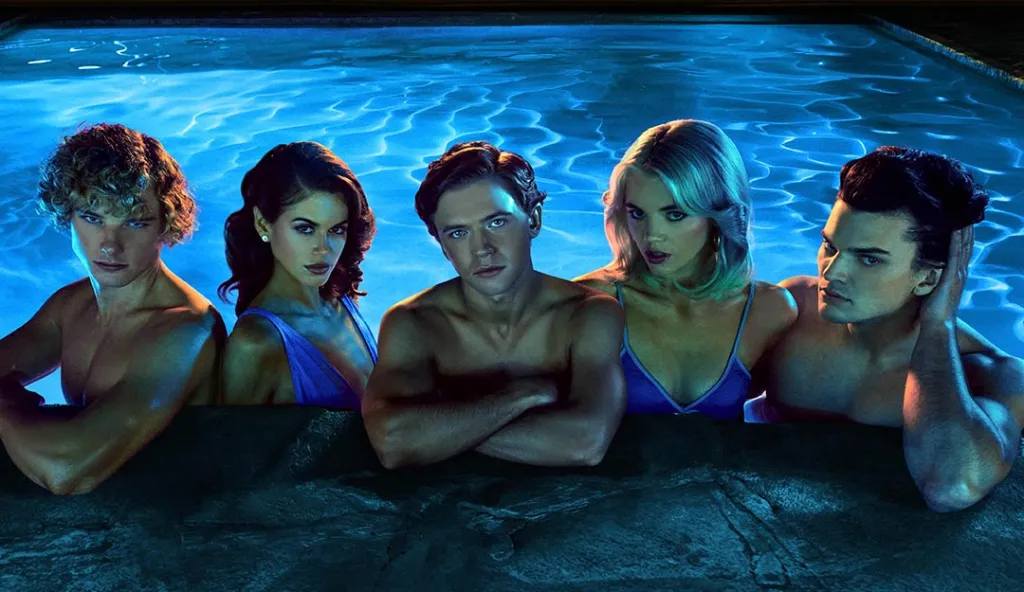
Ryan Murphy‘s anticipated new series The Shards, based on Bret Easton Ellis‘ prep school thriller novel, will premiere August 5 on FX and Hulu, as well as Disney+ internationally, it was announced Wednesday.
Suspense, seduction and obsession. That’s what FX teases we can expect from the drama series, which hails from 20th Television and Ryan Murphy Productions.
First unveiled as a serialized audiobook before hitting the shelves in 2023, The Shards is a dark coming-of-age tale with semi-autobiographical facets for Ellis. Set in Los Angeles in 1981, the story follows a 17-year-old version of Ellis during his final year at the elite Buckley prep school. Upending the character’s world is the arrival of a mysterious new student, Robert Mallory, whose unsettling presence coincides with the activities of a serial killer known as The Trawler.
Per the official logline: Set against the vivid backdrop of 1980s Los Angeles, the series follows a group of privileged high school seniors at an elite prep school as they navigate identity, sex, jealousy, obsession and the dangers lurking beneath the surface of American adolescence.
Igby Rigney stars as Bret, an aspiring writer and keenly observant teenager whose reality begins to unravel with the arrival of a mysterious and magnetic new student, Robert Mallory (Homer Gere), per the official logline. Transferring in just before his senior year, Robert’s appearance coincides with the growing terror of The Trawler, a serial killer targeting teenagers across the city.
Alongside Bret is his elite social circle, which includes Susan Reynolds (Kaia Gerber), Debbie Schaffer (Hayes Warner) and Thom Wright (Graham Campbell), a glamorous and deeply entangled group drawn into a life of wealth, beauty, parties and excess. The promise of their youth is contrasted with the dark and cynical world of the adults surrounding them: Terry Schaffer (Wes Bentley), Liz Schaffer (Evan Rachel Wood) and Steven Reinhardt (Jordan Roth).
Gere’s (son of Richard Gere) Robert Mallory and Wright’s Graham Campbell are key characters in the novel.
The Shards is executive produced by Murphy, Nina Jacobson, Brad Simpson, Ellis, Eric Kovtun, Scott Robertson, Nissa Diederich, Tanase Popa, Nick Hall, Michael Uppendahl, Max Winkler, Kathleen McCaffrey and Brian Young. The series is produced by 20th Television.
>

In At Night, British filmmaker and artist Beatrice Gibson’s first feature-length film, the nightly sights and sounds of Paris interweave with the stories and conversations of six women – from hopes, dreams and sexual desires to worries about the future.
Rhythm and mood are key elements that make the experimental and “autofictional” movie, which world-premieres on Saturday, Aug. 8, in the Filmmakers of the Present competition program of the 79th edition of the Locarno Film Festival, a special kind of cinematic ride. Just ask Locarno’s artistic director, Giona A. Nazzaro. In a chat with THR, he described the movie as “this nocturnal, ambient film where you can almost hear music that makes you think of Brian Eno. If At Night were a record, it could be music for lonely people at night.”
Written and directed by Gibson, At Night features cinematography by her long-time collaborator Ben Rivers and editing by Liyo Gong. But the music doesn’t come courtesy of Brian Eno. No, it is the creation of Elvin Brandhi.
If you don’t follow experimental music, here are some basics to know about her. Elvin Brandhi is the pseudonym of Freya Edmondes, an improvising voice and sound artist who was born in Wales, but has become a citizen of the world. Her music features unusual beats created from field recordings, her own voice, tape, vinyl and instruments. She is also part of all sorts of music collaborations, including father/daughter “noise-improv berserkers” Yeah You, Pollution Opera with Nadah El Shazly, the duo Avril Spleen with Joseph Jadam, the band PFL with Peter Kutin and Lukas König, and the project Bahk with Daniel Blumberg.
At Night, which features an array of Gibson’s non-professional actor friends and influences as they discuss and explore such topics as sexuality, money, motherhood and mental health, is the musical artist’s first-ever feature film soundtrack. And it seems fitting that she collaborated with Gibson on this film that press notes call “a love letter to friendships, relationships, and the quiet yet poignant stories women share together but rarely to an audience.”
Brandhi took time out of her busy schedule to talk to THR about the creation of the soundtrack for At Night, her other music work and whether we may be able to hear more from her on future cinematic journeys.
‘At Night,’ courtesy of Night Films
The artist confirms that the work on At Night marks a new step for her. “It’s the first time I’ve done a soundtrack for a feature film,” she tells THR. “I did a couple of short films with friends, and I make my own music video-type thing. So I consider myself more of an audiovisual artist. I think in both realms, but this was obviously very different. I’ve worked with Daniel Blumberg a little bit, hanging out with him a lot in the process of The Brutalist and then the Anne Lee film, [The Testament of Ann Lee]. I was doing quite a lot of vocal stuff, also with [avant-garde improvisational vocalists] Phil Minton and Maggie Nicols. And Daniel has been creating this nice bridge between the experimental scene in London and Hollywood cinema.”
So, this must be a good time for Brandhi to get her first feature film soundtrack under her belt, you may wonder. “It was probably helpful for me to get involved in the experience of how to make a soundtrack,” she confirms, but notes that it required a different focus from her usual work. “It was quite a unique experience, and I had to adjust a little bit how I think about composing. A lot of my music is quite in your face and trying to be as present as possible. But with a soundtrack, you have to almost make it sneak in from the sides, or be somehow invisible, coming out of the background.”
Given that Brandhi works a lot with field recordings, how did the Paris setting of At Night play to her passions? “What was really nice about this film was that the metro is such a big center of the narrative, and that’s already quite a noisy place,” she tells THR. “It has a lot of the kind of frequencies and ambient noise and things that I might feel like field recording and be inspired by anyway. So it was this perfect entry point for coming into that film world.”
‘At Night,’ courtesy of Night Films
Courtesy of Night Films Ltd.
Gibson and Brandhi have all sorts of connections but made their acquaintance by coincidence. “I met Beatrice for the first time at [the experimental music festival] Borealis [in Bergen, Norway], but only very briefly,” the music artist recalls. “We were in the same taxi going somewhere, and I was playing, and she was screening something. I think she knew of my music, and then a common friend, Leonardo Ruvolo, from Alcamo in Sicily, put us in contact because I also did his residency, and she’s living in Palermo [in Sicily] now, so there were various coincidences.”
And the women quickly got along. “When we started working together, we became very good friends immediately,” Brandhi shares. “And working on At Night was a very intimate and special process.”
But what was this process like, and how early did Brandhi start crafting music for the film? “Beatrice wanted to have as much sound as possible before even starting to shoot. So I did get sent a first draft of the script, but that did get changed as the film went through different shifts,” she recalls. “We spent a week going through ideas before any shoot. I sent her some drafts of things that might work. And she had one reference of a song that she really liked, which was actually from a collaboration I have that is called Insin [with Palestinian producer/MC Bashar Suleiman]. The track is called ‘Kidney Spears,’ which is a little bit more dreamy. I’m also singing in that. So I tried to send her other things within that kind of dynamic.”
When Gibson started shooting in Paris, Brandhi also came to the French capital. “I was taking some recordings when they were going into the metro,” the musician tells THR. “And there was originally even a scene of me performing in Paris in the film.”
‘At Night,’ courtesy of Night Films
Courtesy of Night Films Ltd.
All in all, the soundtrack came together in an ongoing collaboration. “There were some core themes that we developed, and then little bits that needed a very specific kind of mood or dynamic,” she says. The collaboration also included editor Liyo Gong. “She is really amazing,” says Brandhi. “She’s also a DJ, so she has a very strong sense of the musicality in film and in how she edits.”
Crystabel Riley also contributed, drum sounds, to the soundtrack. “I asked her if she would contribute some drumming that I could weave into different parts of it,” Brandhi recalls. “She was actually involved in the film, doing some of the makeup, because she’s a makeup artist as well as a musician.”
Fans of the artist’s work may get to hear more from her in feature movies in the future. “I definitely would like to,” Brandhi tells THR. “I would be really up for it; it was really interesting entering the story and composing from a different perspective.” She adds: “I saw her playing live for the first time last year, and I was just so blown away because she’s such an incredible performer, and her stage energy is so engaging. There’s this warmth and tension as well. It feels very urgent. I was just watching her and felt the state of mind of the women in the film echoing in her performance.”
Concludes Brandhi: “It was really special for me and Bea that she was part of it.”
The creative mentions that she has also worked with video herself, and being involved with At Night inspired her to return to more of it. “In the lockdown, I did a lot more filming and editing stuff, so I feel that this soundtrack world is also a nice potential way to get back into the editing of my own film material,” she shares.
Not that Brandhi doesn’t have all sorts of music stuff in the works. Including an album with Berlin-based Kenyan musician KMRU under their name A|||oy, which will be released on KMRU’s label offnot. “He is associated a bit more with ambient music. But we have so much in common and are both fans of each other’s music, even though it might seem like we have quite contrasting dynamics,” she tells THR. “There’s a strong similarity in the way we work with field recordings and sounds, textures and spaces.” Concludes Brandhi: “We’ve been collaborating for three years now, and we have an album coming out that we made between a couple of residencies, one at [Swedish electroacoustic music and sound art center] EMS in Stockholm, and then one in [Max Richter and his partner Yulia Mahr’s] Richter Mahr studio in Oxfordshire. We just listened to the test pressing, and it was really exciting. We’re both singing, and it’s completely different from both of our works.”
>

Real history, fiction and AI blend together for a look at a former radical far-left underground armed organization in Portugal in the new film from auteur Edgar Pêra (Telepathic Letters, Manual of Evasion LX94), Asphalt Guerrilla (Guerrilha no Asfalto). The movie marks the Portuguese writer-director’s return to the Locarno Film Festival in Switzerland, where it will world premiere in the Out of Competition program during its 79th edition on Monday, Aug. 10.
The militant group that the film revisits is the FP-25, short for Forças Populares 25 de Abril, or Popular Forces 25th of April, which was active between 1980 and 1987. It carried out dozens of bombings, shootings and bank robberies. The film is based on the eponymous book by Manuel Ricardo de Sousa, a member who ended up being lynched by a mob in the aftermath of a bank robbery.
But there is also a meta level to the movie. “It’s also about trying to make a film that ought to be shot in a guerrilla mode, with no compromises with the system,” notes the Locarno website.
A synopsis teases the mind-bending quality of the movie by describing it as “a fictional film rooted in reality about a utopian time in Portuguese democracy.” And it continues: “Set in the early ’80s, it begins with a quiet student who becomes involved in a radical organization and ends up being shot and lynched by the mob in the aftermath of a bank robbery. Throughout the film, we witness the sometimes comical, sometimes tragic problems of these ‘asphalt guerrillas’ fighting against the system; at the same time, the director of the film quits the organization in order to fight to make films in a guerrilla mode.”
‘Asphalt Guerrilla,’ courtesy of Bando à Parte
Pêra wrote the screenplay with Rodrigo Areias, and the voices of Pêra and Albano Jerónimo feature in Asphalt Guerrilla. Jorge Quintela is the cinematographer, while João Mora is the editor. The cast features Miguel Moreira, Maria Leite, Ivo Arroja, Jerónimo, Bernardo Santo Tirso and Luke Eberl.
Pêra talked to THR about Asphalt Guerrilla, what inspired it and what it says about his latest take on the use of AI in filmmaking.
“There are many films in this film,” Pêra highlights. “The very beginning was this book, which I read in the ’90s and basically shows a very amateurish group of guerrilla men or terrorists, depending on your point of view, but it gradually transforms into a film about my own guerrilla [film] scene, mainly because my friend and producer Rodrigo Areias made me do it.”
Indeed, Pêra started making an underground name for himself in the mid-1980s with his avant-garde style as a “neuro-punk” filmmaker associated with DIY counterculture and the Portuguese music scene.
“I would never pitch a film about me, including an autobiography, but I really understood that Rodrigo proposed it,” he tells THR. “I told him that I wanted the film to be about the future, not about the past, not about the ’80s and the problems we had back then in Portugal, but about this society and the state of cinema.”
If you are watching the film and can’t quite tell which parts are real and which ones are fictional, Pêra won’t mind. “This fusion, or blur, of fiction and reality is something that I like, but it’s also something that I must fight against,” he explains. “So the film is also a mirror of what’s happening, where you sometimes don’t really know what’s real.”
‘Asphalt Guerrilla,’ courtesy of Bando à Parte
Does he really feel like a film guerilla? “Actually, when I was in my 30s, there was this producer who called me the Sniper,” Pêra tells THR. “I think he said that with respect. I think I have that respect from other filmmakers of my country because I never tried to do anything that was not myself.”
As the filmmaker did in his 2024 Locarno film Telepathic Letters (Cartas Telepáticas), Asphalt Guerrilla uses AI images. “I always try to leave some clues for what is AI-made,” he highlights. “But there are moments where, to show the danger of AI, you have to behave like a dangerous AI, which is why this film has moments [referencing] what worries me most, news becoming fabricated. And actually, the worst part is that AI also gets the most fun part of creating, such as [people] asking AI to write prompts.” Concludes Pêra: “So I try to fight all of that and create my own prompts and create my own algorithm. If you leave things to the YouTube algorithm, you know what you get.”
Added the auteur: “You have to make at least a playlist so that you’re not invaded by this ultra commercial thing. That’s my fight inside of AI to create some images that are original in the way that they are recombinations of things that already exist. That’s what every artist does.”
How does that fit into Pêra’s early neuro-punk days? “I was always interested in the effects of cinema on the minds of people and how the mind works,” he tells THR. “Neuro-punk was meant to say that we have to fight things with ideas, not with violence. So, cameras are weapons. Make films, not violence.”
‘Asphalt Guerrilla,’ courtesy of Bando à Parte
The auteur didn’t necessarily know how timely his film would feel in a time full of wars, a rise in political and other radicalism and, of course, AI when he first started conceiving it. “I think it’s not a coincidence. It’s a synchronicity,” he offers. “But even when we think times are okay, we have lots of things that worry us. Now, we are in the worst of times, as they say. But even in the best of times, there’s still exploitation, people dying and all that. So yes, I think it’s a timely moment to go to the roots of the problems and not only focus on radicalism. I think radicalism is a symptom; it’s not the problem.”
He sees the underlying issue this way: “Radicalism is a symptom of the decay of our system. I’m not an expert, but I feel that it’s not the radicalist we have to fight because that means [we are] becoming another radical. So that’s a trap. Instead, let’s talk about what makes our planet worse.”
Pêra is working on another movie, which will keep speaking out about worries he has. It’s called The Spiral of Fear, and it’s about “big tech and what media says about the masters and all that.”
>

In 1988, Afghanistan sent its first cosmonaut into space. Yes, really. Abdul Ahad Momand went where no Afghan had gone before — or has gone since — making Pashto the fourth language ever spoken beyond Earth. So why does barely anyone remember his name, his journey, or the hope it sparked among fellow Afghans at the time?
Part of the answer may lie in timing: just as the spaceflight took place, Afghanistan was on the brink of civil war, a conflict that would soon force millions of its people into exile. As a new film argues, the country’s story has been shaped by conflict, exile and diaspora ever since, with science, culture and ideas pushed to the margins.
Elham Ehsas (There Will Come Soft Rains, Yellow, Our Kind of Love), a London-based Afghan filmmaker and actor, is working to change that narrative and spotlight a piece of history too often left out of it. His short film Forgotten Spaceman — which blends documentary and essay elements while uncovering a surprising link between Afghanistan’s space history and his own family’s past — will world premiere on Aug. 9 in the Pardi di Domani – Concorso Internazionale program of the 79th edition of the Locarno Film Festival.
Ehsas wrote, directed and edited Forgotten Spaceman, which is executive produced by Catherine Tschaepe and Jack Thomas-O’Brien of Ken Loach’s Sixteen Films, which backed the film. World sales and festivals are being handled by María Vera of Kino Rebelde.
Beyond the story of Afghanistan’s spaceman and Ehsas’s own family history, the short also examines “shadows of colonialism and the memory of a fractured and silenced nation,” per its synopsis. Ehsas spoke with THR about his surprise at discovering Momand’s story, how Forgotten Spaceman came together, and what he hopes audiences take away from it.
Can you share a little bit about the journey behind Forgotten Spaceman?
I feel this film was almost a coming of age for me in terms of getting to know my own past and my country’s past. I was researching a short fiction film that I was trying to make around space. And then I came across Abdul Ahad Momand, and I was like, “Who is this guy? How is it possible that we have an Afghan cosmonaut who went to space?” He put Afghanistan on the map in 1988. When he called his mom, Pashto became the fourth language ever spoken in space. It’s Russian, English, Mandarin and Pashto. And it just blew my mind.
So I went to my parents and spoke to my mom and dad, and I was like: “How did you guys not tell me about him?” And it’s interesting because I’ve spoken to a lot of my cousins and family members my age and asked, “Do you guys know we have a spaceman?” And they were all [reacting the same way]: “What? Come again?” So, almost at every turn, this was a teaching opportunity for my own cousins and friends as well. It was such a discovery.
And I also learned a lot. Through this experience of listening, I learned about making a documentary because it’s my first documentary. I learned to just relinquish control and go where this story is taking me. Sometimes, letting go is one of the best things you can do.
‘Forgotten Spaceman’
Courtesy of Foreigner Ltd.
The film starts out as a story about the Afghan spaceman, but then it also connects to your family story, and then you zoom out to show us a universal story. Did you know from the start that Forgotten Spaceman would also touch on these bigger themes?
This whole film was a complete accident. I was trying to make this fiction film about space and then found Momand. And then I realized that he’s a refugee out in Europe somewhere, so then my idea was that I’d make a documentary about me looking for him. I put in about four, five months of work, shooting different footage around London. When I found out that he’s in Stuttgart in Germany, I thought I’ll go to Germany and speak to him.
And then several months into this whole process, my dad gave me a picture. “Oh yeah, I have this photo of Momand.” That completely blew the whole thing open for me. It was insane. I can’t believe we have this photo, and I can’t believe that this photo speaks so much of my own family and of my own relationship with Momand and space, but also all of us and our relationship to home, to our country, to Afghanistan.
Do you want to talk more about the photo and what it shows, or is that too much of a spoiler? And what did you do?
I pivoted because I felt something was happening here. I am being guided by this film, and this film wants to be something else. Because I come from a narrative background, I’m used to scripting, casting, shooting, crafting, and engineering this whole narrative. But here is a true story that kept evolving, and it kept changing, and I felt the best thing here was to surrender to what’s happening. Maybe the story isn’t about me looking for Momand. Maybe the story is about this photo. And what if I can build something around this one photograph? No spoilers, but for people who see it, they’ll realize why this picture is so important, and that gave me the architecture for the rest of the film.
Parts of the film felt a bit like a detective movie to me. And it also felt like a journey of discovery where another layer is uncovered. We see some family footage but also official, I assume, TV footage from Afghanistan about the space trip. Where did you find all this footage?
It’s so interesting that you speak about the detective element. I almost felt like a detective trying to find this footage, these different pieces of archive. It’s really hard to find pre-Soviet era archive footage around Afghanistan, especially around such a niche as the space program.
‘Forgotten Spaceman’
Courtesy pf Foreigner Ltd.
I reached out to a bunch of official, independent archive houses, [Russian Space Agency] Roscosmos, as well as the Afghanistan archive in Kabul. Because my dad is a journalist, he still has his network in Afghanistan. So I was speaking to a bunch of really interesting people, and through that, we found all of this beautiful footage. But I wanted the texture of the footage to not just be about his flight, but also about the rest of Afghanistan, about the history of his country. So that meant I had to dig deeper into the Soviet invasion from ‘79 to ‘89. At one point, I licensed about six hours of random footage that I didn’t know what it was. I just knew it was coming from Afghanistan and from that part of history. An archive house said, “Look, the deal is we’ll give you this for an affordable price, but we don’t know what’s in it, so you have to just take a blind shot.” So I had all of this footage, and it really helped me get the whole thing together. So, yes, the whole thing is a discovery.
You have big-name executive producers on the film, such as Ken Loach’s Sixteen Films…
I’m incredibly lucky for this project to attract such incredible collaborators, including someone like Ken Loach and Sixteen Films. They are renowned for telling stories that aren’t often told, telling human stories from different times and from different social and historical backgrounds. One of the executive producers is Sixteen’s Jack Thomas-O’Brien, who worked on this amazing film On Falling [by Laura Carreira]. So I have had a bunch of collaborators that I was sending the film to and getting their thoughts. The story started in my bedroom, and it just started getting bigger and bigger with all of these collaborators. It’s all about the magic of the moment [of the Afghan space trip], but also space and what it tells us about home and ourselves. I’m very lucky for the film to have resonated with incredible collaborators who have come on board and championed us and supported us. It’s just an incredible privilege and honor.
You mentioned how Forgotten Spaceman goes into what space tells us about Afghanistan and, actually, also the exile experience. Can you talk about that a little bit?
When I started this film, I thought I was making a film about this really super cool guy called Momand, who was an Afghan spaceman. But as the film was evolving in front of my eyes, I realized that there’s this family connection, so it’s also about me and my family. But then you keep going, and you keep discovering, digging deeper and deeper, excavating. And then I realized that actually this film isn’t just about Momand, me and my family. It’s about all of us and all of those people who have left home and moved. It’s about migration, it’s about refugeeship, it’s about the loss of home and the things we leave behind.
‘Forgotten Spaceman’ director Elham Ehsas
Courtesy of Locarno Film Festival
Here is Momand, an astronaut who went up to space, took the Quran with him and spoke Pashto up there. And then he came plummeting back down, went into exile, lived in Germany and became an accountant. So, it’s also about what a country loses when its children go into exile.
That also speaks to memory, history and this divide between the East and the West. The East has these incredible stories, this incredible history, but this fragile memory, while the West has a short memory. As an Afghan filmmaker, I thought it was almost my duty to bring this story to life. I need more people to learn about Momand, and I need more people to know that he was Afghan. We’re not just bullets and blood and violence. We’re more than that. The West has chosen to only show Afghanistan in a specific light, which speaks to a bias. My colleagues from the diaspora and I feel it’s our duty to tell these stories in different ways.
The film mentions that Afghans’ and Afghanistan’s stories usually get told through violence, conflict and war…
Yes, for most of my lifetime, Afghanistan has been defined in the world’s imagination by conflict, headlines of war, statistics of death. But that’s not the country that my parents grew up in, or my grandparents. And it’s not the whole story of the place. Afghanistan is a country of poets and scientists and filmmakers and history and art and music, as I’ve shown in the film as well. And it’s a country that sent a man into space in 1988. When you start pulling on that thread, you find the whole landscape of achievement and imagination that has been buried and the tragedy of the lost potential of those people who had no choice but to move.
Is that also why Forgotten Spaceman features Afghan music?
I was faced with this incredible, epic tale of this man, and then through that tale, I zoom out and talk about our country and migration and refugees. But how do I tell that story, especially in a short documentary, in the most succinct way? I love music, especially Afghan music. I grew up on it, especially old folk songs. So, I thought, what if I engineer the film like a music album? What if it’s built around three different songs for the three different acts of the story? And that’s where the inspiration for that came. I went down this deep rabbit hole of old Afghan music that I grew up listening to, but also discovering new songs and remembering which songs my mum or dad used to listen to when I was a kid. I found these three beautiful, beautiful songs, and the fourth one in the credits by an incredible artist called Zarsanga.
‘Forgotten Spaceman’
Courtesy of Foreigner Ltd.
Does the film’s original title Hershewe Fazanawerd mean exactly the same as the English title – Forgotten Spaceman?
It literally translates to the man who went to space, or the spaceman. But Afghanistan has two national languages: Pashto and Dari. I was mindful that my previous films had dialogue in Dari, and I never included Pashto, which is actually my mother tongue, and it’s the language that Momand spoke in space. So, I decided to do the voiceover in Pashto, almost as an ode to my mother tongue and to Momand.
I heard that you are working on your first feature as a writer and director?
Yes, it’s a feature film called Our Kind of Love, and it’s based on my first-ever short film. We’ve been working hard on developing it with the BFI, and we’re just coming out of the script stage. Making films is so hard, and telling stories is so hard. I think there is value in putting a lot of time into trying to get it right, especially when you want to speak about a specific theme.
Our Kind of Love ultimately is about the East and the West meeting. The short film was about an Afghan woman who was on a first date with an Afghan man who was born here [in the U.K.], and she was born in Kabul. It’s about how, if you put the East and the West together in a room, they interact. I’m a first-generation refugee. I came from Afghanistan to this country, and so I juggle two identities, and I juggle two cultures and countries. That’s what really always informs my work.
‘Forgotten Spaceman’
Courtesy of Foreigner Ltd.
What’s next for Forgotten Spaceman?
We’re really excited that the film will premiere at the Locarno Film Festival, and then it is going to Toronto. I’ll be so curious being there for the first screening at Locarno to look at the audience and their reactions. It will be such a privilege for me to see them experience it. The film is how the legacy of Momand survives, and the legacy of these refugees who have done great things.
Do you ever think that Forgotten Spaceman could be expanded into a feature-length film?
Well, it’s such an epic story, and it’s such a beautiful story that speaks to so much. So, I’d be very curious to see and discover how it would look as a feature film.
Is there anything else you’d like to highlight or mention?
I want to also speak about my collaborators, the people I worked with on this film, and especially the music. My co-producer is Lorraine Bhattachary, and our composer CJ Mirra. Our sound designers are Rob Szeliga and John Cohen, who did such an incredible job because a lot of the film lives and dies in the sound. A lot of these experiences are so sonic, especially in space, and we wanted it to be something grand and beautiful. They all smashed it, and that’s what this film, and film in general, is about — collaboration.
>


Search For Canadian TV Actor Stewart McLean Now Homicide Investigation


These ’90s fashion trends are making a comeback in 2017
According to Dior Couture, this taboo fashion accessory is back
Model Jocelyn Chew’s Instagram is the best vacation you’ve ever had
Your comprehensive guide to this fall’s biggest trends
9 Celebrities who have spoken out about being photoshopped
Emily Ratajkowski channels back-to-school style
A photo diary of the nightlife scene from LA To Ibiza