
Tech
Omen AI’s plan to optimize data centers is all wet

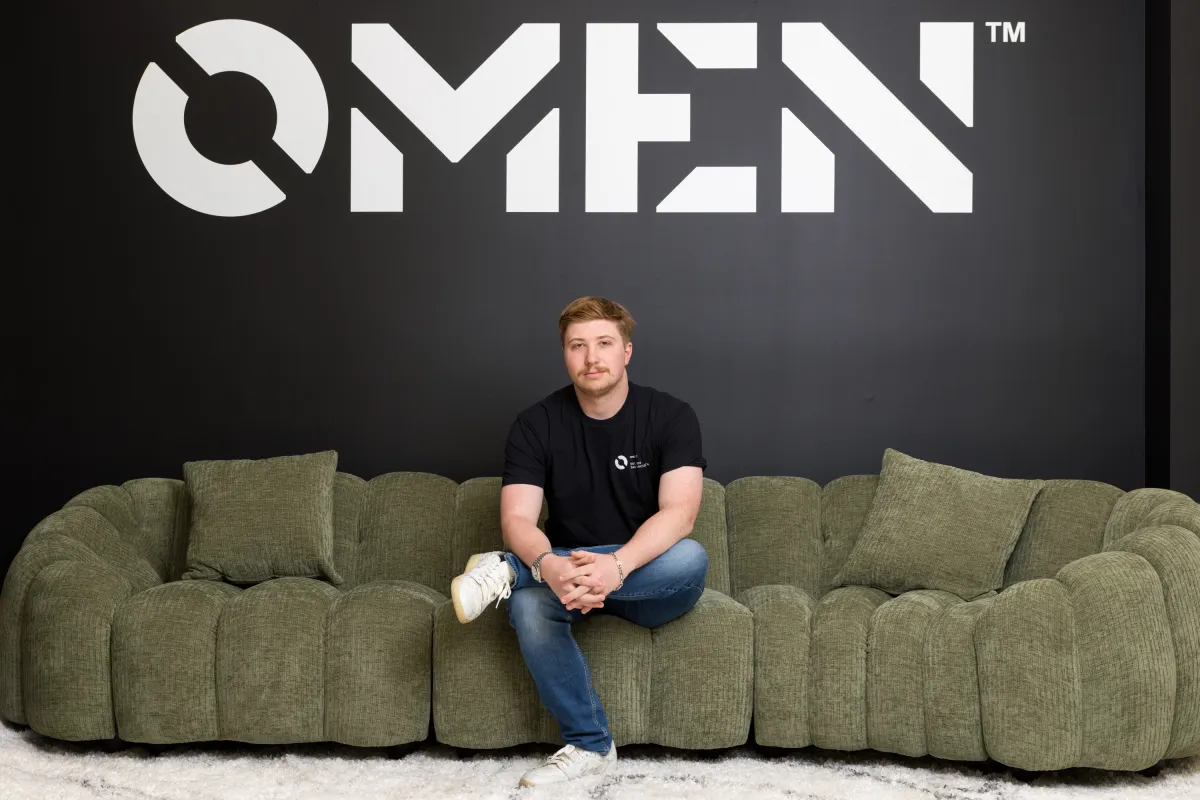
The AI-driven demand for compute power has data centers looking to squeeze more from every rack of GPUs. One consequence? Bacterial outbreaks.
The liquid for liquid-cooled chips is a mixture of water and a substance that inhibits bacteria growth. To run the chips hotter, data center managers can change the mix to include more water, which absorbs heat better, but leads to nasty contamination that clogs the flow. To solve that, they flush the system, which can mean shutting down a rack for five or six hours at a potential cost of millions of dollars.
Omen AI has a solution: A tiny spectrometer that can monitor that fluid health in real time, spotting bacterial growth before it becomes a massive problem. “You’re not risking huge amounts of downtime because you have no insight into what’s going on chemically,” explains CEO and founder Zach Laberge.
Today, Omen AI said it raised a $31 million Series A round, led by Nava Ventures and including participation from CRV, Vanderbilt University, Mann+Hummel, Starhill Holdings, Hard Launch Capital, as well as personal investments from executives at Bridgestone, GM, Johnson Controls, and Tensorwave.
Laberge founded his first company in 2020 when he was 14, raising $3 million to install sensors on construction equipment and ultimately dropping out of high school. (His father and mother, a former Minister of Education for Ontario, were supportive of his plan to carve his own path.)
After that startup shut down, Laberge started Omen in 2024, with the idea of focusing on fluid systems as they key to enabling construction machinery smart enough to know when it needed to be fixed. The idea was to replace the time-consuming process of extracting samples and sending them to a lab with real-time awareness. Besides bacterial growth, the device can spot pumps and pumps wearing out if it sees copper or chromium, or seals if it sees silicon.
Caterpillar dealerships were a key early customer for Omen’s heavy vehicles business, but Cat is also a major supplier of gas-powered turbines and generator to provide on-premises power for data centers. It didn’t take long for Omen to see where the wind was blowing.
“That was kind of the transition,” Laberge told TechCrunch. About six months ago, “a lot of the dealerships were saying, ‘Hey, we’re starting to put sensors on our turbines, can you guys do anything on the building side of things?’”
Omen discovered that those buildings are full of fluid, from their HVAC systems to their chip cooling. Spotting a new, fast-growing group of potential customers, Omen began to focus on data centers.
“It’s rare to see such a young founder who has the respect of established, large corporations in a space that moves a bit more slowly,” said Cory Rellas, a partner at Nava Ventures who sits on Omen’s board. “For Omen in particular, much of our diligence came through our introductions with large customers which quickly validated their approach.”
Omen, which has raised $40 million since its founding in 2024, is working with a dozen data center customers as they build out their offering, including TensorWave, a company building an AI compute cloud on AMD chips.
“The fluid running through these massive systems is a critical variable that most of the industry is flying blind on,” Piotr Tomasik, TensorWave’s president, said in a statement. “Omen [sees] the future of infrastructure exactly the way we do, better monitoring to optimally support compute customers.”
While many organizations rely on mailing fluid samples to labs for insight, Omen isn’t alone in developing on-premises analytics — Pyxis, an established water-monitoring firm, rolled out its data center coolant monitoring product earlier this month.
The key tech advances that unlocked this approach are recent improvements in both optical technologies and signal processing software. “Hardware is just cheap enough that it makes sense to play at scale, and then signal processing lets us make more sense out of the noise,” Laberge said.
When you purchase through links in our articles, we may earn a small commission. This doesn’t affect our editorial independence.
>

Chips running AI workloads are too hot: That’s one reason why data centers consume so much electricity and require cooling systems. And, inevitably, entrepreneurs are turning to AI to solve the problem it created.
Discovered Materials is the latest, with plans to use swarms of AI agents to find new materials that can be used to build more efficient integrated circuits. The startup said it recently closed a $9 million seed round from Lightspeed India Partners after emerging from from Y Combinator, with investment from Peak XV Partners and angel investors Paul Graham, Gokul Rajaram, and Thariq Shihipar.
Founders Advaith Sridhar and Akash Ramdas teamed up to launch the company, drawing on Ramdas’ experience earning a doctorate in materials science from Stanford, and Sridhar’s work on agents at Persona AI and Luma Labs.
The two have created a software pipeline that uses Anthropic models in a custom harness to generate material leads, and then turns to foundational physics models they’ve trained to run simulations that verify if the candidate materials are actually of interest.
“[Ramdas] was doing maybe 20 guesses a day during his PhD,” Sridhar told TechCrunch. “We’re able to do thousands of guesses a day now by having these agents run 24/7 on the cloud, exploring research directions that he gives them.”
Discovered Materials released examples of hundreds of new materials today, as well as their “Material Discovery Bench” today, which is designed to track how frontier models take on this challenge.
Companies like MatNex, SandboxAQ, and CuspAI have all launched similar efforts, but Discovered Materials is betting that a laser-focus on the thermal problems of semiconductor materials is the path to success. The startup says it has already discovered several materials that match the properties of existing materials used by major chipmakers, but can’t share more details about them.
One challenge is the engineering trade-space: If they find a material that might reduce heat generation or improve dissipation, it might be too difficult to actually manufacture a chip out of it, or its electrical properties are compromised.
“It’s a bit of playing whack-a-mole with atomic structures,” Hemant Mohapatra, the Lightspeed partner who led this round, told TechCrunch. “A material is only useful in the real world if all of them converge at once, which is what makes this a really interesting search problem.”
Mohapatra expects that the business of predicting novel substances will be commoditized as models continue to improve. The difference with Discovered Materials is Ramdas’ deep experience in the field, and the ability to run a lab that can rapidly experiment and validate the candidates — something he says the two founders have already done with several new materials.
When they find valuable candidates, Sridhar says the company will attempt to patent the use of the materials in GPUs, or the process by which chips can be made out of the substance, licensing them out to chipmakers. He hopes that they will have new materials worth patenting in the next year.
However, for all the excitement, we still haven’t seen any drugs or materials discovered by AI actually make a commercial impact. The closest is perhaps Insilico Medicine’s Renterosib, the first drug discovered with generative AI to make it into a Phase II clinical trial. On the materials side, promising candidates have been found, like MatNex’s rare-earth free permanent magnets or new semiconductor materials worked out by Panasonic and Citrine Informatics. But these haven’t been commercially deployed at scale yet.
These techniques may be coming into their own now as AI continues to improve, but it’s one reason why Mohapatra says that he doesn’t believe finding more candidates is the hold-up for AI materials science; instead, “filtering them correctly and synthesizing them is the bottleneck.”
While Sridhar believes that Discovered Materials’ unique data and expertise will help the startup compete with deep-pocketed frontier labs, he acknowledged that the reality is that “a lot of this will involve actually going into wet labs and like making things as well. And this is the process that cannot be sped up.”
When you purchase through links in our articles, we may earn a small commission. This doesn’t affect our editorial independence.
>

Google said that it is adding Venmo as a payment option today on Google Play for purchases including games, apps, add-ons, and other digital content.
The company said that users can use Venmo’s wallet or other linked payment methods, such as bank accounts and cards, to pay for subscriptions or tip creators within different content-based apps.
Users can go to payment methods within their account’s settings to link a Venmo account. Google Play already offers other digital payment methods including PayPal and Cash App along with cards from American Express, Visa, Mastercard, Discover and JCB in the United States.
Outside the U.S., the company has also experimented with allowing users to pay for digital purchases using cash at a nearby store.
People are spending more money on apps and games across the world. In 2025, user spend across iOS and Play Store was over $167 billion for in-app purchases, up 10.6% year-on-year, according to a report from analytics firm Sensor Tower.
>

Situational Awareness may have had to sell off the majority of its public portfolio last month, but the AI-focused hedge fund is still making some big bets.
This week, the fund invested $400 million into Source Foundry, a startup founded by Stanford researchers aiming to make chip manufacturing faster and cheaper, according to The Wall Street Journal. That brings its total investment in Source Foundry to $500 million.
Situational Awareness was founded by Leopold Aschenbrenner, a former OpenAI researcher in his mid-twenties who had no trading experience when he launched the fund in 2024. Early returns were reportedly strong, but the fund faced steep losses in recent months amidst the decline in AI infrastructure stocks.
At the end of July, Situational Awareness sold off the majority of its public portfolio to Ken Griffin’s Citadel, although the fund held on to its Anthropic shares. Its assets under management reportedly fell from $20 billion to $10 billion.
On the bright side, Aschenbrenner didn’t let those setbacks get in the way of his wedding.
>

How Bryan Abreu returned from the abyss and reprised his role as the Astros’ setup man

‘Hearing’ Review: Vietnamese Slow-Burn Is a Feast for the Senses

Best Friend Forever Boards TIFF Midnight Madness Indian Title ‘Half’
-

 movies3 months ago
Search For Canadian TV Actor Stewart McLean Now Homicide Investigation
-

 Fashion9 years ago
These ’90s fashion trends are making a comeback in 2017
-
Fashion9 years ago
According to Dior Couture, this taboo fashion accessory is back
-
Fashion9 years ago
Model Jocelyn Chew’s Instagram is the best vacation you’ve ever had
-
Fashion9 years ago
Your comprehensive guide to this fall’s biggest trends
-
Fashion9 years ago
9 Celebrities who have spoken out about being photoshopped
-
Fashion9 years ago
Emily Ratajkowski channels back-to-school style
-
Fashion9 years ago
A photo diary of the nightlife scene from LA To Ibiza