
‘Objet a’ film still, courtesy of Juan Sarmiento G./Schuldenberg Films



It’s hard to think of a recent entertainment industry development that generated more goodwill than The Onion’s acquisition of InfoWars and instatement of Tim Heidecker as its creative director. On paper, The Onion‘s satirical news bona fides and Heidecker’s commitment to genre-bending alternative comedy make them the perfect pairing to take over the hollowed-out shell of Alex Jones’ disgraced conspiracy brand and rebuild it as a comedy institution for the increasingly weird 21st century.
Then the actual work began.
Heidecker announced the news in an April Instagram post that saw him bust out a gravel-voiced Alex Jones impression, and soon followed it with an 18-minute “emergency” livestream that parodied the ludicrous tropes of the old InfoWars. But the comedy multi-hyphenate always made it clear that he has much bigger dreams for the brand than simply lampooning Jones’ decades-long war against information.


“I think most satire gets old pretty quickly, and we don’t want to keep fueling [Jones],” Heidecker said during his Future of Filmmaking keynote conversation with IndieWire at Cannes. “So the plan is to goof on him for a few months, and have fun with it, and then transition the site into a comedy streaming platform for people that he would hate to see have success.”
This week, we’ll get to see the first glimpses of that vision. To coincide with the Independence Day holiday, The Onion starts rolling out its first wave of official InfoWars shows on Thursday, July 2.
During a recent conversation with IndieWire, Heidecker stressed that this is a soft launch — everything will still live on The Onion because a standalone InfoWars website and social media channels have yet to be set up, and the programming will still be heavy on parodying Jones and his right-wing media counterparts. But he made it clear that it’s all in service of laying a foundation for a much bigger project.
“We’re launching a couple of shows,” Heidecker said. “One is my extension of my Emergency Broadcast from a month or so ago, sort of a parody of the Alex Jones InfoWars world. And we’re launching The Onion’s Jim Haggerty Show that we’ve been teasing for a while. And that’ll set the tone for the summer. There’s some other little bits and pieces some people were starting to work with, little interstitial short comedy bits.”
It would be all but impossible to start a comedy-focused InfoWars reboot without a good deal of making fun of Alex Jones. But anyone who enjoys Heidecker’s impression shouldn’t get too comfortable. The comedian explained that, after his six Emergency Broadcast episodes drop this summer, he might drop the character altogether.
“I wouldn’t want to become the thing I suddenly become Rich Little who just does Alex Jones as my only form of expression,” he said.
While Heidecker is keeping the door open to revive his Jones impression if the real conspiracy theorist reemerges in public life, his real goal is for InfoWars to eventually stand on its own as an internet-focused comedy brand that erases Jones’ legacy. He and his small team of producers, many of which came from his “On Cinema” and “Office Hours” orbits, are scouring the internet for comedians who are using the language of social media to create new comedy formats.
“I think it’s very much comedians and artists and creators, I guess you’d say, who are using their experience and our experience with the internet as the fuel and inspiration for their comedy. It is very much people that are using the tools of social media, and satirizing that or reflecting that,” Heidecker said. “Parodies of influencer videos or how-to videos, that’s kind of the people that I find the funniest right now, as opposed to, I don’t know what, standup comedy, or more traditional sketch comedy or sitcoms or whatever. It’s that kind of breed right now.”
He continued, “I would say it’s also fairly diverse and progressive, and full of young people who don’t necessarily fall into easy-to-categorize boxes, that work with the current state of the table and streaming right now.”
The plan is to expand InfoWars’ programming over the coming months, primarily starting with short-form videos but eventually pushing into bigger projects that could rival what you see on larger cable networks and streaming services.
“Over the next year, you’ll see smaller pieces and maybe some longer, still relatively short, but some continuing series that would go, try to keep people’s attention span, not worry too much about fitting it into a traditional linear timeline of a TV programming schedule,” he said. “We’re looking to eventually develop longer things that might feel in the Adult Swim 11-minute range. That to us feels long right now. But there’s also going to be just one-offs and minute-long things, three-minute-long things.”
Heidecker is aware that InfoWars can’t yet compete financially with other potential buyers for hot comedy projects, but he stressed that the sky is the limit for future projects. Bigger ideas will be dependent on resources, but he sees no reason why InfoWars couldn’t be a home for longer series or feature-length films in the future.
“I hope, over time, it gets to a point where, if somebody comes in with a half hour that we love, we would want to try to make that happen and beyond,” he said. “There’s all kinds of ways to do it. If you’ve got a movie that feels [like] no one wants to do [it], but it works as something you’d watch on YouTube, there’s no reason why we wouldn’t want to do that.”
Heidecker influenced a generation of comics with his boundary-pushing “Tim and Eric” and “On Cinema” projects, but these days he’s doing something that’s arguably more important: building infrastructure for making comedy outside of traditional channels. His meta streaming service HEI Network is a successful prototype for an artist-owned, fan-supported comedy project. And now with InfoWars, he’s looking to replicate what Adult Swim represented for him: a curation-minded institution where you could count on receiving creative freedom at the beginning of your career.
“The thing that drove Adult Swim in my mind was they were giving autonomy and creative freedom to very individual voices,” he said. “They weren’t trying to fit into any specific format, necessarily. Although they often do, because I think good creatives make stuff that feel like they belong that they’re meant to be watched and you want to ground things in something that people understand.”
He continued, “But, I think the difference is, Adult Swim started very much linearly as a TV channel, and it was something you’d go and watch when it was on, of course. And they’ve since, of course, like everybody else, spread out and are all over the place. They’re also working within the structure of a major media company … and we’re still pretty small, pretty independent. So the buckets of cash aren’t quite as deep as it would be at Adult Swim, even though that was fairly low budget. We’re not exactly super competitive with other major streamers and networks yet, but we’re in sort of a prove-it phase.”
What happens after they prove it? Heidecker explained that the goal is to grow InfoWars into the kind of place where comedians dream of developing their projects, and where audiences can reliably expect to find exciting new talent. Both because the industry needs it, and because of his larger goal: to compensate the families of the Sandy Hook shooting victims, who acquired InfoWars as part of Jones’ defamation settlement and pushed for it to end up in the hands of The Onion instead of a Jones ally.
“I think we’d want to be a viable competitor to other comedy destinations for people,” he said. “I think we’d want to be at the vanguard of where people are discovering new talent, and producing quality stuff, and turning some kind of profit for not only the people that investing in this, but also the path towards paying back, paying the families of the Sandy Hook tragedy, which is kind of at the core of all this.”
>

Writer-director Natalka Vorozhbyt (Bad Roads) decided to face the Demons to explore the roots of the war between Russia and Ukraine. Now, she is unleashing the Demons at the 79th edition of the Locarno Film Festival, where the film will world-premiere in the Filmmakers of the Present competition program on Aug. 13.
Here is how a synopsis describes the movie: “In the 1990s, Slavik, a homeless drifter from Russia with a blurred past who claims to be a writer, wanders into a remote village in central Ukraine. Nina, a strong and independent woman much older than Slavik, takes the stranger into her home. At first, their strange companionship resembles an unlikely love story. But as their relationship unfolds, love turns into betrayal, and the village begins to reveal its hidden rules — a place where witches may live next door, and the dead sometimes speak with the living.”
The creator of the film highlights that it unfolds on three interconnected levels. “The first is the relationship between a man and a woman within a traditional society,” Vorozhbyt explains in a director’s statement. “The second is socio-political, where this relationship becomes a metaphor for the relationship between Russia and Ukraine. The third is mystical, exploring the connection between the living, the dead, and the otherworld.”
In case you wonder: Nina seems to be the embodiment of post-Soviet Ukraine and the country’s independence. So, you’ll want to look out for any danger to her.
Ruslana Pysanka, Aleksey Mitin, Tatiana Stepanova, Ruslan Garmash and Mykola Ponomarenko feature in the cast. Demons was filmed by cinematographer Volodymyr Ivanov, with editing by Milenia Fiedler and Andriy Gulyanych. Celluloid Dreams is handling international sales.
THR can now exclusively premiere the trailer for Demons. Don’t expect any exorcizing of demons here! Instead, it is time for a drink and “fire in the belly.” You look confused! To change that, watch the trailer for Demons right here.
>
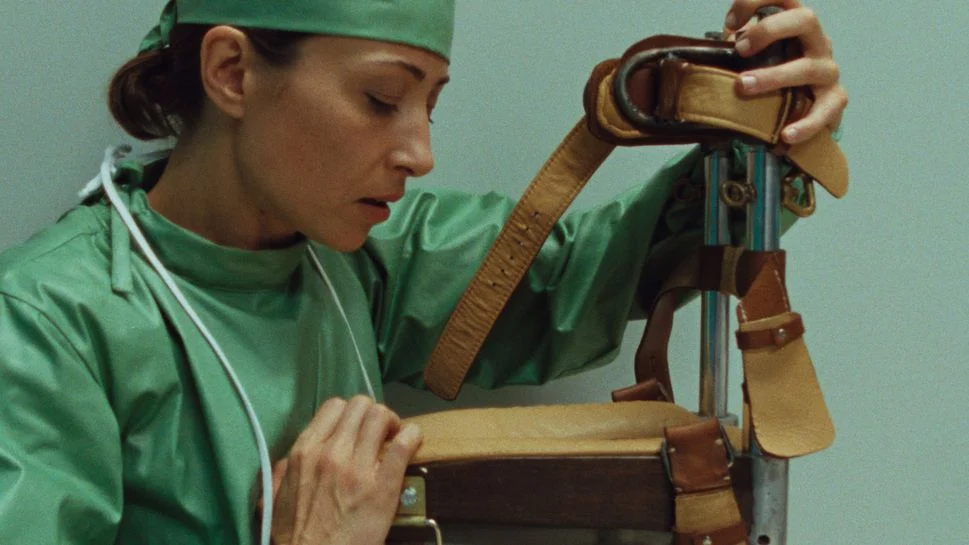
Ingeborg and Adam are visionary hand surgeons who are bound by love, control and irresistible fixations. Ingeborg, for one, feels compelled to steal objects. Adam longs to become one.
But after an accident, their well-choreographed lives suddenly face a force that could upset the careful balance that has long defined their relationship: the enigmatic Gaia. With her arrival, unexpected desires start springing up.
With Objet a, her new mind-bending and visceral feature, Berlin-based visual artist and filmmaker Ann Oren (Piaffe) returns to Locarno. It is a stylized cinematic exploration of the fragile relationships between humans, as well as humans and nature. And it is likely to make you look and think at control, desire, intimacy, identity – and kleptomania – in a different way.
Objet a, world-premiering in the international competition of the 79th edition of the Locarno Film Festival on Tuesday, Aug. 11, stars Aenne Schwarz (All Is Well, Every You Every Me) as Ingeborg, Louis Hofmann (All the Light We Cannot See, The Forger, Dark) as Adam, and Simone Bucio (Piaffe, The Ivy) as Gaia. Georg Friedrich (Great Freedom) and Sofia Kokkali (Our Wildest Days) also feature.
“I’m interested in human desire and how it connects us to other species,” Oren says in a director’s note. “The human body is the starting point for my cinematic language: the more control we have over it, the more we separate ourselves from the natural world.”
Oren wrote the screenplay for Objet a with Geoffroy Grison. The cinematography is courtesy of Juan Sarmiento G. (The Voice of Hind Rajab, A Poet), with editing by Hansjörg Weißbrich (Rose, Late Shift). The film is produced by Schuldenberg Films in co-production with Tarantula, asterisk* and ERT.
A theatrical release in Germany through Grandfilm is scheduled for the first quarter of 2027. Oscilloscope Laboratories has acquired the North American rights. Bendita Film Sales is handling international sales.
Ahead of the Locarno premiere of Objet a, Oren, Schwarz and Hofmann talked to THR about the serious and fun sides of the production, how they collaborated on its choreography and how timely its themes are if you look close enough.
Ann, what gave you the idea for this film and this story?
ANN OREN Several things, but what I was starting with was the sense of touch. I make very visceral films. My first feature film, Piaffe, dealt with the sense of sound. I start with the experience of the human body today in order to understand the human condition today. Here, I was thinking about the sense of touch today and what happens when we touch flat screens more than we touch our lover’s skin. A lot of experiences have flattened down to touching this plexiglass most of the day, so what is happening to our fingertips? I think they’re really deprived, and I was imagining zombie-like, hungry fingers – hungry to touch something. And then I had this idea of a couple that is living a very bubbled life and communicating emotionally through objects.
‘Objet a’ film still, courtesy of Juan Sarmiento G./Schuldenberg Films
I am curious, Aenne and Louis, how Ann pitched this project to you. To me as a viewer, Objet a sometimes felt a bit like a dance choreography that was very body-driven and that I could “feel” physically while watching.
AENNE SCHWARZ When I read the script, I felt a real longing to become part of this genuinely faraway world, which, at the same time, felt somehow familiar. What was very intense was when Ann talked us through the script. I remember when we all met, she had such a precise and full vision of what she wanted. And then, yes, it was a very physical experience. I experienced it like diving in, and at the same time, you had to hold the line and be very straight because they’re such delicate characters.
LOUIS HOFMANN I remember that in our first rehearsal, the term dance popped up quite a few times. The way we moved around one another was, I guess, testing out how near you could be to one another and what distance you could create. I remember that there were only a few moments where the characters would actually touch. But most of the time, it was about playing with the distance between them, creating tension, and playing with that tension.
SCHWARZ Yes. The gaze was part of the tension between us. You never lose each other. But sometimes, you are very far and sometimes much closer. It’s always a thin line holding us together.
HOFMANN And that longing for the touch is, I think, omnipresent, and that created the tension.
Interesting how you both describe this. Now it makes more sense to me why I sometimes felt that you two were almost moving like marionettes. Ann, are you happy if viewers get that sense?
OREN Absolutely, because this is exactly the type of work that I’m doing. I see working with actors as being about a very physical performance. There is also the psychology, but what I’m actually interested in is how the characters make decisions, not rationally, but rather through gut feeling. I look at human beings as the species that they are. In everyday life, it happens to everybody that we are compelled to do something, although we don’t really understand why. And I think it’s very exciting for a viewer to see that in a character and see that things are charged with this kind of tension.
In the psychoanalytic theory of Jacques Lacan, “objet a” is an unattainable object of desire. Aenne, Louis, were you familiar with this term, or did Ann go through some of this theory? Or was it not really that important to understand such concepts?
HOFMANN My girlfriend mentioned it to me. I wasn’t aware of it, but she was. And then during rehearsals, we touched on it a little bit. My character Adam has this desire of wanting to be a desired object for someone else. But then through his journey, he is also developing a sense of what he wants to be for himself. For me, that was a very beautiful journey to go on.
Ann Oren, courtesy of Björn Melhus
AENNE I saw the title and remembered that a long time ago I studied literature, and Lacan was a topic in one seminar. I remember that I was very excited about it, and so I got a little bit into it. A close friend of mine is a Lacanian psychoanalyst. I felt I had a very intense meeting with this “objet a” myself during filming. The film became this object, in a way. I also wanted to touch it. I also wanted to have it, to own it, and it was also slipping away. So for me, it was a very personal experience with the theme.
HOFMANN You mentioned marionettes. I sometimes felt that the way I was being, or we were being directed, I felt so secure and so safe. In Ann’s world that she created, we just kind of obeyed her vision in a very beautiful way. I don’t mean that we had no say in it anymore, because it was quite the opposite. She was still welcoming all of our ideas.
Do you remember any examples?
HOFMANN When I tried to find the character, I very much went through voice. It was an impulse. I’d read somewhere that the soul of a character is placed in the voice, and I’ve never really gone through that, using the voice in particular to create the character. During rehearsals, I was reading Georg [Friedrich]’s part with Aenne, and I was mimicking, for fun, Georg’s [Austrian] accent and dialect. And then Ann was like: “Wait, I love this voice for you.” And I said: “Hang on, I can’t really have Georg’s voice when being in a film with Georg.” But I then took that placement of the voice, where his voice sits. That’s just an example of how playful we were with one another while being in that very safe and secure environment of Ann’s vision.
Ann, as a filmmaker, how do you think about colors? I noticed, or maybe I should say “felt,” colors quite a bit in Objet a…
OREN This is the bread and butter of my language. I don’t even have to sketch it out. It just comes to me. What would be the color palette of the film and how does that support the mood that I would like to bring across? For this film, I wanted to reduce colors. Actually, we only have natural colors in the film until, slowly, green becomes the guest and the star color in the film. You have to work very hard to reduce color, actually, especially when you’re shooting outside, and then you slowly introduce it. So when you have a sequence in the end, it’s really ecstatic.
So we made sure in the production design and in the costumes that the range is from whites and beiges into the deep browns. The red color was used only in the bedroom … and [somewhere else] in the background. When I see Adam and Ingeborg within these natural colors, it really makes me think of them a little bit more like animals.
I felt the desire below the surface of the couple without the characters having to talk about it. Is there a trick to tap into that to make us viewers sense this desire?
SCHWARZ With Ingeborg, what I thought was very exciting about her is that her fingertips and her eyes are her sensual organs. And I really tried to dive into these sensations. The crutch she [gets for one of her legs as the film unfolds] became part of my body. It was exciting for me to really open to the world that an object can become so strong that you want to become one. And with Gaia, she also has a sense she never had before, and she can’t control it. That is like an earthquake for her. She goes into a direction she never went before, and she can’t understand it.
She has things basically in order. She knows what she wants. She’s very sensitive and delicate, but also very clear in where the limbs are and what the object has to do for her. And then this kind of melting starts when her body breaks. When her leg is broken, something breaks into pieces.
‘Objet a’ film still, courtesy of Juan Sarmiento G./Schuldenberg Films
HOFMANN I remember that the objects, the crutch, as well as the corset I use, had an immense effect – not only on us but on the whole team. There was a fascination with the beauty of how they were built, and maybe how we got attached to them. We treated them as maybe extended parts of ourselves, and there was this fascination coming from the team as well.
I also remember us as actors acting differently when we had our objects with us. There was more to ourselves, and it was kind of between us. This film is about these two people that are symbiotic and living their life in a in a very symbiotic way, doing everything with one another, working together, living together, loving each other, and then there are these new elements popping up that are so disturbing at first, and so irritating, and so frightening. And then they slowly but surely start to go with those impulses, and they don’t really know where they’re coming from.
SCHWARZ One thing that was very special was that it very playful, and also funny in a way. And that gave us also a lot of freedom. We were having fun. We were laughing.
HOFMANN At first, I wondered, “Is this going to become not body horror, but is it all going to be really dark and scary or just full of doom?” But I felt it was quite endearing, and I think it’s so sweet, no matter how strange these desires might appear to other people. At the end of the day, they are very endearing, sweet desires. And I found the characters so endearing.
SCHWARZ Yes, there’s a tenderness.
Ann, can you share how you think of rituals as part of your storytelling?
OREN That has a lot to do with obsessions with control. You see that with both of them, especially with Adam’s character. He’s obsessed with controlling his body, developing his body, and then he wants his body to also get attention. But the more control we have over our bodies, the more we are disconnected from the natural world that we are a part of. And I think this is a very contemporary condition.
The need for rituals, historically, first of all, is that they are relaxing. It doesn’t have to be a religious ritual, but it can be the things that you have to do in the morning or the things that you have to do before you leave the house. I think that the need for it also has to do with forgetting ourselves and connect with something larger than ourselves. If in the beginning, the characters are connected to controlling their lives and to objects, towards the end it opens up to a psychedelic experience that is like ecstasy. And ecstasy has always been part of a need for humankind. Today, there is a renaissance now of psychedelics in the world and because we’re so controlled, the need to forget ourselves, to have a moment of ego loss, and to connect to something larger than ourselves. I didn’t want to have a didactic experience for the audience, but rather lure them into something through passion.
Speaking of passion, Adam and Ingeborg also try to control that…
OREN This is why I built the sexuality between the couple so that they were canceling parts of their bodies, like they’re not including their genitals. It’s all about this exchange of the experience of touching and being touched, but in the most clinical way, which makes it absurd and interesting and a very particular choice for the two of them, which makes them suit each other very well. I think we lived so bubbled today, and we’re trying to control everything, and it’s becoming about maximizing the length of your life, but you forget to live your life.
The film starts with thinking about the human condition, our bubbled life, and what, in a way, leads us to the disaster that we are in right now. We’re living in times of war, climate catastrophe and tech fascism, and it starts from that. So, it’s something very fantastical, and I have very particular characters. But it touches on living in the world right now, and I hope that it’s going to resonate and be absorbed this way. I like to work with ambiguity, so I don’t want a person to come out of the film and be able to describe it with one sentence. That would make it rather boring.
>

As Larry David‘s comedic trip through U.S. history comes to an end, he took credit for one of the nation’s more recent presidential scandals.
On Friday’s season finale of the HBO sketch comedy miniseries Life, Larry and the Pursuit of Unhappiness, President Barack Obama made a surprise appearance as himself in a sketch set in 2014, as David advised him to wear the now-infamous, outrage-inducing tan suit during his live press conference on military response to ISIS.
Following some banter on how the POTUS avoids stains, David accidentally spills juice on Obama’s suit jacket when he leaves the room. When the 44th president returns, the comedian recommends he wear the tan suit that Obama planned on taking it to Turin for NATO Summit, for “a daytime event, it’s outdoors, a little more casual.”
“First of all, it’s a gorgeous suit,” David declared. “And this is casual Friday!”
“It is a great suit,” admitted Obama, as David told him, “Oh boy, oh boy. I think this is the move. … Old lips won’t let you down. You’ll thank me!”
As Obama models the look, David gives him his signature, “Pretty good! Pretty, pretty, pretty, pretty, pretty good.”
“You sure about this?” asks Obama, as David assures him, “Never been more sure about anything in my life. People are going to be talking about this for a long, long time.”
Obama’s cameo in the finale comes as David marks the United States Semiquencentennial with the seven-part sketch comedy limited series, which recounts major events in U.S. history through the comedian’s signature observational humor.
David’s longtime Curb Your Enthusiasm partner Jeff Schaffer, who serves as an executive producer on Life, Larry and the Pursuit of Unhappiness, previously told Deadline that Obama, who produced under his Higher Ground banner, reached out to his buddy David to ask if he’d be interested in making the show to celebrate the country’s 250th birthday.
“When you’re doing a show about American history, you want to do it warts and right now we have this orange saggy wart that we wish would go away,” said Schaffer. “But the nice thing about having President Obama produce this and be a part of it is that this country’s had a lot of fuck ups, we’ve seemed to have learned very little, but we’re still moving forward sometimes, and then we move back a little bit, but we always move forward again. While Larry’s pointing out a lot of the steps back, the President is telling us we can still step forward.”
>


Search For Canadian TV Actor Stewart McLean Now Homicide Investigation


These ’90s fashion trends are making a comeback in 2017
According to Dior Couture, this taboo fashion accessory is back
Model Jocelyn Chew’s Instagram is the best vacation you’ve ever had
Your comprehensive guide to this fall’s biggest trends
Emily Ratajkowski channels back-to-school style
9 Celebrities who have spoken out about being photoshopped
A photo diary of the nightlife scene from LA To Ibiza