
Sports
‘I couldn’t stay silent’: Why Sacha Wall publicly accused David Sullivan of being a sexual predator

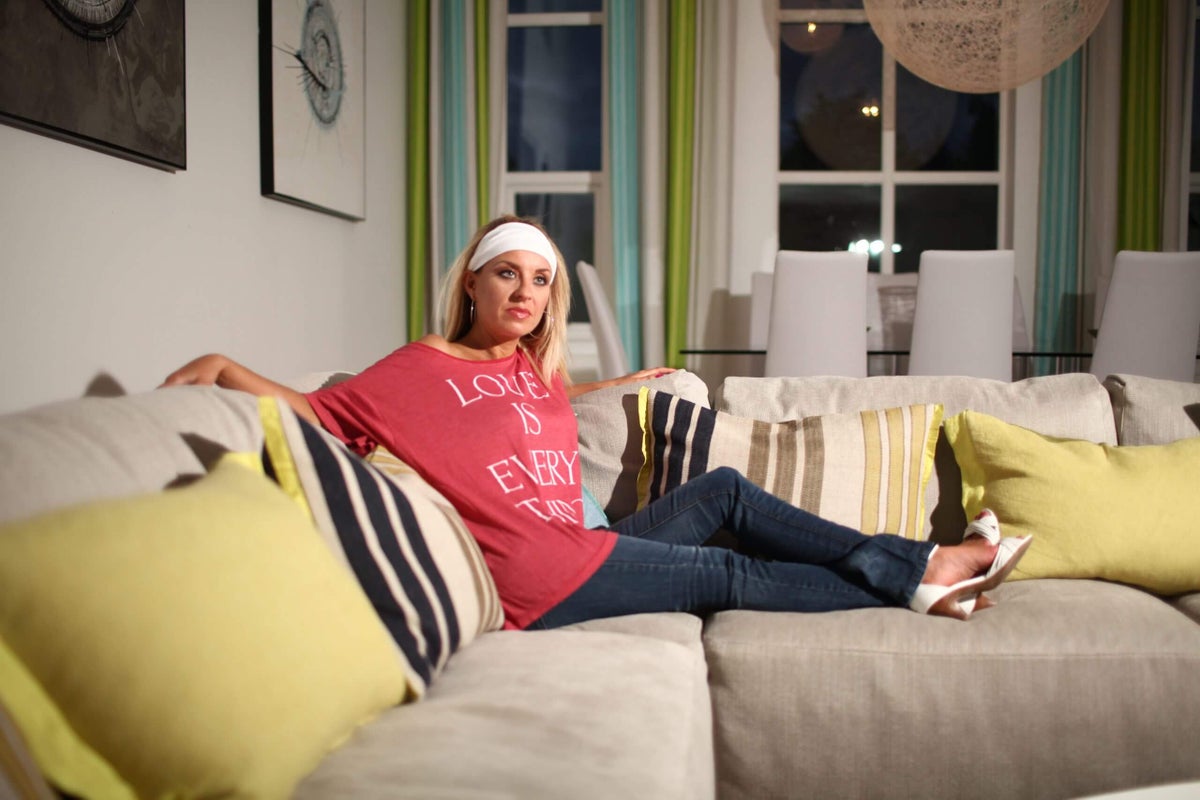
Sacha Wall is a forceful presence, speaking softly but pulling no punches.
The first woman to waive her anonymity in making claims of sexual misconduct against the former West Ham joint-chair, David Sullivan, Wall has a lot on her mind when she meets The Athletic over lunch in Exeter.
She speaks unflinchingly of her experiences as a glamour model for Sullivan’s Sport newspaper, how she felt listening to the claims of the other women featured in Panorama’s Predator: The Billionaire Football Boss this month, and the scars inflicted by an industry that has moved away from newspaper spreads of topless models and found a new life on apps such as TikTok and OnlyFans.
“It’s broken the silence,” she says. “That has been a huge release. It’s freed me to move on with my life.”
Wall’s life has certainly changed since the airing of Panorama, broadcast in conjunction with an investigation by The Times newspaper, which alleged that Sullivan had been guilty of sexually exploitative and predatory behaviour against women over several decades. Sullivan says he “categorically denies” all the claims, which he says are “factually incorrect and entirely false”, and has threatened legal action against those who report them.
Wall was one of the women who accused Sullivan in the programme, and the only one to waive her anonymity. She encountered Sullivan — the so-called ‘King of Porn’ — when she had been seeking work at his Daily and Sunday Sport newspapers, which were known for their images of topless glamour models. She alleges that she was invited to meet Sullivan in 1998, in his capacity as owner of the Sport titles, for what she thought was a business meeting about modelling for the newspaper, while she considered leaving her job as an insurance broker.
Then 24, she had not heard of him before. The address she was given turned out to be Sullivan’s private home, where she says he asked her to accompany him upstairs and undress to her underwear. Wall alleges Sullivan, now 77, said he could feature her in the Sport were she to become one of his “special friends”. When she told him that she would not sleep with him, she claims he replied: “What? Not even a blow job?” She tried to leave, only to find that he had locked the door. She demanded he open it and says he then shouted at her, saying, “You’re going about it the hard way,” before unlocking the door.
Wall, who went on to model occasionally for the Sport, made a report to Essex Police in 2023, over which the force ultimately decided to take no further action. Sullivan had also been arrested by the same force in 2008 on suspicion of sexual assault of a 25-year-old woman but no charges were brought. Sullivan categorically denied that allegation, which centred on consensual sexual touching, saying the claim was totally without foundation.
The Times and BBC also reported that Sullivan had admitted to paying for sex in the 1990s with a girl who he claims he believed was aged 16 or 17. That was legal at the time: the law was changed in 2003 to raise the age of consent to engage in sex work to 18.
A lot has happened since the Panorama programme was aired. Sullivan had already resigned from his role as West Ham’s joint-chair before the allegations against him were made public, and is now set to lose his status as the club’s largest shareholder, with Czech billionaire Daniel Kretinsky poised to take his stake to 43 per cent.
It has also emerged that Sullivan has been suspended from having contact with West Ham’s women’s and youth teams since 2023, as part of a Football Association safeguarding investigation relating to a single incident in 1981. Sullivan said the 1981 incident “did not happen” and called the suspension “a meaningless restriction” that he accepted for “a quiet life”.
Wall has spent the days since the documentary trying to understand the bigger picture it revealed around Sullivan’s alleged conduct and the mechanisms that prevented the claims from coming to light decades ago.
“Now I understand more of what’s gone on, how other girls didn’t get out, the larger picture and how this was actually rolling, I couldn’t stay silent,” Wall says. “I couldn’t live with myself.”
She “wants to be the face and the voice for the story” on behalf of those who feel they cannot speak publicly. “Different people have really suffered,” she says. “There’s a lot of mental health involved. We have literally just scratched the surface.”

David Sullivan is facing serious allegations from multiple women (Glyn Kirk/AFP via Getty Images)
Essex Police confirmed to The Athletic on June 11 that they have opened more enquiries into Sullivan in the wake of the Panorama-Times investigation.
It is actually three years since Wall was first interviewed by the BBC, which had to negotiate a painstaking legal process as it pieced together the claims from seven women, all of whom were in their late teens or early twenties at the time of the alleged incidents. She was the only one prepared to be identified and speak on camera.
Panorama and the Times had been investigating Sullivan for “about a year”, Wall says, when they approached her in response to a blog she had written, in which she recounted her experience and referred to Sullivan — already the subject of widespread social media speculation — as “a major media publication owner”.
“It was only afterwards that West Ham fans got in touch, because they recognised the pattern,” she says. “Then I really started to think about it again: the incident, the grooming and the pattern and how this was actually rolling.”
Wall has not heard from anyone at West Ham, the Football Association or the Sunday Sport since the documentary aired on June 8.
Both West Ham and the FA told The Athletic that as the allegations made against Sullivan were not related to the club or football, they did not fall within their remit. Both insisted they have robust safeguarding measures in place. The Athletic has contacted the Sunday Sport for comment.
Wall is particularly critical of former West Ham deputy-chair Baroness Karren Brady, who stepped down in April after 16 years at the club.
Brady is facing questions over the timing of that decision — which came while the club were embroiled in a fight against relegation from the Premier League they ultimately lost — and what she knew of Sullivan’s behaviour during a working relationship spanning almost four decades, first with his Sport titles and then at his first football club, Birmingham City, where a then-23-year-old Brady was managing director.
The Athletic revealed this month that Brady — who has positioned herself as a champion of women’s rights throughout her business career — had told concerned fan groups that there was “no investigation involving West Ham United” despite knowing Sullivan had been suspended from having contact with the women’s and youth teams.
When asked if the timing of her departure was impacted by the imminent revelation of the Panorama-Times claims against Sullivan, Brady’s legal representatives did not comment other than to say that “the allegations which have been made against Mr Sullivan in a personal capacity do not relate to our client”.

Sacha Wall being interviewed for the Panorama documentary (BBC)
Sullivan had made little attempt at hiding his predilection for sex throughout his career. The Times reported that when asked by a newspaper in 1996 about his relationships with his models, he replied: “I’ve always said what’s the point in owning a sweet shop if you can’t eat a few sweets.” Linzi Drew, a model and porn star from the 1980s, also told a 2015 documentary about Mary Millington, an adult entertainer and Sullivan’s former partner, that he had the nickname: “‘No-job Blowjobs’ — if you didn’t give him a blowjob, you didn’t get a job. I never gave him a blowjob and I didn’t get a job.”
In addition, Sullivan had a criminal conviction from 1982 for living off the immoral earnings of prostitutes. He served 71 days in prison before being freed on appeal.
Wall is sceptical that Brady could have been unaware of Sullivan’s reputation. “When you’re in the work, when you are in the job, everybody knows what his reputation was,” she says. “I had no idea who he was before I went to see him, but once I’d been working in page three modelling for six months, I’d had my experience and you’d hear other things. You get to know. It’s like if there’s a dodgy boss and you join a company, you’ll get to know, quite quickly, once you start at the company. Somebody at lunch hour’s going to tell you. It’s exactly that same kind of scenario.”
It is not the first time Brady has received scrutiny for her business relationships with men accused of wrongdoing. In 2019, she resigned from the board of businessman Sir Philip Green’s retail empire after claims that he had sexually harassed and racially abused staff (Green denied any unlawful behaviour).
When asked in an interview by Sky News about whether she could square her feminist principles with the claims made against Green, she replied: “I didn’t square them because I resigned, so that says all it needs to say.”
Wall questions whether Brady should remain in the House of Lords, the unelected upper chamber of the UK Parliament that helps to make laws, hold government to account and consider public policy. On the House of Lords website, Brady’s policy interests are listed as ‘Business, industry and consumers’, ‘Sport’ and ‘Equality, diversity and inclusion’.
The Athletic contacted Brady’s legal representatives for comment but did not receive a response. In correspondence with the BBC published on June 12, Brady’s lawyers acknowledged that she was made aware that the FA had raised concerns about Sullivan in July 2023 but had not been involved in the decision to suspend him. They told the BBC that Brady had remained at West Ham because Sullivan had always insisted he was not guilty of any wrongdoing, and “on the principle of presumption of innocence in continuing to work at the club”.
On claims that Brady’s stance jars with her self-professed figurehead for women’s rights, her lawyers insisted that there “is no inconsistency or hypocrisy between our client advocating for the protection of women and respecting the confidential safeguarding investigation and process that was being managed by the appropriate safeguarding professionals and statutory authorities”.

Karren Brady (left) watches West Ham with (far right) David Sullivan (Adam Davy/Pool via Getty Images)
Wall, however, is not satisfied.
“I’m not saying that she handed them (the women) all over. What I’m saying is: she must have known (about his reputation) and, if she did, was she stopping him? Was she addressing it? Was she saying: ‘You can’t carry on doing all that to all these girls?’. That’s empowerment. Standing up to the boss is empowerment.”
She is also particularly keen that none of this is dismissed by classifying it as part of Sullivan’s ‘private life’, which would obscure the dynamics at play. “This isn’t about his private life; this is his business life,” she explains. “None of us were turning up for his private life. It wasn’t a party. It wasn’t a date. It wasn’t any of those things. This was a casting for modelling work.”
Wall would like to invite Brady to meet her and other women who claim to have been exploited by Sullivan to hear their stories.
“Every victim wants to be believed and wants to be heard,” she adds. “The worst thing for any victim is to be gaslighted and told that it didn’t happen.”
Wall says she would like to be the spokesperson for the women alleging they were exploited by Sullivan, and by others, and says several have contacted her in the wake of Panorama being aired.
“It is the hardest thing to think you’re not worth anything,” she says. “That pain is the hard thing for these girls to deal with. If we can actually empathise and give compassion to these people, it’s unquantifiable as to how much it helps them.”
She considers Gisele Pelicot, the French abuse survivor who waived her right to anonymity after she was drugged and raped by her husband and dozens of other men, and her mantra that “shame must change sides” and move back to the abuser.
“For all the guys that want to slut-shame, I really couldn’t give a toss,” Wall says. “If I can make girls feel better about themselves and be able to live a nicer and happier life, I’ve done a good job.
“If you’re in a position to (share your story), then you have to. It’s incredibly cathartic, and has all kinds of outcomes that you won’t even know until you start to talk your truth and be able to release that.”
>
Sports
Jorge Messi was Lionel’s father, agent and confidant. He recognised his son’s gift before anyone else

We have seen the images of a disillusioned Lionel Messi standing alone on a football pitch. His worst defeats appeared to consume him within his own solitude. What can one say to someone who, from a competitive standpoint, represents success in excess?
For Messi, that voice of reason, the shoulder to cry on, was his father, Jorge. On Saturday, Jorge passed away at the age of 68 in Rosario, Argentina.
Through both his son’s successes and difficult moments as a player, Jorge had been there, quietly controlling the multi-million dollar Messi brand. He was his boy’s agent and acted as a determined negotiator for one of the greatest athletes of all time. But beyond the headlines and business dealings stood a supportive father.
Jorge knew before anyone else on this planet that ‘Leo’ had a gift. He saw greatness when many others around him saw a weak child with growth issues.
When Jorge packed a suitcase and took his 13-year-old son across the Atlantic Ocean to join Barcelona in 2000, it would change football forever. It sounds like a Hollywood script, but few boys at that age — never mind one who only knew his surroundings in Rosario — would be equipped to move thousands of miles away, to leave their mother and siblings behind.
“My old man was always by my side. We went through a lot of ugly things together,” Messi told Radio Del Plata in 2007. “Sometimes, I would shut myself in my room to cry alone, or he’d do the same, without me seeing him. We’d pretend we were both OK, but we weren’t. My old man asked me, ‘What do you want to do? Do you want to keep going or should we go back home?’ I wanted to keep going, and he stayed with me.”

Lionel Messi with his family, including Jorge, centre, at their home in Rosario in 2003 (Marcelo Boeri/El Grafico/Getty Images)
The life of a footballer was foreign to Messi.
His father was an ardent Newell’s Old Boys supporter and worked at a local metal factory as a supervisor. Players for clubs such as Newell’s, Boca Juniors, River Plate and Argentina’s national team were god-like heroes. Jorge introduced the young Lionel to the folklore of Argentine football and encouraged him to play the sport. After all, that is what parents so often do.
“My old man would get up at four in the morning and get back home at nine at night for dinner, practically every day,” Messi told TyC Sports in 2019. “We saw little of each other, and when we did see each other, he enjoyed my company. He never scolded me. I enjoyed him so much, I would wait for him just to hug him and be with him. He spent all his time working, honestly.”
In Ariel Senosiain’s 2023 book Messi, El Genio Completo (Messi, The Complete Genius), Jorge, in a rare on-the-record interview, spoke about his celebrity son and the initial bond that defined their relationship. He debunked any notion that Messi did not enjoy football as a child — gossip that had gained traction in Argentina. “It’s not true,” Jorge said. “He always had a passion for the sport.”
In that interview, Jorge embraced the comparisons to fellow Argentina footballing icon Diego Maradona that have long followed his son. That discourse has centered on Maradona’s shadow, and the cult of personality that the late Argentina captain still holds around the world. But Jorge chose to remember it much differently, like a proud father.
“We would go to Newell’s matches together,” he told Senosiain. “It became normal for us to do so after he began to play at the club as a seven-year-old. When he was 10, he watched a Newell’s game pitchside. It was against Union (de Santa Fe) and he started juggling and playing with the ball at half-time. The fans began to chant, ‘Marado’, Marado’. (Which supporters years before had also sung in salute to Maradona.)
“I would always watch (his) games by myself, and I still do to this day,” Jorge continued. “I try to sit far away from everyone.
“When he was a youth player at Barcelona, there were times when he would disconnect from what was happening during a game. I would try to get him to look over at me. I’d give him a sign, I’d try to give him a boost and I’d tell him to move. He would throw an arm gesture at me and would respond that I should leave him alone. But he would reconnect, and he’d do something marvellous with the ball.”
Jorge was speaking publicly, and graciously, after Messi had led Argentina to the 2021 Copa America title. That win ended a 28-year drought where Argentina failed to lift a trophy. Messi, however, was collecting Ballons d’Or, claiming La Liga titles and winning two Champions Leagues with Barcelona.
It was a rare interview, and one that came after years of relentless scrutiny in Argentina for his son’s failure to secure a title with the national team.
When Argentina were defeated 1-0 in the 2014 World Cup final by Germany after extra time, Messi’s solitary stare inside the Maracana stadium in Rio de Janeiro became a lasting image of that clash of titans. After they lost the following year’s Copa America final to Chile on penalties, his despair was evident, too. His vacant look captured a moment he could not understand. ‘Why him? Why now?’
A further year later, in the final of the Copa America Centenario, Argentina were beaten by Chile in another shootout. Messi sent his penalty over the crossbar. He cried on the pitch, then abruptly announced his retirement from international football while still at the stadium, surrendering to the hopelessness of the moment. And while the world wondered why, he retreated to the intimate circle of trust that only one’s family can provide.
One can imagine how, at that time, he must have leaned on his father through conversations over mate that would convince him to change his mind. Because in moments when Messi has seemed alone inside his own bubble, Dad was always there. A phone call away.
If that 2016 Copa America final was Messi’s most distressing moment as a professional, today, he is experiencing much greater pain. The solace, perhaps, after such a loss, is that Jorge witnessed his son’s most recent run towards eternal greatness.

Jorge Messi with his son’s Golden Ball award as best player of the tournament at the 2022 World Cup (Jean Catuffe/Getty Images)
There was the tumultuous 2022 World Cup campaign that ended with victory over France in the final. An eighth Ballon d’Or followed in 2023. And then came the 2024 Copa America final defeat of Colombia.
And of course, Argentina’s labored run to the 2026 World Cup final last month, with Messi at its forefront, holds greater weight in light of what we now know he was facing off the field.
Having previously been accused of being crippled by the pressure of representing Argentina, Lionel and Jorge, together, celebrated all the symbolic triumphs.
Messi continued to play for his country, even as Jorge dealt with a health issue during this World Cup. He was overcome with emotion after scoring his first of three goals against Algeria in their opening group game on June 16. “It was something completely unrelated to football,” he told reporters after the match. “I went through some difficult days.”
Words will do little to ease the hurt that Messi and his family are now feeling. The death of a loved one changes you.
But that is unlikely to be what Jorge would want for his son, who is now a father of three boys. In a video message he recorded for him in 2007, Jorge encouraged Messi to remember the life lessons that adversity can deliver.
“We always come out stronger,” he said.
“It helps you become who you are, because I believe that above being a good football player, you’re an excellent person. I’m not saying that because I’m your father, but because most people who know you know that’s true. And so I hope this continues for the rest of your life. That you keep being who you are, and that people love you for that.”
>

Despite a huge batting collapse, Manchester Super Giants do enough to beat Southern Brave by 10 runs in Southampton, to keep their hopes alive of qualifying for the knockout stages of the men’s Hundred.
WATCH MORE: ‘They are falling apart’ – Super Giants lose eight wickets for 30 runs
Available to UK users only.
>
Sports
Fever’s Sophie Cunningham takes hit to face, Sky’s DiJonai Carrington ejected for flagrant foul

CHICAGO — The ongoing Sophie Cunningham saga has another chapter.
The Indiana Fever guard took a hard shot to the face from Chicago Sky guard DiJonai Carrington during the first quarter Saturday at the United Center that earned Carrington a Flagrant 2 foul and an ejection.
After an errant pass from the Sky’s Elizabeth Williams, the Fever’s Monique Billings collected the loose ball and threw ahead to a streaking Cunningham. On the shot attempt, Carrington’s left arm connected with Cunningham’s head and jaw, sending her to the floor.
The foul by DiJonai Carrington on Sophie Cunningham that resulted in a Flagrant 2 and ejection.
(via @ESPN) pic.twitter.com/Z27J934irs https://t.co/GAMYI5V151
— Yahoo Sports (@YahooSports) August 8, 2026
Cunningham immediately popped up and had to be separated from Carrington by teammate Makayla Timpson. After a review, officials upgraded the common foul to a Flagrant 2 and sent Carrington to the locker room. On her way through the tunnel, Carrington grinned and shook her head as Sky fans gave her an ovation.
Cunningham, an eighth-year veteran reserve, has been in the spotlight since ESPN quoted her in a July 21 story saying she wants to “protect young girls in a locker room” and that “they shouldn’t have to go against biological men.”
The ensuing uproar has included demonstrations and counter-demonstrations outside of Fever games, a trend that continued Saturday near the United Center on Chicago’s West Side. In addition, Cunningham has been booed by crowds in Portland and Minneapolis, and Minnesota Lynx coach Cheryl Reeve wore a T-shirt declaring “Trans kids belong” during her team’s game against the Fever on Aug. 2.
On Friday, the Women’s National Basketball Players Association denounced “hate, abuse, and demonization” of the transgender community in a statement that did not reference Cunningham by name.
Against the Sky, Cunningham checked into the game at the 6:13 mark of the first quarter to a strong but mixed reaction of boos and cheers. After the dust-up with Carrington and the Sky guard’s ejection, the United Center scoreboard showed a fan with a T-shirt supporting transgender rights before quickly cutting away to a different attendee.
>

Jorge Messi was Lionel’s father, agent and confidant. He recognised his son’s gift before anyone else

Jared Padalecki Supports Perez Hilton After Self-Harm Livestream

Monica Barbaro Talks ‘Artificial,’ Timothee Chalamet’s Ballet Comments
-

 movies3 months ago
Search For Canadian TV Actor Stewart McLean Now Homicide Investigation
-

 Fashion9 years ago
These ’90s fashion trends are making a comeback in 2017
-
Fashion9 years ago
According to Dior Couture, this taboo fashion accessory is back
-
Fashion9 years ago
Model Jocelyn Chew’s Instagram is the best vacation you’ve ever had
-
Fashion9 years ago
Your comprehensive guide to this fall’s biggest trends
-
Fashion9 years ago
9 Celebrities who have spoken out about being photoshopped
-
Fashion9 years ago
Emily Ratajkowski channels back-to-school style
-
Fashion9 years ago
A photo diary of the nightlife scene from LA To Ibiza