
‘At Night,’ courtesy of Night Films


Millie Bobby Brown admitted she struggles to connect with people her own age after “primarily” growing up around “men on crews.”
The actress, who achieved global fame at the age of 12 after “Stranger Things” debuted on Netflix in 2016, opened up about this personal snag during her recent appearance on the “Happy Sad Confused” podcast.
The topic arose after host Josh Horowitz asked Brown if she ever felt like she missed certain milestones given her child star status, to which the actress confessed: “Maybe a bit of socialization. Sometimes when fans come up to me, they’ll be like ‘Millie!’ and I’ll be like ‘Aah!’”
“I just don’t know how to react sometimes to people my own age,” the “Enola Holmes” actress explained. “I have a harder time. Because I grew up with primarily men on crews, let’s change that.”

As Brown went on, she noted that she was often surrounded by 40-year-old men, further recalling, “So I heard a lot of adult talk growing up and didn’t really talk about the things you’re meant to talk about as a kid.”
Specifically, the former child star said she heard a lot of industry talk, like, “Where’s the grip?” and “Let’s grab a ladder.”
“So that’s your whole conversation,” she said. “So I could talk to that person extensively for hours about different lens changes and shots, but I can’t talk about, you know, ‘Oh My god, what bars do you like around this area?’ I’m like, ‘I don’t know.’”
Though, Brown said she’s making more of an effort to be in her “social era,” given her husband Jake Bongiovi is “the most social butterfly.”
Brown married Bongiovi in May 2024, with the couple welcoming a daughter via adoption the next year.
“We are beyond excited to embark on this beautiful next chapter of parenthood in both peace and privacy,” the pair wrote on Instagram at the time.
Watch Brown’s full “Happy Sad Confused” podcast interview above.

>
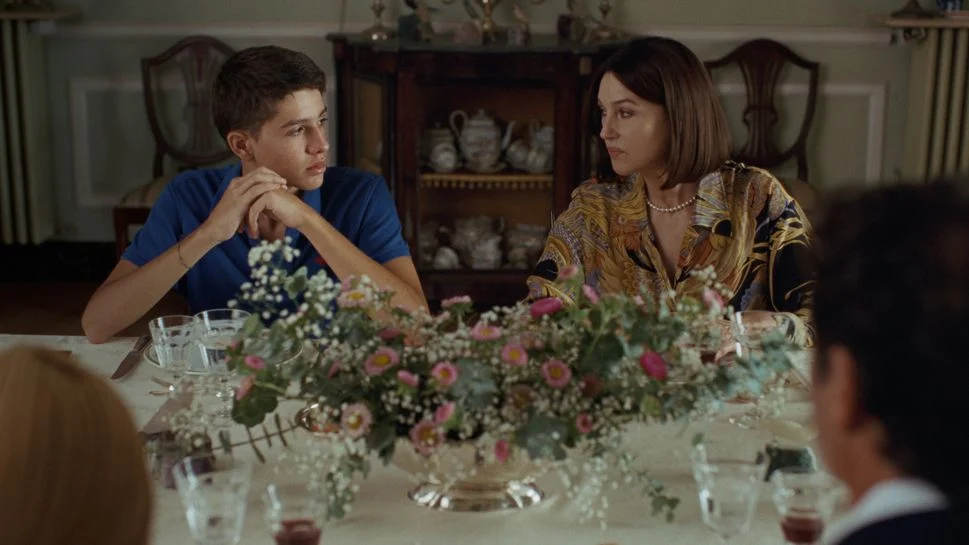
An Italian film, whose cast features Monica Bellucci and whose list of producers includes Luca Guadagnino, took the spotlight at the 79th edition of the Locarno Film Festival on Saturday. Its title: Ketticè.
The coming-of-age drama is the sophomore feature of former Guadagnino assistant Giovanni Tortorici (Diciannove), who wrote and directed it, and stars Salvatore Gallina and Rachele Testagrossa.
Set in Palermo, Sicily, in 2012, the era of media mogul-turned-populist politician Silvio Berlusconi, the movie revolves around Giulio, a listless and dissatisfied 16-year-old who drifts through his days without any enthusiasm for school and no real future prospects. “His encounter with Ketty, a more self-assured peer, offers him an escape from the monotony,” reads a synopsis. “The two form an exclusive friendship, a shared refuge in their search for freedom, far from the judgmental gaze of the adult world.”
With cinematography by Camilla Cattabriga and editing by Marco Costa, the film has been boarded by PiperPlay to handle international sales.
The film’s title refers to Ketty’s nickname in the Sicilian dialect. Bellucci plays Giulio’s mother in an aristocratic Sicilian family that leaves her feeling oppressed.
During a press conference with the three stars and Tortorici, Bellucci shared about her character: “It was interesting to play a different role because this wife and mother tells us about the frustration behind the entire perfection of society. … She is the victim of a social role. So she tries to counterbalance this frustration by eating up snacks. There [is a] scene where she’s sleeping in front of the TV, and she has plenty of snacks.”
The star also addressed how body and voice are key to her role. “This is a woman who forgot about her femininity. She doesn’t take care of herself,” Bellucci explained. “And when she talks, she yells.”
That keeps the relationship with her son on the edge throughout much of the movie. “She creates this constant tension with her son,” Bellucci offered. “There is a mutual humiliation that [shows] a true impossibility of exchange between generations. You see a generation of adults who can no longer understand the youth. And we are talking about 2012. Imagine how it is now!”
Tortorici was asked about a scene in which a girl expresses admiration for former Italian fascist dictator Benito Mussolini. “I remember I had a girlfriend who would say such things,” the writer-director explained. “So I think this would represent a youth culture, which is a bit absurd. I mean, the girl I knew was refined and educated, and then she would admire Mussolini. It’s a reference to my own biography, but I think it was very symptomatic and significant, and it was representing that age of Berlusconi.”
Bellucci lauded the director and the young stars of Ketticè who were discovery via an extensive street casting process. “It’s been a wonderful experience being on this set,” she shared. “Giovanni Tortorici is a young director who knows exactly what he wants, and he’s very self-confident, determined, and he made a very personal and really unique film. … This film confirms his talent as an auteur. And these two teenagers are fantastic. They’re awesome. They are so natural and so spontaneous.”
>

In At Night, British filmmaker and artist Beatrice Gibson’s first feature-length film, the nightly sights and sounds of Paris interweave with the stories and conversations of six women – from hopes, dreams and sexual desires to worries about the future.
Rhythm and mood are key elements that make the experimental and “autofictional” movie, which world-premieres on Saturday, Aug. 8, in the Filmmakers of the Present competition program of the 79th edition of the Locarno Film Festival, a special kind of cinematic ride. Just ask Locarno’s artistic director, Giona A. Nazzaro. In a chat with THR, he described the movie as “this nocturnal, ambient film where you can almost hear music that makes you think of Brian Eno. If At Night were a record, it could be music for lonely people at night.”
Written and directed by Gibson, At Night features cinematography by her long-time collaborator Ben Rivers and editing by Liyo Gong. But the music doesn’t come courtesy of Brian Eno. No, it is the creation of Elvin Brandhi.
If you don’t follow experimental music, here are some basics to know about her. Elvin Brandhi is the pseudonym of Freya Edmondes, an improvising voice and sound artist who was born in Wales, but has become a citizen of the world. Her music features unusual beats created from field recordings, her own voice, tape, vinyl and instruments. She is also part of all sorts of music collaborations, including father/daughter “noise-improv berserkers” Yeah You, Pollution Opera with Nadah El Shazly, the duo Avril Spleen with Joseph Jadam, the band PFL with Peter Kutin and Lukas König, and the project Bahk with Daniel Blumberg.
At Night, which features an array of Gibson’s non-professional actor friends and influences as they discuss and explore such topics as sexuality, money, motherhood and mental health, is the musical artist’s first-ever feature film soundtrack. And it seems fitting that she collaborated with Gibson on this film that press notes call “a love letter to friendships, relationships, and the quiet yet poignant stories women share together but rarely to an audience.”
Brandhi took time out of her busy schedule to talk to THR about the creation of the soundtrack for At Night, her other music work and whether we may be able to hear more from her on future cinematic journeys.
‘At Night,’ courtesy of Night Films
The artist confirms that the work on At Night marks a new step for her. “It’s the first time I’ve done a soundtrack for a feature film,” she tells THR. “I did a couple of short films with friends, and I make my own music video-type thing. So I consider myself more of an audiovisual artist. I think in both realms, but this was obviously very different. I’ve worked with Daniel Blumberg a little bit, hanging out with him a lot in the process of The Brutalist and then the Anne Lee film, [The Testament of Ann Lee]. I was doing quite a lot of vocal stuff, also with [avant-garde improvisational vocalists] Phil Minton and Maggie Nicols. And Daniel has been creating this nice bridge between the experimental scene in London and Hollywood cinema.”
So, this must be a good time for Brandhi to get her first feature film soundtrack under her belt, you may wonder. “It was probably helpful for me to get involved in the experience of how to make a soundtrack,” she confirms, but notes that it required a different focus from her usual work. “It was quite a unique experience, and I had to adjust a little bit how I think about composing. A lot of my music is quite in your face and trying to be as present as possible. But with a soundtrack, you have to almost make it sneak in from the sides, or be somehow invisible, coming out of the background.”
Given that Brandhi works a lot with field recordings, how did the Paris setting of At Night play to her passions? “What was really nice about this film was that the metro is such a big center of the narrative, and that’s already quite a noisy place,” she tells THR. “It has a lot of the kind of frequencies and ambient noise and things that I might feel like field recording and be inspired by anyway. So it was this perfect entry point for coming into that film world.”
‘At Night,’ courtesy of Night Films
Courtesy of Night Films Ltd.
Gibson and Brandhi have all sorts of connections but made their acquaintance by coincidence. “I met Beatrice for the first time at [the experimental music festival] Borealis [in Bergen, Norway], but only very briefly,” the music artist recalls. “We were in the same taxi going somewhere, and I was playing, and she was screening something. I think she knew of my music, and then a common friend, Leonardo Ruvolo, from Alcamo in Sicily, put us in contact because I also did his residency, and she’s living in Palermo [in Sicily] now, so there were various coincidences.”
And the women quickly got along. “When we started working together, we became very good friends immediately,” Brandhi shares. “And working on At Night was a very intimate and special process.”
But what was this process like, and how early did Brandhi start crafting music for the film? “Beatrice wanted to have as much sound as possible before even starting to shoot. So I did get sent a first draft of the script, but that did get changed as the film went through different shifts,” she recalls. “We spent a week going through ideas before any shoot. I sent her some drafts of things that might work. And she had one reference of a song that she really liked, which was actually from a collaboration I have that is called Insin [with Palestinian producer/MC Bashar Suleiman]. The track is called ‘Kidney Spears,’ which is a little bit more dreamy. I’m also singing in that. So I tried to send her other things within that kind of dynamic.”
When Gibson started shooting in Paris, Brandhi also came to the French capital. “I was taking some recordings when they were going into the metro,” the musician tells THR. “And there was originally even a scene of me performing in Paris in the film.”
‘At Night,’ courtesy of Night Films
Courtesy of Night Films Ltd.
All in all, the soundtrack came together in an ongoing collaboration. “There were some core themes that we developed, and then little bits that needed a very specific kind of mood or dynamic,” she says. The collaboration also included editor Liyo Gong. “She is really amazing,” says Brandhi. “She’s also a DJ, so she has a very strong sense of the musicality in film and in how she edits.”
Crystabel Riley also contributed, drum sounds, to the soundtrack. “I asked her if she would contribute some drumming that I could weave into different parts of it,” Brandhi recalls. “She was actually involved in the film, doing some of the makeup, because she’s a makeup artist as well as a musician.”
Fans of the artist’s work may get to hear more from her in feature movies in the future. “I definitely would like to,” Brandhi tells THR. “I would be really up for it; it was really interesting entering the story and composing from a different perspective.” She adds: “I saw her playing live for the first time last year, and I was just so blown away because she’s such an incredible performer, and her stage energy is so engaging. There’s this warmth and tension as well. It feels very urgent. I was just watching her and felt the state of mind of the women in the film echoing in her performance.”
Concludes Brandhi: “It was really special for me and Bea that she was part of it.”
The creative mentions that she has also worked with video herself, and being involved with At Night inspired her to return to more of it. “In the lockdown, I did a lot more filming and editing stuff, so I feel that this soundtrack world is also a nice potential way to get back into the editing of my own film material,” she shares.
Not that Brandhi doesn’t have all sorts of music stuff in the works. Including an album with Berlin-based Kenyan musician KMRU under their name A|||oy, which will be released on KMRU’s label offnot. “He is associated a bit more with ambient music. But we have so much in common and are both fans of each other’s music, even though it might seem like we have quite contrasting dynamics,” she tells THR. “There’s a strong similarity in the way we work with field recordings and sounds, textures and spaces.” Concludes Brandhi: “We’ve been collaborating for three years now, and we have an album coming out that we made between a couple of residencies, one at [Swedish electroacoustic music and sound art center] EMS in Stockholm, and then one in [Max Richter and his partner Yulia Mahr’s] Richter Mahr studio in Oxfordshire. We just listened to the test pressing, and it was really exciting. We’re both singing, and it’s completely different from both of our works.”
>

Real history, fiction and AI blend together for a look at a former radical far-left underground armed organization in Portugal in the new film from auteur Edgar Pêra (Telepathic Letters, Manual of Evasion LX94), Asphalt Guerrilla (Guerrilha no Asfalto). The movie marks the Portuguese writer-director’s return to the Locarno Film Festival in Switzerland, where it will world premiere in the Out of Competition program during its 79th edition on Monday, Aug. 10.
The militant group that the film revisits is the FP-25, short for Forças Populares 25 de Abril, or Popular Forces 25th of April, which was active between 1980 and 1987. It carried out dozens of bombings, shootings and bank robberies. The film is based on the eponymous book by Manuel Ricardo de Sousa, a member who ended up being lynched by a mob in the aftermath of a bank robbery.
But there is also a meta level to the movie. “It’s also about trying to make a film that ought to be shot in a guerrilla mode, with no compromises with the system,” notes the Locarno website.
A synopsis teases the mind-bending quality of the movie by describing it as “a fictional film rooted in reality about a utopian time in Portuguese democracy.” And it continues: “Set in the early ’80s, it begins with a quiet student who becomes involved in a radical organization and ends up being shot and lynched by the mob in the aftermath of a bank robbery. Throughout the film, we witness the sometimes comical, sometimes tragic problems of these ‘asphalt guerrillas’ fighting against the system; at the same time, the director of the film quits the organization in order to fight to make films in a guerrilla mode.”
‘Asphalt Guerrilla,’ courtesy of Bando à Parte
Pêra wrote the screenplay with Rodrigo Areias, and the voices of Pêra and Albano Jerónimo feature in Asphalt Guerrilla. Jorge Quintela is the cinematographer, while João Mora is the editor. The cast features Miguel Moreira, Maria Leite, Ivo Arroja, Jerónimo, Bernardo Santo Tirso and Luke Eberl.
Pêra talked to THR about Asphalt Guerrilla, what inspired it and what it says about his latest take on the use of AI in filmmaking.
“There are many films in this film,” Pêra highlights. “The very beginning was this book, which I read in the ’90s and basically shows a very amateurish group of guerrilla men or terrorists, depending on your point of view, but it gradually transforms into a film about my own guerrilla [film] scene, mainly because my friend and producer Rodrigo Areias made me do it.”
Indeed, Pêra started making an underground name for himself in the mid-1980s with his avant-garde style as a “neuro-punk” filmmaker associated with DIY counterculture and the Portuguese music scene.
“I would never pitch a film about me, including an autobiography, but I really understood that Rodrigo proposed it,” he tells THR. “I told him that I wanted the film to be about the future, not about the past, not about the ’80s and the problems we had back then in Portugal, but about this society and the state of cinema.”
If you are watching the film and can’t quite tell which parts are real and which ones are fictional, Pêra won’t mind. “This fusion, or blur, of fiction and reality is something that I like, but it’s also something that I must fight against,” he explains. “So the film is also a mirror of what’s happening, where you sometimes don’t really know what’s real.”
‘Asphalt Guerrilla,’ courtesy of Bando à Parte
Does he really feel like a film guerilla? “Actually, when I was in my 30s, there was this producer who called me the Sniper,” Pêra tells THR. “I think he said that with respect. I think I have that respect from other filmmakers of my country because I never tried to do anything that was not myself.”
As the filmmaker did in his 2024 Locarno film Telepathic Letters (Cartas Telepáticas), Asphalt Guerrilla uses AI images. “I always try to leave some clues for what is AI-made,” he highlights. “But there are moments where, to show the danger of AI, you have to behave like a dangerous AI, which is why this film has moments [referencing] what worries me most, news becoming fabricated. And actually, the worst part is that AI also gets the most fun part of creating, such as [people] asking AI to write prompts.” Concludes Pêra: “So I try to fight all of that and create my own prompts and create my own algorithm. If you leave things to the YouTube algorithm, you know what you get.”
Added the auteur: “You have to make at least a playlist so that you’re not invaded by this ultra commercial thing. That’s my fight inside of AI to create some images that are original in the way that they are recombinations of things that already exist. That’s what every artist does.”
How does that fit into Pêra’s early neuro-punk days? “I was always interested in the effects of cinema on the minds of people and how the mind works,” he tells THR. “Neuro-punk was meant to say that we have to fight things with ideas, not with violence. So, cameras are weapons. Make films, not violence.”
‘Asphalt Guerrilla,’ courtesy of Bando à Parte
The auteur didn’t necessarily know how timely his film would feel in a time full of wars, a rise in political and other radicalism and, of course, AI when he first started conceiving it. “I think it’s not a coincidence. It’s a synchronicity,” he offers. “But even when we think times are okay, we have lots of things that worry us. Now, we are in the worst of times, as they say. But even in the best of times, there’s still exploitation, people dying and all that. So yes, I think it’s a timely moment to go to the roots of the problems and not only focus on radicalism. I think radicalism is a symptom; it’s not the problem.”
He sees the underlying issue this way: “Radicalism is a symptom of the decay of our system. I’m not an expert, but I feel that it’s not the radicalist we have to fight because that means [we are] becoming another radical. So that’s a trap. Instead, let’s talk about what makes our planet worse.”
Pêra is working on another movie, which will keep speaking out about worries he has. It’s called The Spiral of Fear, and it’s about “big tech and what media says about the masters and all that.”
>


Search For Canadian TV Actor Stewart McLean Now Homicide Investigation


These ’90s fashion trends are making a comeback in 2017
According to Dior Couture, this taboo fashion accessory is back
Model Jocelyn Chew’s Instagram is the best vacation you’ve ever had
Your comprehensive guide to this fall’s biggest trends
9 Celebrities who have spoken out about being photoshopped
Emily Ratajkowski channels back-to-school style
A photo diary of the nightlife scene from LA To Ibiza