
Sports
Argentina march on thanks to Messi-oriented tactics. But cracks are starting to show


There’s no debate that Lionel Messi is having the tournament of his life. Aged 39, at likely his final World Cup, he continues to win matches on his own.
With 78 minutes on the clock and Argentina 2-0 down against Egypt, they were staring at a round-of-16 exit and a meek defence of their crown. At which point, enter Messi.
The captain made the first goal, headed home by Cristian Romero, and then scored the second four minutes later, before Enzo Fernandez headed in the winner in stoppage time — the latest a team has successfully staged a comeback win this big inside 90 minutes in tournament history.
In the previous round, Argentina also won 3-2 after an engrossing game, twice being pegged back by Cape Verde, the tournament’s surprise package. Two outswinging Messi corners in extra time led to two goals. This was after the Inter Miami forward had put them 1-0 up mid-way through the first half after some clever movement. He walked back slowly from an offside position to avoid being marked, then sprinted forward to latch onto Lisandro Martinez’s ball over the top, taking one touch to control and another to score.

Argentina’s results make for good reading: 12 straight wins and, in the four-year cycle since winning the 2022 World Cup in Qatar, just four defeats.
That includes the 2024 Copa America, also hosted in the United States, which they won by conceding just once in six matches. Such continental success is significant given they were on a 25-year drought when head coach Lionel Scaloni took charge in 2018.
Then, in 2021, he led Messi and Argentina to the Copa America title, beating fierce rivals Brazil in Rio de Janeiro. Now they have back-to-back titles after previously having been serial losers of finals, and are just three wins away from back-to-back World Cup trophies. Messi, with eight goals, is leading the golden boot race, one away from France’s Kylian Mbappe and Norway’s Erling Haaland.
So, what’s there to be concerned about?

Well, they are starting to see some flaws exposed. A lack of athleticism in midfield showed when Egypt counter-attacked in Atlanta. Julian Alvarez helplessly tried to trigger a counter-press when Martinez lost the ball by the corner flag — he’d been boxed in two-vs-one.
Haissem Hassan, Egypt’s right midfielder, threatened with dribbles all match, and carried the ball into the final third past Fernandez. He gave it to Mohamed Salah, who split two defenders to find Mostafa Ziko. The striker chipped Emiliano Martinez, and, momentarily, Egypt were 2-0 up, before VAR controversially disallowed it for a foul early in the move.

Nine minutes later, it happened again. A Messi inswinging corner was headed clear and, somehow, Salah found himself in space, leading a counter-attack. Leandro Paredes made a recovery run but mistimed his tackle, and the ball was worked to Hassan on the edge of the box.
The overload — four-vs-three — was in Argentina’s favour, though they stood off Hassan too much and he hit the byline again. This opened up a cutback for Ziko, who ghosted in to fire a second past Martinez. There was no problem with that one.


The comeback owed to Argentina doing something they did less than everyone else in the group stage: crossing. Scaloni’s side attempted 26 crosses in total and 18 in open play against Egypt, the latter their most in a major tournament game under the 48-year-old.

This is a team without wingers, save for Thiago Almada.
“He gives us a little more one-vs-one (quality),” Scaloni told reporters during the group stage. “Before, there were four midfielders… which was much more about play and footwork.”
Almada is the closest player in profile to Angel Di Maria, the 38-year-old former Real Madrid and Manchester United winger who scored in the last World Cup final but has since retired from international duty.
So the crossing burden, like all others, falls to Messi. He picked out Romero, a centre-back playing emergency striker, to make it 2-1.

The equaliser was much scrappier. Messi had two goes at the inswinging cross. Mohanad Lasheen blocked the first and then deflected the second, which sent it looping towards the back post. Lautaro Martinez hooked it centrally, where Gonzalo Montiel set up Messi for a half-volley.

Argentina’s reliance on Messi, and desire to be unstoppable rather than unpredictable, may bring future problems.
The shape is a narrow 4-4-2 to overload the centre with No 10s rather than wingers. Scaloni wants to make passing lanes through midfield so Messi can receive to feet, or for his side to counter-press when moves break down.

Often the midfield resembles a box, especially in the deep build-up. Messi has licence to roam. Egypt disrupted this with good man-marking in central midfield, and had centre-back Rami Rabia step to Messi when defending in a mid-block.

Flying full-backs provide the width. That came from left-back Nicolas Tagliafico against Egypt.
Egypt pressed Argentina high and defended in a 4-4-2 — sometimes dropping to a 6-2-2 by bringing their wingers down.


Tagliafico’s forward dashes almost brought two first-half goals. He ran onto Paredes’ long ball and hit a low ball to Alvarez, who forced an excellent save from Mostafa Shobeir.
A similar move led to the Argentina penalty. Messi dropped deep, split the Egypt midfield to find Fernandez, and the Chelsea man threaded a through ball for Tagliafico, who was bundled over by Hassan.

Messi, for the second time this tournament (and fourth in total from eight World Cup penalties), failed to convert from the spot. Shobeir dived low to his left and parried the effort away. Scaloni’s simplest decision is to put Alexis Mac Allister or Fernandez on penalties instead.
Compare Scaloni’s side to France, the losing finalists from 2022, and they have fewer open-play solutions, beyond giving the ball to Messi. They even owed their 3-1 win against Jordan in the final group-stage match to direct free-kick goals from their star man and Giovani Lo Celso, plus a Lautaro penalty.
Eight of the teams who had been left in the round of 16 have made more final-third regains than Argentina, while they rank second for tackles — a sign of defending much more reactively than proactively. They rarely press to conserve Messi’s energy, and he bemoaned how Cape Verde played through their gaps when Argentina tried to smother them.
For Scaloni to be reduced to tears in an on-pitch interview after the Egypt win, completely overwhelmed by the late comeback, was telling.
Their Messi-orientated tactics are working, but cracks are starting to show.
>
Sports
Rugby League World Cup: Mikey Lewis has been left out of England’s opening match against Tonga | Rugby League News
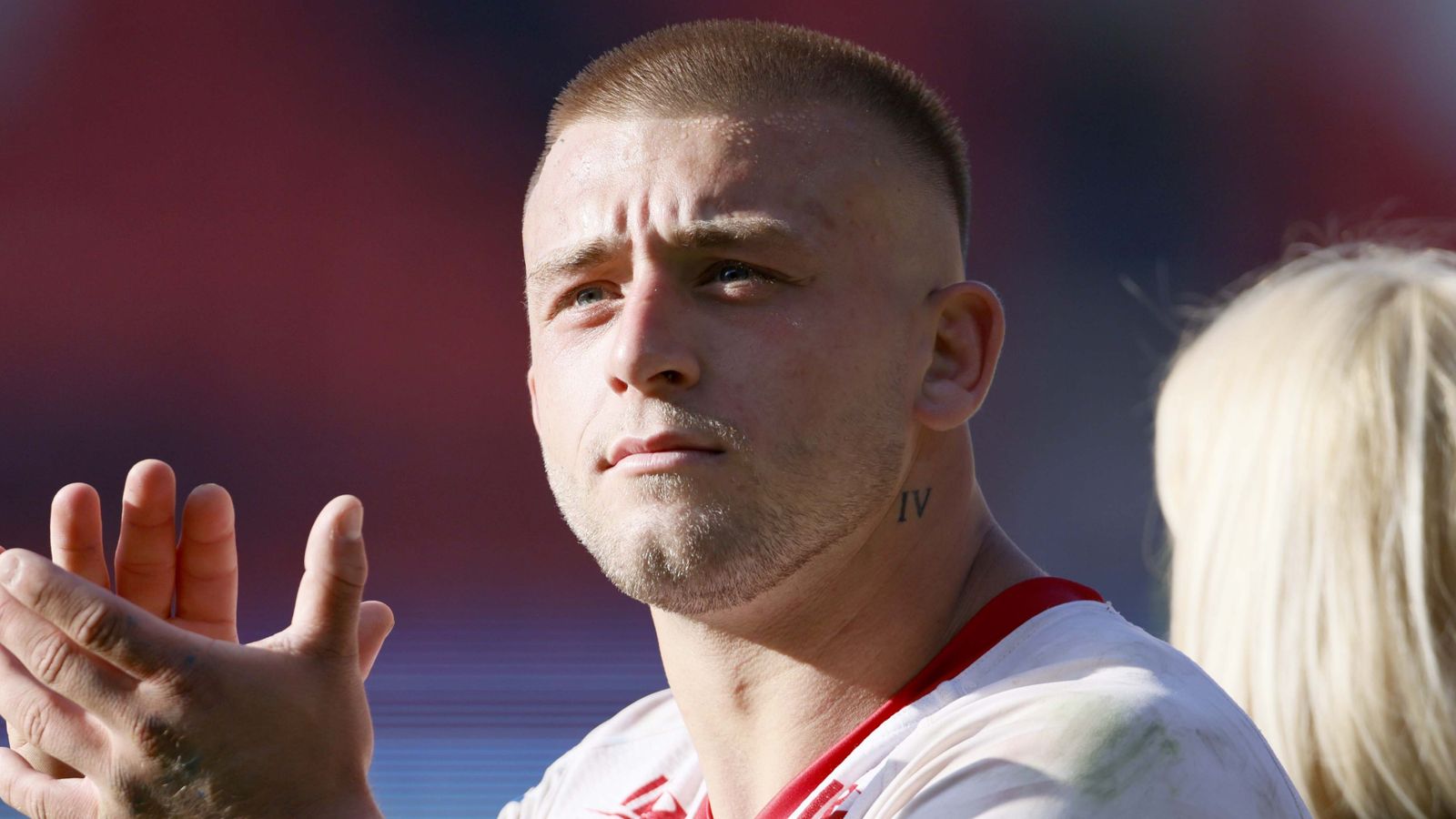
Mikey Lewis has been left out of England’s Rugby League World Cup opening match against Tonga by head coach Brian McDermott, while Jack Welsby has only made the bench.
Hull KR’s Lewis, who edged 2025 Super League Man of Steel Jake Connor for a place in England’s squad, has been named among the three reserves alongside Ben Currie and Ben Talty, leaving him set to miss out on selection.
Jack Welsby had been widely tipped to start at full-back, but head coach Brad McDermott has instead opted for Gold Coast Titans star AJ Brimson.
Wigan winger Zach Eckersley is set to make his international debut after being selected ahead of Matty Ashton, while fellow Warriors team-mate Sam Walters is also named to start.
NRL Premiership winner Victor Radley returns to the England side for the first time since the 2024 series victory over Samoa, while his Sydney Roosters team-mate Hugo Savala is in line to earn his first international cap.
Canterbury Bulldogs prop Max King is also set to make his first start for England following another impressive season in Australia.
Super League Grand Finalist George Williams, who is set to join the Dolphins, will captain the side and partner Harry Smith in the halves.
Brad O’Neill also returns to the England team after earning his only cap in the 2024 mid-season international against France.
England men: AJ Brimson, Dom Young, Hugo Savala, Herbie Farnworth, Zach Eckersley, George Williams, Harry Smith, Max King, Brad O’Neill, Morgan Knowles, Junior Nsemba, Kai Pearce-Paul, Victor Radley.
Interchange: Jez Litten, Luke Thompson, Ethan Havard, Sam Walters, Jack Welsby, Matty Ashton.
Strange and Boyd set for international debuts
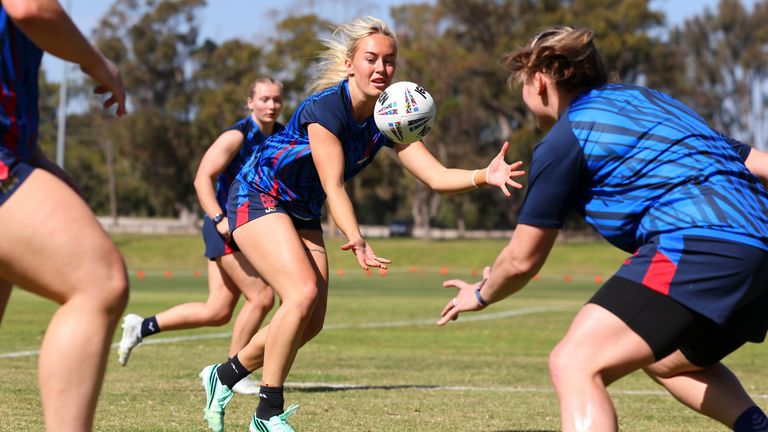
Jasmine Strange is set to make her senior international debut for England
England Women’s head coach Stu Barrow has named his squad for Saturday’s World Cup opener against Wales in Perth, with kick-off scheduled for 7.35am (BST).
Jasmin Strange, Connie Boyd and Hope Millard are all in line to make their senior international debuts.
Strange joins the squad after featuring in her fourth consecutive NRLW Grand Final and has already won premierships with both the Newcastle Knights and Sydney Roosters.
Reigning Woman of Steel Jenna Foubister has been named on the interchange bench and is set to make her World Cup debut. The 19-year-old Wigan Warriors half-back has scored in each of her first two senior internationals and registered nine tries in 18 appearances across all competitions in 2026.
Fran Goldthorp returns to the England side for the first time since the 2022 World Cup, where she scored three tries in four appearances. The full-back is one of three NRLW-based players selected, alongside Newcastle Knights half-back Georgia Roche and Canberra Raiders forward Hollie-Mae Dodd.
Amelia Brown is also in line to make her first England appearance since scoring a hat-trick on debut against Wales at AMT Headingley in November 2024, while Jodie Cunningham is set to captain England at her fourth World Cup.
England Women: Fran Goldthorp, Anna Davies, Georgia Wilson, Connie Boyd, Amelia Brown, Isabel Rowe, Georgia Roche, Mary Coleman, Keara Bennett, Hollie-Mae Dodd, Jasmin Strange, Eva Hunter, Megan Williams.
Interchange: Jodie Cunningham, Vicky Whitfield, Jenna Foubister, Hope Millard.
Wales Women: Leanne Burnell, Dani McGifford, Hannah Bluck, Zoe Heeley, Frances Layton, Ffion Lewis, Tayla Preston, Agnes Wood, Jasmine Gibbons, Emily Hughes, Georgia Cussons, Paige Travis, Bethan Dainton.
Interchange: Carys Marsh, Kathryn Salter, Katie Carr, Erin Williams.
>
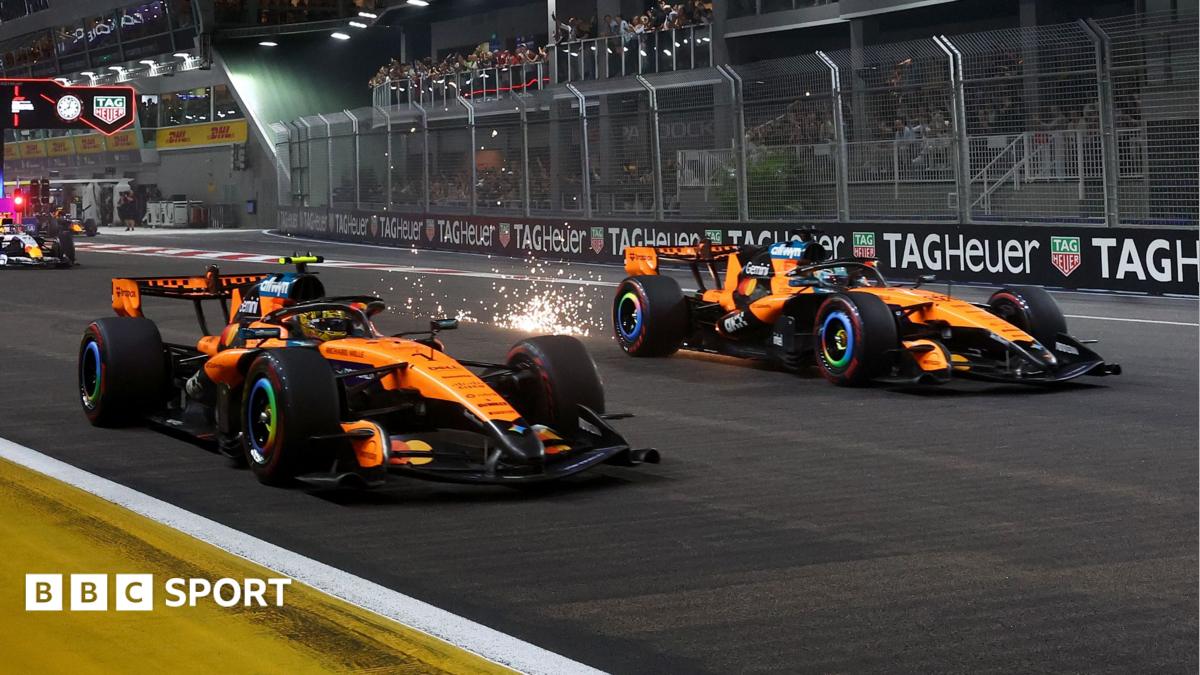
Red Bull’s Max Verstappen dominated the Singapore Grand Prix weekend, winning the main race and the sprint.
His maximum total of 33 points from the event moved him up to fourth in the drivers’ standings.
Ferrari’s Charles Leclerc finished the race in second and championship leader Kimi Antonelli completed the podium.
BBC F1 correspondent Andrew Benson answers your latest questions after the race at Marina Bay.
After the last-lap incident in the sprint race in Singapore, are ‘papaya rules’ finally failing at McLaren, and with them the premise of running two number one drivers? – Alexandros
The crash between Lando Norris and Oscar Piastri in the sprint race in Singapore left, in Norris’ words, “no-one very happy” at McLaren.
Norris went for a gap at Turn Five on the final lap. It was a legitimate move, in terms of the racing guidelines, but he tried to back out of it as he saw he was not being left sufficient space, and the two cars collided.
Both spun, Piastri into the barriers and retirement and Norris down from fifth place to eighth. What would have been nine points for the team from the sprint therefore became one.
There are two ways of looking at the move.
On a pure competitive level, between two rivals, Norris had the right to go for the move, and he complied with the driving-standards guidelines as to how far alongside he needed to be up to the point he started to back out.
But from a team perspective, it was all risk and no reward.
If Norris had pulled off the move, it would have meant one more point for him and one fewer for Piastri, but for the team collectively it would have made no difference.
What was interesting was that, despite having had initial talks with the team about it after the sprint, Norris was still pushing his point of view after qualifying.
“Really, it’s still my fault,” he said, “but I deserved to go for the space and I still believe I had the right for it.”
That raised a few eyebrows, but the truth is both drivers could have handled themselves better.
While there is an argument Norris should not have tried the move, there is an equally powerful one that, once he had, Piastri should have given him more space, and carried the fight down the following straight.
Team boss Andrea Stella was asked later that evening whether he was concerned about the message about team play not getting through to his drivers, and he dealt with it with his usual diplomacy.
Stella maintained his usual calm, even demeanour, but words like “unacceptable”, “disappointed” and “serious” made it abundantly clear how angry he was.
The following day, Norris had changed his tune. Not only did he offer to help out Piastri late in the race as the Australian was trying to pass Lewis Hamilton’s fading Ferrari, but he also finally took full responsibility for the incident.
“I can’t attempt what I did,” he said. “I should never have attempted it in the first place, even if the move was on. I’ve simply got to think more of the team that I represent rather than myself. It was a mistake on my part and I let down the team.”
Stella made it clear McLaren would not deviate from their policy of fairness and equal status between the drivers, even though he is well aware it will lead to issues such as this that test its limits from time to time.
“I classified it as unacceptable,” he said, “which is a statement that comes from the team principal, but I was very encouraged by the fact that it’s a statement that very rapidly came from our drivers as well.
“So we are aligned as to how we want to lead this team forward in a joint effort between the team and the drivers. The conversations that we are having, they are not finished, but it’s not because we need to go back discussing if Lando was alongside Oscar. That’s not the interesting bit.
“For me, the interesting bit is a reflection that all the stakeholders – the team, the drivers – will have to make around leading together the team, embracing constantly from inside the cockpit the interest of the team as something that is superior to any particular, singular, individual interest.
“And while the conversations from this point of view are not concluded, and there’s more we can do to become a more united and even stronger team, I’m pleased that Lando at some stage in the race adopted this way of thinking.
“This is what I expect as a team principal, this is what the 1,000 people that work at McLaren expect from our drivers.”
>

When the club announced his new contract, they also confirmed new deals for Joao Neves, Fabian Ruiz, Willian Pacho, Lucas Beraldo and Senny Mayulu, sending a clear message to the dressing room that this is still a long-term project.
There has been remarkably little change in the technical staff since Luis Enrique arrived at PSG in 2023.
Assistant Joaquin Valdes has been alongside Luis Enrique since their Barcelona B days, and he is the one who talks to the players on a personal level.
He also helps keep his boss grounded when Luis Enrique’s mind drifts too far away, and you can see him in the background in every news conference.
Rafel Pol, who handles strategy and acts as second in command, is another constant presence.
Very little of the way they train on and off the pitch has altered during Luis Enrique’s three years at the club.
The players aren’t shown a huge amount of videos, but there is a big screen on the training pitch to correct players and two cranes for the coaches to see everything from a height.
The one real change though is in the luxury of depth – a factor that proved key last campaign.
Luis Enrique can now regularly leave out a couple of key players from his squad and the team does not suffer.
Ousmane Dembele was not in the squad for the win against Le Mans on Saturday, and earlier in the season it was Lucas Digne who was left out. Against the bigger opponents, such as Manchester City and Barcelona, the starters arrive rested.
Against Le Mans, he used eight players that would not start the bigger matches, and, with the match level, he brought on four of his ‘stars’ to ensure the win.
His attack has been renewed after Gonzalo Ramos, Bradley Barcola and Lee Kang-in all departed.
Dani Gil, Paris correspondent for the Spanish radio station COPE, explains: “Barcola could not be given the minutes he wanted, they had won everything and been paid well for it, and the club could do with players who were hungrier.
“Mika Godts and Ferran Torres fit that description. Neither has yet won at club level what the departed players won.”
Barcola was not rated by the coaches as someone who could reach the level Dembele sets, yet his flashes of brilliance were enough to convince Liverpool to pay £123m for him.
Summer signing Torres is the more intriguing case. He went through a difficult stretch psychologically, worked on his mental strength and now calls himself ‘the Shark’.
He was unhappy at Barcelona when he was not playing regularly, even though last season produced his best numbers.
Now, having netted the winner for Spain in the World Cup final, he has scored seven goals in France. For the first time in his career he feels really wanted.
He also knows what kind of team he has joined. In a Luis Enrique side the star is Luis Enrique, and the forward is content with that.
>

Rugby League World Cup: Mikey Lewis has been left out of England’s opening match against Tonga | Rugby League News

F1 Q&A: Does Lando Norris-Oscar Piastri crash show ‘papaya rules’ are failing?

Skydance International: The Paramount & Warner Execs Leading The Group
-

 movies5 months ago
Search For Canadian TV Actor Stewart McLean Now Homicide Investigation
-

 Fashion9 years ago
These ’90s fashion trends are making a comeback in 2017
-
Fashion9 years ago
According to Dior Couture, this taboo fashion accessory is back
-
Fashion9 years ago
Model Jocelyn Chew’s Instagram is the best vacation you’ve ever had
-
Fashion9 years ago
Emily Ratajkowski channels back-to-school style
-
Fashion9 years ago
9 Celebrities who have spoken out about being photoshopped
-

 Anime4 months ago
Rurouni Kenshin: Hokkaido Arc Manga Takes 1-Issue Break – News
-

 Anime3 months ago
HIDIVE to Stream English Dubs for The World Is Dancing, The Forsaken Saintess and Her Foodie Roadtrip in Another World, The Dangers in My Heart: The Movie Anime – News