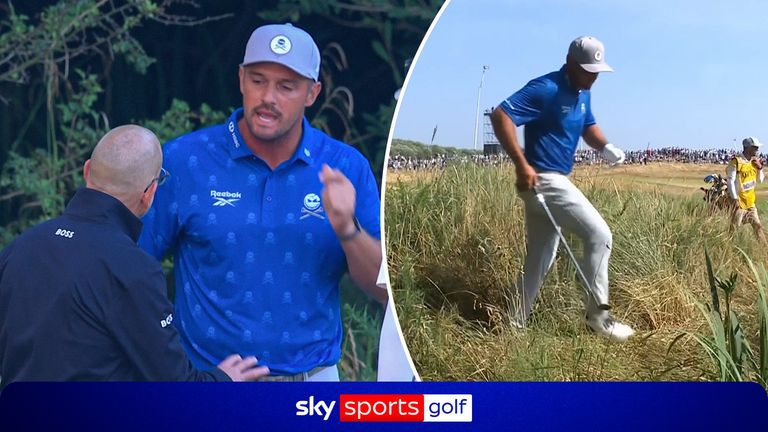
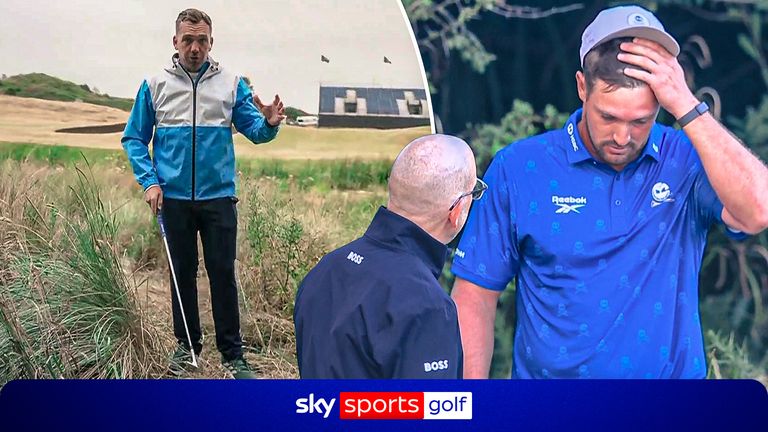
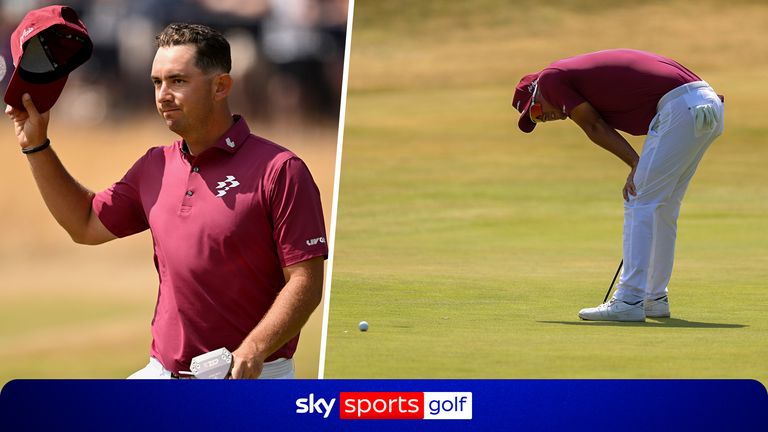
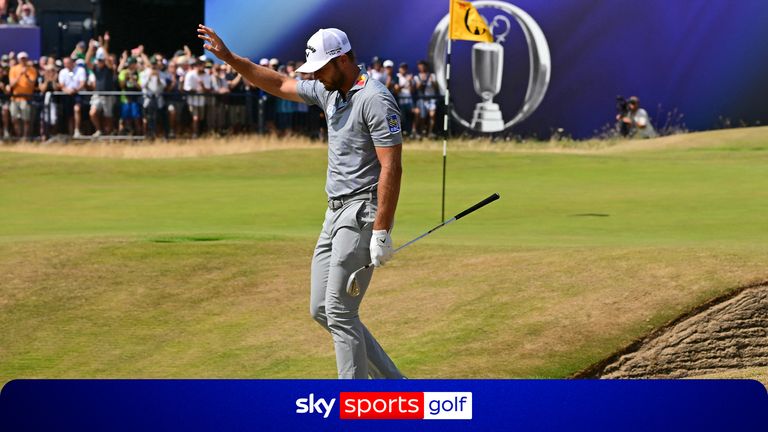
SOUTHPORT, England — This whole thing is really about a moment. Not the alleged stomp, but a small, unseen decision made sometime inside that scoring tent. It’s after the electrifying round. It’s after the cart expedition out to the scene of the crime in pettish protest, after he came back inside, and more than an hour after his round completed, when the ruling was final.
It was the moment Bryson DeChambeau decided he was going to turn The Open Championship into The Bryson DeChambeau Show.
Really dial that down in your mind. He just went from the most vindicating round of his Open Championship career — after one of golf’s leading pundits tore him down and another he didn’t have a strategic bone in his body — to put himself one back of the lead entering the weekend. And then, aside from any thoughts on the ruling, it’s taken from DeChambeau. He’s livid. Fuming. Desperate to plead his case. Throwing his arms in the air and threatening not to play anymore. He is, understandably, deeply upset.
So how, in the heat of the maelstrom, did he shift to a leisurely stroll off to the driving range with a showman’s grin on his face? To stopping and signing an autograph for the pair of spectators still waiting to see him up close? How did he make that jump to performer, hitting balls until 10:30 p.m., cracking jokes to the horde of reporters about his swing or if they want a snack from his bag?
Could you get there after what just happened? Really? Could you make that shift in your mind and heart?
Because whenever that moment came, it was when he consciously chose to make it into theater. He let people wonder if he would withdraw (of course he wouldn’t). He let reporters watch for an hour in mystery, as he pounded driver after driver into the night’s sky. He set the stage for Saturday and one of the more bizarre, fascinating rounds of golf we’ve seen since the day of Scottie Scheffler’s Louisville arrest.
It’s why the past 48 hours truly explain DeChambeau.
Why is this golf course’s bunker shaped like a donut?
Gabby Herzig and Lauren Morales-Jones
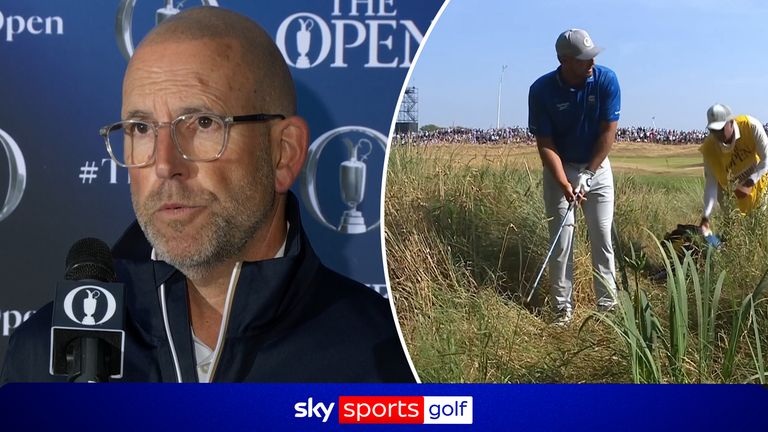
Other pieces can and have been written about the actual ruling. That’s not really what this is about. What happened on the fifth hole on Friday was probably a penalty. It also is something that, unfortunately, happens too often at professional golf events and nobody calls out. Do I think a less controversial player would have been penalized for it? Probably not. Does that mean I think it was a corrupt ruling by the R&A? Probably not.
What will define this tournament is what happened next. Also what happened well before it. This entire dynamic took on extra gunpowder because of the discourse Tuesday, Wednesday and Thursday. Golf Channel’s Brandel Chamblee criticized DeChambeau for focusing too much on social media, wondering if he was more interested in chasing Grant Horvat than Scottie Scheffler. Sir Nick Faldo said DeChambeau has “zero clue of strategy.” Earlier in the week, he declined multiple reporters’ in-person requests, including one from The Athletic. He reasoned that his quotes were always being taken out of context and argued that the media has ruined his reputation.
By the time he shot an exciting first-round 67 — surely to be one of the more positive stories of the day — he made clear he would not speak to the media, print or television. A protest. He did do a quite brief Q&A with the governing R&A in which he sassily over-emphasized the word “strategy” three times to make his point. And long before the events of Friday night, his agent, Brent Falkoff, indicated there was zero chance DeChambeau would speak to the media after his round.
And this is the part where I must make something very clear: I do not care that much about a player skipping a media session. I didn’t care when Rory McIlroy did the same last year. I understood when Collin Morikawa wanted no part of the media. This isn’t media self-aggrandizing because it’s not about DeChambeau talking or not to us. It’s the why.
Somewhere along the line, Bryson DeChambeau convinced himself that people showing his actions are the problem. Not his actions.
Nobody changed their mind on DeChambeau because of what they read or heard. They changed it — for better or worse — because of what the cameras saw him do. What the scribes witnessed and wrote down.
There’s a core text of Bryson that almost feels so minuscule in the grand mythology of the past decade, but it’s the most explicit example of this dynamic. It was the 2020 Rocket Mortgage Classic in Detroit when DeChambeau hit a bunker shot, got frustrated and swiped at the sand before dropping an expletive.
He then followed the cameraman and had a heated discussion about following him so long after the shot. DeChambeau felt the coverage was trying to damage his brand.
“I understand it’s his job to video me,” DeChambeau said, “but at the same point, I think we need to start protecting our players out here compared to showing a potential vulnerability and hurting someone’s image.”

Bryson DeChambeau stopped to speak to fans and sign an autograph in the heat of the moment Friday. (Michael Reaves / Getty Images)
Is that shame prompting him to rush to the cameraman? Is it fear of people seeing what he doesn’t curate for audiences? The point isn’t even his reaction. Who cares? Everybody does that. Nobody would have thought twice.
The point is that DeChambeau has never cared about truth. He cares about the image he projects.
DeChambeau rebuilt his image quite successfully over the past four years after he left for LIV Golf, and good for him. He doesn’t deserve to be hated. Life is hard enough. He made dramatic improvements and engaged with fans like nobody else in the sport. His YouTube channel was a large part of that, of course. His 2024 U.S. Open win was a proper moment of rehabilitation and redemption.
But it was always on his terms. He took pride in his YouTube channel allowing him to finally display the “real him,” and I’ve never been able to pin down if I believe that he believes that or if it’s part of the construct. Because surely anybody with critical thinking skills understands a heavily-produced, sanitized, curated series of videos is verging on the opposite of reality.
He believes when reporters cited PGA Tour peers who had issues with DeChambeau’s behavior, it was the media hurting him, not ever wondering if he did something wrong to upset the other players.
He thinks it was PGA Tour officials always out to get him, never wondering if he was out of line.
He thinks the PGA Tour is being unfair by threatening him with severe penalties if he tries to come back, never considering that he was one of 11 plaintiffs suing the PGA Tour back in 2023 and was the last one to remove himself from it.

Bryson DeChambeau, left, and R&A rules official Grant Moir disagreed about whether the former’s actions were worthy of a penalty. (Richard Heathcote / Getty Images)
Responsibility is rarely something DeChambeau takes. Instead, his superpower is taking a bad moment and turning it into content.
This week, DeChambeau has quite artfully turned the worst major championship season of his career — missing all three cuts — into a sympathetic tale. He turned a penalty against him into victimhood. He turned a petulant reaction into a series of moments where, I must admit, he was somehow likeable.
Bryson DeChambeau has again successfully made himself the entire story of the weekend, and he’s so successfully crafted a narrative in which if he wins it’s an all-time triumph against corruption and if he loses it deserves an asterisk. Well played.
And at 2:02 p.m. local time Saturday, a van door opened, and DeChambeau hopped out ready for his next performance. So many others arrived dressed casually, but he was in his Crushers GC sweater and hat, as if already in costume. And as he walked by, he passed a sign with the Open Championship slogan displayed along the wall.
Forged by nature, it read. But so much of Bryson DeChambeau has been concocted.