
Politics
Politics Home | Keir Starmer Says He Is Leaving “With A Smile” and “Good Grace” In Final Speech As PM


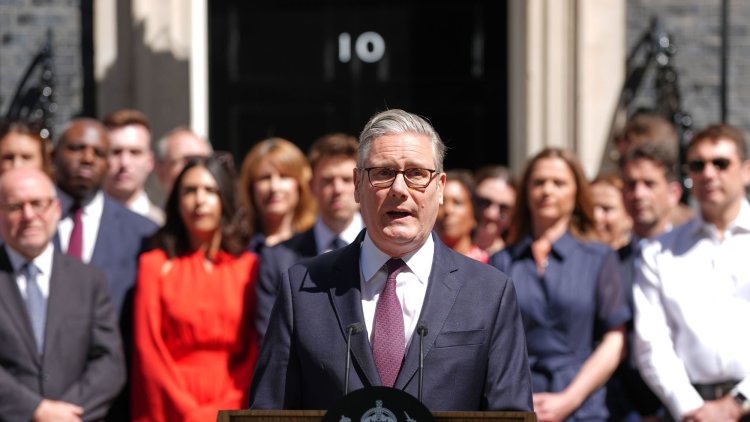
Keir Starmer gave his final address as PM outside No 10 on Monday morning (Alamy)

3 min read
Keir Starmer said he would “go with good grace” and “with a smile” from No 10, as he gave his final speech as prime minister of the United Kingdom.
Starmer gave his final address outside No 10 Downing Street on Monday morning, ahead of former Greater Manchester mayor Andy Burnham replacing him in office in the afternoon.
“For all the focus on individuals, politics will always be a team sport, and the changes we’ve delivered for our country and our party belong to everyone who has fought for them,” Starmer said.
“I thank them again today, and I thank the British people for the opportunity to serve. I go with good grace, I go with a smile, and I go proud of everything that we have achieved.”
He said he was “confident” that Britain is now “stronger and fairer” than it was before Labour entered government in 2024.
“Our economy is stronger,” he said.
“Our public services are on the up, with the biggest fall in waiting times for 17 years. Children are being lifted out of poverty every single day. Immigration is down significantly. Our defence and security are on a far stronger footing, and our international reputation is greatly enhanced.”
He also highlighted his achievement of securing a landslide election win for the Labour Party in the 2024 general election.
Describing “everyday immeasurable acts of resolve, grit, decency, and compassion from people who serve our country”, Starmer made a call for national unity among “different people under our common flag”.
“We face a world now where our enemies will stop at nothing to divide us, because of our values, our freedom, our decency, and frankly, because of our unflinching resolve towards the brave people of Ukraine,” he continued.
“And so, under this attack, it is vital that we remember the greatness of the Britain all around us.”
The outgoing prime minister wished Burnham well in taking over the premiership, and said he had his “full support”, before thanking his family, his staff, the civil service, and “everyone who has supported our efforts along the way”.
As Starmer spoke, his key staff, allies and supporters stood behind him and along Downing Street. His wife Victoria Starmer, Chancellor Rachel Reeves, Deputy Prime Minister David Lammy, Mayor of London Sadiq Khan, Secretary of State for Housing, Communities and Local Government Steve Reed, Attorney General Lord Richard Hermer, and Starmer’s top advisers Sophie Nazemi, Ben Nunn, and Amy Richards were among those surrounding him by the front door to No 10.
Following the speech, Starmer headed to Buckingham Palace to meet the King and offer his resignation as PM.
>


Andy Burnham appointed his cabinet on Monday (Alamy)
2 min read
Andy Burnham’s Cabinet has been described as a northern takeover of government. Analysis shows one part of the north in particular is on the rise.
After taking office on Monday, the new Prime Minister gave high-profile ministerial jobs to fellow northern Labour MPs like Angela Rayner and Lucy Powell. There are also seats at the Cabinet table for Lou Haigh and Anneliese Midgley, who both played key parts in Burnham’s journey from the Manchester mayoralty to Downing Street.
Burnham’s northern roots, particularly “Manchesterism”, are an important part of his political identity.
He has set up a new Downing Street base in Manchester, ‘No 10 North’, where he intends to work at least one day a week, starting on Friday, and where he could host foreign leaders.
It’s not just the politics of these places and his devolution agenda, but the cultural side, too, like his love for Everton FC, rugby league and The Smiths.
A comparison of Burnham’s Cabinet with Keir Starmer’s top team when he stood down to make way for his successor shows that specifically the northwest – the PM’s home region – is the big winner in terms of senior ministerial representation.
Burnham has appointed six Labour MPs representing seats in part of the country: Education Secretary Powell; Communities Secretary Rayner; Chief Whip Midgley; Business Secretary Jonathan Reynolds; Environment Secretary Angela Eagle; and Culture Secretary Lisa Nandy.
This compares to two MPs in Starmer’s cabinet at the time of his resignation who were from constituencies in the northwest.
>


3 min read
Prime Minister Andy Burnham’s plan to scrap digital ID has created confusion in Whitehall and resulted in an apology to officials working on the scheme.
Before entering office on Monday, Burnham announced that he would abandon the Keir Starmer policy and redirect the resources to tackling cost-of-living pressures.
Speaking in his first Cabinet as PM on Tuesday, he said the decision was about “reprioritisation”, after announcing that money saved by ditching the scheme would be put towards cutting VAT from household energy bills.
On Tuesday morning, the Permanent Secretary in the Cabinet Office, Cat Little, apologised to department officials who had been working on digital ID for not being told about the decision before it was announced, PoliticsHome understands.
Little told officials that what remains of the scheme will move to an expanded Department for Digital, Culture, Media and Sport, headed by Lisa Nandy.
This detail has led to questions about what part of the policy is actually being discarded.
The new Burnham administration has said that it remains committed to the existing Blueprint for Modern Digital Government, including the GOV.UK app, GOV.UK OneLogin and the Government Wallet, with a digital driving licence expected shortly. Digital inclusion work will continue, building on the 2025 Digital Inclusion Action Plan.
Insiders have told PoliticsHome that the government has already spent around £15m on developing the policy since it was announced by Starmer in September last year.
The Institute for Government’s Heloise Dunlop said the money that has already been spent on the policy “is unlikely to be insignificant, given the size of the team and extensive consultation process”.
She told PoliticsHome it was “not clear how the government was going to fund digital ID: the policy was not yet fully finalised, there was no clear idea what online services would be included in the join-up, and the OBR had said no specific funding had been allocated for digital ID in the spending review”.
On Tuesday morning, Darren Jones, a Starmer ally who Burnham sacked from Cabinet on Monday, and who led on digital ID while in government, posted on X that the policy of scrapping digital ID to fund energy bill cuts was “unfunded” as the latter is based on unspecified departmental cuts.
“The government will have to set out how it will pay for its new policies at the budget,” he wrote.
Helen Miller, director of the Institute for Fiscal Studies, added: “At last year’s Budget, the OBR estimated that the [digital ID] programme could cost a cumulative £1.8bn between 2026–27 and 2028–29, and the Treasury estimates that today’s VAT cut will cost £850m this year.”
Miller said that the numbers mean that the government “will therefore still need to make around £850m of as yet unspecified cuts from other departmental spending to pay for this”.
If the tax cut remains permanent, Miller said, “the government would have a range of options for how to pay for it in future years”.
“This could include departmental spending cuts, but it is unlikely these can be justified solely by scrapping digital ID. Much of the cost of this scheme was likely to be upfront investment to set it up over the next few years, such that scrapping it cannot fund a permanent tax cut.”
The Starmer government hoped that introducing digital ID would help modernise the state and make public services more efficient.
However, it polled negatively once announced, with Labour MPs complaining that the early communications strategy focused too much on how it could help combat illegal migration, with not enough messaging about how it could improve the everyday lives of voters.
In January, PoliticsHome revealed that the Starmer administration was abandoning plans to make the scheme mandatory amid warnings, including from many Labour MPs, that going ahead with the compulsory element would be strongly opposed by the public.
>


(Aldo Ciarrocchi/Alamy)

11 min read
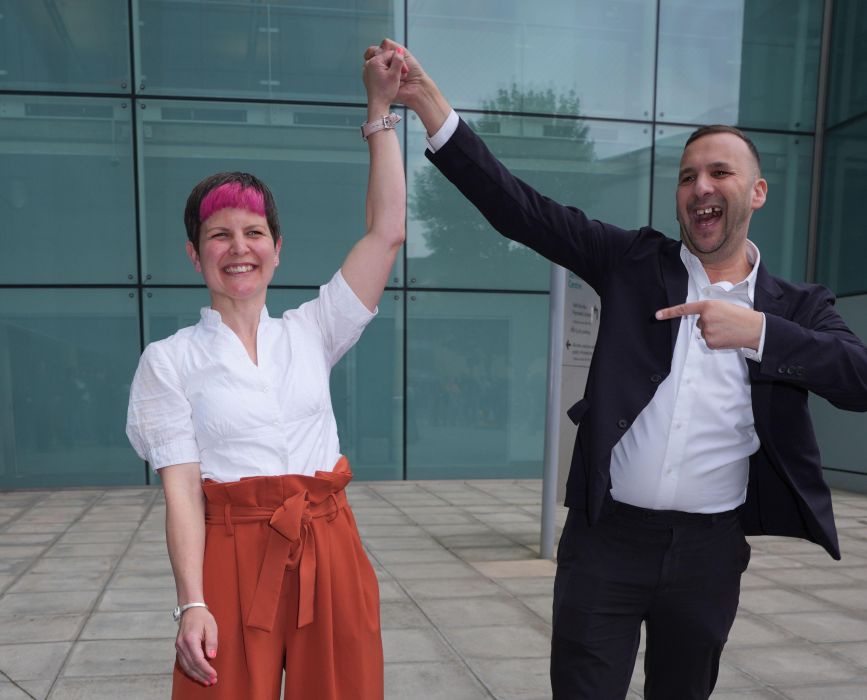
Hackney’s new Green mayor Zoë Garbett talks to Noah Vickers about winning a Labour stronghold, taking Sir Sadiq Khan to court and why she wants Andy Burnham ‘to succeed’
Zoë Garbett had expected a good showing for the Green Party in May’s local elections, but the scale of her victory in the Hackney mayoral race came as something of a shock.
“I kept saying before the election, ‘This is going to really change politics in London,’ but I had no idea I’d be sitting here with the majority we got,” says the 39-year-old mayor.
The Greens had war-gamed for several scenarios as they sought to wrest control of the Labour stronghold, including some where they won a majority of councillors without also taking the mayoralty, which is separately elected.
“We really were planning for all eventualities. At our worst prediction, we thought we’d have 10 councillors.”
In the event, the party went from winning two of the borough’s 57 seats in 2022 – of whom Garbett was one – to 42 in 2026. Labour were reduced to nine seats, down from the 50 they won four years ago.
Garbett, raised in Somerset by teacher parents, worked in public health at Labour-run Barking and Dagenham council and later in an officer role at Conservative-run Barnet council. Non-clinical posts in the NHS followed, including in children’s mental health and as an assistant director for health inequalities.
In 2024, she took voluntary redundancy to focus on her campaign against Sir Sadiq Khan in that year’s London mayoral race. While she lost the contest by a wide margin, Siân Berry’s unexpected departure from City Hall opened up a vacancy for her on the London Assembly, where she spent the last two years with Green leader Zack Polanski.
A Green member since 2013, Garbett was an early supporter of Greens Organise, a group seeking to “build the left within the party”, which shared activists and an ethos with Polanski’s leadership campaign.
Khan texted Garbett his congratulations following her victory in Hackney. But within weeks of taking office, she is already on the warpath against him, as she has joined a legal challenge against City Hall.
Working with Lewisham’s Green mayor Liam Shrivastava and Tower Hamlets mayor Lutfur Rahman – who leads his own Aspire Party – the three borough leaders are applying for a judicial review in the High Court. Their aim is to overturn Khan’s decision last year to temporarily reduce London’s affordable housing requirements.
Previously, all major developments on private land in London needed to include at least 35 per cent affordable housing in order to be ‘fast-tracked’ through the planning system, but in October 2025 Khan agreed with the government to slash the requirement to 20 per cent.
With London housebuilding having reached record lows in recent years, the change was agreed as part of a wider “emergency package” of measures to help the construction industry, which has struggled with inflated costs, high interest rates and new regulations.
Khan and the government argue that lowering the threshold will allow more affordable homes to be built, following the maxim that 20 per cent of something is better than 35 per cent of nothing.
But Garbett says there should have been more focus on building already-consented homes first.
“There’s loads of planning applications that have been approved that haven’t been built out. I think it’s thousands across London, a few hundred in Hackney. What are we doing to make sure those are being delivered?”
She’s also unconvinced that reducing the threshold to 20 per cent will actually result in more affordable homes getting started, saying: “It did very much feel like it was just developers pushing for it and it wasn’t in conversation with local authorities.”
Labour lost Hackney partly due to anger from some in the borough over the impact of Low Traffic Neighbourhoods (LTNs), where roads are closed to through-traffic to discourage car use. Hackney Greens have had to walk a delicate line on the issue, with their manifesto noting the “hard truth” that LTNs “have not yet delivered fair outcomes everywhere”.
The party said that “while rollout of recent schemes by the Labour-led council has been rushed, reactively scrapping schemes can recreate the original problem – bringing rat-running and road danger back”. Instead, the Greens pledged to take a fresh approach to new LTNs, with “community-led design, fair impact assessments, full data transparency, and scheme-by-scheme decisions”.
Hackney’s Labour administration, Garbett says, talked about LTNs as a way of improving air quality, but she believes road safety has been overlooked as an “absolutely paramount” factor.
“If you speak to people who are upset about some of the road changes, if I say, ‘Yeah, but school streets are all about children being able to walk to school,’ most people say they can understand that.
“We need to do some work to really be transparent about the evidence, where things are working and not working, and where we’re collectively measuring what that looks like.”
The installation of a bus gate on Chatsworth Road has proved especially controversial among locals, who made their feelings known to Garbett during the campaign.
“We had some quite robust challenge from people about the [Greens’] approach,” she admits, “but, as I said, people can find commonality around road safety.
“People do feel like it’s connected to a push against people’s freedoms to move around, and I do really hear that, so we need to really make sure that alternatives are there.”
Garbett is also pushing for a “pause” in the use of Live Facial Recognition in the borough by the Metropolitan Police. In Hackney, Garbett says the technology – which has sparked concerns about civil liberties and racial biases – is usually found in busy retail areas like the Narrow Way and Ridley Road.
“Traders report that less people come. A van sits there with its engine on for six hours, with its cameras pointed around,” she says. “Yesterday I went up to the Narrow Way and I think at one point there were 12 officers. It’s such a heavy police presence.”
In the north of the borough, Stamford Hill is home to Europe’s largest population of Charedi Orthodox Jews. The mayor says she is “really proud” of the community and has already met with its leaders a number of times.
But amid media reports of alleged antisemitic comments made by some Green candidates and councillors elsewhere in the country, did Garbett in her new role as mayor feel the need to give them any kind of assurance?
“Yes,” she says. “I did a little speech with some of the community leaders and they kind of looked a bit perplexed. They were like ‘We know that you’re local, we know that you care about our community’…
“It was interesting, because I did just want to put it on the table. I want people to talk to me – I don’t want you to feel that you can’t.”
“I had no idea I’d be sitting here with the majority we got”
In March, the Greens’ spring conference looked set to discuss a motion titled ‘Zionism is racism’, though it was not ultimately debated. Former Green leader Caroline Lucas recently told The House she was “not sure it’s a very helpful debate” as “Zionism can be interpreted in so many different ways”. Does the subject need more nuance?
“Motions are brought to conference and get debated, which is the beauty of the Green Party in the sense that any members can bring anything they want to discuss,” replies Garbett. “I think there’s been some feedback on the motion as it was written, to make sure that it’s as helpful and practical as possible.”
Would she say, straightforwardly, that Zionism is racism?
“Well, I think the framing is…” she says, finding her words. “It depends on context and who you’re speaking with and what our aim is. I think our aim has to be bringing people together and focusing on a solution.
“Like here in Hackney, we’re doing as much as possible to divest our pension funds [from companies complicit in territorial human rights violations]. That process was started off last week, which is really exciting. We know it’s going to be a long road.
“So, I think anything that helps us be practical, but I know that that framing is really important to people who are Palestinian or have family in the area, so I think it’s important that we’re able to, you know – we need to listen to them.”
Garbett speaks to The House the day after Andy Burnham has given his speech in Manchester promising “the biggest rebalancing of power our country has ever seen” through a sweeping devolution programme.
“The proof’s going to be in the pudding,” says Garbett, adding: “There is some nervousness about some of his rhetoric around moving money out of London, because I’d like there to be a focus on the issues. What are we doing about children with SEND needs? What are we doing about child poverty?
“People have got this perception that London is rich and we’re all living the best life, but 50 per cent of children in Hackney live in poverty.”
She also urges the next PM to empower her and other mayors to set rent controls on private tenancies.
“I think it would make such a huge difference,” she says, pointing out that as long as rents remain as high as they are, billions of pounds will continue to be transferred from the government to private landlords every year in housing benefit. Notably, Burnham himself called for the then-Tory government to freeze private rents in 2023.
Nor should Burnham’s devolution vision be limited to metro mayors alone, Garbett warns.
“We don’t want the powers to just go to the Mayor of London. There needs to be powers coming to [borough] authorities.”
Garbett brushes off concern about Burnham winning back disaffected Labour voters who have drifted to the Greens.
“A lot of people support the Greens because we are pushing for things like rent controls, because we are very bold against the complicity in the genocide. We want climate action and I know he’s already making some mutterings about gas and oil drilling, and migration – him sticking to some of the horrendous migration laws… I think it will be that first 100 days, about what decisions he prioritises.”
There will remain enough distance between the parties, then, for him not to threaten the Greens?
“This is really difficult, because I don’t want people to continue to suffer,” she replies. “I want him to succeed in doing things like nationalising the railways so that people can get around more cheaply, making energy cheaper, making food cheaper. I really want to see him making those good decisions.”
While Polanski’s arrival as leader saw the Greens enjoy a sustained surge in the polls, their standing in opinion surveys appears now to be ebbing. Garbett doesn’t seem sure why.
“I don’t know what’s going on,” she says. “I’ve been very focused on Hackney, where we’ve had the most amazing election, and that is in part [thanks] to Zack’s leadership. But I think it’s just changing times as well, like what happens with Andy Burnham.”
Will Polanski face a challenge in keeping the party’s momentum going?
“He’s suffered a huge amount of scrutiny. The press have been through his bins and calling everyone he’s ever known. I think that has been really difficult.
“He’s apologised where he’s needed to. Some of it wasn’t even a story, but obviously the headlines run away, don’t they. He has been really under attack recently.”
The Greens have now set their sights on the Greater Manchester mayoral by-election. Can the party win there, even with the change back to the supplementary vote system?
“No,” she blurts out, before moderating her answer: “Well, it’s a big step up, isn’t it?”
The party is pleased, she says, that the government has ditched first-past-the-post in favour of a more democratic system for mayoral contests.
“It’s going to be a big-scale [election], we’re just going to do as best as we can. It’s like here – we tried our best,” she laughs. “The polls didn’t look good for us a year ago.”
>

Red Sox run out of magic, fall to the Orioles as win streak stops at 15

Phil Foden signs new Manchester City contract to 2030 with extra year option

Live-Action High School Family: Kokosei Kazoku Film Reveals 12 Cast Members – News

-

 Fashion9 years ago
These ’90s fashion trends are making a comeback in 2017
-
Fashion9 years ago
According to Dior Couture, this taboo fashion accessory is back
-
Fashion9 years ago
Model Jocelyn Chew’s Instagram is the best vacation you’ve ever had
-
Fashion9 years ago
Your comprehensive guide to this fall’s biggest trends
-
Fashion9 years ago
9 Celebrities who have spoken out about being photoshopped
-
Fashion9 years ago
Emily Ratajkowski channels back-to-school style
-
Fashion9 years ago
A photo diary of the nightlife scene from LA To Ibiza
-
 Tech3 months ago
OpenAI CEO apologizes to Tumbler Ridge community

