
Sports
Nations Championship: England forward slams ‘brutal’ Nations Championship schedule after travelling 25,000 miles in July | Rugby Union News


Ben Earl has called for a rethink of the Nations Championship format following England’s “brutal” itinerary that featured three Tests in three continents on successive weekends.
Steve Borthwick’s team ended their 25,000-mile July tour with a victory over Argentina on Saturday and their two wins offer sight of a place in the inaugural competition’s final at Allianz Stadium on November 29.
But victory over the Pumas in Santiago del Estero was sealed despite sleep-deprived players being limited to a reduced training schedule in order to recover from the travel, while the time difference was also a hurdle to overcome.
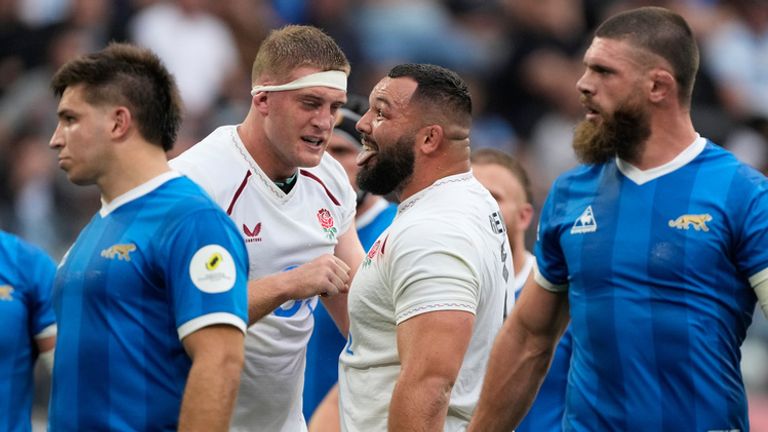
England’s Ellis Genge (centre) celebrates scoring a try against Argentina
The itinerary – the toughest faced by any nation this month – was especially challenging for England’s British and Irish Lions stars such as Earl, Ellis Genge and Ollie Chessum who faced Australia last summer.
Having taken four long haul and four short haul flights in just under four weeks, the amount of travel has been a point of discussion within the squad.
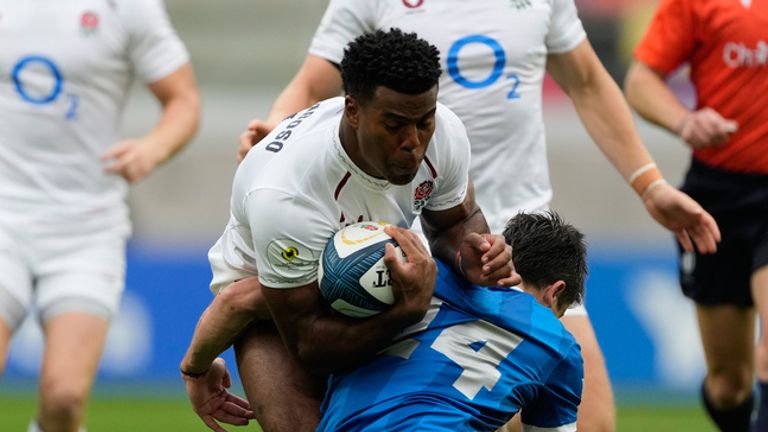
England’s Immanuel Feyi-Waboso scored a stunning solo finish against Argentina
Earl said: “It’s been brutal, there’s no two ways about it.
“We’ve been speaking about it – why would we not all be playing in one country? So you just don’t travel, you go to one nation and have that festival feel.
“You come to Australia, South Africa, wherever, and there’s so much rugby going on. How cool would that be?
“I’m not paid to make those decisions but it has been tough. It’s been tough coming at the end of what’s been quite a long season anyway for most of us.
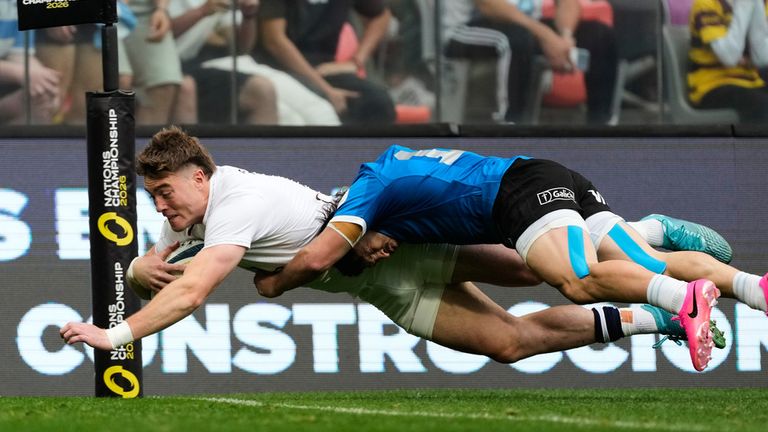
England’s Tommy Freeman scores a try while being tackled by Argentina’s Mateo Carreras
“It’s been back and forth, coming back to England, seeing your families and then going away again.
“It has seemed a bit weird but it’s just something we’re going to have to get used to because I think it’s just the beginning.”
England’s Nations Championship results
>

When footballers ‘do boxing’, it rarely looks great.
It looks, well, like footballers boxing. The punches are wide and thrown from waist high and there’s not a hint of head movement. All of which is fine, considering they’re usually doing it as a bit of fun; a way to break up the training monotony of the week or maintain some fitness while rehabilitating an injury.
When Manchester City midfielder Rayan Cherki does boxing however, he looks… well, like a boxer.
“It’s scary,” joked City manager Pep Guardiola when asked about a video of the 22-year-old Frenchman doing padwork that went viral earlier this month. “He will play every game!”
The brief clip posted on Instagram shows Cherki hitting pads with French boxing coach Omrani Faycal at his gym in Villeurbanne, northeast of Lyon, a few weeks before he joined City from Lyon last summer. During the 30-second clip, he can be seen throwing a series of combinations while using his feet to move in and out of range, with several slips, ducks and rolls thrown in for good measure.
“He’s tasty, isn’t he?” says Curtis Woodhouse, the former England Under-21 midfielder who retired from football to become a professional boxer and won the British light-welterweight title in 2014, after watching the video. “It looks like he’s got very fast hands and a bit of pop in his shots as well. I don’t know how long he’s been boxing, but if I didn’t know that was Rayan Cherki and he played for Man City, I’d think he was a boxer.”
Cherki is far from the only elite footballer to harbour a passion for boxing. At most big fight nights in the UK, you’ll see an array of them sitting at ringside. Some, including Everton’s England No 1 goalkeeper Jordan Pickford and former Manchester United and England striker Wayne Rooney, grew up with the sport.
Rooney would train at his uncle’s gym in the Liverpool suburb of Croxteth and once, notoriously, sparred with former United team-mate Phil Bardsley in his kitchen at home — a session that ended with Rooney lying knocked out on the floor. He at least saw the funny side by pretending to collapse after scoring against Tottenham Hotspur in his next match.

Wayne Rooney pretends to be ‘knocked out’ after scoring against Tottenham in 2015 (Oli Scarff/AFP via Getty Images)
Speaking on a podcast with Eddie Hearn, the chairman of promotion giant Matchroom, in 2019, Rooney said that he believes the boxing training he did as a kid is what helped give him the strength to be able to play in the Premier League aged just 16.
“It made me physically ready, and without that I don’t know I would have been able to cope with playing against the likes of Sol Campbell, Martin Keown and these big defenders,” he said. “So that really helped me get in a condition where I was young, but physically I could handle it.”
Others have no such boxing pedigree, but see value in adding the training for it to their schedules.
Early on in the 2024-25 season, Manchester United and England forward Marcus Rashford uploaded an Instagram video of himself hitting pads and bags interspersed with bunny hops over a high bar (an intense conditioning session favoured by former Boxing News and Ring magazine trainer of the year Joe Gallagher). Former Liverpool and England captain Jordan Henderson has also been seen hitting pads, while ex-Manchester United and France midfielder Paul Pogba has been known to utilise kickboxing in his training.
But is it actually beneficial to these players?
Faycal, who started working with Cherki eight years ago, training him once a week up until the Frenchman left Lyon, is in no doubt. He describes their boxing sessions as a “real lever for improvement, especially in modern football where one-on-one battles and quick decision-making are paramount”.
Woodhouse believes the benefits are mostly related to breaking up the monotony of a training week and giving naturally competitive individuals the opportunity to improve in a different realm, but Faycal says there is far more to it. He reels off a list of crossover benefits, starting with co-ordination and neuromuscular agility.
What does this mean in practice? “Boxing develops very fine coordination between the upper and lower body,” says Faycal, who explains that throwing combinations, dodging punches (even pretend ones from your trainer) and moving with your shots requires “synchronising perception and action.
“For a technically gifted playmaker like Rayan, this improves his changes of direction, his feints, and his ability to beat defenders in tight spaces.”
Thierry Henry on the magic of Rayan Cherki
Adam Crafton
Core strength is something that Liverpool and Egypt forward Mohamed Salah is known to dedicate hours of gym work to, focusing on deep rotational stability, abdominal strength, and balance. It’s been key in allowing him to withstand forces from defenders, maintain acceleration and turn quickly while moving at high speed.
Boxing, says Faycal, can produce the same effect, resulting in better ball protection, more resistance to loads and less imbalance during contact.
It can also help improve reaction time and anticipation. Faycal says that during boxing sessions, Cherki learns to read his opponents’ intentions in a fraction of a second by looking at their shoulders, gaze and rhythm. “In football, this refines anticipation,” says Faycal. “It’s about knowing when to accelerate, feint, or pass before the defender even reacts.”
Footwork is one area that could be considered contentious. Faycal believes the work boxers constantly do on being light and reactive on their feet and maintaining balance can translate into being more explosive on the pitch; sharper starts and better stability in one-on-one situations.
Conversely, former super-middleweight world champion and GB Boxing coach Richie Woodhall, who spent time training players at his beloved West Bromwich Albion, believes that while donning the gloves can help make players fitter, there is “no real benefit footwork-wise” as the two sports are “very different in what’s required to perform well”.

Mohamed Salah works out during Liverpool’s 2024 pre-season (Andrew Powell/Liverpool FC via Getty Images)
His view is supported by Professor Alan Ruddock, a performance physiologist and co-founder of Boxing Science, a performance support team that has worked with over 700 athletes, including former world champions Fabio Wardley, Kell Brook and Terri Harper.
“A Premier League footballer needs the ability to accelerate, decelerate, change direction with high force – you’re not going to get that through boxing because the forces are not there,” says Ruddock. “When you’re practicing footwork drills, it’s all a bit too polite; a bit tappy-tappy, more like dancing. It’s the Queensberry part of the Queensberry Rules. A footballer needs to produce high rates of force in a very short space of time. Boxing footwork is not going to do that for you, unfortunately.”
When Woodhouse made the switch to boxing, everyone expected him to have the feet of Vasiliy Lomachenko, the great Ukrainian fighter renowned for his exceptional footwork. Sadly for him, he still had those of a retired footballer. “I never had good feet as a boxer,” he says. “Everyone thought (I’d be) twinkle toes, but it’s a completely different skill set. I was a bit of a plodder.”
There are always exceptions, though.
Boxing world champions Katie Taylor and Lauren Price both started out as footballers, making it to international level for the Republic of Ireland and Wales, respectively). And both have exceptional footwork and balance, attributes which are often attributed to the time they spent on the pitch. Equally, these could be natural traits — ones that helped them to reach the levels they did in football and are now doing the same in the ring — as opposed to ones developed through the beautiful game.
Cardiovascular fitness is also an interesting area.
Much depends on the type of boxing training footballers are doing, and on who is implementing it. Ruddock says that, having tested and trained hundreds of boxers, the level of explosiveness they present is “nowhere near” that of a Premier League footballer.

Katie Taylor (left) went from footballer to boxer (Ed Mulholland/Getty Images)
While boxers have good levels of fitness and can hold a good speed for a long time, Ruddock says they don’t necessarily have the same repeated sprint ability as elite footballers. That’s not to say it isn’t possible to get a good cardiovascular stimulus from padwork. Ruddock cites a 2014 study that showed it is possible to push boxers towards 90 per cent of their VO2 max or 90 per cent of their maximum heart rate using a pad protocol that mimicked amateur boxing.
“So it is possible to get a good cardiovascular stimulus from pads,” says Ruddock, “but you need a very skilled coach and pad man, because it can’t just be one type of shot that they’re throwing or a low number of shots that they’re throwing.
“He’s got to have a high variation. He’s got to know when to push you, when to pull you back, and then progressively add the demand rather than almost burn the boxer out to start with. It has to be high force, repeated activity rather than Floyd Mayweather Junior-style, tappy-tappy choreographed pads.”
The final area Faycal mentions is that of mental strength and stress management. Boxing, he says, demands composure under pressure, focus during exertion and acceptance of direct confrontation. “For a playmaker like Cherki, this can help him remain decisive in tense moments (the end of a match or intense pressure from the opponent),” he adds.
For Ruddock, there is a potential psychological transfer in terms of self-confidence. “I’m a Premier League footballer, and I’m in a battle twice a week,” he says. “What’s a good way of preparing myself for that? Getting on boxing gloves, getting in a boxing gym, and doing some boxing training.”
Cherki spoke about his passion for combat sports on the Men in Blazers podcast, explaining how “it allows me to work on my physique, it allows me to express myself”. But despite his countryman’s love for it, Faycal warns there are caveats when it comes to implementing boxing training into a player’s schedule.
The first of those is with regard to volume. “Too much could hinder the specific freshness required for football,” he says.
The second is the risk of getting hurt, especially the hands, wrists and impact injuries. “This necessitates strict supervision and often training without direct sparring,” says Faycal.
The goal, he explains, is not to turn Cherki into a boxer, but to use boxing to enhance the elite qualities he already has. “When properly integrated, boxing can transform a technically gifted player into an even more complete athlete,” he says, “much like adding a subtle turbocharger to an already highly efficient engine.”
Could there be a post-football boxing career for a player like Cherki? Woodhouse has his doubts.
“I’d tell him,” he laughs, “to continue earning that £150,000 ($202,500) a week from Man City.”
>

The Texas High School Coaches Association’s annual coaching school and convention, which wrapped up Tuesday in Houston, is one of the most important events on the Lone Star State’s football calendar.
Roughly 17,000 high school coaches across all sports — with football coaches representing the most significant chunk of attendees — zigzagged through the George R. Brown Convention Center to network and hear from people at the top of their profession, including college coaches at top-25 programs like Texas, Texas A&M and Texas Tech.
But there’s a championship-winning coach whose staff members didn’t speak during the three-day event, and he offered a full-throated criticism of the omission as part of his ongoing effort to garner respect for his program and Historically Black College and University football.
Prairie View A&M coach Tremaine Jackson took exception with what he called “disrespect” of his coaching staff and HBCU football when members of the Panthers’ staff were not invited to speak at the THSCA convention after a historic 2025 season for the Panthers.
Jackson, who led Prairie View to the 2025 Southwest Athletic Conference title and an appearance in the Celebration Bowl, posted a three-minute video on his social media accounts late Tuesday night venting about the omission. The Panthers went 10-4 last season — Jackson’s first as PV’s head coach — won the SWAC for the first time since 2009 and lost 40-38 to South Carolina State in the Celebration Bowl, which is considered the HBCU national championship game.
Jackson, whose staff attended the convention, prefaced his comments with praise for the THSCA and its event, calling it “phenomenal” before critiquing the lack of speaker invitations for his staff.
All disrespect will be addressed!! #FTF pic.twitter.com/1lpBwUtZVG
— Tremaine Jackson (@coachjack212) July 22, 2026
“Why weren’t our coaches there?” Jackson said in the video. “I found out that coaches were invited based off of last year’s results. … If that was the criteria, then somebody should have invited our assistant coaches.”
“Our coordinators, our position coaches did a phenomenal job,” Jackson continued. “We’re the only school in the state of Texas to play for a national championship. Regardless of the result, we were the only school in this state to get there. … Top defense in the state; one of the top offenses in the state. All due respect to those (other) guys, we have some guys that were way in the back statistically compared to our coaches and compared to our team. And so if that’s the criteria, then why weren’t (Prairie View coaches) selected? Why weren’t they invited?
“And I can only think of one thing. It has nothing to do with any of the fluff that you might say. My issue with the THSCA coaches board that picks clinic speakers is you don’t respect our ball. And I’m sitting here, and I’m getting about tired of that. You don’t respect our ball because we’re a historical Black college. You don’t respect our ball because you thought Prairie View was something that Prairie View A&M is not anymore. And I’m from this state. I know the ‘good-ol’-boy’ network; I get it. That time is over with. Prairie View A&M plays real ball. We play real ball, we coach real ball, we recruit real football players. And so whatever you thought it was, it ain’t that anymore.”
The three-day convention had 42 football lectures or demonstrations by coaches, according to the posted agenda. Of those slots, 31 went to college coaches, primarily at the FBS level, though there were speakers from FCS schools and a Division III school. The other 11 time slots went to high school coaches. The convention annually hosts a range of high school coaches and college coaches as lecturers, with college speakers typically being FBS-heavy but usually inclusive of lower divisions, too.
Colleges that had football staff members speak in those lectures included all 13 FBS schools in the state — Texas, Texas A&M, Texas Tech, Baylor, Houston, SMU, TCU, North Texas, Rice, Sam Houston, Texas State, UTEP and UTSA — as well as FCS schools Abilene Christian, Lamar, Stephen F. Austin and Division III Trinity.
A message from The Athletic to THSCA executive director Joe Martin on Wednesday requesting comment and clarity on the speaker selection process went unreturned.
In an interview with The Athletic on Wednesday, Jackson said he nominated four of his coaches as speakers this spring through the THSCA’s website. Jackson, who said he’s been a member, annually subscribes to “Texas Coach” magazine — published by the THSCA — and has regularly attended the convention since 2006, expressed a general frustration that the issue extends beyond simply this issue or the THSCA.
“I felt like they left us out,” Jackson said. “Since I’ve been here, I’ve been fighting the fight that we’re not second to anybody.”
Jackson, who is from Houston, said he believes some high school coaches view his program as lesser than other FCS programs in the state and filter that message down to players he tries to recruit. “In their mind, the ball is better (in other FCS conferences),” he said. He also alluded to what he believes is a national disrespect for HBCU football.
“We played in the Celebration Bowl,” Jackson said. “It was one of the highest-rated, most-viewed bowl games. But people will respect the f—ing Xbox Bowl, where you get a controller to be the MVP. They give that game more respect than the Celebration Bowl.”
He also cited Prairie View’s football reputation from the 1990s, when the Panthers endured an 80-game losing streak — which included seven consecutive winless seasons before breaking the streak in 1998 — as something people use to discount his program.
“People hold Prairie View football hostage to the ’90s,” he said.
Jackson said he hadn’t heard from anyone at the THSCA about the issue and that he doesn’t have interest in speaking at the event, but he wanted his coaches to get recognized for what they accomplished. Having played high school football and coached in Texas, Jackson is aware of how important the THSCA is and how much influence the organization has.
“My frustration came from not only did you leave our coaches out of this opportunity to speak in front of high school coaches, but you robbed the high school coaches from learning what one of the championship programs in the state does on a daily basis,” Jackson said. “So, you’re not giving the best to our own people.”
He added: “If your criteria is picking championship coaches, then you should have considered our coaches. If nobody in the room brought up our coaches, then that’s a problem in itself. That means you’re not doing your research on your speaker. And we make enough noise on social media for you to always think about us.”
The THSCA originated in 1930 and hosted its first coaching school and convention in 1933. This week’s convention was the 94th edition. Coaches from every state-sponsored sport attend the convention, but the THSCA’s largest imprint is in high school football. It’s considered the largest convention of its kind in the country.
What an incredible three days!🙌
Thank you to every coach, speaker, exhibitor, partner, and volunteer who made the 2026 THSCA Coaching School & Convention one to remember.
📚 276 hours of content
🤝 17 networking events
🎤 11 panel discussions
🎙️ 30 press conferences
🏟️ 350+… pic.twitter.com/RKoZjFY7pm— THSCA (@THSCAcoaches) July 22, 2026
The event is also heavily attended by college coaches from in and out of state, since Texas is considered a recruiting hotbed.
Texas Tech coach Joey McGuire served as the keynote speaker Tuesday, and coordinators from Texas (Will Muschamp), Texas A&M (Holmon Wiggins), Baylor (Jake Spavital) and TCU (Gordon Sammis) were among the notable college football speakers at this year’s event. In recent years, the convention has also hosted Nick Saban, Kirby Smart, Steve Sarkisian and Lincoln Riley as keynote speakers.
Jackson has garnered attention for his social media posts in the past. In 2025, he posted a set of guidelines for interested potential transfers to follow if they wanted to join his program, which he called the “Panther Portal Understanding.” It included assertions that interested prospects should follow Jackson back within four hours of being followed by him “or we’re done,” how to properly address the staff, and to refrain from asking for name, image and likeness money if they had a limited number of college snaps. He posted the messages before the 2025 spring transfer window and the 2026 winter transfer window, and each garnered more than 600,000 views and sparked plenty of reaction and discussion.
Now that the portal opens in a few days, here’s our updated understanding!!
We look forward to hearing from all transfers that want to COMPETE for CHAMPIONSHIPS!!
Panther Portal Understanding Pt. 2 pic.twitter.com/NwEcInOH0L
— Tremaine Jackson (@coachjack212) December 28, 2025
Jackson said the social media rule was the one he got the most negative reaction about, but he found it amusing.
“Where are we as a society all the time? We’re always on our phones, right?” he said. “So if I follow you during the portal season, you know what I want, dawg. And if you don’t want me back, that’s fine. But I don’t want my Twitter ratio out of whack, so if you don’t follow me, I’m going to unfollow you.”
Jackson said he speaks candidly because his administration “won’t put a muzzle on him” and it’s how he feels. He said after he posted his video, he got messages from other coaches who felt similarly and thanked him for speaking out because they don’t feel they can.
Jackson, who is part of the Minority Coaches Advancement Association — a group that hosts events and mock interviews to train and prepare minority coaches for head-coaching jobs — doesn’t intend to stop speaking up.
“My daddy wasn’t a coach, so I didn’t start on second base,” Jackson said. “I started as a volunteer at Texas A&M-Kingsville and had a 6-month-old daughter, and I went to work for room and board. I didn’t even get a scholarship. They just gave me a meal card and told me my room was over there.
“This is what I’m called to do, and just like we tell players the truth, I’m about telling grown folks the truth, too. I say this stuff because one, as a Black man, there’s a lot of us that feel frustrated, like ‘There’s no tomorrow; I’m never going to advance,’ and we refuse to talk about it.
“I’ve got a job where I can say that, and that’s how I really feel, but it also makes Prairie View A&M relevant too. Because you’ve never heard of nobody talking about Prairie View A&M in March, April, May, June and July before fall camp. And Prairie View A&M deserves to be relevant.”
>

Manchester United are in the middle of a squad rebuild. The 2026-27 season will bring new challenges for Michael Carrick and his coaching staff, and if the club are to better compete on four fronts domestically and in Europe, they will need to recruit smartly.
And so, welcome back to another edition of the ‘ Shopping For…’ series, in which The Athletic looks to find players best suited to the tactical needs of a particular United manager. Part one of ‘Shopping for Carrick…’ focused on defensive midfielders.
Part two? Left-wingers…
The existing options, and how they affect transfer plans
Patrick Dorgu performed well in the first two matches of Carrick’s interim stint at the start of 2026, scoring in the Manchester derby before netting a goal-of-the-season contender against Arsenal. The 21-year-old suffered a hamstring injury in the latter stages of that 3-2 win in north London, but did return to feature in the final four matches of the season.
Carrick may prefer Dorgu for games against tougher opposition in the league and in Europe, but Matheus Cunha is likely to be the head coach’s first choice on the left wing.
The 27-year-old Brazil international had a series of noteworthy performances across his 2025-26 United debut season, with 10 goals and four assists in 35 appearances. Cunha’s playing relationship with Bruno Fernandes became a standout when United attacked, and his ability to commit defenders and attack the left half-space was a valued weapon.
Marcus Rashford’s United career remains up in the air. Carrick was non-committal when asked about reintegrating the forward during press conferences last season. Barcelona’s decision to sign Anthony Gordon and then Karim Adeyemi have reduced Rashford’s chances of returning to the Catalan club where he spent most of last season on loan.
If he is kept at United beyond this window closing on September 1 and reintegrated into the playing squad, that would reduce the need for another player in this position.
The playing traits of Dorgu and Cunha may dictate the sort of winger United target this summer.
The former is most dangerous when running in behind, while the latter is most threatening when attacking the half-space. A new addition may be useful as a point of variance: a confident dribbler comfortable when challenging a defender down the outside. If said winger were a talented crosser, that would complement the aerial ability of striker Benjamin Sesko. The ability to also play on the right at a pinch would help bolster squad depth, but is not a necessity.
If money were no object, Bradley Barcola of Paris Saint-Germain or RB Leipzig’s Yan Diomande would top such a shortlist. But United’s more immediate needs when retooling the midfield mean their winger search needs to focus on a lower price bracket.
Did you spot Fernandez-Pardo at the World Cup?
Lille forward Matias Fernandez-Pardo made three brief appearances for Belgium in the group stage of the World Cup. The 21-year-old is one of several gems developing in a promising Lille side, and has shown proficiency playing on either wing and up front.
Standing at 6ft (183cm) tall, Fernandez-Pardo excels when working in open space. He scored eight goals and provided five assists last season, with many of his best movements starting with him standing up a defender one-versus-one out wide. From there, he is fond of giving his opponent a quick drop of the shoulder and then burning them for pace.


His passing in the final third is orientated towards getting the ball “in the right area”, rather than necessarily picking out a team-mate directly.
Fernandez-Pardo favours low, driven efforts across the six-yard box, or chipped efforts towards either post…


He can be effective when deployed on the wing, but his greater appeal comes through his stretchy skill set. During the first half of last season, Lille’s then head coach Bruno Genesio played him mostly on the left wing, before using him as a centre-forward for the final 11 league games.
There are shades of (the young) Anthony Martial to Fernandez-Pardo’s off-ball running, where he can be confident on the underlap and sprinting in behind defences. However, his link-up play will need further development if he is to scale up to a top Premier League club.

Fernandez-Pardo will need help making the jump to a club of United’s stature, and if he were to get such a move now, it would be to play as a winger rather than as a centre-forward outright.
This is a rough diamond who requires polishing. He may need another season in French football first.
Bahoya is another Eintracht Frankfurt success story
France Under-21 international Jean-Matteo Bahoya is yet another promising attacking player to find his feet at Eintracht Frankfurt in recent times. The 21-year-old is fast, skilful, and multi-positional, ranking in the top 15 Bundesliga players for chances created per 90 minutes (2.1) last season.
An enjoyable aspect of Bahoya’s play comes in what he does after dribbling past a defender. Unlike many wingers his age, he largely avoids the rush of blood to the head that comes from a successful nutmeg or skill move. If Bahoya beats one defender, he’s not tempted to try to take on a second or third.

While he is a winger who likes to use his first touch to knock the ball into space before assessing his passing options…


… he is good at recognising when it is not the right time to do that.
Bahoya’s instinct is to avoid dribbling through traffic jams, and instead to find a team-mate with a pass where possible. If he is inside the box and with the ball on his right foot, he might also gamble and try to get a shot away quickly.
That said, his shooting needs further refinement, with the winger liable to lean back and scoop his efforts off target.

He is in good company among Bundesliga players for key passes made last season after a successful take-on. Only Diomande, Michael Olise of Bayern Munich and St Pauli’s Arkadiusz Pyrka ranked above him for passing creativity after dribbling chaos.
A look at his attacking data — provided by SkillCorner — offers a deeper view of his all-round game. Bahoya boasts intelligent link play, incisive dribbling, and decent defensive cover for his full-back as well.
Eight of his 37 appearances last season came in more central areas, with Frankfurt using him as a left-sided No 10 in phases, similar to how United deployed Cunha.

His immediate goal for 2026-27 will be to increase his attacking output. Three goals and four assists are reasonable numbers for a youngster in what was his second full Bundesliga campaign, but Bahoya will need to find a more clinical edge in and around the penalty area next season, be it still with Frankfurt or at another club.
An exciting player with a bright future, Bahoya may command a hefty transfer fee in the coming years.
Rodriguez may be another Spanish star of the future
Twenty-year-old winger Jesus Rodriguez had an impressive debut season with Como of Italy’s Serie A in 2025-26, with four goals and 10 assists across 36 appearances. A graduate of Real Betis’ youth academy, Rodriguez began his senior career on the right wing but swapped flanks after the Seville side signed Antony (yes, that one) on loan.
He is wiry, two-footed and eye-catching for wearing his socks low down, and he can shred full-backs. Squint and tilt your head a bit, and you might spot flickers of Khvicha Kvaratskhelia in Rodriguez’s game. He employs many small feints and drops of the shoulder to gain separation from a full-back, much like Kvaratskhelia does for PSG.
Rodriguez attempts to take many small touches of the ball when dribbling, even when running into larger areas of open space. This habit is his attempt to constantly reassess the attacking situation and turn any one-versus-one duel into a ‘pick your poison’ conundrum for the defender up against him.
If he spots his opponent resting on their heels, he attempts a quick burst of pace or chop inside onto his stronger foot. If he can’t attack the half-space, he’s confident enough when using his left foot to run on the outside.

Last season under head coach Cesc Fabregas, Rodriguez developed into one of Como’s most reliable attacking threats. He dribbled and crossed the ball into the penalty area in good volume. No player in Serie A attempted more take-ons in the box than his total of 29 (Juventus’ Kenan Yildiz was some distance behind in second with 20).
In addition to this, Rodriguez also led the division in shots immediately after a take-on, with eight (Yildiz was second for this statistic as well, with six).

However, as with many young wingers, Rodriguez can run into trouble if his full-back refuses to take the bait on his dribbles. His dribbling doesn’t yet have the efficiency of top wingers such as Kvaratskhelia or Arsenal’s Bukayo Saka.
While Rodriguez is good in a one-versus-one duel, at the moment he is less effective in situations when defenders start using their shoulders more or have team-mates nearby to provide help. Making sure he gets a clean connection with the ball in the tightest of spaces will be Rodriguez’s next dribbling challenge.


Yet the numbers make for encouraging reading. He averaged 6.1 take-ons per 90 in Serie A last season — only his team-mate Assane Diao (6.5) had more.
However, his success rate on those was 35 per cent, and his fouls won per 90 was 1.7. This is a winger who is trying a lot of nutmegs, but not connecting on every trick (yet), or regularly getting the referee’s benefit of the doubt when a defender sticks a boot in.
That the 20-year-old is already getting double-teamed when he gets the ball out wide speaks to his potential. Rodriguez is threatening to become one of the best players in Italy, and if he can prove himself as more than a single-season wonder, bigger clubs than Como will eventually come calling.
He is another option with rich potential, but would be unlikely to dislodge Cunha from the starting line-up if he were to join United this summer.
An earlier draft of this piece had a Summerville section…
As reported in previous editions of The Athletic’s weekly Transfer DealSheet article, United held exploratory talks with relegated West Ham over a possible move for Crysencio Summerville. However, the Netherlands international was first subject to a bid from Roma, before looking set for a move to Saudi Arabian side Al Hilal in a deal that will reach €70million (£60m; $80m).
The left-wing situation at United is a question of quality rather than quantity. In their first game of pre-season this past weekend, Dorgu started there before being replaced by academy prospect Ethan Williams at half-time. The club have further bolstered their options on the wing by signing 18-year-old winger Tynan Thompson from Tottenham, and the teenager’s acquisition has been described similarly to Ayden Heaven’s arrival from London neighbours Arsenal in February 2025.
Thompson’s United career may start with him playing in the under-23s, but he could be fast-tracked to senior level if the situation requires it. The club appear willing to wait until players who participated in the World Cup — including Rashford — return from a brief summer holiday before reassessing the overall squad and market possibilities (World Cup participants are expected back for the pre-season game against Leeds on August 12).
Carrick and his staff are preparing for a season of at least 55 games, competing on four fronts, and finding a quality left-winger who can add newness to the position while shopping on a budget will be difficult.
There are options if the recruitment team wish to expand their purview. A player such as Benfica’s 22-year-old Norway international Andreas Schjelderup is worthy of a quick mention, but might not qualify as a ‘must buy’ when the club have problem positions elsewhere that need to be filled.
Carrick already has depth on the left wing. Time will tell whether he has the required craft and versatility, too.
>

Elliot Page Explains Why He Was ‘Terrified’ of His ‘Odyssey’ Role

Boxing makes Rayan Cherki even better at football – and he’s not alone

Prairie View A&M football coach Tremaine Jackson sounds off on THSCA snub
-

 Fashion9 years ago
These ’90s fashion trends are making a comeback in 2017
-
Fashion9 years ago
According to Dior Couture, this taboo fashion accessory is back
-
Fashion9 years ago
Model Jocelyn Chew’s Instagram is the best vacation you’ve ever had
-
Fashion9 years ago
Your comprehensive guide to this fall’s biggest trends
-
Fashion9 years ago
9 Celebrities who have spoken out about being photoshopped
-
Fashion9 years ago
Emily Ratajkowski channels back-to-school style
-
Fashion9 years ago
A photo diary of the nightlife scene from LA To Ibiza
-

 Tech3 months ago
OpenAI CEO apologizes to Tumbler Ridge community