
Sports
Kevin Stefanski’s task with the Falcons is tall. Those who know him say he’s built for it


FLOWERY BRANCH, Ga. — Kevin Stefanski entered the week facing one of the biggest jobs in professional football — stopping the NFL’s second-longest active streak of losing seasons and getting the Atlanta Falcons back to the playoffs. The challenge comes two decades after he started his career with the Minnesota Vikings, saddled with the smallest jobs in football.
“You know the totem pole? I was underneath the totem pole,” the 44-year-old Stefanski said. “I was not visible on the totem pole.”
Stefanski stocked Gatorades in the locker room coolers — labels had to be facing out, he remembers. He delivered fine letters to players and often had to tap them on the shoulder to say, “Coach wants to see you; bring your playbook.”
“He never bitched or moaned,” Brad Childress, who was the Vikings head coach in those days, said.
Childress hired Stefanski as his assistant in 2006. Not assistant head coach, but assistant to the head coach. It’s a job title Childress stole from Andy Reid, and its responsibilities were “whatever the head coach tells you to do that day.”
“When I gave those guys a job,” Childress said, “I told them the same thing Andy told me: ‘If I give you a job, just know it’s important, and do it better than I’d do it. To me, Kevin exemplified that.”
Inside a dysfunctional start for the Falcons at training camp
Josh Kendall
When Stefanski survived the worst of the jobs, he was handed more responsibility — like team weatherman. It was his job to tell Childress, depending on the forecast, if the Vikings should practice indoors or out. Stefanski had three Minneapolis meteorologists on speed dial.
“I would ask them, ‘We’ve got practice at 11:30. What are you thinking?’” Stefanski said.
He still remembers drawing Steve Hutchinson’s wrath for moving practice inside on what turned out to be “a gorgeous day.”
“I have PTSD from those types of decisions,” he said. “Luckily, we have better apps now.”
Stefanski made enough correct calls, though, that he was soon plotting Minnesota’s strategy for instant replay challenges and holding the red flag for Childress on the sideline.
Leslie Frazier, the Vikings’ assistant head coach and defensive coordinator, marveled at all the scenarios Stefanski presented during his challenge flag presentation to the coaches.
“It didn’t matter what job you gave him, he was going to work as hard as he could to make it a ‘Mona Lisa,’” Frazier said. “When you see guys like that, you like to believe they have a great future.”
Through much of his time in that job with the Vikings, Stefanski lived in an apartment that included an air mattress, a television sitting on a cardboard box and only cereal and milk on the menu. But he was rarely there anyway. He was out living his dream.
“There are so many things I love about our sport,” he said. “I think it’s the best game there is, and I remind our players, it is a kid’s game, and they all fell in love with it at a very young age.”
Stefanski did as an 8-year-old in Philadelphia, playing for the Conestoga Generals and cheering for Buddy Ryan’s Eagles.
“I can vividly remember taking a plain white T-shirt and having my mom write No. 92 in green on the back,” Stefanski said. “Reggie White was my favorite player. I loved him.”
Football snuck up on Stefanski. He grew up tailing his father around high school and college basketball gyms in Pennsylvania. Ed Stefanski was a standout at Penn in basketball and a 10th-round draft pick by the 76ers who went on to be the general manager of the 76ers and the New Jersey Nets.
“I feel like I was raised in the high school gyms and at the Palestra,” Stefanski said of the historic Penn Quakers arena.
He can still close his eyes and see Lionel “L-Train” Simmons dominating practices at La Salle University on the way to becoming the seventh pick in the 1990 NBA Draft.
“We all played all the sports, and for whatever reason, I just fell in love with football early,” Stefanski said.
His own playing career exhausted its potential after four years at Penn, where he was honorable mention All-Ivy League as a sophomore.
“What is it? Those who can’t do it, teach … or coach,” Stefanski said.

Kevin Stefanski will have plenty of decisions to make ahead of Week 1, including picking a starting quarterback. (Todd Kirkland / Getty Images)
After one year in football operations at his alma mater, Stefanski got his opportunity with Childress.
“He was just a tireless worker and a very smart guy,” Childress said. “He saw things over the horizon that were about to come. After a couple years, he wanted to get into coaching.”
For the next 11 years, Stefanski climbed the ladder in Minnesota, from assistant quarterbacks coach in 2009 to offensive coordinator in 2019. He worked under Bill Musgrave, Norv Turner and Pat Shurmur and developed what has become a lifelong relationship with the Kubiaks, father Gary and sons Klint, Klay and Klein. Stefanski has joked that he sometimes considers himself the fourth Kubiak brother.
“Got the K thing,” he said.
“My boys have all become friends with Kevin one way or another, but Klint and Kevin kind of grew up together,” Gary Kubiak said. “I think the world of him. I know he’s a hell of a person, and he’s a hell of a coach.”
Gary and Klint Kubiak came to Minnesota in 2019 after Gary left Denver. The elder Kubiak became the assistant head coach and offensive advisor, while his oldest son, who this year was named the Raiders’ head coach, became Stefanski’s quarterbacks coach.
“We sat in an office about as big as this table, and Kevin showed me the ropes,” Klint said while sitting at a small banquet table at the league’s annual meeting this year. “I have always been really close to Kevin and appreciate him for really helping develop me as a head coach.”
Stefanski used that year to cram the Kubiak tenets into an offensive philosophy that started in Bill Walsh’s West Coast style and tacked on pieces throughout the years.
“You get stereotyped — this is what he does, or this is what he runs — but your system has to be such that you can branch off in a lot of directions,” Gary said. “You can’t have a playbook and say, ‘That’s what we do,’ and run it for 18 weeks. You’re going to get your (butt) kicked in the NFL. What you have to do is have a system in place that allows you to branch off in a lot of directions.”
The Vikings finished fifth in the NFL in offensive EPA per play (0.06) and eighth in scoring (25.4 ppg) in 2019, good enough to get Stefanski the head coaching job in Cleveland. In six years with the Browns, his core offensive beliefs surfaced. Cleveland was 11th in the NFL in run rate (40.1 percent) and sixth in play-action dropback rate on traditional run downs (50.8 percent), according to TruMedia, during his time there.
“He believes in the physicality of offense and being able to run the ball, the play-action pass game and quarterback movement, keepers and boots,” Patriots coach Mike Vrabel, who spent the 2024 season as a coaching consultant in Cleveland, said. “Those all marry well with each other, and he brings a physicality to his play calling.”
The results of Stefanski’s time in Cleveland were mixed. He was named the league’s Coach of the Year twice but missed the playoffs four times and churned through 13 starting quarterbacks while averaging 20.3 points per game, which ranked 29th in the league over those six years.
“The year I spent with them was a tough year, and sometimes you run into a tough year in the NFL,” Vrabel said. “But he handled it with class and never failed to lead their staff and players. That’s what I was impressed by. Kevin is a great leader, a great coach.”
The Browns fired Stefanski in January with a 45-56 career record.
“Any team you’re on, I don’t care what sport you’re playing, you want to win, and you want ultimately to be that last team standing, and we didn’t accomplish that,” he said. “That’s my regret, and it’s something that all of us take with us, and I certainly take with me in my desire to do better.”
However, Stefanski brings no bitterness with him to Atlanta, he has insisted.
“I have nothing but love for that organization,” he said of the Browns.
Those who know him, though, say he does bring a chip on his shoulder.
“I know Kevin is very driven after what he’s been through in Cleveland,” Gary Kubiak said. “Don’t let Kevin’s smile fool you, boy. He is competitive as hell, and he’s extremely driven. It’s going to be fun to watch.”
Turner, who spent three years as the Vikings’ offensive coordinator, believes Stefanski’s Browns experience will benefit the Falcons.
“I don’t think anyone knows what he could control and what he couldn’t control in Cleveland, but you learn from all of it,” Turner said. “The thing he has going for him in my mind is he has been through a tough situation.”
Stefanski’s only real interests outside of football and a family that includes Michelle, his wife of 19 years, two sons and a daughter are golfing and reading, and “composed” is probably the most accurate way to describe his public approach to the job.
“Kevin is steady, which I love about him,” Falcons first-year general manager Ian Cunningham said. “He doesn’t ride the waves of emotion, but you can see there is passion in there. Don’t mistake that.”
In the six months since his hiring, Stefanski has hammered away at the Falcons about the importance of details and accountability, wide receiver Drake London said.
“We are never complacent,” London said. “That’s the big motto right now … just keep pushing forward and striving for greatness. That’s what he is implementing in probably the chillest way ever, but at the same time, he’s all about business.”
Players respond to Stefanski because of his quiet confidence, Gary Kubiak said.
“He’s just such a good person,” Kubiak said. “If you work for him, you want to die for him. If you play for him, you want to play hard for him.”
Stefanski will need all of his self-belief to reverse the Falcons’ fortunes. Atlanta hasn’t made the playoffs since the 2017 season and is 25th in the NFL in wins (55) since then.
“He’s going to do a great job, and when you go back and look at his first press conference and then his press conference when they win the NFC South, you’re going to say, ‘Man, it hasn’t gone to his head. He’s still that same humble, intelligent, smart guy,’” Frazier predicted. “That’s rare to find in a guy who has as much talent as he has.”
>
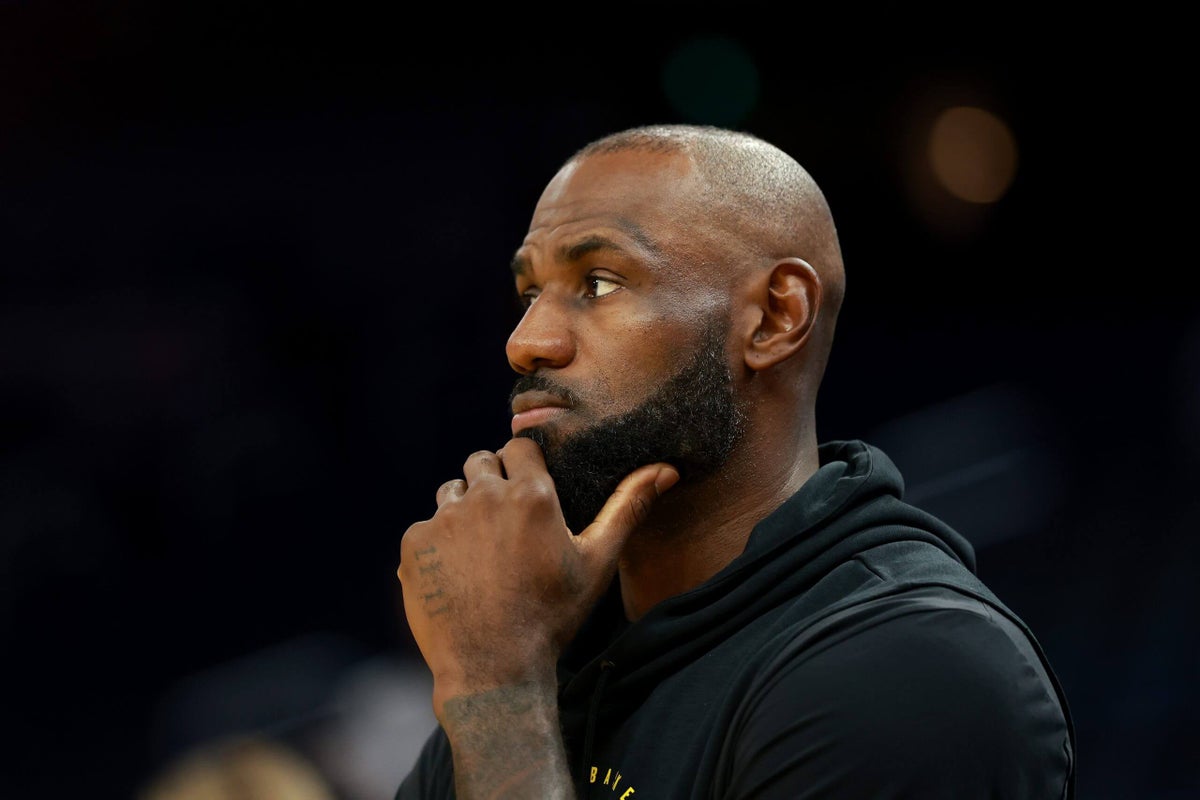
One unexpected element could impact LeBron James’ time with the Philadelphia 76ers: The wind.
Multiple reports have suggested that James, who agreed to sign with Philly last week, may not actually live in the city where he’ll play. Instead, James could reside in New York City and commute the 100 miles to Xfinity Mobile Arena in Philadelphia or to the Sixers’ practice facility in Camden, N.J., just across the Delaware River. To speed up the trip, he could do so via helicopter, those reports say, which would take approximately 45 minutes.
James has not publicly commented on his living arrangements. His plans have yet to be finalized, according to a league source who spoke on the condition of anonymity because he was not authorized to speak publicly.
James would not be the first NBA player to live in New York City while playing with the 76ers. JJ Redick commuted from Brooklyn, N.Y., when he played for the Sixers from 2017 to 2019. Decades ago, when Wilt Chamberlain was leading the league in scoring every season, the Hall of Famer lived in New York and even operated a popular Harlem nightclub, all while he played for Philadelphia.
But this setup is not common — for obvious reasons. And helicopter travel is highly regulated in New York City, in part because of noise ordinances and because of safety.
Why Philly will be LeBron’s hardest test
David Aldridge and Johnny Sweet
Here is what the four-time MVP’s travels could look like:
To chopper from New York to Philadelphia, a one-way trip that costs in the range of $4,000, one must leave from one of three heliports in Manhattan. One is downtown, another is on West 34th Street and a third is on West 30th Street.
New York has been conservative with allowing helipads on tops of buildings since 1977, when a helicopter tipped over while attempting to land on the MetLife building in Midtown Manhattan. Some remain, but they are not for commercial use; instead, they are allowed for hospitals or police. Though he has yet to change the city’s policies, New York mayor Zohran Mamdani campaigned on further restrictions for air travel, saying last April that “we must end non-essential helicopter flights immediately.”
Conditions must be ideal. Visibility is the most common reason for helicopter delays or cancellations. And remember, the environment around James matters here. LA Clippers wing Kawhi Leonard famously commuted from San Diego via helicopter, while Kobe Bryant choppered from his home in Orange County, Calif., to Los Angeles Lakers games. But that was in Southern California, where skies are clearer than they are in the Northeast. Fog is common in the New York-to-Philadelphia corridor, especially in the mornings.
Pilots generally require at least three miles of visibility, per FAA regulations. Clouds must be at least 1,000 feet above ground. If they’re too low, the chopper is grounded. If the wind is too extreme, it’s not going anywhere. Gusts and crosswinds affect helicopters more than a single consistent headwind does. Gusts above 40 miles per hour can make flying dicey.
And while those are not an everyday occurrence, they are common in the winter. Between October 2025 and April 2026, the approximate length of the NBA season, New York City experienced 11 days with gusts of 40-plus miles per hour, according to the National Weather Service’s Local Climatology Data. Philadelphia was more extreme during that time frame, totaling 33 days of 40-plus miles-per-hour gusts. James’ helicopter would not be able to take off in those moments, nor could it do so during thunderstorms, blizzards or if there is risk of icing on the rotor blades.
In those scenarios, considering James is a tad too famous to pop into Penn Station for a last-second Amtrak, he would have to take a car. Redick drove from his home in Brooklyn to Philadelphia, a trip down Interstate 95 that could squeeze in at less than two hours when there is no traffic. Alas, this is I-95, the main highway on the most densely populated corridor in the country.
Why LeBron James chose the Philadelphia 76ers
Joe Vardon and Jeshua Kidd
A typical game day for an NBA player starts long before tipoff. Teams hold shootarounds in the mornings, when they outline the plans for the upcoming game. James also arrives at the arena atypically early, part of a diligent pregame routine.
For the sake of argument, though the math certainly would not work out this cleanly, choppering to and from 41 home games at $4,000 a flight would rack up a $328,000 tab. That doesn’t include flying to practices but also doesn’t account for inevitable flight cancellations, overnight stays or whatever deals James could unlock as a frequent customer.
For James, who has made $584 million just from on-court earnings during a 24-year NBA career, the price tag is likely of little concern. And he could secure accommodations closer to Sixers’ headquarters for back-to-backs or emergencies.
But the logistics of his potential commute add an additional wrinkle to a season that will capture the attention of the entire NBA.
— The Athletic’s Tony Jones contributed to this story
>

West Ham United and Northern Ireland striker Callum Marshall has joined League One club Luton Town for an undisclosed fee.
Luton said the 21-year-old has agreed a “long-term” contract.
Marshall made three first-team appearances for West Ham after signing from Linfield in January 2022 and was part of the squad that won the FA Youth Cup in 2023.
He spent the 2024-25 season playing in League One for Huddersfield Town, scoring 10 goals during a loan spell, and ended last season in Germany on loan at Bochum.
Luton boss Jack Wilshere told the club website:, external “From the first moment I met Callum, I knew how hungry he was for success.
“Naturally, a lot of other clubs were in for him, so we’re pleased that he’s chosen us and that we’re a club that’s matching his ambition and vice-versa.”
Marshall said he felt the move is a “great next step for my career” and Luton is a club “heading in the right direction”.
>

Hearts are in transition under new management and a raft of new players in the post-Derek McInnes, Lawrence Shankland age. They’ll take time to settle.
Is there a different bolter out there? Motherwell, so easy on the eye last season, have had their guts ripped out in the summer and are also rebuilding, albeit playing with the same easy style as before.
Aberdeen? It would take a brave soul to support any claim for an Old Firm-challenging run, but in Stephen Robinson’s first full season, they should go a whole lot better than last term.
Hibernian have the potential to push hard for third, but consistency problems follow them around year upon year. Falkirk, the other top-six club, would see a repeat of last season as a fantastic outcome, which it would be.
The plaintive cry is that young Scottish footballers get a chance to play a part in all this, that clubs trust their youth for a change. It’s an appeal made this time every year and, for the most part, ignored.
We look to be back in the realms of a two-horse race and the two horses have experienced jockeys now, not two Old Firm apprentices like Russell Martin and Wilfried Nancy.
Hearts did so many outstanding things in taking the race to the wire, but both of those hapless characters helped them on their way. In Martin O’Neill and McInnes, the capacity for Celtic and Rangers slapstick, and that of an outsider causing them tremors, has been dramatically reduced.
The surreal cameos of Martin and Nancy and Hearts’ thrilling surge that reverberated around the UK, Europe and parts of the wider world were just a few of things that made last season unmatchable in terms of drama and genuine gobsmacking moments.
The fall of Brendan Rodgers, and Dermot Desmond’s startling evisceration of a celebrated manager, could only be rivalled if Celtic’s major shareholder suddenly takes a flamethrower to his relationship with O’Neill.
Desmond’s son, Ross, thought it a good idea to declare football war on the club’s own supporters at an annual meeting that was promptly cancelled. On the really dark side, Peter Lawwell, the titan of 20 years at Parkhead, left while citing intolerable abuse of a section of the support that lost the run of themselves.
O’Neill’s return was astonishing, his second return almost every bit as remarkable. Danny Rohl came and went at Rangers. Jimmy Thelin exited Aberdeen. St Mirren won a League Cup in thrilling circumstances and then almost got themselves relegated. Everybody fell in love with Jens Berthel Askou’s Motherwell. Praise was heaped on the quality of Falkirk’s football.
At the start of the season nobody foresaw much, if any, of this. What was more predictable then, as it is now, is the toxic nature of some of what goes around the biggest games.
As a club, Hearts have every right to remain livid at the crass goading of their players during the invasion that greeted Celtic’s title win – and the tokenistic sanction that followed it.
The Scottish FA’s independent review of the disgraceful scenes before, during and after the Old Firm Cup tie at Ibrox in March was thunderously critical of all parties – clubs, governing bodies, police.
Their recommendation, one of many, was that the SFA and Scottish Professional Football League start to get serious with stand closures and then stadium closures as a direct consequence of misbehaviour. Enough is enough was the mantra.
How long before the mettle of the governing bodies is tested? And how long before the independent report, in the face of resistance from the most powerful clubs in the land, is quietly forgotten about?
In the coming seasons, the narratives don’t just begin and end on the pitch. The off-pitch stuff is compelling, too.
The standards of refereeing will be under the microscope like never before after the contentious and title-defining calls came in a mad flurry at the end of last season. We want the drama and the storylines of much of the campaign just gone, but we could do without the poisonous way it all finished in the final week or two.
Controversial decisions, threats to officials, a noxious atmosphere culminating with Celtic fans squaring up to Hearts players – it was a pitiful end to what been a thrilling season.
>

Block The Merger Submits Paramount-Warner Evidence To Lisa Nandy

LeBron James commuting to Philly? Why a helicopter ride from New York is tricky

Callum Marshall: Luton Town sign West Ham United striker for undisclosed fee
-

 movies2 months ago
Search For Canadian TV Actor Stewart McLean Now Homicide Investigation
-

 Fashion9 years ago
These ’90s fashion trends are making a comeback in 2017
-
Fashion9 years ago
According to Dior Couture, this taboo fashion accessory is back
-
Fashion9 years ago
Model Jocelyn Chew’s Instagram is the best vacation you’ve ever had
-
Fashion9 years ago
Your comprehensive guide to this fall’s biggest trends
-
Fashion9 years ago
9 Celebrities who have spoken out about being photoshopped
-
Fashion9 years ago
Emily Ratajkowski channels back-to-school style
-
Fashion9 years ago
A photo diary of the nightlife scene from LA To Ibiza