
‘Forgotten Spaceman’
Courtesy of Foreigner Ltd.


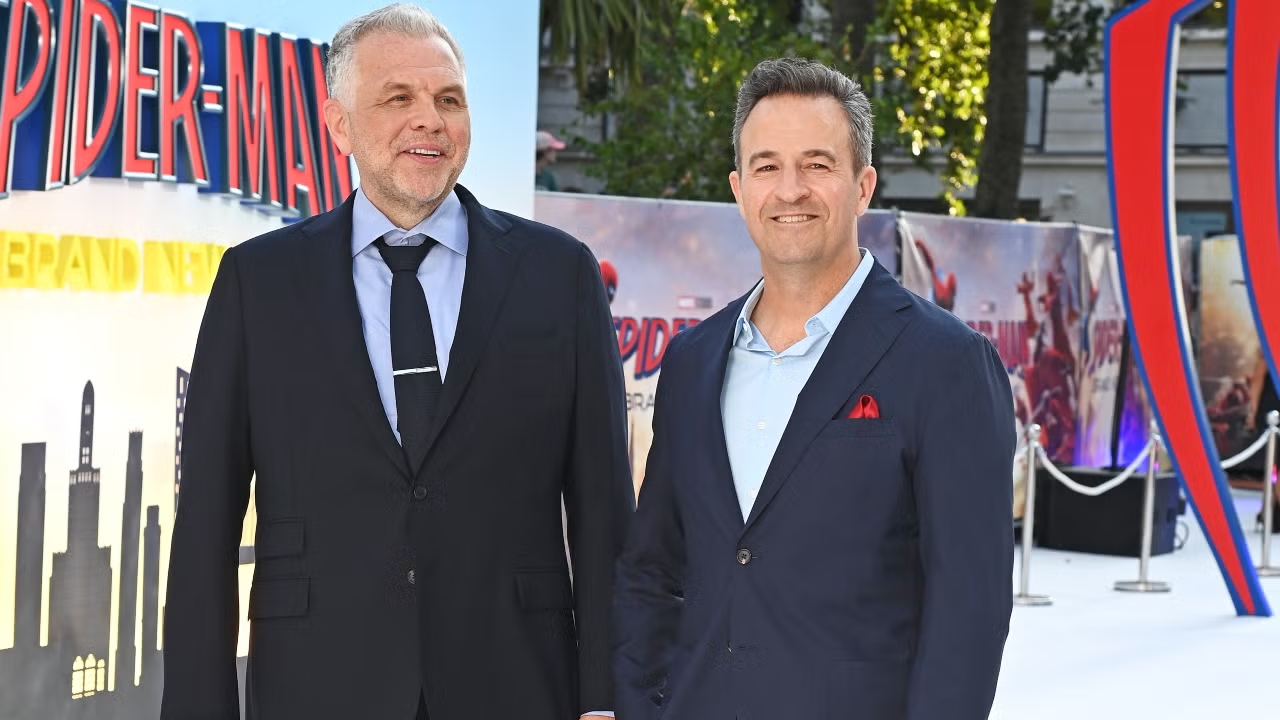
“Spider-Man: Brand New Day” has swung to the top of the box office since its release last week. The fourth Tom Holland-led mainline “Spider-Man” film, from Sony and Marvel Studios, broke the record for the biggest domestic box office run and has already surpassed the $1.5 billion mark at the global box office. And, again, the movie has only been out for a week.
The latest adventure sees Peter Parker (Holland) dealing with the fallout of making everyone forget who he was at the end of “Spider-Man: No Way Home,” along with a spider gene that seems to be getting stronger, giving him new and unexpected powers. Oh, and there’s a new villain who can take over people’s minds. Bruce Banner (Mark Ruffalo) is there, too, as is his alter ego, the Hulk. So is Frank Castle, also known as the Punisher (Jon Bernthal).
But how did this intoxicating stew come together? We asked “Spider-Man: Brand New Day” writers Chris McKenna and Erik Sommers all about their super-powered sequel. Major spoiler warning for the entire conversation, really. If you are one of the 10 people who hasn’t watched “Spider-Man: Brand New Day,” well, time to correct that. The interview will still be here when you get back.
“Spider-Man: Brand. New Day” marks a departure for your Friendly Neighborhood Spider-Man. Yes, there is an oversized force that he has to deal with but the emotional bedrock of the movie is much closer to the earthy “Spider-Man: Homecoming” than the later installments, which saw him battling space aliens and wearing a high-tech suit designed by Tony Stark.
This, McKenna and Sommers said, was always a part of the plan.
“I think it came from not only organically from where that [last] movie ended, where we were able to hand ourselves a real dilemma and a real new beginning for Peter, but I you know all of us and particularly Tom really wanted to explore a darker, more mature chapter. We were all on board,” said McKenna. “We felt what he had been through in the last movie with essentially his metaphorical death, the death of Peter Parker essentially – what would that look like? And as much as it was like, Oh, we get to go back to basics, we knew that there would be a huge emotional toll that would go with giving up your past, giving up your life, giving up all of your loved ones. We knew we knew we’d be able to explore some deeper, more personal elements of his journey.”
Sommers added: “On a practical level too, I think everybody felt like, Well, are we going to try to go bigger than that last minute? What would that even be like? Six Spider-Mans? Like what? I think everyone agreed that just trying to go even bigger was not the way to go, and then that just led right into everything Chris was just talking about. There was no question that doing something deeper was the answer.”
And deeper they went.

Another notable difference in “Spider-Man: Brand New Day” is that, for the first time in the Holland timeline, Peter Parker is free of an older mentor figure. In “Homecoming,” Tony Stark (Robert Downey Jr.) kept a watchful eye on Peter; “Far From Home” saw him guided by superspy (or was it a Skrull in disguise?) Nick Fury (Samuel L. Jackson); and “No Way Home” saw him butting heads with Sorcerer Supreme Doctor Strange (Benedict Cumberbatch).
This was also at the top of Sommers and McKenna’s to-do list.
“We’ve seen that he’s going to these mentors. He’s a younger character. He has people he looks up to and sometimes it goes well. Sometimes it doesn’t. But let’s not do that anymore. We want to tell a story about him growing up,” said Sommers. “Part of growing up is that he needs to start addressing things on his own. He needs to start coming up with answers on his own and not looking to others and it would be fun to see him interact with people as more of an equal and an adult. His relationship with Punisher, even his relationship with [Damage Control member] Metzger or his relationship with Jean DeWolff, these are more mature relationships – as a coworker, as a colleague, as a fellow adult, as opposed to he’s that kid coming to ask the older person for counsel or guidance.”
As for why they chose to have Bruce Banner in “Brand New Day,” McKenna said that they knew, when they gave Peter a “spider-problem,” he would need to ask for some help and that Banner would be “perfect for that story, that he would go to learn about that would be Bruce Banner.” The character also paid off doubly so – with a heavy that can inhabit people’s minds, imagine how destructive it would be if she could occupy the mind of the Hulk.
“Hulk would be a great legacy character for our villain to be able to mind control and then we can get a great Spider-Man-versus-Hulk fight. So that was one of those things that lined up in a way, and we were really, really happy and lucky that Marvel allowed us to use Hulk in the movie because I think he just worked in so many ways,” said McKenna. “That was that was a case of things could not have things lined up more perfectly, and there was a lot of gratitude that we were able to use Bruce Banner and Hulk.”

Of course, that dastardly villain occupying peoples’ minds is, of course, revealed to be Jean Grey. This is a young Jean Grey, not yet a part of any super-team and before she met all of her iconic buddies at Xavier’s School for Gifted Youngsters (yes, that is really what it’s called). This is her grappling with her powers and forming new abilities; by the end of the movie she is fully equipped to become one of the MCU’s premiere bad-asses but is still an awkward kid, on a bus seemingly to a location upstate – a school, perhaps?
But it wasn’t always like this.
McKenna and Sommers said that there were a couple of alternate villains developed and then discarded, before they fully committed to Jean Grey and, in effect, jump-starting the X-Men era for the MCU.
“We had mind control and we had this story about Peter’s metamorphosis that we loved. We had mind control that was working well but we didn’t have the right character for that story,” McKenna said.
McKenna said that he had just landed in Boston for a family wedding and got a call from one of the producers, who told him that the writers could actually use Jean Grey.
“I just remember going, Oh, thank God! Now we can now we can tell a story that with a really great character that can mirror Peter’s in a really great way and we can get to a place. Because obviously she’s such an important character in the MCU. We will have even more leeway to humanize this character and redeem her by the end,” McKenna said. “And it seemed everything started lining up once we had Jean, and it was really exciting. It was the breakthrough moment.”
Unlike earlier “Spider-Man” movies, dating back to the Sam Raimi films starring Tobey Maguire, “Spider-Man: Brand New Day” features Spider-Man facing off against a villain who is not a traditional Spider-Man villain. Instead, McKenna said, it was a Marvel villain, further placing the story within the larger Marvel Cinematic Universe.
“We really needed the right character playing that role,” said McKenna.
When we asked how long they toiled over the villain, waiting to get the green light for Jean Grey, the writers said months.
“We were exploring other characters and it just wasn’t … It was Jean really helped unlock it. She was the missing piece. It was the piece that the movie was dying for,” McKenna explained. “Once we got her, then everything started unlocking.”

In an earlier version of the movie, Claire Temple, aka the Night Nurse (played by Rosario Dawson in the “Daredevil” series), showed up for a brief scene. While there have been rumors that her scene would have been toward the end of the movie, when Peter Parker wakes up in the hospital, that scene now involves the Punisher and is one of the funniest, most affecting scenes.
McKenna and Sommers said that it was actually an earlier scene in the movie where the Night Nurse and Spider-Man would have interacted. It followed Spider-Man’s fight with Scorpion. Spider-Man goes to the hospital and has a scene with the Night Nurse.
“Rosario Dawson is great. I wasn’t there for those discussions. But it was great. If anything, you have a movie that is two-and-a-half hours long, and it’s almost an embarrassment of riches with so many great characters and so many great scenes,” said McKenna.
“The scene they did was a good scene I think the only reason it’s not in the final cut was just it was probably cut for time because it was very good,” added Sommers.
The scene would have been right before Peter goes to see Bruce at the college and McKenna said “it’s kind of a double beat.”
In the words of the great Christopher McQuarrie – it could go, so it went.

Unlike Jean Grey, who was a late addition, and Night Nurse didn’t make the final cut, Yelena (Florence Pugh) aka the new Black Widow, was always a part of “Spider-Man: Brand New Day.”
“We were talking about Yelena and then the idea that she’s in the banya and that he has to get in. He won’t take his mask off. It was one of those things that made us all laugh, and then the next thing you know, it’s happening,” said Sommers.
“It existed in every draft. We have to have to have the sequence. We just knew. We felt like it’s always better to him on his heels. Tom playing Spider-Man on his heels is just the dream. And her putting him on his heels just felt like, Oh we gotta have this in the movie, even though we knew we could only have her probably for a little bit because of the Avengers timeline and everything,” said McKenna. (It’s his wife’s favorite scene in the movie.)
The scene is also a little sexy; Yelena is submerged underwater but clearly nude and Peter is in a towel (and his mask). Sommers said that the scene’s sexual underpinnings were discussed. But it felt right for the movie because this isn’t Peter in high school – this is Peter as a young adult.
“That came up. It’s like, Can we? Should we? And then it was the same thing – it’s like, Well, he’s a big boy now,” said Sommers.
The post-credits scene for “Spider-Man: Brand New Day” features the Spider-Man tracking app that Ned developed picking up a new ping – it’s Spider-Man but he seems to be … off-world. It’s unclear what this exactly means. Is it teeing up “Avengers: Doomsday” or “Secret Wars?” The next Spider-Man adventure? Who knows!
One thing’s for sure – McKenna and Sommers aren’t telling us what it means.
“It’s fun. It’s a little tease of something to come. Or maybe not. I don’t know,” said McKenna.
McKenna and Sommers said that they have written dozens of tags, across their Marvel Studios movies, that never saw the light of day.
“At some point I wrote something involving Spider-Man the TVA and this was a while ago,” said Sommers. Yes, this was before the Time Variance Authority emerged in “Loki,” its second season and, eventually, “Deadpool & Wolverine.”
Sommers continued: “We’ve written a whole bunch of things. You’re like, Oh, that would be so cool, and then ultimately decide, Well, we’d rather point towards this or drop a clue about that.”
They both love that the conversation about the post-credits scene is ongoing and encourage active discussion around it. Not that they’re going to elaborate any further on it.
“It’s purposely vague,” said McKenna.
“Spider-Man: Brand New Day” is in theaters now.

>

In 1988, Afghanistan sent its first cosmonaut into space. Yes, really. Abdul Ahad Momand went where no Afghan had gone before — or has gone since — making Pashto the fourth language ever spoken beyond Earth. So why does barely anyone remember his name, his journey, or the hope it sparked among fellow Afghans at the time?
Part of the answer may lie in timing: just as the spaceflight took place, Afghanistan was on the brink of civil war, a conflict that would soon force millions of its people into exile. As a new film argues, the country’s story has been shaped by conflict, exile and diaspora ever since, with science, culture and ideas pushed to the margins.
Elham Ehsas (There Will Come Soft Rains, Yellow, Our Kind of Love), a London-based Afghan filmmaker and actor, is working to change that narrative and spotlight a piece of history too often left out of it. His short film Forgotten Spaceman — which blends documentary and essay elements while uncovering a surprising link between Afghanistan’s space history and his own family’s past — will world premiere on Aug. 9 in the Pardi di Domani – Concorso Internazionale program of the 79th edition of the Locarno Film Festival.
Ehsas wrote, directed and edited Forgotten Spaceman, which is executive produced by Catherine Tschaepe and Jack Thomas-O’Brien of Ken Loach’s Sixteen Films, which backed the film. World sales and festivals are being handled by María Vera of Kino Rebelde.
Beyond the story of Afghanistan’s spaceman and Ehsas’s own family history, the short also examines “shadows of colonialism and the memory of a fractured and silenced nation,” per its synopsis. Ehsas spoke with THR about his surprise at discovering Momand’s story, how Forgotten Spaceman came together, and what he hopes audiences take away from it.
Can you share a little bit about the journey behind Forgotten Spaceman?
I feel this film was almost a coming of age for me in terms of getting to know my own past and my country’s past. I was researching a short fiction film that I was trying to make around space. And then I came across Abdul Ahad Momand, and I was like, “Who is this guy? How is it possible that we have an Afghan cosmonaut who went to space?” He put Afghanistan on the map in 1988. When he called his mom, Pashto became the fourth language ever spoken in space. It’s Russian, English, Mandarin and Pashto. And it just blew my mind.
So I went to my parents and spoke to my mom and dad, and I was like: “How did you guys not tell me about him?” And it’s interesting because I’ve spoken to a lot of my cousins and family members my age and asked, “Do you guys know we have a spaceman?” And they were all [reacting the same way]: “What? Come again?” So, almost at every turn, this was a teaching opportunity for my own cousins and friends as well. It was such a discovery.
And I also learned a lot. Through this experience of listening, I learned about making a documentary because it’s my first documentary. I learned to just relinquish control and go where this story is taking me. Sometimes, letting go is one of the best things you can do.
‘Forgotten Spaceman’
Courtesy of Foreigner Ltd.
The film starts out as a story about the Afghan spaceman, but then it also connects to your family story, and then you zoom out to show us a universal story. Did you know from the start that Forgotten Spaceman would also touch on these bigger themes?
This whole film was a complete accident. I was trying to make this fiction film about space and then found Momand. And then I realized that he’s a refugee out in Europe somewhere, so then my idea was that I’d make a documentary about me looking for him. I put in about four, five months of work, shooting different footage around London. When I found out that he’s in Stuttgart in Germany, I thought I’ll go to Germany and speak to him.
And then several months into this whole process, my dad gave me a picture. “Oh yeah, I have this photo of Momand.” That completely blew the whole thing open for me. It was insane. I can’t believe we have this photo, and I can’t believe that this photo speaks so much of my own family and of my own relationship with Momand and space, but also all of us and our relationship to home, to our country, to Afghanistan.
Do you want to talk more about the photo and what it shows, or is that too much of a spoiler? And what did you do?
I pivoted because I felt something was happening here. I am being guided by this film, and this film wants to be something else. Because I come from a narrative background, I’m used to scripting, casting, shooting, crafting, and engineering this whole narrative. But here is a true story that kept evolving, and it kept changing, and I felt the best thing here was to surrender to what’s happening. Maybe the story isn’t about me looking for Momand. Maybe the story is about this photo. And what if I can build something around this one photograph? No spoilers, but for people who see it, they’ll realize why this picture is so important, and that gave me the architecture for the rest of the film.
Parts of the film felt a bit like a detective movie to me. And it also felt like a journey of discovery where another layer is uncovered. We see some family footage but also official, I assume, TV footage from Afghanistan about the space trip. Where did you find all this footage?
It’s so interesting that you speak about the detective element. I almost felt like a detective trying to find this footage, these different pieces of archive. It’s really hard to find pre-Soviet era archive footage around Afghanistan, especially around such a niche as the space program.
‘Forgotten Spaceman’
Courtesy pf Foreigner Ltd.
I reached out to a bunch of official, independent archive houses, [Russian Space Agency] Roscosmos, as well as the Afghanistan archive in Kabul. Because my dad is a journalist, he still has his network in Afghanistan. So I was speaking to a bunch of really interesting people, and through that, we found all of this beautiful footage. But I wanted the texture of the footage to not just be about his flight, but also about the rest of Afghanistan, about the history of his country. So that meant I had to dig deeper into the Soviet invasion from ‘79 to ‘89. At one point, I licensed about six hours of random footage that I didn’t know what it was. I just knew it was coming from Afghanistan and from that part of history. An archive house said, “Look, the deal is we’ll give you this for an affordable price, but we don’t know what’s in it, so you have to just take a blind shot.” So I had all of this footage, and it really helped me get the whole thing together. So, yes, the whole thing is a discovery.
You have big-name executive producers on the film, such as Ken Loach’s Sixteen Films…
I’m incredibly lucky for this project to attract such incredible collaborators, including someone like Ken Loach and Sixteen Films. They are renowned for telling stories that aren’t often told, telling human stories from different times and from different social and historical backgrounds. One of the executive producers is Sixteen’s Jack Thomas-O’Brien, who worked on this amazing film On Falling [by Laura Carreira]. So I have had a bunch of collaborators that I was sending the film to and getting their thoughts. The story started in my bedroom, and it just started getting bigger and bigger with all of these collaborators. It’s all about the magic of the moment [of the Afghan space trip], but also space and what it tells us about home and ourselves. I’m very lucky for the film to have resonated with incredible collaborators who have come on board and championed us and supported us. It’s just an incredible privilege and honor.
You mentioned how Forgotten Spaceman goes into what space tells us about Afghanistan and, actually, also the exile experience. Can you talk about that a little bit?
When I started this film, I thought I was making a film about this really super cool guy called Momand, who was an Afghan spaceman. But as the film was evolving in front of my eyes, I realized that there’s this family connection, so it’s also about me and my family. But then you keep going, and you keep discovering, digging deeper and deeper, excavating. And then I realized that actually this film isn’t just about Momand, me and my family. It’s about all of us and all of those people who have left home and moved. It’s about migration, it’s about refugeeship, it’s about the loss of home and the things we leave behind.
‘Forgotten Spaceman’ director Elham Ehsas
Courtesy of Locarno Film Festival
Here is Momand, an astronaut who went up to space, took the Quran with him and spoke Pashto up there. And then he came plummeting back down, went into exile, lived in Germany and became an accountant. So, it’s also about what a country loses when its children go into exile.
That also speaks to memory, history and this divide between the East and the West. The East has these incredible stories, this incredible history, but this fragile memory, while the West has a short memory. As an Afghan filmmaker, I thought it was almost my duty to bring this story to life. I need more people to learn about Momand, and I need more people to know that he was Afghan. We’re not just bullets and blood and violence. We’re more than that. The West has chosen to only show Afghanistan in a specific light, which speaks to a bias. My colleagues from the diaspora and I feel it’s our duty to tell these stories in different ways.
The film mentions that Afghans’ and Afghanistan’s stories usually get told through violence, conflict and war…
Yes, for most of my lifetime, Afghanistan has been defined in the world’s imagination by conflict, headlines of war, statistics of death. But that’s not the country that my parents grew up in, or my grandparents. And it’s not the whole story of the place. Afghanistan is a country of poets and scientists and filmmakers and history and art and music, as I’ve shown in the film as well. And it’s a country that sent a man into space in 1988. When you start pulling on that thread, you find the whole landscape of achievement and imagination that has been buried and the tragedy of the lost potential of those people who had no choice but to move.
Is that also why Forgotten Spaceman features Afghan music?
I was faced with this incredible, epic tale of this man, and then through that tale, I zoom out and talk about our country and migration and refugees. But how do I tell that story, especially in a short documentary, in the most succinct way? I love music, especially Afghan music. I grew up on it, especially old folk songs. So, I thought, what if I engineer the film like a music album? What if it’s built around three different songs for the three different acts of the story? And that’s where the inspiration for that came. I went down this deep rabbit hole of old Afghan music that I grew up listening to, but also discovering new songs and remembering which songs my mum or dad used to listen to when I was a kid. I found these three beautiful, beautiful songs, and the fourth one in the credits by an incredible artist called Zarsanga.
‘Forgotten Spaceman’
Courtesy of Foreigner Ltd.
Does the film’s original title Hershewe Fazanawerd mean exactly the same as the English title – Forgotten Spaceman?
It literally translates to the man who went to space, or the spaceman. But Afghanistan has two national languages: Pashto and Dari. I was mindful that my previous films had dialogue in Dari, and I never included Pashto, which is actually my mother tongue, and it’s the language that Momand spoke in space. So, I decided to do the voiceover in Pashto, almost as an ode to my mother tongue and to Momand.
I heard that you are working on your first feature as a writer and director?
Yes, it’s a feature film called Our Kind of Love, and it’s based on my first-ever short film. We’ve been working hard on developing it with the BFI, and we’re just coming out of the script stage. Making films is so hard, and telling stories is so hard. I think there is value in putting a lot of time into trying to get it right, especially when you want to speak about a specific theme.
Our Kind of Love ultimately is about the East and the West meeting. The short film was about an Afghan woman who was on a first date with an Afghan man who was born here [in the U.K.], and she was born in Kabul. It’s about how, if you put the East and the West together in a room, they interact. I’m a first-generation refugee. I came from Afghanistan to this country, and so I juggle two identities, and I juggle two cultures and countries. That’s what really always informs my work.
‘Forgotten Spaceman’
Courtesy of Foreigner Ltd.
What’s next for Forgotten Spaceman?
We’re really excited that the film will premiere at the Locarno Film Festival, and then it is going to Toronto. I’ll be so curious being there for the first screening at Locarno to look at the audience and their reactions. It will be such a privilege for me to see them experience it. The film is how the legacy of Momand survives, and the legacy of these refugees who have done great things.
Do you ever think that Forgotten Spaceman could be expanded into a feature-length film?
Well, it’s such an epic story, and it’s such a beautiful story that speaks to so much. So, I’d be very curious to see and discover how it would look as a feature film.
Is there anything else you’d like to highlight or mention?
I want to also speak about my collaborators, the people I worked with on this film, and especially the music. My co-producer is Lorraine Bhattachary, and our composer CJ Mirra. Our sound designers are Rob Szeliga and John Cohen, who did such an incredible job because a lot of the film lives and dies in the sound. A lot of these experiences are so sonic, especially in space, and we wanted it to be something grand and beautiful. They all smashed it, and that’s what this film, and film in general, is about — collaboration.
>

Amanda Knox hit back at a petition calling for the cancellation of her Edinburgh Fringe show, defending the critics had made “many false assumptions” about her work.
The media personality, who infamously spent almost four years in an Italian prison after the 2007 murder of roommate Meredith Kercher, addressed the growing controversy surrounding her appearance at the annual arts festival in Scotland.
“There is a petition to cancel my show at Edinburgh Festival Fringe. Here is my statement,” she wrote as the petition in-question exceeded 10,000 signatures. “‘Cartwheel’ is a show about motherhood, raising a daughter in a world that is unfair and dangerous for women, and what it costs to be the kind of mother who tells her the truth about that.”
She continued: “Neither the author of this petition nor anyone who signed it has seen ‘Cartwheel.’ The petition contains many false assumptions and completely mischaracterizes the show.”

The Change.org petition, launched by a former coworker of Kercher’s, named Sally Alington, has accused Knox’s “Cartwheel” of “disrespect[ing] Meredith’s memory,” as well as “normalizing violence against women by making light of such a harrowing event.”
However, Knox defended that her show did the exact opposite, writing, “‘Cartwheel’ honors Meredith Kercher’s memory and calls out the violence that was done to her and to me.”
“A petition to cancel a show no one has seen, on the grounds of false accusations intended to shame and vilify a wronged woman into silence, is not an argument against ‘Cartwheel,’” Knox continued. “It’s a fairly precise description of what ‘Cartwheel’ is about and why it deserves to exist. And the Edinburgh Fringe is the perfect place for a show like this.”
As Knox went on, she described the arts festival as a place where the “most celebrated comedy shows tackle difficult subjects including grief, trauma, mental health, addiction, illness, identity and politics.”
“Comics rarely treat these experiences lightly or make them the butt of the joke,” she concluded. “Instead, they use comedy as a way to explore them, creating space for audiences to engage with complex ideas, connect through shared experience, and find moments of relief, perspective and hope in subjects that might otherwise feel overwhelming.”
Knox was convicted of Kercher’s murder in 2009 and sentenced to 26 years in prison, but the conviction was overturned in 2011 before she was fully acquitted in 2015. After her release, Knox transformed into a media personality, writing books, hosting a podcast and producing television series.

>


On Friday nights, IndieWire After Dark honors fringe cinema in the streaming age with midnight movies from any moment in film history.
First, the BAIT: a weird genre pick, and why we’re exploring its specific niche right now. Then, the BITE: a spoiler-filled answer to the all-important question, “Is this old cult film actually worth recommending?”
Note: This is part two of IndieWire After Dark‘s three-part animated “Lord of the Rings” series! Have you watched 1977’s “The Hobbit” yet?
A fascinating case study for the perils of skipping straight to the good part, 1980’s Rankin/Bass musical/fantasy/animated psychedelia TV movie “The Return of the King” doesn’t even cover the whole of the final book in J.R.R. Tolkien’s “The Lord of the Rings” series. Those who’ve seen the Peter Jackson films will recognize the Battle of Pelennor Fields and Frodo and Sam’s long march to Mount Doom on offer here. Plus, signature some Rankin/Bass folk interludes that have a lot less clarity (or indeed coherence) than the ones in their 1977 telling of “The Hobbit.”


If ever there’s been a “LOTR” adaptation to be held lightly — split into eighths like a pot brownie and nibbled on rather than devoured — it is this one. Which is not to say “Return of the King” doesn’t have its charms. The animation style by Studio Ghibli forerunner Topcraft is a fascinating melange of medievalisms and Art Nouveau: an almost storybook way of rendering this world that can’t help but feel rare and beautiful in this, our collapsing Age of “live-action” remakes and Minions spin-offs. But the double-edged sword of Jackson’s films’ staying power is that the aesthetic of them has so imprinted onto “serious” epics and high fantasy stories, from “Game of Thrones” to “The Odyssey,” that it’s easy to forget other interpretations of Mordor are possible.
“The Return of the King” is very much another interpretation, and as a means of keeping After Dark’s revisitation of the IP’s animated era ongoing? It’s worth preserving for its potential.
As with “The Hobbit,” the Rankin/Bass monsters are much less humanoid and more wrinkly wee beasties — both to their benefit and to ours. The one true bop among the musical interludes absolutely has to be the all-orc banger, “Where’s there’s a whip, there’s a way.” And a lot of the sound effects and voice filtering, especially for the Lord of the Nazgul (John Stephenson), are more sci-fi than fantasy coded, which has a fascinating effect. There’s a rendering of Sauron’s Eye here that’s unhinged and almost unmoored from reality in the best way imaginable. In that sense, it’s energizing to see a fantasy story be this openly fantastical.
Unfortunately, “The Return of the King” is also spectacularly uninterested in coherent exposition, tying itself into a plate of pretzel knots just to set the stage. It starts with Bilbo and Frodo Baggins (both Orson Bean, reporting again for duty after voicing Bilbo in “The Hobbit”) along with their friend Gandalf the wizard (John Huston; yes, that John Huston), and Frodo’s faithful servant Samwise (Roddy McDowell; yes, that Roddy McDowell) sitting around in Rivendell telling old, forgetful Bilbo about their adventures getting rid of his old ring. But also there’s a balladeer who starts singing about the quest of the Fellowship of the Ring? And also there’s a voiceover?
There’s a lot going on — clearly too much to pronounce any of Tolkien’s placenames correctly, so just let go of that now, nerds, lest ye despair. No doubt Romeo Muller had legitimate concerns about losing people over the ABC commercial breaks. But man, the first like 20 minutes of this movie are rough going… although, probably not as rough going as poor Sam’s attempt to break into Cirith Ungol, where Frodo has been taken captive when our tale within a tale begins.
If I did not know the books well enough to catch when characters are just straight up quoting them verbatim, then I am not sure what I would make of, say, the way that this movie chooses to handle the madness the One Ring can induce — or the introduction of Denethor (William Conrad) only to have him order his own fiery death (but offscreen) like… five minutes later. I’m not sure I’d feel much for King Theoden (Don Messick), who just kinda rides in on a horse only to be bucked off it and die. Meanwhile, Aragorn (Theodore Bikel) is kinda big and buff and beardy, and that’s it.
But for worse and, at times, even for better, the main legacy of “The Return of the King” is its incompleteness. It’s often mistaken for the sequel to the 1978 Ralph Bakshi “The Lord of the Rings,” which adapts the first two parts of Tolkien’s epic, “The Fellowship of the Ring” and “The Two Towers.” Bakshi and Rankin/Bass developed the projects separately, of course. Bakshi’s vision is different, and we’ll be exploring that movie next week. But once Warner Brothers had the rights to both, it started packaging both films and “The Hobbit” as a trilogy of sorts. Still, “The Return of the King” feels like its own discrete thing. And it does so, perhaps, in spite of itself.
Given the working title here was once “Frodo, The Hobbit II,” the Rankin/Bass team clearly wanted to double down on what had already worked for them. But the 1980 special is also darker, more bittersweet, and less fully formed — seemingly stuck in an eternal search for an origin, for a counterpart, for ground on which to build. Even then, it’s always satisfying to see the Dark Tower crumble, however unstable its base. —Sarah Shachat
When Sarah and I watched 1977’s “The Hobbit” a few weeks back, I vowed the first Rankin/Bass affair would not be my last. Still, catapulting into a time jump that had the audacity to hand-wave a huge part of Tolkien’s plot — and make me envision America’s sweetheart Elijah Wood with a mere nine fingers? That was harrowing. Even so, I pressed on.
It’s funny. Having grown up in the 2000s, you’d think the actual story of “The Lord of the Rings” would have seeped into my life more than it has. But before now, my understanding of the live-action films was almost entirely rooted in the fame of their director, his millennial cast, and eventually the cultural event that was Martin Freeman’s portrayal of Bilbo Baggins.
By all accounts, if I had experienced this story through the evolution New Line intended, then I would have met Frodo before Bilbo. That chronology worked explosively well for those who saw Jackson’s rendition unfold at the box office. And yet, for me, I question whether the repertory journey would have been half as compelling if I’d encountered the characters in that order.
I’ll admit, it doesn’t seem like Frodo has put his best foot forward here, and as a diehard fan of “Come to Daddy,” “Eternal Sunshine of the Spotless Mind,” and “Sin City,” I’m confident Wood will get a lot farther impressing me in Jackson’s movies. But approaching the hero’s journey from opposite angles, Frodo and Bilbo seem written to connect with two fundamentally different types of people. While the Frodos among us are defined by the burdens we agree to carry, the Bilbos must first be convinced there’s something worth leaving home to find.
Perhaps, I was once a Frodo. But these days, I’m a Bilbo, through and through. And somewhat paradoxically identifying more with the character I’ve also seen at the older, prequel hero reinvigorated parts of me that I wish had been just a bit more hopeful when I was younger.
For years, I’ve suspected my life would be fundamentally better if I had been a teenager in the ’80s. (I find the golden era of slashers particularly appealing.) And thanks to Rankin/Bass, I finally got a taste of that experience. Sitting helplessly before an epic fantasy already in progress — desperately trying to determine which of several interchangeable little men was now carrying the weight of the world and why — I got to properly stumble into a narrative for the first time in many years.
That might sound like I watched “The Return of the King” incorrectly, but because of our good pal Sarah, you and I both know I didn’t. Jumping directly from Bilbo’s first adventure to the final movement of Frodo’s quest is how many audiences go to experience this story originally. Plenty of viewers, particularly children, watched Bilbo return from the Lonely Mountain in 1977. Then, they tuned in three years later, and discovered that his funny little invisibility ring had nearly brought about the apocalypse… and cost some guy they’d never met his finger.
Effectively going “out” the “in,” the 1980 follow-up film seems like an objectively misguided approach to the structure Tolkien’s story. But it’s also strangely freeing.
By meeting Bilbo first, your curiosity about this storytelling universe gets teased out gradually. And in turn, your emotional connection to its most potent themes gets stronger as you head deeper into the darkness — reminded that every step you’ve taken was done so with curatorial courage and purpose, ring or no ring. Sure, “Return of the King” is the lesser of the two Rankin/Bass movies. But enjoying it anyway made me want to explore Tolkien more, not less. That’s a testament to his literary prowess and a reminder that he did write the books this way.
Watching the Academy Award-winning aughts movies has felt like a daunting task for me until now, partly because Jackson’s work is so legendary that it has felt shameful to not have seen it up to this point. After 1980’s “The Return of the King,” I know a lot more than I once did. Yes, Frodo loses a finger. Gollum and the Ring also fall into Mount Doom, while Sauron is defeated, Aragorn goes on to rule, and Éowyn, disguised as a male warrior, kills the Witch-king of Angmar. (Someone please tell me that’s Cate Blachett’s character. Please!)
But exiting Middle-earth beside cartoon Frodo, there’s a sense that this 98-minute musical adaptation is truly just the beginning. Arriving between “Lord of the Rings” eras, 1992’s “Cool World” is the sleazy masterpiece — about a horny pinup drawing and the cop who wants to arrest her for having sex with a human (uh, sure!) — that introduced me to Ralph Bakshi. It’s also the deep-cute genre recommendation that started this column in the summer of 2023.
Next week, we’ll see how his sensibilities do filling in some of the gaps Rankin/Bass left behind. No matter what, it probably won’t beat the joy I got reading this line from the 1980 version’s Wikipedia page: “Both critics and fans gave ‘The Return of the King’ an indifferent reception.” Accurate? Who knows. But it is incredible. And not all those who shrug are lost. —Alison Foreman
Read more installments of After Dark, IndieWire’s midnight movie club:
>


Search For Canadian TV Actor Stewart McLean Now Homicide Investigation


These ’90s fashion trends are making a comeback in 2017
According to Dior Couture, this taboo fashion accessory is back
Model Jocelyn Chew’s Instagram is the best vacation you’ve ever had
Your comprehensive guide to this fall’s biggest trends
9 Celebrities who have spoken out about being photoshopped
Emily Ratajkowski channels back-to-school style
A photo diary of the nightlife scene from LA To Ibiza