
Sports
Submit a question for Stewart Mandel's College Football Mailbag


Sports
Yaroslava Mahuchikh on making history while her country is at war: ‘I want to win gold for my people’
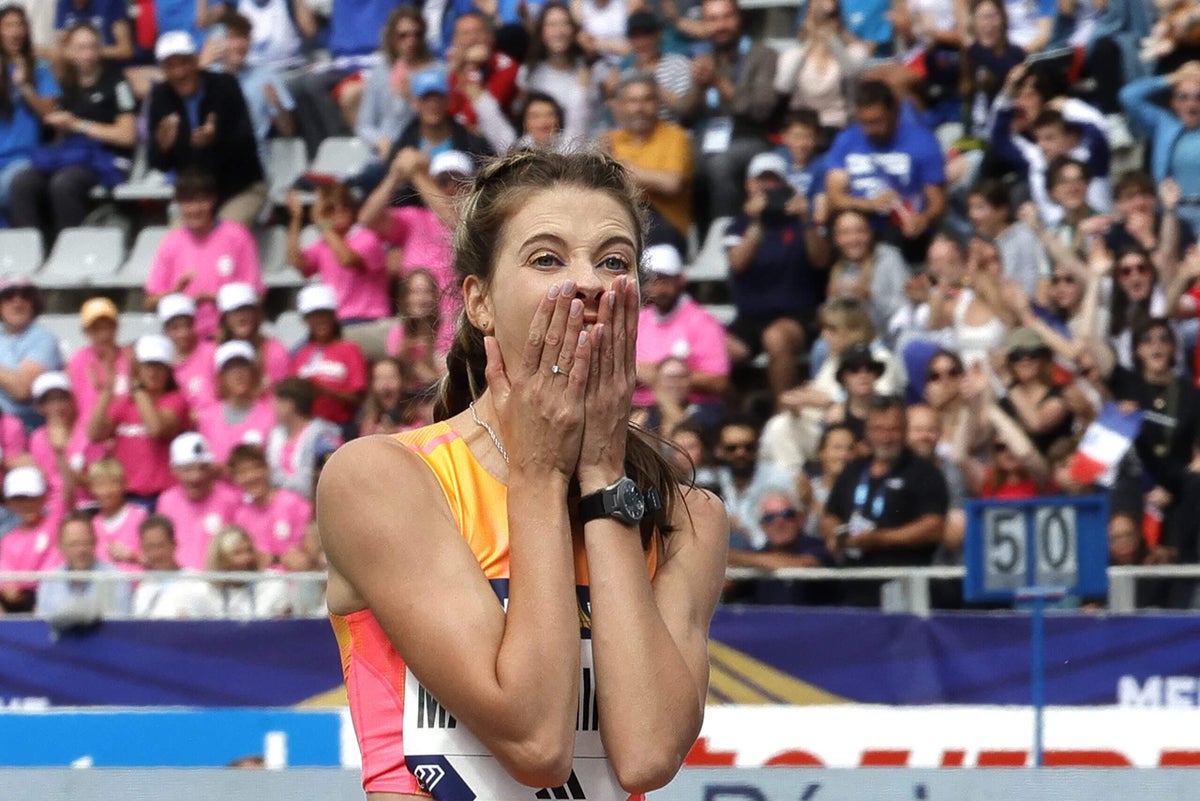
When Yaroslava Mahuchikh competes, she does so with added weight on her shoulders.
“I want to win gold for my people,” the high jumper says. “A lot of soldiers watch or read the news and they write to me: ‘Thanks for representing Ukraine.’ Because of them I have the opportunity to represent my country and (keep) our country alive.”
Born in Dnipro, eastern Ukraine, in September 2001, the majority of Mahuchikh’s professional track and field career has been intertwined with the Russia-Ukraine War, the biggest ground war in Europe since World War II. Russia first attacked in 2014, but the war then escalated four years ago when Russia started a full-scale invasion on its neighbor, attacking the Ukrainian capital Kyiv and the city of Kharkiv in February 2022.
A month after that February invasion, Mahuchikh competed at the World Indoor Championships in Belgrade, Serbia, and won her first global title with a 2.02 meters clearance. Having been a teen sensation — she won silver at the 2019 World Championships with an under-20 world-record jump of 2.04m, and took bronze at the 2021 Olympics — this gold took the then-20-year-old to new heights.
Three more global titles have followed, including Olympic gold in 2024. She’s the youngest ‘grand slam’ high jumper by six years — holding the Olympic, world championship and European crowns indoors and outdoors by the time she was 22. Only two other athletes — Mariya Lasitskene (28) and Stefka Kostadinova (31) — have achieved that feat.
She’s a five-time European champion (three times indoors) and, at the upcoming edition in Birmingham, England, which starts today, Mahuchikh has the chance to emulate Spaniard Ruth Beitia as a three-time continental gold-medal winner. The championship record of 2.03m should be under threat, too.
“I’m going there to protect my title,” she grins over a video call.

Yaroslava Mahuchikh celebrates winning the women’s high jump at the World Athletics Indoor Championships in Poland in March. (Kirill Kudryavtsev / AFP via Getty Images)
Russian athletes will not be in Birmingham. They are still excluded by governing body World Athletics, a stance which “hasn’t altered,” according to president Sebastian Coe last month. But the International Olympic Committee (IOC) has provisionally lifted its suspension of the Russian Olympic Committee, opening the door for their participation under the Russian flag at the 2028 Los Angeles Games.
“When I saw this news, I was pretty shocked because nothing has changed in our world since 2022,” Mahuchikh says.
“For us Ukrainians, it was really tough. I’m really thankful to Coe because he supports Ukrainian athletes and he has a strict position.”
The IOC’s policy change is especially pertinent for Mahuchikh. High jump is a sport historically dominated by eastern and central European nations. Of the 88 women who have jumped 2.00m or above, nearly half are from that region — 14 are Russian and seven are from Ukraine.
“We were talking, us girls, about why we have so (many) competitive high jumpers and, truly, we don’t know,” she laughs. “It’s just in Ukraine, high jump is really a national event.”
In March, there was a Ukrainian high jump double at the World Indoor Championships in Torun, Poland: Gold for Mahuchikh in the women’s event, while Oleg Doroshchuk claimed the men’s title.
“I’ve come back to the shape that I was in before the 2024 Olympics,” Mahuchikh says. “I feel it with my technique, I feel my speed.”
“I have big goals,” she adds. “At my first Olympic Games (2021), I won a bronze medal. (From) the second one I have gold. At the third (2028), I would like to win gold with an Olympic record.”
Winning gold in L.A. would make her only the second woman to retain the Olympic high jump title, replicating the feat of Romanian Iolanda Balas in 1960 and 1964. Meanwhile, the Olympic record of 2.06m was set by Russia’s Yelena Slesarenko in 2004.
“I wrote my name into the history of track and field,” she says of her success two years ago. “But I want to make it again.”
Mahuchikh’s training camps typically take place in Estonia, although she is speaking to The Athletic from Belgium as she puts the finer details on her preparations for this week’s European Championships, where she will first be in action on August 13 during qualification for Saturday’s final.
She is close to her season peak, which in training terms means one high jump session per week, half of what she was doing at the start of the year.
Training also includes the hurdles and long jump, events she competed in as a child. “When I met my coach, Tetiana Stepanova (in 2011), I thought that I’d be a hurdler,” she says.
Now she uses those disciplines to improve her runway speed, completing sprinting drills with the hurdles spaced at different distances. That is to mimic how she transitions from big steps early in her run-up to short steps before take-off.
The last step “should be short and fast,” she says, “because this is physics.”

Mahuchikh explains that her golden year in 2024 owed to a run-up tweak. That season, she won nine of the 10 competitions she entered, including European and Olympic gold, and a third Diamond League title. She also cleared 2.10m to break a world record which had stood since 1987. Her only defeat? Silver at the World Indoors.
“It was so risky,” she says of the change in approach. “Because I had nine steps on the runway and I jumped like that for five years. It was working. But we decided that I have more speed and the power to have two more (steps).
“When we did it in training, it was good. Then, after three training sessions, I could not even jump 1.85m. It was ‘what the f***, really?’” She puts her hands on her head, imitating the disbelief she had at the time.
“My coach said, ‘We’re not changing back. Yaroslava, please change your mind’. I felt comfortable but I needed to find this balance. I found it, and it gave me the world record and (Olympic) gold.”

Yaroslava Mahuchikh won Olympic gold in Paris on countback (Andrej Isakovic / AFP via Getty Images)
Her main recollection from 2024 is how hard it felt. “All the focus was on the Olympics,” she says.
She had to overcome heel problems at the start of the year, disrupting her preparation ahead of the World Indoor Championships, then hamstring trouble came before the European Championships in June. Against the advice of some close to her who wanted her to prioritize the Olympics, she nevertheless competed at Stadio Olimpico in Rome.
“I’m a top athlete, I went there to represent my country,” she says. After repeated trips to the hospital to help manage her hamstring, she won the European title by four centimeters with a 2.01m clearance.
A month later came the Diamond League in Paris. The aim: to better her personal best of 2.06m.
“I didn’t expect the world record, and my coach didn’t expect it, because of the injury. I just said, ‘OK, jump,’” she says.
She achieved a personal best with a second-time clearance at 2.07m. “A brilliant jump,” is how she describes the national-record mark which lasted just a few minutes.
Her world-record jump, made at the first attempt, owed to that longer run-up. She powered down the runway with big strides and pumping arms, then shortened her final two steps. Like a coiled spring, Mahuchikh took off, contorting herself so aggressively her mouth was wide open. Every sinew stretched.
She had so much height from her run-up that she only tickled the bar. She bounced off the mat and then ran with her hands over her mouth, equal parts elation and disbelief. Kostadinova’s 2.09m mark had stood since the 1987 World Championships, and had been considered one of track and field’s untouchable world records.
The irony? The greatest jump in history is not even her favorite. “If I technically awarded the jumps, I think 2.07m was better than 2.10m.”
The day after her world record, Russia hit Ukraine with a deadly missile attack and her joy quickly dissipated. “No record will bring joy while Russia attacks my country every day, kills our soldiers, and takes the lives of children and their parents,” she wrote on Instagram.
She made an even bigger statement at the Olympics, clearing the first four bars without any failures, the highest of those being 2.00m, to win gold on countback and become Ukraine’s third Olympic champion in track and field, following Inessa Kravets (triple jump, 1996) and Nataliya Dobrynska (heptathlon, 2008).
“If I reflect now, this is so impressive,” she says of that year.
“For me, it’s really important to show the whole world that we are Ukrainians, that we are strong and we continue fighting for independence, for liberty,” she adds.
It’s why she will jump for gold in Birmingham, so that the Ukraine flag can fly atop the podium once again.
>
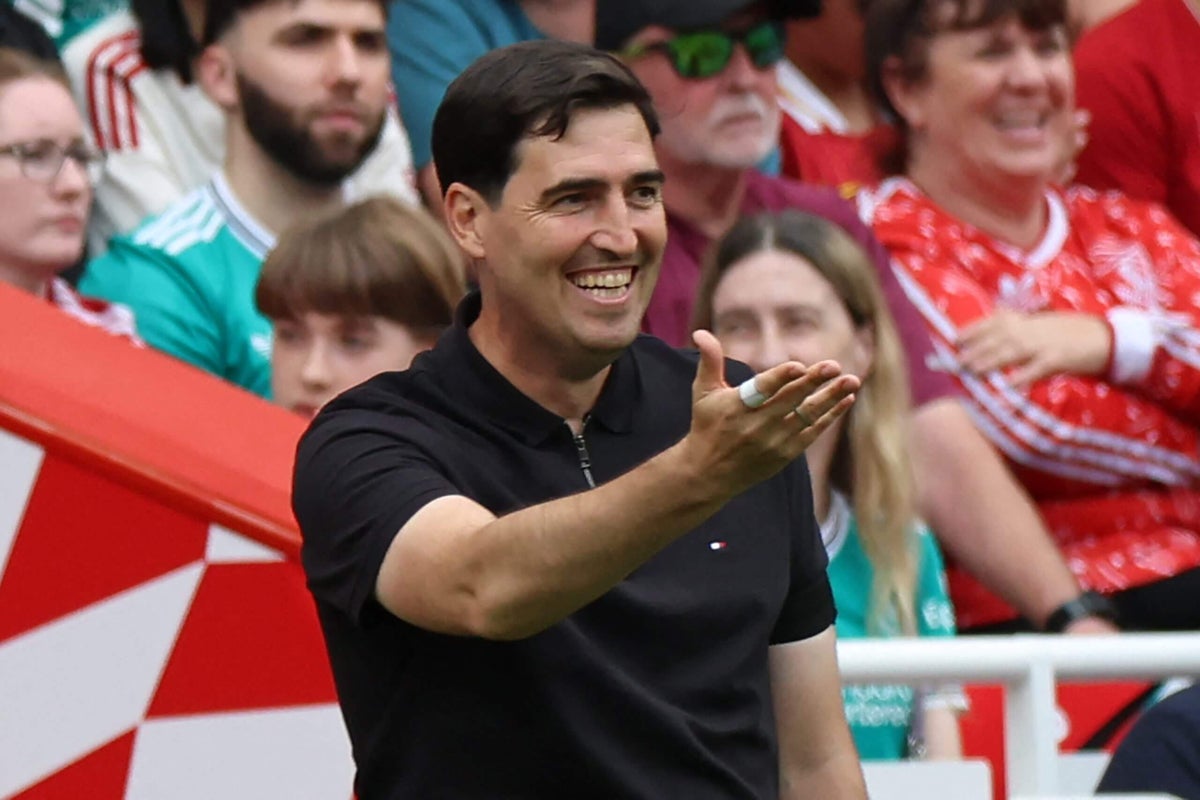
As the arrival of Ronald Araujo addressed one problem for Andoni Iraola, other glaring issues raised their ugly head in Liverpool’s friendly defeat by Monaco at Anfield.
The Uruguay international flew into the UK on Sunday morning to undergo a medical before completing his season-long loan move from Barcelona.
Capable of playing centre-back or right-back, Araujo will provide some much-needed experienced defensive cover. His presence should help ensure that never again do Liverpool end a game with the makeshift combination of Wataru Endo and Luke Chambers at the heart of their back line.
It was hardly a surprise that Liverpool surrendered a 2-1 half-time lead against Monaco after the double act of captain Virgil van Dijk and impressive teenager Ifeanyi Ndukwe was broken up in the second half.
Ndukwe’s impact during pre-season has been bittersweet. So composed, so commanding, it certainly bodes well for the long term following his arrival from Austria Vienna after a £2.5million ($3.4m) deal was struck in January.
However, with the 18-year-old defender unable to get a work permit to play in England in 2026-27, a year away on loan beckons, with Liverpool weighing up offers from across Europe since his eye-catching performances on the pre-season tour of the United States.
The addition of Araujo to the squad this week should coincide with the return of Jeremy Jacquet to full training. The young French defender has not featured since his £60m move from Rennes due to a minor knee problem, but is expected to be fit for next Sunday’s home double-header with Serie A outfit Como.
With Joe Gomez and Giovanni Leoni still sidelined, either Araujo or Jacquet will be needed to partner Van Dijk in the Premier League opener against Newcastle United at St James’ Park on August 23.
There was the welcome sight of Alisson back between the posts against Monaco before Giorgi Mamardashvili replaced him in the second half. The gulf between Liverpool’s No 1 and his back-up remains sizeable.
In the continued absence of the injured Conor Bradley, Jeremie Frimpong and Milos Kerkez look destined to fill the full-back roles when the serious action starts. But further forward, there is ongoing uncertainty and understandable levels of concern among the fanbase regarding squad depth.
Most of the first half on Sunday showcased what Iraola wants Liverpool to be. With Florian Wirtz operating ahead of Ryan Gravenberch and Dominik Szoboszlai, the hosts were on the front foot and dominant. They pressed high and repeatedly forced the visitors to cough up possession.
Alexander Isak opened the scoring with a clinical finish into the bottom corner after slick interplay between Gravenberch and Szoboszlai. Cody Gakpo looked sharp on his first outing of pre-season and the Dutchman’s header led to Wirtz forcing home the second from close range.

Alexander Isak’s goal against Monaco was an encouraging sign for Liverpool (Darren Staples/AFP via Getty Images)
However, those energy levels were not sustained and Iraola’s Anfield bow fell decidedly flat. There were clear parallels with the friendly against Leeds United in Chicago a week earlier, when a raft of second-half changes led to a drastic decline in standards. Suddenly, Liverpool were far too easy to play through.
Given a lifeline by Aleksandr Golovin’s penalty just before the interval, Monaco equalised through Mika Biereth before substitute Paris Brunner headed home a late winner from a corner — another example of their vulnerability from set pieces.
“We played a good first half, especially a good 30 minutes,” Liverpool head coach Iraola told LFCTV. “Right now we probably don’t have much more, in terms of the levels required to play like this. They were much better in the second half. They deserved to turn around the game.
“We cannot sustain the level we want for all of the game. As soon as we made some changes, players started to get tired. We have work to do. We can take a lot of positives, but also a lot of negatives.”
After Gravenberch, Szoboszlai and Wirtz were taken off, Liverpool finished with a midfield trio of Trey Nyoni, James McConnell and Harvey Elliott. There’s much to sort out regarding that department.
Iraola said Curtis Jones was unavailable after feeling some discomfort in his hip on Saturday, but his absence coincides with Inter’s ongoing pursuit of him. The sooner there’s clarity on that front the better, because selling Jones and not replacing him is unthinkable.
Alexis Mac Allister is due to report back on Monday after enjoying a post-World Cup break. For all the speculation regarding the Argentina international’s future this summer, there have been no offers for him and Iraola has made it clear he expects him to stay put.
Given how frequently Liverpool were outfought and outrun in midfield last season, the fact they have not bought a specialist holding midfielder to ease the burden on Gravenberch is a worry.
And then there is the top end of the pitch, where the long wait to replace Mohamed Salah is ticking dangerously close to the start of the new Premier League season.
We are approaching crunch time in terms of their pursuit of Paris Saint-Germain winger Bradley Barcola. Senior club sources have dismissed reports in France that Liverpool tabled a bid of €115m (£99m, $133m) for the France international last week.
With PSG demanding around £145m, they insist that such an offer would have been pointless. Unless PSG are willing to reduce the asking price, Liverpool will have to turn their attention to alternative targets.
As long as he stays fit, Isak will certainly lead the line at St James’ Park, but who will operate either side of him? Academy youngster Lewis Koumas deservedly started ahead of Federico Chiesa on the right against Monaco after his impact on the pre-season tour.
A decision on whether to loan out Koumas, who helped Hull City win promotion to the Premier League last season, is likely to be delayed until late in the window. He is an exciting talent who gives everything for the cause, but decision-making lets him down at times and he is not ready to be a regular starter in the top flight.
New signing Victor Munoz showed flashes of his pace and trickery down the left after being brought on for the final half-hour. Rio Ngumoha came on at the same time down the right but added more weight to the argument that he’s much more comfortable cutting in off the other flank.
If Tottenham Hotspur do not make Liverpool an offer they cannot refuse for Gakpo, they will have him, Ngumoha and Munoz all desperate to start on the left at Newcastle. The choice on the right is currently Chiesa or Koumas and that is not sufficient.
Balance is required with the acquisition of a naturally right-sided attacker, with PSG teenage winger Ibrahim Mbaye among the options under consideration.
“It was lovely, especially in the first half when we were pushing and everything was going so well,” Iraola said about the first Anfield game of his tenure.
“The second half was harsh because when they (the fans) were expecting… and you cannot give them what they wanted. It is frustrating.”
There is considerable work to be done both on and off the pitch at Liverpool with the new campaign less than a fortnight away.
>
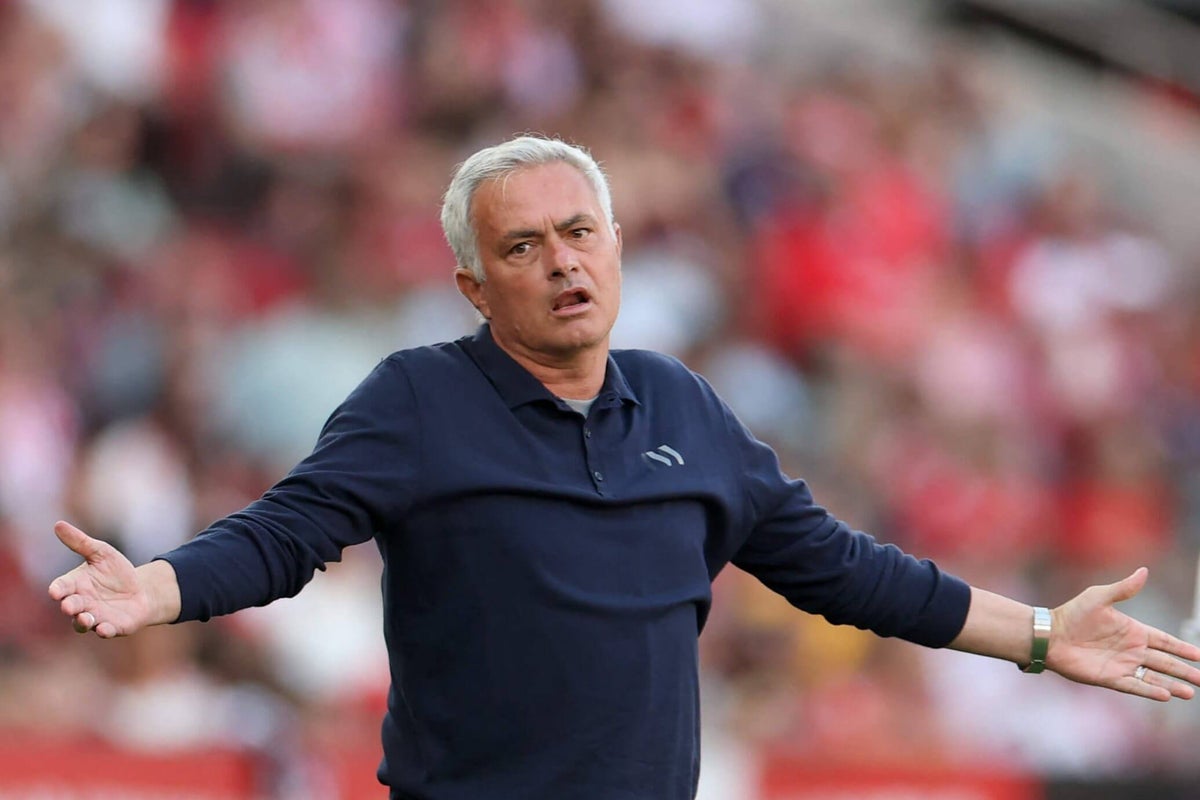
Is Jose Mourinho still ‘box office’?
It’s the phrase that has followed him around over the past decade, during which the prior flow of trophies has turned into more of a trickle. It is trotted out whenever he does something weird, or obnoxious, or genuinely entertaining, or really anything vaguely ‘Jose’, that makes us think of the manager we once knew.
Often though, these things aren’t really ‘box office’, and if anyone else did them, they would be dismissed as a minor eccentricity.
It is difficult to deny, however, that there is continuing fascination with the man, despite his apparently waning powers — he has not won a league title in 11 years, nor a trophy of any kind in four. The interest in him stretches from internet comment sections, through journalism and filmmaking, right up to the president’s office at Real Madrid.
The question of whether he is still ‘box office’ might have already been answered by his reappointment this summer for a second spell as Madrid manager, 13 years after the first one ended.
But it will potentially be stress-tested further, in a more literal sense, by the new Netflix documentary ‘Mourinho’, made by John Battsek (producer of Oscar-winning documentaries ‘One Day In September’ and ‘Searching For Sugar Man’, as well as the recent Netflix film about David Beckham) and director Joe Pearlman (mostly known for films about music acts Bros and Lewis Capaldi).
How Jose Mourinho returned to Real Madrid
Tifo Football and Mario Cortegana
The documentary is in three parts, and the juiciest and most interesting stuff is saved for the third.
Discussing the end of that first three-year stint at Madrid, Mourinho pauses, gives the knowing look of a man who is trying to live up to being ‘box office’ and says: “I go to Chelsea in 2013, but in that period there is something nobody knows. I think I can say, without hurting anyone with the truth. I think the objective of this work we are doing is to tell the truth.”
He then goes on to reveal he agreed to take the Manchester United job in summer 2013, to succeed the retiring Sir Alex Ferguson, before Everton’s David Moyes was offered the position. However, he says he changed his mind, and followed his heart back to Chelsea for a second spell there because, “after Real Madrid, I needed to feel love”.
At first, you think he’s hamming it up, but then Ferguson appears to confirm the story, revealing Mourinho was offered the job and accepted before performing a U-turn, saying the Portuguese called him in tears to say he had changed his mind.
That will be the headline revelation from ‘Mourinho’. And fair enough: it’s new, and seems to contradict the accepted narrative of his dalliances with United before he eventually arrived there in 2016. But it’s not the most interesting thing about the three-part series.
Mourinho first started taking meetings about being the subject of a documentary in 2022, when he was managing Italian side Roma.
“I think he was ready to try to set the record straight,” says Pearlman, “and to say to everyone, ‘I’m Jose Mourinho, remember what I did, and this is what I’m going to do’. That’s the person I thought I met. That changed over the years, but when I met the man, it felt like it was a score to settle.”
There is some of that in the show, notably some bitterness about being sacked by Chelsea (twice), the odd drive-by at those who belittled him in his early career on the staff at Barcelona and what we have to describe as a ‘thinly-veiled’ dig at one former foe, Pep Guardiola: “Don’t talk to me about sabbaticals,” he says. “To me, sabbatical means weakness.”
There’s also plenty of fairly standard stuff you would expect and want from a documentary of this sort: there are the talking heads from his past — John Terry, Frank Lampard, Iker Casillas, most of his former assistants — telling stories you know the gist of. There are the clips from his glory days. There are some nice anecdotes, like the one from his first spell at Chelsea about being asked to go to Sardinia to coach a team of staff from Roman Abramovich’s yacht.
But the really interesting stuff, arguably the heart of the whole thing, is how the film exposes Mourinho’s vulnerability.
Blubbing on the phone to Ferguson is one example, but we’ve seen him cry before, albeit usually in the afterglow of victory: when Inter won the treble under him in 2010, for example, and he left their celebrations early, because he said he would not have taken the Madrid job that summer had he stayed with his players.

Jose Mourinho, then at Inter, goes head to head with Sir Alex Ferguson in 2009 (Andrew Yates/AFP via Getty Images)
The vulnerability is more present and authentic in the moments when Mourinho talks about his family, admitting at one stage he thinks his children “enjoy life much more without me”. Or when he talks about his early years, when he was part of the game but always on its fringes, from being a professional footballer’s son to being dismissed as a ‘translator’ when an assistant at Barcelona.
He has seemingly never lost that chip on his shoulder, the idea that he has still never been accepted (despite now twice being appointed manager of the biggest club in the world) by football, which at least in part explains why he is like he is.
It’s probably a cliche to say this, but most of the interesting stuff centres around his relationship with his father, Felix.
“He is the opposite of me, because everybody loved him,” Mourinho says at one point, which almost makes you feel sorry for him until you consider another quote — “I’m not nice, that’s just the way it is. I do it with pride. Anything to get your players not to lose” — which suggests to one extent or another he chose to be the opposite of his old man. “I don’t want to change,” he says later. “It’s too late.”
Maybe the killer line in the whole thing comes when Pearlman is asking about his dad, and Mourinho says: “You are pushing me to speak about myself, which I don’t want to.”
Taken on face value, this could look like one of the more absurd statements in the history of language: Jose Mourinho not wanting to talk about himself?
But what he actually means is he doesn’t want to talk about his real self, as opposed to his persona, the character that he created nearly a quarter of a century ago, the one who always feels the need to be ‘box office’. The one that, over the years, has probably become entwined with the actual person, but still isn’t the genuine Mourinho.
If you get him to talk too much about his father, he can’t help but reveal his real self.
“I think we got as close as anyone’s ever got,” says Pearlman, when asked how near he thinks they got to the real Mourinho, over countless hours of interviews that stretched from just after leaving Roma in January 2024, across his 13 months at Fenerbahce and into his recent second spell at Benfica.
“People think they know me, but they don’t know me,” Mourinho says at one point. “I don’t care.” Just the sort of thing that someone who is participating in a multi-part documentary about themselves would say.
If the show has a weakness, it’s that it’s either too short or too long. That sounds like a pretty silly critique, but the series is in three parts: the first broadly focuses on the initial spell at Chelsea, with some origin story thrown in; the second is Inter, the pinnacle of his career; the last is Madrid part one, plus everything else, including most of the vulnerability and the discussion of his family.
There are a couple of other possible films in there. They could have made a shorter character study, one that broadly ignores the nostalgia and the historical beats of his time in football, and treated it as a concentrated look into the soul of the man. Or they could have really stretched their legs and made it six, seven or eight episodes, going into every bit of his career in more detail.
In the end, we have a mix of the two, and it certainly works and entertains and brings out some unexpected stuff from Mourinho, but you are left wondering about the other versions that could have existed somewhere.
Mourinho was recalled to the Madrid job as the finishing touches were being put on the film, which gives it a fairly satisfying narrative arc.
“You see a version of the descent of the man,” says Pearlman, “and then he does what Jose Mourinho does — he arrives back at the place he says he deserves to be.”
Why Real Madrid have quietly made the most sensible transfer of the summer
JJ Bull
So is Mourinho still ‘box office’? He thinks so. Madrid’s president Florentino Perez thinks so. This show thinks so.
All of that makes him an inevitable subject for a documentary, and the surprise is it has taken this long for one to be made.
‘Mourinho’ will be available on Netflix from Tuesday, August 11
>

Yaroslava Mahuchikh on making history while her country is at war: ‘I want to win gold for my people’

There are glaring gaps in Liverpool’s squad. They have plenty of transfer work to do

Is Jose Mourinho still ‘box office’? His latest Man Utd revelation shows he can be
-

 movies3 months ago
Search For Canadian TV Actor Stewart McLean Now Homicide Investigation
-

 Fashion9 years ago
These ’90s fashion trends are making a comeback in 2017
-
Fashion9 years ago
According to Dior Couture, this taboo fashion accessory is back
-
Fashion9 years ago
Model Jocelyn Chew’s Instagram is the best vacation you’ve ever had
-
Fashion9 years ago
Your comprehensive guide to this fall’s biggest trends
-
Fashion9 years ago
9 Celebrities who have spoken out about being photoshopped
-
Fashion9 years ago
Emily Ratajkowski channels back-to-school style
-
Fashion9 years ago
A photo diary of the nightlife scene from LA To Ibiza