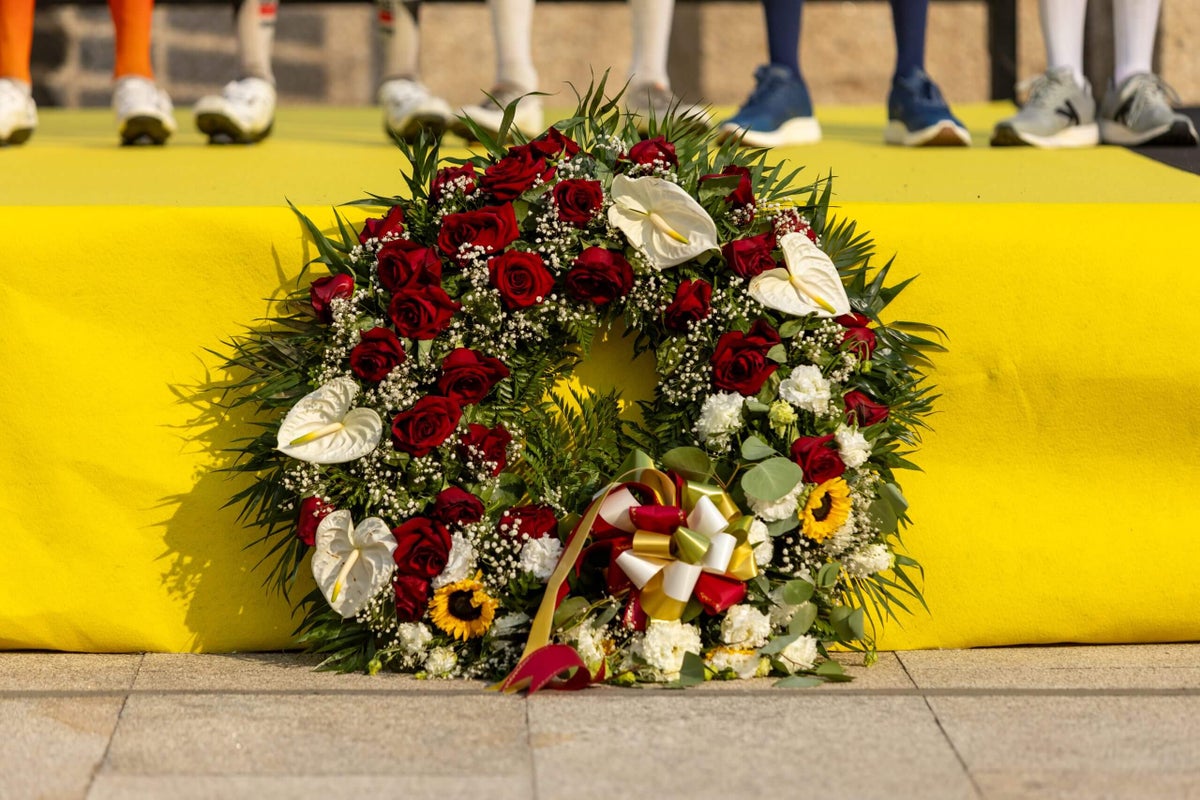
Jean-Pierre Monseré was wearing the world champion’s jersey when he died, aged 22, in 1971.
Known affectionately as ‘Jempi’, the Belgian had entered a criterium in Retie, against his initial wishes, as training for that year’s Milan-Sanremo. He was hit by an unauthorized car on the race course in a head-on crash, and was killed instantly. Compatriot Eddy Merckx, on winning Milan-Sanremo four days later, placed the winners’ bouquet on Monseré’s coffin.
In a tragic parallel, Monseré’s seven-year-old son, Giovanni, was killed by a car five years later. Like his father, he was wearing a rainbow jersey.
Monseré’s death is a formative and bitter chapter in cycling’s history; a champion, a potential Tour de France winner, killed in his prime. Fifty-five years on, it is shameful to every one of cycling’s stakeholders that the sport is still seeing its riders die in near-identical incidents.
In the 1995 edition of Milano-Torino, future Tour de France winner Marco Pantani was almost killed after hitting a car coming towards him during a high-speed descent. Spanish rider Saúl Morales died at the 2000 Tour of Argentina after he was struck by a truck mid-race. In the 2020s alone, there have been several more near misses.
Now comes the latest, gut-wrenching image from stage eight of last week’s Volta a Portugal: a bike sheared almost in two, lying broken on the tarmac. In front is a dented van with a broken windshield. British rider Finlay Tarling was 19 when he died, avoidably and senselessly.
The sport has had its warnings; at least a dozen races in the past six years featuring vehicles which somehow gained access to the course, riders shooting past at up to 80kph, believing the road was closed.
Each near miss was an opportunity. None were taken. Cycling’s stakeholders must now reflect on their own responsibility in the circumstances which facilitated Tarling’s death.
On Saturday, there was a moment of silence, the commemorative rendering of a yellow jersey into a black facsimile, but the race, and sport at large, carried on.
Over recent seasons, as they have for much of cycling’s history, inquiries into fatal accidents have failed to deliver meaningful and lasting policy change — if they are investigated at all. This avoidable tragedy, at the very least and as a moral minimum, must deliver that.
Cycling’s arenas are public roads, except for the few hours of the race itself, as the peloton flashes past in a blur of colours, gears, and shouts. This is the sport’s beauty, and also, all too often, its tragedy. Even within that framework, there are risks that are acceptable and those that are unacceptable.
Riders understand there is an inherent danger of crashing; it is a contract they sign and face down on every high-speed descent. In training, too, there is an understanding that their workplace is shared with cars, not that this knowledge protects them. Come race day, the course design can be perfect — and make no mistake, too many times it is not — and some crashes will still occur. Potentially, in the worst cases, such as Gino Mäder’s accident at the 2023 Tour de Suisse, fatalities too.
But what Tarling met was an unacceptable risk: an unauthorized vehicle on closed roads, driving uphill towards descending riders. The Briton should have been able to take the corner’s inside line without fear of what may be present on the exit. By not being afforded the basics of protection, the teenager paid with his life.

Tarling’s death on Friday stunned a sport that is nonetheless familiar with tragedy (Pedro Brandao/NurPhoto via Getty Images)
There have been warnings. In this year’s Volta a Catalunya, vehicles suddenly appeared out of a tunnel, driving straight towards the oncoming riders. Several teams quit last year’s Etoile de Besseges, the season’s opening stage race, after a motorist entered a roundabout, causing a crash after which Belgian rider Maxim Van Gils was forced to quit the race.
“Generally speaking, cars are a real problem,” one rider who competed in that race tells The Athletic, speaking anonymously so he could discuss the issue candidly. He has directly experienced three other races in which the peloton passed cars head-on during descents.
“Most roads aren’t permanently closed, but only for a brief moment whilst the peloton is passing through. Most cars don’t join the road at major junctions, but rather from small side roads. Many people simply can’t judge when all the riders have passed, or don’t realise that the race isn’t really over until the tail car has gone through.
“It’s simply not possible to secure every single driveway, so there’s inevitably a residual risk. In my experience, this sort of thing happens more often at smaller races because the organisation there is probably not up to scratch, or there’s a lack of funds.”
Another high-profile example came at the 2023 edition of Paris-Nice, while later that year, the women’s peloton complained of the issue at that year’s Tour Féminin International des Pyrénées, with 17 of 23 teams voting against continuing.
The lack of sensitivity in race director Pascal Baudron’s response was stunning. “The girls have demands that are not in line with their level. They imagine that they are on the Tour de France and that all the roads must be closed, that everything must be locked down. But in France, we can’t do that. Quite honestly, I tell myself it is not worth organising a race to see all those months of effort ruined for the whims of spoiled children.”
Riders have the right to protest because the human cost is real; the competitors, who have the smallest voice in a race’s organisation, bear the risk. In Tarling’s case, it has been exacted.
At 19, Tarling was taking the first steps of his professional career, moving to Andorra last year and racing for WorldTour squad NSN’s Development Team. The Welshman was a member of Great Britain’s junior road and track teams, having taken third place in June’s national Under-23 time trial championships, at four years younger than many other competitors.

Tarling pictured in 2022 at the Newport Velodrome (Huw Fairclough/Getty Images for The National Lottery)
His older brother Josh, 22, is already a stage winner at the Giro d’Italia and one of the world’s best time trialists. Both parents are high-profile and public advocates for the sport, dedicating themselves to providing opportunities to their sons and others by setting up the West Wales Cycle Racing Team in rural Ceredigion.
When Josh completed the Tour in July, parents Michael and Dawn posted a picture of both sons at the race, 13 years earlier. The expectation, given the strength of his junior career, was that Finlay would follow Josh in participating in the race.
“Hearing how lovingly and fondly Fin was thought of has been a huge help to us,” Michael Tarling wrote on social media this Sunday. “I don’t know how we carry on from here, but we’ll figure it out with the support of all our family, friends, and community.
“Whilst our broken hearts will never be fixed, he was not only our son and brother but our best mate. Gentle, loving with the driest sense of humour, we will miss him terribly. If you’re heading out on your bike in the next few days give him a thought as you clip in.”
The investigation into Tarling’s death is not yet complete, but officials from the Portuguese police have provided rolling updates to local media. Carlos Canatario, a lieutenant in the country’s National Republican Guard, told RTP that their initial findings were that Tarling was behind the main peloton when the crash occurred.
Races at this level typically employ a rolling roadblock, in which side entrances onto the road are only shut when the race passes, rather than closed all day. Not every entry onto the course is manned, with some relying on signage.
According to Catanario, the driver of the van initially stopped at an access point to let the main peloton pass. “As he waited there for some time and no one else was coming, he asked if he could proceed,” the police spokesperson added.
“It is at that moment that he proceeded, even before the sweep vehicle (marking the end of the race convoy) had passed. It was going in the opposite direction to the direction of the race. And the cyclist cut across — as is natural, as cyclists do ‚ the curve on the leftmost lane, and that is what caused the cyclist and the vehicle to collide.”
Catanario described it as a “secondary access point” which “was not one of the locations prioritised in the assessment that had been carried out”.
Whilst immediately expressing their sorrow at Tarling’s death, the race organizers’ reaction was also defensive. “Cycling is a risky sport, and we’re all aware of that,” race director Ezequiel Mosquera told Portuguese newspaper A Bola. “It’s very difficult to control a 1,300-kilometer ‘stadium’, but we’ve always had the best people available to ensure the safety of our race is at the highest level — exemplary professionals.”
It is indisputable that the eighth stage of the Volta went tragically wrong. Lessons must be taken.
“We are speechless and filled with anger after the news of Finlay Tarling’s death at the Tour of Portugal,” the riders’ union, the CPA, posted on Sunday. “It is not right that a young athlete’s life should end this way, and we are furious that even today it is still not possible to prevent such serious accidents.”
Two years ago, another teenager, 18-year-old Swiss junior Muriel Furrer, crashed at the World Championships in Zurich. She was not discovered for almost an hour and a half, dying early the next morning in hospital.
At the time, the UCI (Union Cycliste Internationale), cycling’s lawmakers, told The Athletic that they could not investigate and produce their own report into the apparent failings due to an ongoing Swiss police investigation.
In March, 18 months after the crash, prosecutors closed the case, stating that no individuals were criminally liable for her death. There has been no public sign that the UCI have carried out their own investigation into how a rider could be left alone in woodland for 82 minutes.
It is fair to ask whether any learnings have been taken from Furrer’s death. The UCI did not respond to a request from The Athletic this week for comment.
Ayrton Senna’s fatal crash at the 1994 San Marino Grand Prix brought about safety reforms in Formula One which transformed the sport. Cycling has had many such tragedies. In 1995, Olympic gold medallist Fabio Casartelli was killed on the descent of the Col de Portet d’Aspet in that year’s Tour de France, his skull fractured in a spot that would likely have been protected by a helmet.

The memorial to Olympic champion Fabio Casartelli on the Col de Portet d’Aspet in France. He died descending it during the 1995 Tour de France (Joel Saget/AFP via Getty Images)
It took eight more years, and more riders to die — specifically Andrey Kivilev in that year’s Paris-Nice — for helmets to be mandated.
“It’s the usual madness in cycling where people simply carry on until something bad happens,” says the professional rider we spoke to. “I rode the (second-tier) Tre Valli Varesine (in 2024) when it rained so heavily that manhole covers were lifted, leaving open drains in the middle of the race course. It carried on like this until Tadej Pogačar himself spoke to the organisers. All the riders’ requests before that had been ignored.
“Some of those in cycling show extremely little initiative when it comes to responding to unforeseen events. Either that, or it’s a kind of ignorance, along the lines of ‘nothing will happen anyway’. Probably a mixture of both. When you’re surrounded by people displaying a lack of judgement or decision-making ability, or even outright madness, it can certainly be frightening.
“I don’t think you can completely eliminate the problem that the sport itself carries a certain degree of risk. The question is simply whether you do everything in your power to do so, or whether you have people in positions of responsibility who aren’t really interested in it or who simply can’t assess the situation properly.”
Eight riders have died in crashes since 2023 in elite or developmental road races, more than the previous 13 years combined. The same level of inaction cannot continue.
No sportsperson should die at 19; no sportsperson should die while competing in their sport. It is scant consolation that they should die for something, but sometimes the significance of their deaths in saving others is all there is.
Monseré, Morales, Furrer, and more beyond. On too many occasions, cycling has denied its competitors even that.