
Sports
Formula 1: Kimi Antonelli – the boy ‘born in a garage’ and made on the track

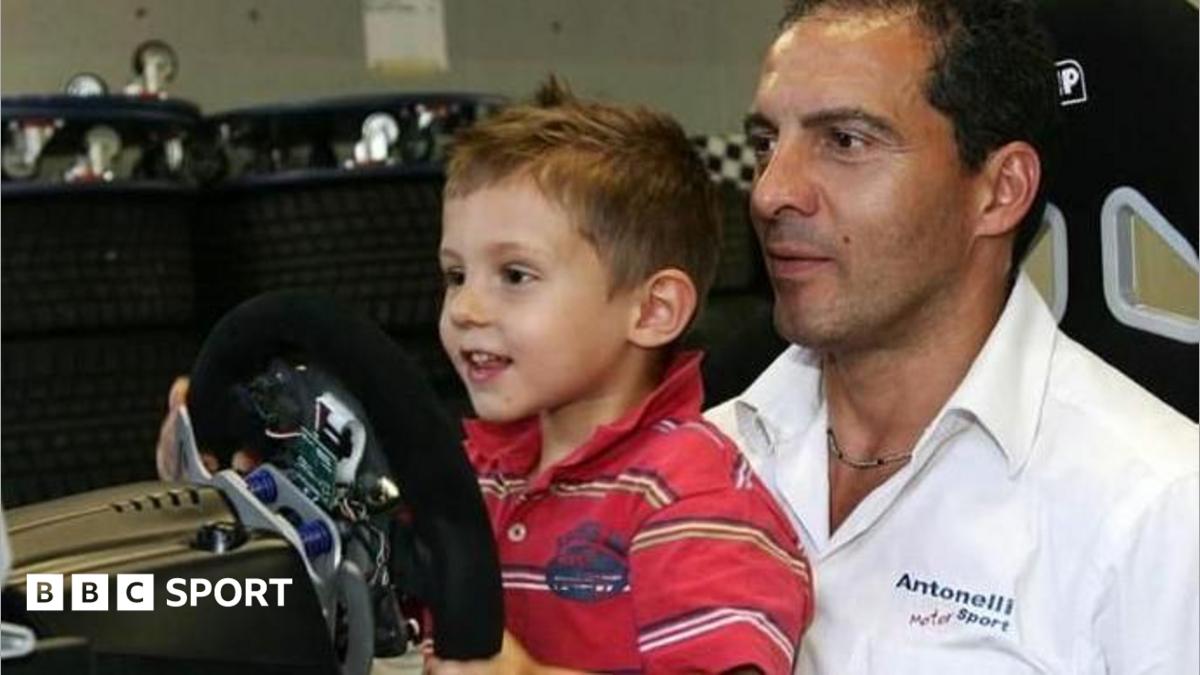
Once F1 had left Europe in the autumn of last year, there was a shift.
“Suddenly, we felt like we were making really good progress,” says Shovlin.
“There were signs towards the end of the year. I’m not saying any of us thought we’d see what we’ve seen so far this year, but that we had a decent F1 driver.”
Antonelli has been rather more than that this year. He has taken the season by storm, and established a consistent supremacy over Russell.
In the best car in the field, Antonelli has taken six poles and six wins in 11 races and heads into the second half of the season, starting at the Dutch Grand Prix this weekend, with a 50-point lead in the championship, and well on course for his first world title. If it had not been for dodgy reliability, he could be even further ahead.
The extent of this turnaround has shocked almost everyone.
“We were all surprised,” Wolff says. “My thoughts were always that he needed to make the experience of knowing all the tracks, the pressure of performing on such a high level under the spotlight of the media, the constant public feedback, whether you’re doing well or not, the situations everyone wanted to be close to him.
“There wasn’t one single defining factor where I would have said that made it difficult for him, but this year, he knew exactly what to expect. What was really nice to see is that the self-confidence, without feeling any entitlement, has shone.”
Marco points to his son’s “very strong” mentality.
“In F4 and Freca, he started with not good results, and he was able to remake everything and, at the end, work hard and win the championship,” he says.
“We talk about F1. I don’t know what the spark is in his brain, but Kimi in the past did the same.”
Verstappen says: “For me, there was never any doubt that he would make the jump the year after and already be a lot more consistently competitive.
“It’s normal in the progression of a driver. In your rookie season, it can be quite tough, but at the moment, of course, he’s doing an amazing job.”
Kimi pays tribute to his father, describing him as his “rock”, while Wolff also praises the driver’s “typical Italian family”.
“They are caring, they are loving,” Wolff says. “Kimi’s character, he’s gentle, he has empathy, he has charisma, he has the right amount of intelligence for being a racing driver.”
>

Speaking of Haaland, Ibsen says last season’s highest-scoring player was “pretty much constantly” in his team last year.
The City forward is currently the most expensive FPL player of all time at £15.5m, but Ibsen is still planning on including him.
“There’s no-one else like Haaland,” said Ibsen.
“Yes there’s no-one as expensive as him, but you can still make a great team around him because everyone else is so cheap.
“I don’t have to sacrifice a lot. A team with Haaland, Florian Wirtz, Dominik Szoboszlai, Joao Pedro, a good keeper and a good defence is possible.
“Plus, he makes the game really straightforward. If you’re in doubt about who to captain, you always have him. He’s a really nice player to have.”
>
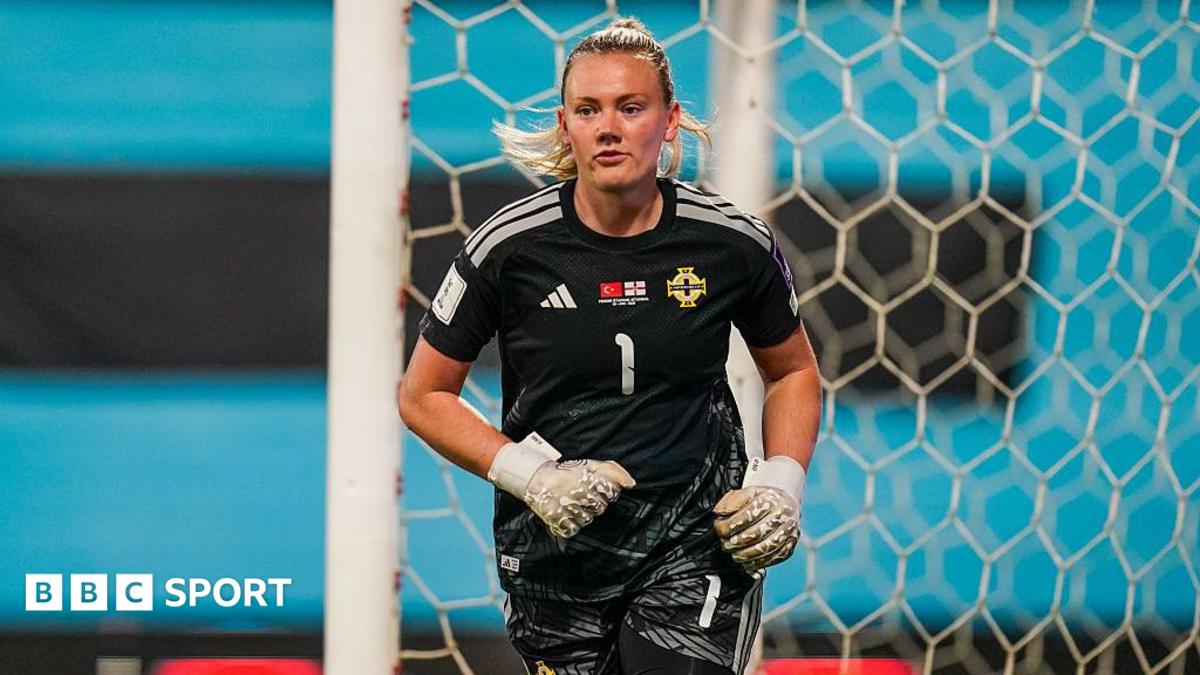
Northern Ireland goalkeeper Jackie Burns is the number one for her country and has just signed for Burnley – but she is already thinking about her next steps.
At some point, the 29-year-old will leave football and she is doing what she can now to prepare herself for a new career.
Across 15 years so far, Burns has built experience playing in leagues across the world, including Iceland, Canada and Sweden.
Along the way she has faced challenges off the pitch, as well as on it, and wants to help players in the future in similar situations.
Speaking about life after football, Burns said: “I have definitely thought about it. I still want to be a part of football in whatever aspect that may be.
“It will probably be in more of a player-care role, just helping players as they progress through a team, and not so much on the football aspect.
“It’s just making sure they are comfortable so it’s not a challenge for them coming in. They are a player in a team – but a person too.”
Burns chose to join newly-promoted Women’s Super League 2 club Burnley this summer having left Bristol City.
She hopes to use her experience to help others settle in and said a big part of her decision to join was Burnley’s willingness to support her post-career ambitions.
The goalkeeper feels that support from Burnley puts “value on her” as a person.
“[I want to] feel heard as a person and they really inspire me in that aspect,” said Burns.
“I’ve been to a few places and while you’re always excited to go, sometimes it can be a challenge. You don’t know what way things work.
“It’s basic stuff like getting a house or a car which can be quite complicated if you’re not from that country.
“If you have someone in a club who can help take that stress off you, it just makes the experience a lot easier.
“It can go unseen sometimes. For a lot of players, as soon as they feel valued, it just turns into an easier experience.”
>
Sports
Breaking down Erling Haaland’s unique running style: 35.5 km/h top speed, curves and acceleration mode
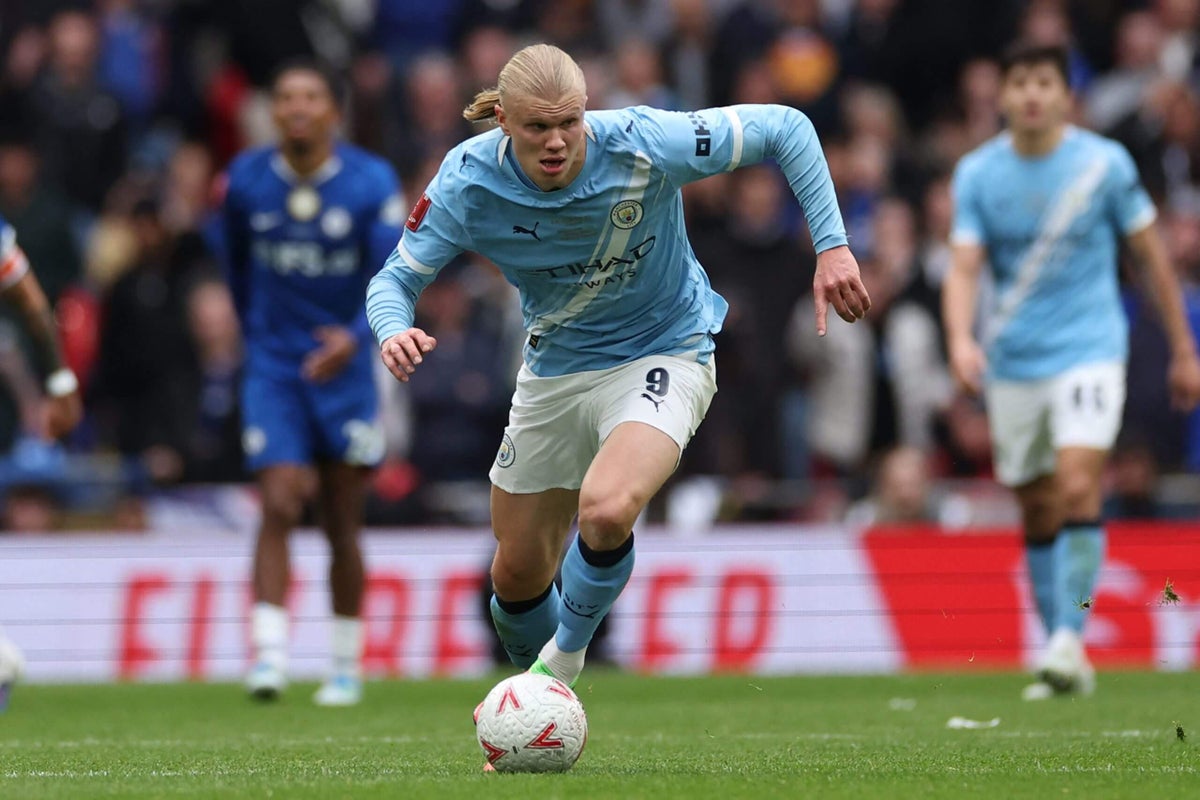
Thierry Henry curved away from defenders, Cristiano Ronaldo attacked their blind side and Kylian Mbappe outran them. But Erling Haaland has a claim to football’s perfect run that borrows from all three.
Haaland is 195cm (6ft 5in), but the Manchester City and Norway striker’s best movement begins before the sprint, with a glance, a drift away from danger and one step that changes his direction. He then opens his stride and turns a few yards of space into a route to goal.
The Athletic spoke to Archit Navandar, assistant professor of biomechanics at the Technical University of Madrid, who compared Haaland with eight-time Olympic champion and 100m and 200m world-record holder Usain Bolt, who is the same height.
“Unlike Bolt, who relied a lot on stride length over stride frequency to accelerate to max velocity, Haaland uses a combination of both to generate speed and control the ball at the same time,” Navandar says.
The 26-year-old scored 38 goals and provided nine assists in 52 appearances for City last season, including 27 Premier League goals to claim his third Golden Boot in four years. He then scored seven times at his debut World Cup as Norway reached the quarter-finals for the first time, surpassing their previous best finish of the round of 16 in 1998.

Opta tracking data shows the scale of the work Haaland does between touches. The distance covered by regular Premier League starters can vary by almost four kilometres per 90 minutes according to position and role, with midfielders generally covering more ground than centre-backs or centre-forwards.
Across City’s opening seven league matches last season, Haaland covered 66.3km, around 9.5km per game, while averaging only 24.2 touches per 90 minutes. He ranked 10th among Premier League forwards and wingers for distance covered despite having the third-fewest touches of any player to complete at least 300 minutes. That equates to roughly 390 metres covered for every touch recorded.
When Haaland accelerates, those metres disappear quickly. His average across his three highest speeds last season was 35.5km/h, joint-sixth in the Premier League data and the highest figure among recognised centre-forwards. Benjamin Sesko was the next-fastest striker at 34.7km/h.

“Tall and big athletes always draw attention when running at high speeds, like Usain Bolt,” Navandar says.
But the comparison only goes so far. Bolt could devote every stride to reaching maximum speed in a straight lane. Haaland has to stay onside, read a pass, evade defenders and retain enough control to change direction or shoot.
His most common high-speed off-ball runs show the difference. Defined as movements averaging at least 25km/h for 0.7 seconds, several begin around halfway before travelling diagonally or bending towards the penalty area rather than taking the shortest route.
Those curves allow Haaland to change the angle from which he attacks the defence while continuing to build speed, rather than committing immediately to a straight-line race.

Navandar analysed one example from City’s 2-1 win over Newcastle United at the Etihad Stadium in February.
Haaland had already crossed for Nico O’Reilly to head what proved to be the winner and, despite not scoring himself, had 43 touches, his most in a Premier League game, and contested a career-high 12 duels.
Pep Guardiola later called it a performance he would “never forget”, praising his striker for having to “run, run, run and fight”.
The sequence came in the 72nd minute, with City protecting their lead. Haaland is almost stationary on the right, waits for the ball and turns infield. Little more than four seconds later, he is approaching Newcastle’s penalty area at speed.
Navandar broke the movement down step by step. The first is deliberately short and lands beneath Haaland’s centre of mass, essentially the point around which his weight is balanced.
He says that positioning helps rotate the shoulders and trunk before his entire 6ft 5in frame commits to the new direction. His second step is much wider and remains on the ground for longer. It produces the sideways force required to turn while still driving him forwards.
Navandar adds that the step generates the turning force needed for Haaland to lean into the turn, comparing the movement to a motorbike taking a corner. Rather than slowing, changing direction and then rebuilding speed, his body can lean through the curve while continuing to accelerate.
The third step comes further inside the bend, allowing a greater lean and a sharper turn without significantly compromising his speed.
“He uses his arms to stabilise the movement, like a speed skater on a curve,” Navandar says.

Once Haaland completes the bend, his mechanics change. The sideways lean becomes a forward one, the gap between his legs increases, and his feet begin landing beneath or slightly behind his centre of mass as his stride lengthens.
Navandar says he shows “all the characteristics of a good acceleration technique, similar to a sprinter”, including a forward trunk lean that gradually reduces as his speed rises, a large arm swing and significant movement through the hips.
But Haaland never quite becomes a conventional sprinter. A 100m runner gradually becomes more upright approaching maximum velocity. Haaland remains inclined forwards because he is still accelerating, allowing a quicker change of direction if the defender or the ball moves.
“It is more like sustained acceleration mechanics, rather than max velocity sprinting mechanics,” Navandar says.
In other words, Haaland is still in the process of speeding up rather than settling into the body position required to run at top speed.
The ball forces another adjustment. Haaland’s stride continues to lengthen, but when a touch is required, he changes where his foot lands before returning to his running pattern. Navandar found his step frequency — how rapidly his feet hit the ground — beginning to settle after around his 12th stride.
Before shooting, he adjusts once more. A wider step gives him greater hip extension and more room for his striking leg to swing, while his upper body contributes to the power of the shot.
A Newcastle defender catches him as he strikes and Haaland ends up on the turf, but Navandar believes it was through no fault of his own.
“He falls down because of the tackle, not loss of balance,” he says.
The move does not produce a goal, but in little more than four seconds, Haaland has changed direction, accelerated, controlled the ball and reorganised his body to shoot. Bolt’s perfect run had a fixed finish line 100 metres away — Haaland’s keeps moving.
>

Fantasy Premier League: Five tips from last season’s FPL champion

Northern Ireland GK Jackie Burns on plans for life after football

Breaking down Erling Haaland’s unique running style: 35.5 km/h top speed, curves and acceleration mode
-

 movies3 months ago
Search For Canadian TV Actor Stewart McLean Now Homicide Investigation
-

 Fashion9 years ago
These ’90s fashion trends are making a comeback in 2017
-
Fashion9 years ago
According to Dior Couture, this taboo fashion accessory is back
-
Fashion9 years ago
Model Jocelyn Chew’s Instagram is the best vacation you’ve ever had
-
Fashion9 years ago
Emily Ratajkowski channels back-to-school style
-
Fashion9 years ago
9 Celebrities who have spoken out about being photoshopped
-
Fashion9 years ago
Your comprehensive guide to this fall’s biggest trends
-
Fashion9 years ago
A photo diary of the nightlife scene from LA To Ibiza