
Tech
5 Best Wave Accounting Alternatives for 2026


Wave Accounting covers invoicing, basic bookkeeping, and expense tracking well for freelancers and very small businesses. Its limitations become more consequential as an organization adds inventory, more demanding reporting, approval requirements, additional accounting users, or a larger technology stack.
I evaluated five leading Wave Accounting alternatives using a weighted accounting software rubric. QuickBooks Online ranks first overall for its combination of accounting depth, reporting, controls, integrations, and scalability. Zoho Books follows closely and stands out for businesses that need stronger accounting automation without immediately taking on QuickBooks-level pricing.
| Provider | Best for | Monthly starting price |
|---|---|---|
| QuickBooks Online | Businesses outgrowing basic bookkeeping | $38 |
| Zoho Books | Value and accounting automation | $0; paid plans from $20 |
| Xero | Multiuser accounting teams | $25 |
| Sage 50 Accounting | Inventory and operational accounting | $128.67 |
| FreshBooks | Invoicing-focused service businesses | $23 |
Why you can trust TechRepublic
I bring an accountant’s perspective to software evaluation, focusing on how financial systems behave when everyday bookkeeping meets real operational complexity.
My experience covers general ledger accounting, accounts payable and receivable, bank reconciliation, financial reporting, inventory, workflow controls, and the practical accounting requirements that emerge as companies grow. That background helps me distinguish useful accounting functionality from features that sound impressive but add little value to the finance operation.
– Eric Gerard Ruiz, CPA, Accounting and Bookkeeping Expert
How I evaluated Wave Accounting alternatives
I used a weighted scoring rubric to compare each product across the areas that matter most once a business moves beyond basic bookkeeping.
- Pricing and value (10%): I reviewed pricing transparency, plan structure, upgrade costs, add-ons, trials, cancellation terms, discounts, and the accounting functionality included for the price.
- Core accounting features (20%): I evaluated the general ledger, accounts payable, accounts receivable, bank reconciliation, fixed assets, inventory, and sales tax.
- Automation and workflow (15%): I examined approval processes, recurring accounting tasks, workflow controls, and support for more complex finance operations.
- Reporting and analytics (20%): I assessed financial reports, customization, dashboards, segmentation, key performance indicators, forecasting, and advanced analysis.
- Compliance and security (15%): I reviewed permissions, audit trails, access controls, and features that strengthen oversight of financial data.
- Integrations and scalability (10%): I evaluated accounting integrations, broader app ecosystems, APIs, operational expansion, and support for growing organizations.
- Ease of use (10%): I considered navigation, search, dashboards, customization, workflow efficiency, and intelligent assistance.
Quick comparison of Wave Accounting alternatives
| Software | ||||
|---|---|---|---|---|
| QuickBooks Online | ||||
| Zoho Books | ||||
| Xero | ||||
| Sage 50 Accounting | ||||
| FreshBooks |
Why QuickBooks Online is my choice for businesses outgrowing Wave
| Overall score: 4.68 / 5 |
|
Pros
- Advanced includes custom reports, approval workflows, and granular user roles
- Plus and Advanced include inventory and project profitability tracking
- Supports class and location tracking for segmented financial reporting
- Integrates with more than 800 third-party applications
- Strong bank reconciliation with matching rules and discrepancy tools
- Advanced supports up to 25 users with role-based access
Cons
- Simple Start supports only one standard user
- Inventory requires the $140-per-month Plus plan or higher
- Custom approval workflows require the $340-per-month Advanced plan
- Advanced pricing creates a large jump from Wave Pro
- Standard QuickBooks Online keeps separate company files for separate entities
Pricing & other deciding factors
| Monthly pricing |
|
| Add-ons pricing | Intuit Payroll, payments, and other services carry separate fees |
| Discount | Introductory promotions vary |
| Free trial | 30 days |
| Customer support channels | Phone callback, chat, chatbot, and self-help resources |
| Features |
|
My evaluation
QuickBooks Online is the strongest Wave replacement for technology-driven organizations that need accounting to operate as part of a broader business systems environment. Its integration ecosystem, API connectivity, reporting depth, structured permissions, and Advanced workflow controls make it far better suited to organizations where finance data touches customer relationship management, ecommerce, payroll, expense management, analytics, and other operational systems.
For IT leaders and technology executives, the key advantage is control without abandoning a mainstream small-business accounting platform. Advanced gives finance teams more precise access management, approval routing, custom reporting, and batch processing. The main constraint is pricing: organizations need a clear operational reason for moving into Plus or Advanced, since those tiers contain many of the capabilities that distinguish QuickBooks from Wave.
Why Zoho Books is my choice for value and workflow automation
| Overall score: 4.59 / 5 |
|
Pros
- Supports configurable transaction approvals with up to 10 levels
- Premium adds native fixed asset management and depreciation tracking
- Elite adds advanced inventory and warehouse-related functionality
- Ultimate adds advanced analytics and business intelligence
- Integrates closely with Zoho CRM, Expense, Inventory, Analytics, and other Zoho apps
- Paid plans start at $20 per month
Cons
- Fixed asset management starts in the $70-per-month Premium plan
- Advanced inventory requires the $150-per-month Elite plan
- Included user counts remain capped by subscription tier
- Additional users cost extra after the plan allowance
- Native consolidated multi-entity accounting remains limited
Pricing & other deciding factors
| Monthly pricing |
|
| Add-ons pricing | Additional users start at $3 per user monthly; scanning, locations, and other services carry separate fees |
| Discount | Lower rates with annual billing |
| Free trial | 14 days |
| Customer support channels | Email, phone, chat, and help center resources |
| Features |
|
My evaluation
Zoho Books fits technology companies that value configurable workflows and tight application integration without paying enterprise accounting prices. Its strongest advantage appears inside the wider Zoho ecosystem: companies using Zoho CRM, Expense, Inventory, Analytics, or other Zoho products gain a more connected operating environment than Wave provides.
The approval engine also separates Zoho Books from simpler accounting platforms. Multi-level routing gives finance and operations teams more structure around purchasing and transaction review, which matters in startups and growing technology companies where spending authority expands faster than the finance team. Native multi-entity consolidation remains a weakness for organizations managing several legal entities.
Why Xero works well for multiuser accounting teams
| Overall score: 4.20 / 5 |
|
Pros
- No per-user license fees across standard plans
- Bank reconciliation includes rules, suggestions, and automated matching
- Native fixed asset register tracks depreciation and disposals
- More than 1,000 app integrations
- Established includes projects, expenses, and multi-currency accounting
- Tracking categories support segmented reporting
Cons
- Early limits users to 20 invoices and five bills
- Project tracking requires the $90-per-month Established plan
- Multi-currency accounting also requires Established
- Standard inventory lacks advanced warehouse and manufacturing controls
- Approval routing lacks configurable multilevel chains
- Native multi-entity consolidation sits outside core Xero accounting
Pricing & other deciding factors
| Monthly pricing |
|
| Add-ons pricing | Inventory Plus and other products carry separate fees |
| Discount | Promotional offers vary |
| Free trial | 30 days |
| Customer support channels | Online support and extensive help resources |
| Features |
|
My evaluation
Xero’s unlimited-user model stands out for technology organizations with distributed finance responsibilities. Finance staff, founders, department leaders, and external accountants all gain access without forcing the company into a more expensive plan simply to add seats. That structure fits startups and technology companies where responsibilities shift quickly across growing teams.
Its integration ecosystem also matters for IT buyers. Xero connects with more than 1,000 applications, which reduces the pressure to force accounting into an isolated workflow. The weakness appears in internal process control: organizations that require formal, conditional, multilevel transaction approvals get stronger native workflow functionality from Zoho Books or QuickBooks Online Advanced.
Why Sage 50 Accounting works well for inventory-heavy businesses
| Overall score: 3.96 / 5 |
|
Pros
- Premium and Quantum plans support inventory tracking
- Higher editions support multiple companies and consolidation
- Quantum supports up to 40 users with role-based permissions
- Advanced job costing tracks labor, materials, and project expenses
- Strong audit trails and traditional accounting controls
- Purchase order and inventory workflows suit product-based operations
Cons
- Pro starts at $128.67 per month for one user, which can be costly
- Subscription requires a one-year commitment
- Fixed asset management relies on a separate Sage product for full lifecycle functionality
- Integration breadth trails QuickBooks Online and Xero
- Desktop-oriented workflows add administrative overhead for cloud-first teams
- Advanced permissions and workflow controls concentrate in Quantum
Pricing & other deciding factors
| Monthly pricing |
|
| Add-ons pricing | Fixed assets and several adjacent Sage services use separate products or pricing |
| Discount | Standard billing offers vary |
| Free trial | 30-day product test drive |
| Customer support channels | Phone, online chat, and customer resources |
| Features |
|
My evaluation
Sage 50 makes sense for technology businesses whose financial complexity comes from physical operations rather than software alone. Hardware companies, device manufacturers, technical distributors, and businesses that combine services with physical inventory gain stronger inventory, purchasing, costing, and multi-company functionality than Wave provides.
Its architecture presents a different trade-off for IT leaders. Sage 50 delivers deep accounting controls, but it lacks the cloud-first extensibility and broad integration ecosystems of QuickBooks Online and Xero. Organizations centered on APIs, browser-based administration, and extensive SaaS interoperability face more friction. Organizations centered on inventory control and traditional financial operations gain more from Sage 50’s depth.
Why FreshBooks is good for invoicing-focused service businesses
| Overall score: 2.81 / 5 |
|
Pros
- Strong invoice customization and recurring billing
- Premium tracks profitability by client project
- Built-in time tracking connects billable hours to invoices
- Client portal centralizes invoices, estimates, and payments
- Expense and receipt capture suit service-based workflows
- Interface requires less accounting knowledge than the other products
Cons
- No native fixed asset lifecycle management
- Inventory functionality stops at basic items and quantities
- No configurable multistep transaction approval workflows
- Additional team members cost $11 per user monthly
- Advanced reporting lacks the segmentation depth of QuickBooks, Zoho Books, and Xero
- Select pricing lacks the transparency of lower tiers
Pricing & other deciding factors
| Monthly pricing |
|
| Add-ons pricing | Additional team members: $11 each per month; Advanced Payments and payroll carry separate fees |
| Discount | Introductory promotions vary |
| Free trial | 30 days |
| Customer support channels | Phone, email, and help center resources |
| Features |
|
My evaluation
FreshBooks fits technology consultancies, development agencies, managed service providers, recruiters, designers, and other service businesses where billing clients matters more than building a sophisticated finance operation. Time tracking, invoicing, project profitability, and client-facing workflows align closely with how those teams generate revenue.
Its limits become clear once finance requires stronger internal controls. FreshBooks lacks the approval depth, inventory, fixed asset management, advanced reporting, and scalability of the leading alternatives. Technology companies with simple service-based revenue gain an approachable system. Companies building a more formal finance function outgrow it faster.
More about Accounting
How to choose a Wave Accounting alternative
Start with the process that Wave no longer handles well. That constraint identifies the right alternative faster than comparing long feature lists.
- Choose QuickBooks Online for broad accounting and systems depth. It offers the strongest combination of reporting, permissions, integrations, inventory, project accounting, and workflow controls in this group.
- Choose Zoho Books for configurable automation at a lower price. Its approval workflows and broader Zoho ecosystem fit growing companies with increasingly structured finance operations.
- Choose Xero for broad user access and application connectivity. Unlimited users and a large integration marketplace suit collaborative, cloud-based organizations.
- Choose Sage 50 for inventory-intensive operations. Its inventory, costing, purchasing, and multi-company capabilities fit businesses with more demanding physical operations.
- Choose FreshBooks for service delivery and client billing. It prioritizes invoicing, time tracking, payments, and project profitability over advanced financial controls.
For technology buyers, the accounting feature list is only part of the decision. Review access controls, integration requirements, API availability, user provisioning, approval rules, reporting architecture, data migration, and the systems that already exchange financial information with accounting.
The strongest replacement solves the constraint that triggered the search and fits the surrounding technology environment.
Frequently asked questions (FAQs)
What is the cheapest Wave Accounting alternative?
Zoho Books has the lowest entry price among the alternatives in this comparison because it offers a free edition. Its paid Standard plan starts at $20 per month.
Is QuickBooks better than Wave?
QuickBooks Online delivers much deeper accounting functionality than Wave, including inventory, project profitability, advanced reporting, granular permissions, custom workflows, and a much larger integration ecosystem.
Wave remains the stronger choice for straightforward bookkeeping when low software cost takes priority over advanced controls and scalability.
Which Wave alternative is best for technology companies?
QuickBooks Online is the strongest overall choice for technology companies because of its reporting, integration ecosystem, API connectivity, role controls, and scalable finance workflows.
Zoho Books stands out for companies already invested in the Zoho ecosystem, while Xero fits organizations that prioritize unlimited user access and extensive SaaS integrations.
When is it time to move away from Wave?
The clearest signal is recurring operational friction. Manual management reports, spreadsheet-based inventory, weak approval controls, duplicate data entry, restricted user access, and accounting processes spread across disconnected tools all indicate that the organization has outgrown Wave.
>
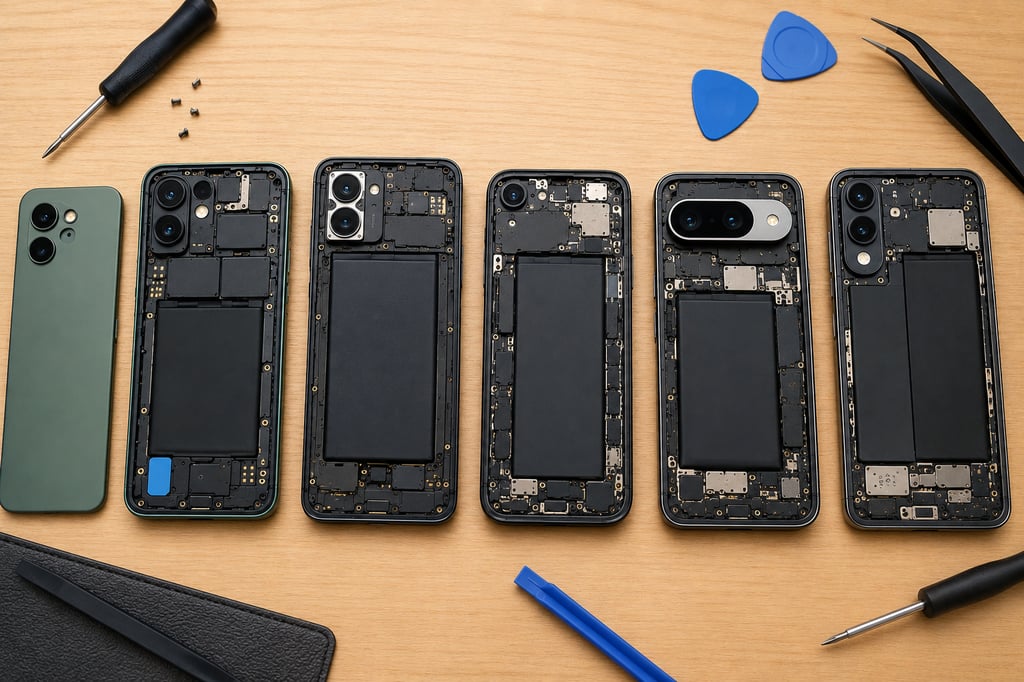
A phone becomes expensive to own when a worn battery, cracked screen, or damaged charging port turns into a complicated repair.
In 2026, some manufacturers make those jobs considerably easier, but repairability still varies widely between models.
Fairphone has centered its phones on modular, owner-replaceable hardware for more than a decade. HMD has adopted similarly repair-friendly designs, while Apple and Google have made common repairs easier on some mainstream models.
For this comparison, we prioritized current phones with independent iFixit repairability scores, available parts or repair documentation, and practical access to components such as batteries, displays, and charging ports.
Most repairable phones at a glance
| Phone | iFixit score | Best for | Main drawback |
|---|---|---|---|
| Fairphone Gen. 6+ | Gen. 6 design: 10/10 | Most replaceable components | Limited availability compared with major brands |
| HMD Skyline | 9/10 | Easier DIY repairs | Shorter software support |
| iPhone 17e | 7/10 provisional | Apple buyers | USB-C repair remains difficult |
| Google Pixel 10 | 6/10 provisional | Android buyers | Display still relies heavily on adhesive |
iFixit changes its scoring methodology over time, so the scores are useful indicators rather than perfectly standardized measurements across every phone generation.
Fairphone Gen. 6+ offers the most modular design
The Fairphone Gen. 6+ keeps the modular construction of the Gen. 6, which earned 10/10 in an iFixit teardown.
Owners can replace 12 modules, including the battery, display, cameras, and USB-C port. The battery and screen avoid adhesive, and Fairphone sells replacement parts directly.
The Gen. 6+ also carries a five-year warranty and software support through 2033. That combination addresses both sides of device longevity: replacing worn hardware and keeping the phone supported after the repair.
HMD Skyline also performs strongly on hardware repairability. iFixit gave it 9/10, citing its screw-assisted opening mechanism, replaceable display, accessible battery, and modular charging port.
Its shorter software-support period is the main trade-off. Buyers planning to keep a phone for several years should compare repairability with current software support windows before choosing a model.
iPhone 17e and Pixel 10 bring easier repairs to major brands
The iPhone 17e received a provisional 7/10 from iFixit. Its dual-entry design lets technicians reach internal components from either side, while Apple’s electrically releasable battery adhesive makes battery replacement easier.
Apple also publishes repair manuals and sells replacement parts. The USB-C port remains a more involved repair because several components must be removed to reach it.
Google’s Pixel 10 received a provisional 6/10. Its back panel can be removed without heat, battery removal is easier than on previous Pixels, and the USB-C board is replaceable.
The display still relies heavily on adhesive, limiting the Pixel’s score. Google offsets some of that hardware complexity with seven years of OS, security, and Pixel Drop updates.
Samsung’s self-repair program does not eliminate hardware complexity
Samsung’s US Self-Repair program provides genuine parts, tools, and documentation for supported Galaxy phones. One UI 9 is also making repair support easier to access from the device.
Recent Galaxy hardware remains more difficult to work on than the highest-scoring phones in this comparison. The Galaxy S25 Edge received a provisional 5/10 from iFixit despite improvements to battery removal and a modular USB-C port.
Its display and back cover still rely heavily on adhesive. Samsung therefore offers stronger access to DIY repair resources than its hardware repairability score alone might suggest.
An independent iFixit score for the Galaxy S26 series was not available when this article was written, so we have not ranked those models alongside independently tested phones.
Which repairable phone should you buy?
The Fairphone Gen. 6+ offers the most repair-friendly hardware in this group, with 12 replaceable modules, readily available spare parts, and software support through 2033.
HMD Skyline provides similarly accessible hardware but a shorter software-support period. The iPhone 17e is the strongest option here for Apple buyers, while Pixel 10 combines improved repair access with seven years of updates.
For long-term ownership, we recommend checking four things before buying: whether the battery and display can be replaced without excessive adhesive, whether high-wear components such as the charging port are modular, whether spare parts and manuals are available, and how long software updates will continue.
Also read: Samsung is reportedly exploring self-healing display glass for the Galaxy S27 Ultra, which could reduce surface damage without necessarily making the phone easier to repair.
>

An old phone can still work in 2026, but age alone does not determine whether a carrier will activate it. A hand-me-down smartphone from several years ago may work perfectly, while an older 4G phone can fail because it lacks the right voice support or carrier compatibility.
Four checks matter most: the phone needs current network support, VoLTE, a compatible IMEI result, and an unlocked status. Software support matters too, especially if you’ll still use the phone for apps, payments, email, or other sensitive tasks.
T-Mobile’s current BYOD guidance recommends checking the IMEI, the phone’s unique device identifier, and unlock status before activation. Its compatibility tool can return fully compatible, partially compatible, incompatible, or blocked.
2G and 3G phones are effectively out
The major US networks have moved beyond the technologies many older phones were built around.
T-Mobile’s Network Evolution page says its 2G GSM network was retired on August 3, 2026. Its 3G UMTS network was retired in July 2022, following the shutdowns of Sprint’s 3G CDMA and LTE networks earlier that year.
AT&T phased out 3G in February 2022. Verizon completed the retirement of its 3G CDMA network at the end of 2022 and says 4G devices without VoLTE also lost calling, texting, and data service.
That means a 2G- or 3G-only phone is no longer a practical option on the major US networks. A 4G label alone is not enough either. The phone still needs VoLTE and carrier support.
Run these four checks before activating an old phone
| Check | Pass | Warning or failure |
|---|---|---|
| Network | Supports the carrier’s LTE or 5G bands | 2G/3G-only or missing important bands |
| Voice | Supports VoLTE on the destination carrier | LTE data works, but voice support is missing |
| IMEI | Carrier reports fully compatible | Partial, incompatible, or blocked |
| Unlock | Device is unlocked | Still locked to another carrier |
Network support depends on the exact model. Phones sold for different carriers or countries can support different frequency bands, so an imported phone may connect to LTE while still missing bands needed for reliable US coverage.
VoLTE, or Voice over LTE, is just as important. A phone can support LTE data without supporting the carrier’s LTE voice service. Verizon’s shutdown guidance specifically says 4G non-VoLTE devices are no longer supported.
Run the IMEI through the destination carrier’s compatibility checker rather than relying only on the specifications. A fully compatible result is the safest sign that activation should work, while a partial or incompatible result deserves a closer look before buying a SIM or switching service.
The phone also needs to be unlocked if it is moving to another carrier. Unlock requirements vary, but carriers commonly require eligible devices to be paid off and in good standing.
Software longevity belongs in the decision too. Recent Samsung and Google phones now receive much longer software support windows, while older models may already have stopped receiving security updates.
A new SIM cannot fix an incompatible phone
Once the phone passes those checks, activation itself is usually straightforward.
A compatible device can use either a physical SIM or eSIM if the phone and carrier support it. Changing the SIM type cannot add missing LTE bands, VoLTE support, or carrier approval.
T-Mobile says many smartphones released since 2020 support eSIM, although availability varies by model and region. With eSIM, activation can often complete within minutes.
After activation, test voice calls, texts, and mobile data. If data or MMS does not work, check the APN settings. Some older and imported devices may require manual configuration.
If you’re transferring an existing phone number, keep the old service active until the port finishes. T-Mobile says number transfers can take from a few minutes to several hours.
A phone can connect and still be too old to use safely
Carrier compatibility is only one part of keeping an old phone useful.
Older devices may no longer receive security patches or current app versions. More than a billion older Android devices were estimated to be outside Google’s current security-update coverage earlier this year, making unsupported Android phones a separate concern from whether they can connect to a cellular network.
Apps can impose their own cutoffs too. WhatsApp, for example, is ending Android 5 support in September 2026.
Before putting an old phone back into regular use, check whether it still receives security updates and whether the apps you rely on still support its operating system.
If the phone supports the carrier’s LTE bands and VoLTE, passes the IMEI check, is unlocked when necessary, and still receives acceptable software support, it can remain perfectly usable in 2026. If one of those checks fails, a new SIM is unlikely to rescue it.
Also read: If replacement is unavoidable, our guide to the most repairable phones in 2026 compares current models by repairability, parts access, and software support.
>

A supposed expert institute publishing academic-looking research was actually part of a covert influence operation supported by ChatGPT, according to OpenAI.
The company said Tuesday it banned a cluster of accounts originating in Russia that were used to promote the International Burke Institute, a self-described Israel-based expert community. OpenAI’s investigation uncovered copied academic research, misleading author attributions and a “sovereignty index” that portrayed Russia favorably while criticizing Western governments.
The operation shows how generative AI can support more than mass-produced social posts. It can also help operators build the surrounding infrastructure — research, branding and coordinated accounts — needed to make an influence campaign look more legitimate.
A fake institution with real-looking research
The operation centered on the International Burke Institute, whose website was registered in February 2025 and presented itself as an Israel-based “expert community.”
OpenAI reviewed 36 articles published on the site between September 2025 and May 2026 and found that 34 appeared to have been copied from elsewhere, sometimes with incorrect authors. One article on the China-Pakistan Economic Corridor, for example, appeared to originate from Cambridge University Press but was attributed to a different academic.
The site also claimed connections to prominent figures including Francis Fukuyama and Noam Chomsky, according to OpenAI.
The institute’s most distinctive feature was its “sovereignty index,” which rated countries across political, economic, technological, information, cultural, cognitive and military measures. OpenAI said the index was used to praise Russia and attack Western governments.
Must-read security coverage
AI was the amplifier, not the whole operation
The ChatGPT accounts generated promotional posts and replies designed to push people toward IBI content. One operator also produced German-language material for a Telegram channel called “Lahme Ente,” which criticized Ukraine, the EU and Germany while advocating closer relations with Russia.
Another created logos for about a dozen Telegram channels focused on countries including Germany, the U.S., France, Poland and Türkiye and used ChatGPT to summarize their activity in Russian.
OpenAI said the campaign’s immediate reach was modest. Most posts received few views, while the associated Telegram channels generally had 10,000 to 20,000 followers each.
That limited reach does not make the operation insignificant. The more important development is the way AI was used as one component of a larger credibility-building system. OpenAI said, “The significance of the operation lies less in the audience it reached, however, than in the infrastructure it had built.”
That distinction matters for platforms, businesses and consumers. Generating a convincing post is increasingly easy; building an apparently independent institution around that content could also make coordinated messaging look more credible and therefore harder for users to recognize as part of an influence operation.
OpenAI said activity involving ChatGPT also gave investigators signals that helped connect parts of the wider campaign. That creates an unusual dynamic for influence operators: the same AI tools that make coordinated activity easier to scale can also leave patterns that platforms can use to uncover it.
More news: Microsoft Teams is rolling out a new policy that lets IT administrators automatically block detected external meeting bots, giving organizations more control over third-party AI assistants in sensitive calls.
>

Emiliano Martinez’s Aston Villa exit: The end of a long goodbye that became an annual saga

Penn Badgley Joins Amazon’s ‘Everyone In My Family Has Killed Someone’

Canucks sign Chris Driedger to PTO: What it means for Thatcher Demko
-

 movies3 months ago
Search For Canadian TV Actor Stewart McLean Now Homicide Investigation
-

 Fashion9 years ago
These ’90s fashion trends are making a comeback in 2017
-
Fashion9 years ago
According to Dior Couture, this taboo fashion accessory is back
-
Fashion9 years ago
Model Jocelyn Chew’s Instagram is the best vacation you’ve ever had
-
Fashion9 years ago
Emily Ratajkowski channels back-to-school style
-
Fashion9 years ago
9 Celebrities who have spoken out about being photoshopped
-
Fashion9 years ago
Your comprehensive guide to this fall’s biggest trends
-

 Anime3 months ago
Rurouni Kenshin: Hokkaido Arc Manga Takes 1-Issue Break – News