Sports
Are the Texans this year’s Seahawks? Plus: 2027 draft rankings, new CTE study
Inside: Dane Brugler ranks the 2027 draft class, the Texans as a legitimate contender and there’s a newly troubling CTE report.
This article is from The Athletic’s NFL newsletter. Sign up here to receive it directly in your inbox. It’s free to subscribe.
2026 Texans: This year’s Seattle?
Last August, I wondered if the Seahawks were quietly fielding a Super Bowl contender. They were.
The Seahawks had an elite defense that just needed its offense to take a step. The latter group, led by Klint Kubiak and Sam Darnold, was intent on establishing the run behind a new-look line.
In other words, they looked similar to this year’s Texans.
Seattle wouldn’t have won last year’s Super Bowl without a dramatic improvement from its offensive line, which was one of the league’s worst units in 2024.
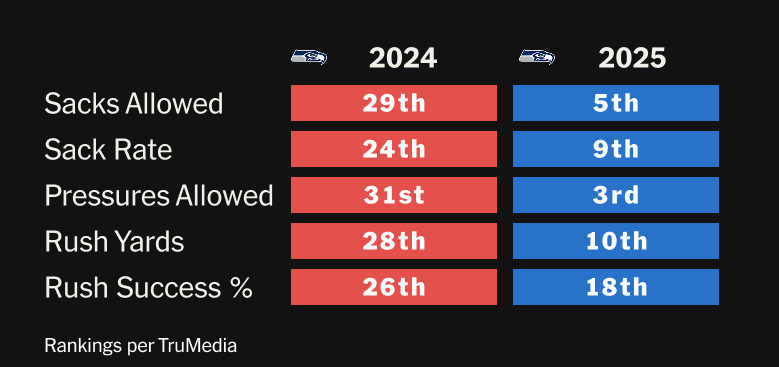

The line became unsung heroes, as Kubiak’s linemen-friendly system paired with a new position coach and first-round guard Grey Zabel to give Seattle one of the league’s top units.
The Texans’ line needs a similar jump. “If the Texans’ offensive front can become an average unit that moves people off the line of scrimmage in the run game, Stroud would get the most help he’s had,” Ted Nguyen noted in his story on Houston’s league-winning potential. “If the offense is even average, the Texans are bona fide Super Bowl contenders.”
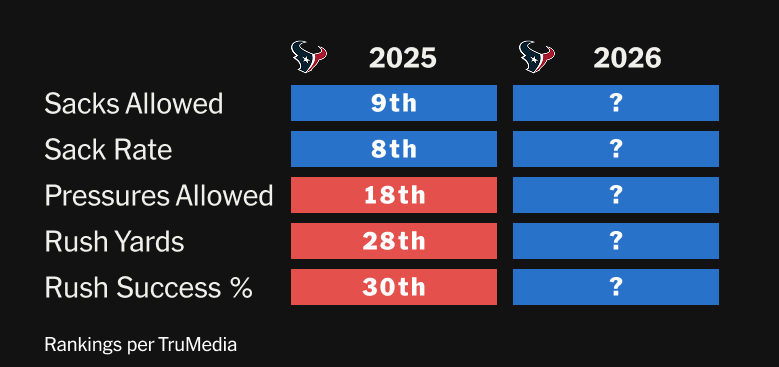
Don’t be fooled by those sack numbers. Houston is not starting at a better place than last year’s Seahawks were.
That’s because it wasn’t good protection that allowed C.J. Stroud to avoid sacks. His line ranked 30th in pass-block win rate (which measures how often linemen sustain blocks for 2.5 seconds or longer). That forced him to get the ball out quickly. Only two teams had more throws in under 2.5 seconds than Houston did.
Houston’s run game was meanwhile non-existent. That line had the league’s worst run-block win rate, and Stroud faced second-and-longs and third-and-longs more often than all but two quarterbacks.
The Texans made offseason changes, quietly:
- They spent a first-round pick on Georgia Tech interior lineman Keylan Rutledge, who is expected to start at center.
- They signed former Browns guard Wyatt Teller, along with Colts tackle Braden Smith. (Smith was carted from practice earlier today.)
- David Montgomery arrived from Detroit to help a running back room that averaged 3.9 yards per carry (29th) and scored just nine touchdowns (27th) last season.
A year ago, the Seahawks smoothed the path for Darnold, and were rewarded with a Super Bowl. If Houston can do the same for Stroud, the league will have a problem beating the Texans.
So, did they do enough to reach that level? I actually don’t think so. Unlike the 2025 Seahawks, Houston’s offense didn’t upgrade at coordinator or line coach. I’m skeptical that a few personnel additions were enough.
2027 draft: A class of its own
Memorable. Not a word Dane uses lightly. Or often. I couldn’t find any examples from previous preseasons of him describing a draft class in that manner.
Until today. The 2027 group could be special, Dane wrote while ranking college football’s top 50 prospects. Plenty to like in his top 20:
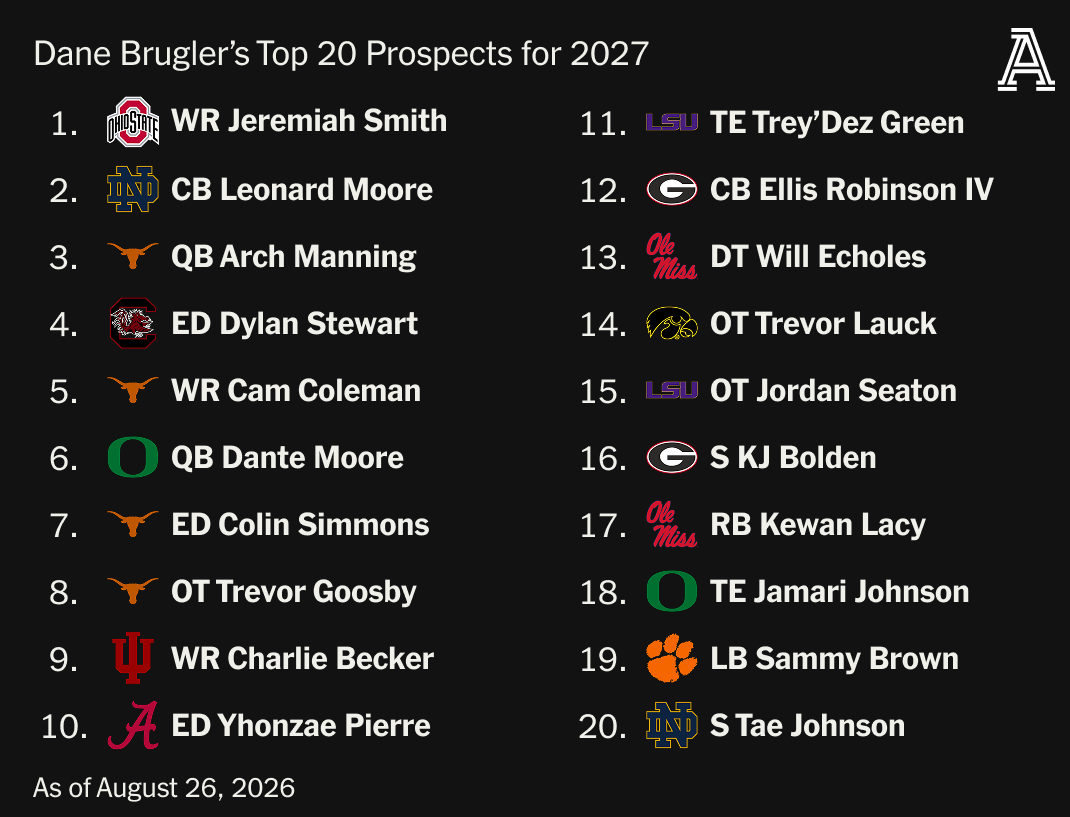

Within that group, there’s a clear top four. If this draft is to stand apart, the blue-chip prospects will need to live up to expectations. And expectations are high. Here’s a quote from Dane on the top names:
1. Jeremiah Smith, Ohio State. “When talking to scouts around the league, you hear lofty player comparisons, including to Andre Johnson and Larry Fitzgerald, who are both enshrined in Canton. I have been scouting for almost two decades, and Smith has a decent chance to finish with the highest grade I have ever given to a wide receiver.” Wow. Wow?!? The intangibles are certainly there.
2. Leonard Moore, Notre Dame. “Arguably the best defensive player in college football, … Moore thrives on an island. According to PFF, he lined up in man coverage on 57.6 percent of his defensive snaps in 2025, the highest rate in the FBS. Moore brings consistency to a position that is inherently volatile.” The lockdown corner is also No. 2 on our separate list of college football’s top 100 players.
3. Arch Manning, Texas. “Would be the No. 1 pick — not because of his last name or lineage, but because of the promise of his traits and tape.” Dig into that tape here.
4. Dylan Stewart, South Carolina. “While he isn’t the most refined pass rusher at this point, NFL teams will be happy to bet on his upside, as his foundational traits are incredibly impressive.” To be specific, he’s a 6-6, 250-pound athletic freak with Jahmyr Gibbs-like speed (22 mph on the GPS). At edge rusher! Incredibly impressive indeed.
College football starts this weekend, then really gets going the week after that. So get excited for April, fans in Miami, Cleveland and Arizona. Dane, who covers the draft in more detail than anyone, certainly is. You can check his full top-50 list here.
Alarming CTE rate
How prevalent is CTE among former NFL players?
Yesterday, a medical journal shared the results of a study that found “at minimum, nearly a quarter of all former NFL players who died during 2016-21 had CTE neuropathology at death.”
Still, that was the conclusion. And the minimum. I read the study, finding it more alarming than the conclusion implies. Here are some numbers:
- 1,712 former NFL players died from 2008 to 2021.
- About 20 percent of those players’ brains were studied. Of those 338, CTE was diagnosed in 315.
- Yes, 93.2 percent of those studied brain donors had CTE.
To be sure, there are important caveats. For example, families of an individual who suffered symptoms of CTE were more likely to donate, and the donors’ mean age at death was 66.5. So most of the study was based on players who hadn’t played in decades; in the meantime, the NFL’s rules, equipment and approach have been changing significantly.
After years spent downplaying the problem, the NFL’s adjusted the kickoff rules and allowed Guardian Caps to cover helmets.
While concussion risks seem to now be trending in the right direction, it’ll be decades before we understand the impact these changes had, since CTE can only be definitively diagnosed after death.
Extra Points


>