
Sports
How to handle Donald Trump – and other World Cup lessons for the LA Olympics


No sooner has one great sporting show rolled out of town than another looms large on the horizon.
Just over a month after the biggest World Cup ever staged, attention is already shifting to the Los Angeles Olympics and Paralympics, when about 15,000 athletes from 206 countries, and millions of fans, will descend on California.
In precisely two years, LA will be bringing down the curtain on the Paralympics after what it hopes will be a summer that matches the commercial and sporting success of the World Cup — but avoids the controversies, particularly around politics.
Gianni Infantino, the FIFA president and International Olympic Committee (IOC) member, was regularly lambasted for his close relationship with the United States president, Donald Trump — who will be approaching the end of his second and final term in July 2028 — with criticism reaching a crescendo over perceived political interference during the Folarin Balogun controversy.
So what, if anything, can the IOC and the 2028 organisers learn from the World Cup?
How to handle Trump
Kirsty Coventry, the IOC president and a former swimmer for Zimbabwe, attended the World Cup final in July, knowing that it would soon be her on stage with Trump to open the Games at SoFi Stadium on July 14, 2028.
Earlier in the year, Coventry admitted she was yet to speak to Trump, having caused a stir in a March 2025 press conference when she said she had “been dealing with, let’s say, difficult men in high positions” for more than two decades. Even though they both attended the World Cup final, Trump and Coventry did not meet, with the pair sitting in different sections of New Jersey’s MetLife Stadium.
Although Coventry is the IOC’s figurehead, the Games’ contractual obligations actually rest with Casey Wasserman, the chairman of the LA28 organising committee, and his team.

IOC president Kirsty Coventry will need to forge ties with President Trump (Fabrice Coffrini/AFP via Getty Images)
There is a dedicated Government Federal Affairs team within LA28 that engages with the White House Task Force — a group established and chaired by Trump — on the 2028 Summer Olympics.
Dialogue with the White House is not exclusively down to LA28, though, and you would expect the IOC and Coventry to get involved on key issues, such as visas, as the Games edge closer.
For Andrew Giuliani, the executive director of the White House Task Force for the 2026 World Cup, it is impossible for the Olympics to succeed without a solid relationship among all the relevant parties.
“It was an incredibly smart thing to do,” Giuliani tells The Athletic when asked about Infantino’s and Coventry’s differing approaches to Trump. “You’re hosting what’s going to be the largest version of the World Cup, you’re talking to the leader of the free world and you have the opportunity to develop a relationship with him.”
The relationship between Infantino and Trump, Giuliani says, “was one of the main reasons the World Cup was so successful”.
“My advice to Kirsty is that your best resource is sitting right there in the Oval Office,” Giuliani adds. “If you don’t form that relationship, and if you don’t take advantage of that, you are not maximising these Olympics.
“These Olympics can be the best Olympics ever, and maybe the greatest sporting event ever. They have the potential.
“But what I can tell you is if you don’t tap into President Trump’s mindset and into his ability to host major events, then you are leaving something on the table.”
After more than a year in the job, Coventry’s approach to being the president of a sport’s governing body starkly contrasts with Infantino’s tenure.
The FIFA president, with nearly six million followers on Instagram and a dedicated team that produces the content for his feed, was front and centre of the World Cup, whether it was in the Oval Office with Trump or attending two games a day.
Coventry has gone down a different route, although during the IOC election, she did campaign on matters close to Trump’s heart, such as restricting the female category at the Olympic Games and other IOC events to “biological females”.
This policy was announced in March and will be implemented from LA28. The IOC has also lifted its suspension of the Russian Olympic Committee, paving the way for Russian athletes to compete under their country’s flag in Los Angeles.

FIFA president Gianni Infantino with Donald Trump at the World Cup final (Carl Recine/Getty Images)
Even though there is no suggestion that Coventry and the IOC did this to placate the White House, it does show common ground between the two parties, with Trump previously making overtures to Vladimir Putin, the Russian president, despite the continuing conflict in Ukraine.
As Giuliani puts it: “There is as much politics in global sports as there is in Washington, D.C.”
Although Infantino’s relationship with Trump drew much of the attention regarding FIFA’s approach to the World Cup, staff at the governing body worked tirelessly behind the scenes to ensure the tournament went as smoothly as possible.
In 2023, for example, FIFA established a dedicated Government Relations and Engagement Division within FIFA26 — the collective group of subsidiaries established by FIFA to organise the tournament in the U.S., Canada and Mexico — in Miami, Washington, D.C., Toronto and Mexico City.
There were also regular meetings and conversations with representatives from local governments and federal agencies, visits to Capitol Hill, coordination of Embassy Workshops, and participation in other diplomatic forums. From a safety and security standpoint, the World Cup was seamless.
Visas
Securing visas for about 15,000 athletes — including the Paralympians — and all of the backroom staff is no small feat, and the World Cup showed it isn’t a straightforward process.
While pre-tournament concerns about possible interventions by Immigration & Customs Enforcement (ICE) on foreign nationals were not realised — there was no immigration enforcement presence at any of the 104 matches (although ICE did deploy staff to address issues around human trafficking and counterfeit vendors) — there were controversies.
Omar Artan, a referee from Somalia, was denied entry to the U.S. before the World Cup, while several Iranian officials also had their visa applications denied, with the national team also needing to move from the L.A. training base to one in Tijuana, Mexico, at relatively short notice.

Referee Omar Artan was denied entry to the U.S. for the World Cup (Alexander Hassenstein/Getty Images)
To get ahead on visas, LA28, which embedded some staff members with FIFA during the World Cup, has established an internal team dedicated to global mobility and visa support to navigate U.S. entry requirements.
One concession FIFA received from the U.S. government was the establishment of the FIFA Pass, which was an expedited way for supporters with tickets travelling to secure visa appointments. It did not have any material impact on whether their application would be approved.
Trump also imposed partial travel bans on four countries — Iran, Senegal, Haiti and Iran — before the World Cup, which, again, is something LA28 and the IOC will need to be aware of, especially given there are over three times as many countries at the Olympics.
“There was a ton of talk before the World Cup, saying it won’t be welcoming, the athletes won’t be let in,” Giuliani says. “Every athlete got in, every coach got in. There was one official who didn’t.
“I go back to what Secretary (of State) Rubio said, in that we were not going to let a soccer tournament be the guys to let bad actors into the United States to cause harm to American citizens or our international guests.”
Giuliani points to the experience of Richard Walters, the executive director of the White House Task Force for LA28, and believes there will be a “lot of noise leading into the Olympics that is wrong”.
“For political purposes, there will be distractions and people will want to throw cold water on the potential for these Games,” he adds.
“One of the reasons the World Cup was so successful is that it never came down to one individual. It was an incredible team that was willing to work through two government shutdowns to be able to achieve its mission, and that’s where the success is going to be based.”
Perhaps unsurprisingly, a working relationship has been formed between the FIFA26 Government Relations and Engagement Division and their LA28 counterparts, which has already enabled the exchange of information on visas and transportation.
Commercial revenue
Another area LA28 hopes to follow in FIFA’s footsteps is the income generated from commercial deals. FIFA is expected to generate a record-breaking $15billion (£11bn) during its 2023-26 cycle, largely due to the World Cup’s appeal.
The introduction of hydration breaks effectively split matches into four quarters and created an additional window for advertisers to part with their cash.
Infantino said that FIFA did not gain extra revenue for the breaks — not at this summer’s tournament, at least — but coffers were controversially boosted by its ticketing policy, which included dynamic pricing and what many critics considered extortionate prices. Responding to the criticism, FIFA introduced a limited number of $60 tickets for each match, but this was still the most expensive football tournament to attend of all time.
World football’s governing body would likely point to average attendances of more than 65,000 at 104 matches as evidence that its ticketing policy worked.

Fans poured into stadiums for the 2026 World Cup, but at a high cost (Adam Gray/Getty Images)
In their first two ticket sale windows, LA28 did not use dynamic pricing, with the cheapest tickets starting at $28. A statement on its website says that nearly 50 per cent of all Olympic tickets cost under $200, with more than three-quarters of all tickets, including finals, priced under $400. While that may compare favourably to many major U.S. sports events, at Paris 2024, organisers made nearly half of the 10million tickets available for $55 or less.
More than six million tickets have been sold for LA28, and they won’t be going on sale again until next year, prompting Wasserman to say the “demand we’ve seen across both drops is a powerful signal that the world is energised for LA28”.
Dynamic pricing could be introduced in future sales windows, but from a commercial and attendance perspective, industry observers feel that LA28 will be a roaring success.
“The LA Olympics will capture the imagination of the American people and it will be the most-ticketed event in the history of humanity,” Gareth Balch, co-founder and CEO of Two Circles, a global sports and entertainment marketing company, tells The Athletic.
“Double the number of tickets (in comparison to the World Cup) in a much greater density is going to be an incredible festival of humanity. We’ll see big brands getting involved.”
As the event’s organiser, LA28 has the rights to strike commercial deals in its own territory — the U.S. in this case — and a flurry of partnerships have already been announced, including with Google, JPMorgan Chase, Starbucks, and Delta Air Lines.
In the coming months, as plans intensify and issues flare up and die down, Giuliani’s view is that the IOC and LA28 are learning that hosting the World Cup is easier said than done, not least because of the challenge of handling the arrival of so many athletes from different countries. There are, however, some advantages.
“They have more time,” he says. “One of the things that will be a little bit easier is from a fan perspective. They are all going to be in LA rather than spread out across the U.S., and the Olympics isn’t being hosted by two other countries, so from that perspective, it’s probably a little easier.”
How LA28, along with the IOC, navigates the political minefield, coupled with how well it can forge ties with Trump’s Oval Office, will shape how smoothly the next two years go.
>
Sports
The rise of Arsenal’s Christos Tzolis: PAOK breakthrough, set-piece assists, showing ‘funny’ side

Christos Tzolis has been a breath of fresh air in his first five weeks at Arsenal.
The 3-0 home win against Coventry City on Friday may have only been Tzolis’ second competitive appearance in red and white (or first, depending on how seriously you take the Community Shield), but his driving dribbles are already getting fans of the Premier League champions excited.
That constant willingness to make something happen in the final third has been a defining quality of the 24-year-old Greece international’s career.
A product of the PAOK club’s academy system in his hometown Thessaloniki, in northern Greece, Tzolis was just 18 when the pandemic hit in March 2020. He had scored 19 goals in 23 games for PAOK’s under-19s, but his momentum was halted.
When football returned post-lockdown that summer, first-team manager Abel Ferreira and his staff were blown away by the aggression with which Tzolis carried the ball towards goal, combining directness with technical quality. Despite not being particularly tall, he was already physically strong, and the combination of all these attributes gave PAOK’s coaches the confidence to give him his senior debut, against domestic giants Olympiacos, in the Greek Super League’s title play-offs that June.
“We had already identified him as an above-average talent with the under-19s, to the point that he would occasionally train with us,” Carlos Martinho, an assistant coach under Ferreira at PAOK, tells The Athletic.
“The Covid break ultimately proved to be a decisive factor, as it allowed him to start training with us every day on a systematic basis. During that period, he gave us clear signs that he was at the same level as the more experienced players. So, when the league resumed and we named him in the starting XI, he didn’t feel the pressure. He handled it naturally because he already felt like a first-team player and an option for us.
“Without that forced ‘pre-season’, perhaps his breakthrough would not have been so quick and evident.”
A teenage Tzolis’ first senior start would also come against Olympiacos a couple of weeks later in the Greek Cup semi-finals. PAOK lost 4-3 on aggregate, but would win that competition with Tzolis’ help the following season — a campaign that began with a statement personal performance.
“During Champions League qualification against Besiktas, seeing that young player, whom we had just promoted two months ago, score two goals and assist another was unforgettable,” Martinho says of a 3-1 second qualifying round win.
Tzolis bent a right-footed shot into the far top corner for his first goal after seven minutes before making a beeline to celebrate with the bench. His second, for 2-0 after 24 minutes, came from being in the right place at the right time for a left-footed finish inside the six-yard box. Within half an hour, he provided a first-time, left-footed pass across the six-yard box similar to his one for Bukayo Saka to score against Coventry on Friday, which made for an easy finish for Dimitrios Pelkas (PAOK’s opposite winger and team captain).
“Christos has a very strong competitive mentality and followed every instruction we gave him,” Ferreira tells The Athletic. “He was one of the players we worked hard to develop, and he never stopped improving. Congratulations to him, his parents, the academy coaches and PAOK for believing in and investing in him.
“Today, we’re seeing the results. It doesn’t surprise me at all that his name is now at Arsenal.”
The now 24-year-old’s inner drive seems to have made just as lasting an impression as those driving runs.
“Off the pitch, at first, he was shy and more reserved,” Martinho says of Tzolis, “but as soon as training started and he realised that we counted on him, he transformed. It was fascinating to see how that shyness disappeared as soon as the ball started rolling, and he showed all the attacking aggression and focus that make him the special player he is today.”
Former Newcastle United and Netherlands goalkeeper Tim Krul crossed paths with the forward at Norwich City — his first big move to England. Tzolis signed for promoted Norwich for £10million in August 2021, aged 19, after one full campaign in senior football, during which he was named PAOK’s player of the year and Greek Super League young player of the season for scoring 16 goals and assisting 10 more.
“I have very fond memories of Christos,” Krul tells The Athletic. “We always had a good laugh. I tried to learn some Greek words on Duolingo and came up with some random stuff that he appreciated.
Was 𝒕𝒉𝒂𝒕 8-2 defeat by Man United the turning point for Arsenal?
Charlie Eccleshare and Duncan Alexander
“Coming to a different country at 19 is not straightforward. I’ve been around a lot of talented players, and it is about how you deal with setbacks. Unfortunately, it wasn’t a successful stint at Norwich for anyone involved, but for him to go out on loan in the Netherlands and Germany, then move permanently to Belgium, shows his pedigree and willingness to not shy away from doing the hard yards.
“It shows real mentality to come through that, leaving your home town and friends so often.”
Tzolis scored twice on his Norwich debut, a 6-0 Carabao Cup thrashing of Bournemouth, but started only three times among 14 league appearances as they went straight back down to the Championship. Life at Carrow Road was made easier by the presence of Dimitris Giannoulis, a fellow Greek and former PAOK team-mate.
The following summer there was a loan to Dutch side FC Twente, which was unremarkable stats-wise, before Tzolis rediscovered his scoring touch on a further loan at Fortuna Dusseldorf of the second-tier 2. Bundesliga, with 24 goals and eight assists in 2023-24.
Tzolis spoke about the need to find his confidence at that time.
“He was the right player at the wrong place at the wrong time,” Krul says, “because going into the Premier League was too soon for him, physically and mentally. If you are in a team that is not dominating all the time but is more counter-attacking, you need players around you to get out, but he always had three defenders around him.
“But I can’t praise him enough for his work ethic. He always stayed back to practise free kicks and shooting. We had a lot of fun with those free kicks. He would miss quite a few, but if he scored one, he’d celebrate like he’d scored 20 in a row.”
Those extras after Norwich training proved extremely beneficial for his future clubs, and could help Arsenal even more this season.
Of his 29 assists in 52 all-competitions games for Brugge in 2025-26, nine were from set pieces (eight corners, one free kick) and, while Declan Rice has resumed corner duties since rejoining the squad after his post-World Cup break, Tzolis was a regular-enough taker during the summer friendlies for the team who scored more set-piece goals (25) than any other in the Premier League last season.
Manager Mikel Arteta also got a sneak peek of the culmination of years of behind-the-scenes practice that started back in Greece and could further elevate his side in north London during Tzolis’ Premier League debut.
When breaking through at PAOK under Fereira, there was a heavy emphasis on Tzolis making diagonal runs off the ball. Extensive work was done with him, both from the wing into central areas and from the latter back out wide — which was present against Coventry, when he found Saka in the box after drifting infield from the left wing.

“Christos has always been a very direct and vertical player in his actions,” Martinho says. “We tried to make the most of the fact that he is strong with both feet and worked a lot on his reading of the game in transition moments, where he is extremely strong too.”
As well as possessing the willingness to work to improve as a player, Tzolis’ human qualities left a mark.
Those who know him at PAOK speak of someone who was extremely focused and professional, while in more personal settings, Krul adds: “He was a very laid-back but funny boy.
“He was always very clever and loved football. He was big on fantasy football, even then. He breathes football and knows everything about all the players and teams. I also saw a clip of him getting his goodbyes from Club Brugge with the whole stadium applauding him. That says a lot, because to be able to walk back to a club through the front door doesn’t happen very often.”
Asked about Tzolis captaining himself in fantasy football, which most Arsenal fans found out about after he claimed an assist for Saka’s goal against Coventry in a post-match interview, Krul adds: “That’s the humour he’s got.”
Five years after his first English adventure, it finally seems like he is now at the right place at the right time.
“He’s an example for a lot of young talents in the new generation,” Krul says. “Even if you’ve been touted as a world-class talent, sometimes it takes time to fully reach your potential. And he’s still not there yet, but for him to make this step to Arsenal is a massive testament to him, and I’m over the moon for him.
“He’s a very clever boy, so he’ll keep his feet on the ground and continue to do the hard graft because he knows he’s not there yet. Knowing him, he’ll work harder to get to the next level.”
>
Sports
Caroline Dubois is the world champion who split from her coach and family – and has ‘no regrets’
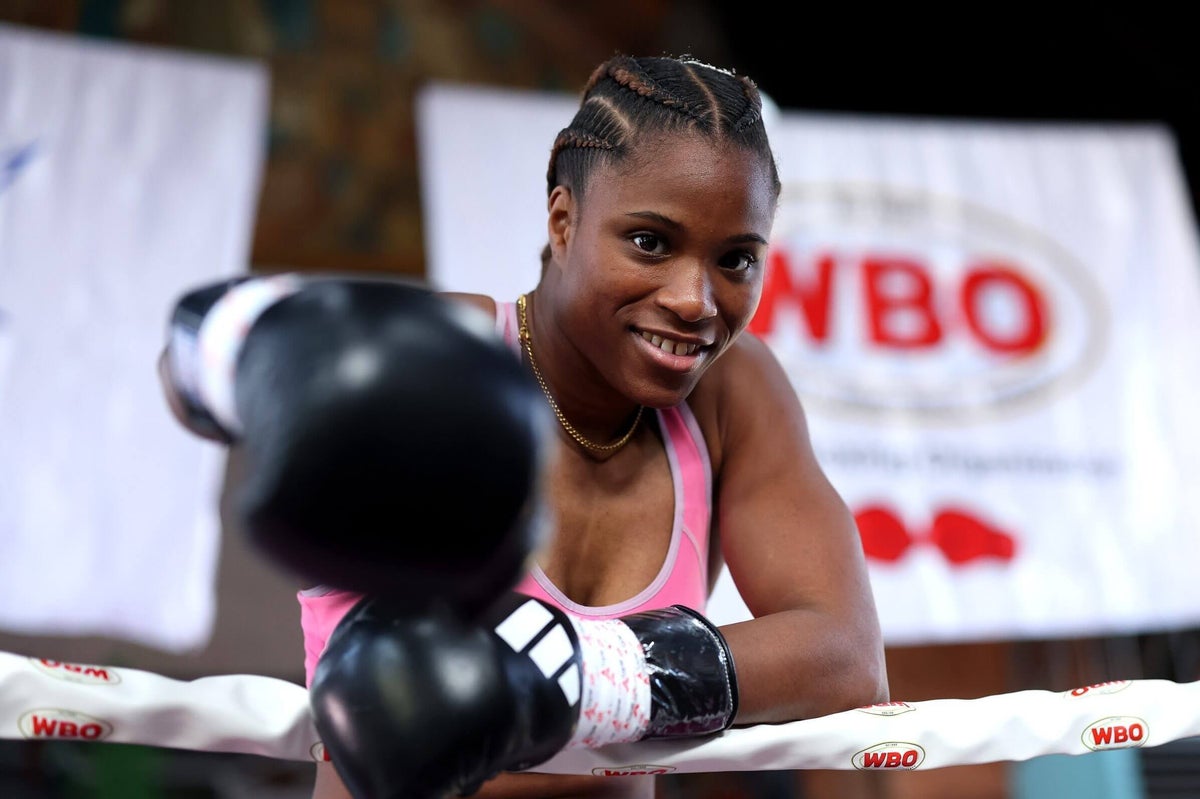
Caroline Dubois may be living in Los Angeles, but do not speak to her about Californian glitz.
“I don’t know if it’s just me or how my mindset is when it comes to camp, but I am an hour away from the beach and I’ve been once for a training day,” says the British world champion lightweight, speaking via a video call.
“I’m about a half-hour away from Beverly Hills as well, but I’ve not seen that yet. I’ve been here six weeks and it is train, home to rest, back to the gym to train, home to rest again. I watch films, some boxing, read. That’s as exciting as it gets.”
Dubois has good reason to be focused. On Saturday, she defends her WBC and WBO titles against American Amelia Moore on Jake Paul’s Most Valuable Promotions (MVP) card in Birmingham, England — her first fight since a surprise split from her long-time coach Shane McGuigan, who guided her from amateur standout to becoming a unified world champion with 13 wins and one draw. She is now trained by American Manny Robles, a switch that caused ripples of shock throughout women’s boxing.
Why do it?
“I’m not going to get into the reasons too much,” Dubois says. “I think the more important thing is that, one, the training has been so different. Sparring has been really high level. And everything that I’ve been wanting and I’ve been looking for, you know, I’ve been ticking those boxes.
“People have been saying, ‘Usually people leave coaches after they’ve lost or after something bad happened.’ And I just think, ‘You know, I ain’t going to wait for that.’ If I feel like I need something, I’m going to go out there and get it. I don’t need to wait to mess up to make a decision that is already sitting in my head.
“The most important thing is to continue to develop, not just as an athlete, but as a person. I feel like I’m doing that, I’m very happy.”

Caroline Dubois has split from her former coach Shane McGuigan (Richard Pelham/Getty Images)
Dubois’ split with McGuigan was all the more surprising given he had been a constant in her life during a period of personal turbulence. In 2024, Caroline, one of her brothers and one of her sisters (she comes from a family of 11 children) effectively split from the rest of their family after a breakdown in relations with their father, Stan (who also goes by the name Dave).
Another of Dubois’ brothers, Daniel, is a heavyweight world champion in his own right, having also been schooled under Stan’s strict, boxing-focused lifestyle which Caroline has previously called “overbearing”. Daniel was also coached by McGuigan at the time, but he moved from the gym under his father’s instruction and Caroline stayed put. The siblings are not on speaking terms.
It feels like a lot for anyone to cope with, let alone a fighter in her early 20s trying to make her way in a notoriously unforgiving profession. Yet Dubois exudes positivity and self-belief, perhaps not surprisingly given this is the same fighter who, as a nine-year-old, tucked her hair into a cap and pretended to be a boy called ‘Colin’ so she could train at a males-only gym in London.
“The worst position to be in at the end of your life is if you’ve got a million regrets,” she says. “You don’t want to be like, ‘The reason why I’m not happy or satisfied with my career is because of this person or that person’.
“With my family situation, obviously it’s very personal and very complicated, but I look at the decision and, again, no regrets, a hundred per cent accountability.

Caroline Dubois with her brother Daniel in 2019 (James Chance/Getty Images)
“To live the life you want to live, you do have to make sacrifices. And these are some of the sacrifices that I make and not just myself, but my brother and my sister as well. And I’m just proud of our journey together and what we’ve achieved. And it is only just the start.”
Dubois has had no shortage of role models as she seeks to carve her own path in boxing. One of them is Claressa Shields, the multi-weight U.S. world champion who Dubois believes shows young women they can speak up and be confident in themselves.
Shields, 31, came from humble beginnings in Flint, Michigan, to win back-to-back Olympic golds and then world professional titles in five different weight classes. She’s outspoken, brash and labels herself as ‘GWOAT’ – the Greatest Woman of All Time.
Dubois watched Shields’ last fight from her training base in L.A. as she beat Kaye Scott in front of a packed State Farm Arena in Atlanta. Shields is a big fan of Dubois and has attended her fights before.
“Claressa Shields has been one of my biggest inspirations for a very long time and I’ll always be vocal about that,” said Dubois. “What she’s done, where she’s come from, especially, that has inspired me on another level.
“I’m just so proud of her. I was watching the card, of course, and seeing the arena slowly fill up, seeing the crowd just get time for a walkout, her energy… for a woman to do that, an American woman, a woman of colour, I’m just in awe. She’s a legend and has always been very supportive of me. She messages me, checks on how I’m doing.
“She gives me good advice to promote yourself. People are so afraid in the UK to be a little bit outspoken, to come off confident. They’re very afraid of that.
“When you see someone like Claressa, who has been so successful, it lets you know that you can be confident. You can talk your s—. If you believe it, you can say it. Proclaim it before it happens. Speak it into existence. Claressa is the number one for that.”

Caroline Dubois shows off her world title belts with Claressa Shields (Richard Pelham/Getty Images)
Shields is 31, so may not be going anywhere anytime soon, but another superstar is leaving the firmament in the form of Katie Taylor. The Irish fighter is retiring following her September 5 bout against France’s Flora Pili in front of 82,000 fans in Dublin’s Croke Park.
There will be a void left by Taylor, while Puerto Rican Amanda Serrano, who had three epic bouts with Taylor, is also at the end of her career after her 50th victory recently.
Dubois, who features on the undercard of American Mikaela Mayer against England’s Chantelle Cameron in a WBO and WBC super-welterweight bout this weekend, feels the women’s sport needs more than one star to carry it forward.
“The aim is to become undisputed, to be involved in the biggest fights, the biggest nights, the biggest moments possible in women’s boxing,” she said. “I want to be a face, a trendsetter and pushing it.
“But I feel like there can be multiple faces. There doesn’t need to be one unanimous face. It’s a terrible thing when there is, because it means that the sport is dead.
“Look at the men’s sport — there’s loads of different stars. Women’s boxing needs to be that. I want to be a part of it.”
>

There was just enough familiarity to stir sensory memories.
The same slender figure as in 2010. The same rapid, slightly shuffling run-up that looks a little incongruous for such a tall man. The same tight gather, unfurling into a whipped left-arm delivery. The same lean away to the right, which looks like it should completely unbalance him but doesn’t.
Some things were different here, in 2026. The bowling was not quite as quick. The swing not as violent. The hair shorter. The physique more developed. The features more mature — a man now rather than a boy in a man’s body.
But the thing that really remained in the Hundred final, a couple of weeks ago at Lord’s, was a sense of what might have been. What should have been.
Mohammad Amir has enjoyed a good cricket career. He won 36 Test caps and made 123 white-ball appearances for Pakistan. He won the 2009 Twenty20 World Cup and the 2017 Champions Trophy. He has spent much of the last decade on the franchise cricket circuit, making a nice living playing. He has taken 266 first-class wickets at a terrific average of 22.63.
He could have been one of the greats, though, had he not been caught spot-fixing during a Test match when he was just 18. Had he not been banned from all cricket for over four years, and not spent 82 days in prison.
He came back, picked again by Pakistan in 2016, his ban served. He played another 22 Tests after his return and was pretty good. But having lost those four years, he was no longer the astonishing force of his early career, the hurricane of a fast bowler that blew England and Australia away while he was still a teenager. He could have been leading this Pakistan attack today, as they return to Lord’s for the second Test.
If only he had not lost those four years.
It is almost exactly 16 years since one version of Amir’s career died.
The morning of Thursday, August 26, 2010, was rainy, but the weather had cleared by the early afternoon when Amir ran in to bowl the third over of England’s innings, captain Alastair Cook, the batter.
The first delivery was called a no-ball. Usually, when a bowler oversteps his mark, it is by an inch or so. This one was closer to a foot. At first, perhaps because of a collective naivety, there was surprise that he had erred by so much but surely this was just a mistake, a young bowler who had made a misjudgment.
But an air of unease hung around, especially when he did it again the next day. By that point, England were in trouble, 52-5, with Amir responsible for most of that damage, having taken four wickets for zero runs, laying waste to England’s top order.

Mohammad Amir, left, after taking the wicket of Kevin Pietersen at Lord’s in 2010 (Clive Rose/Getty Images)
After a short chat with his captain, Salman Butt, Amir bowled another no ball on the third delivery of the 19th over. Again, it was huge. This time, there was more chat, more brows furrowed.
By Saturday, rumours began that a newspaper story was brewing, one that would implicate some Pakistan players in illicit dealings, maybe even match-fixing. “Please don’t let it be the kid,” said former England captain Nasser Hussain.
It was the kid. A story in the News of the World, a now-defunct Sunday newspaper, revealed that Butt had been caught in a sting operation by the notorious investigative journalist Mazher Mahmood and had taken money to ensure that no balls were bowled at predetermined points of the game.
The theory was that knowing the timing of those no balls would allow gamblers to place bets and profit, which is, needless to say, illegal. It turned out not to be match-fixing, but spot-fixing — the distortion of discrete events that were unlikely to impact the final result of the game.
Butt, along with agent and bookmaker Mazhar Majeed, recruited Amir and his fellow opening bowler Mohammad Asif. Amir later claimed he had refused to take part in the scheme twice, but was pressured into it. He said he didn’t even touch the £1,500 he had been given by Majeed, money that was later found by police in the safe of his hotel room.
After the game, which England came back to win convincingly, the scandal hung thick in the air. A fantastically awkward scene presented itself when Giles Clarke, the famously pompous chairman of the ECB, refused to shake Amir’s hand as he handed over his medal and novelty-sized cheque for £4,000, reward for being named Pakistan’s player of the series.

Giles Clarke awkwardly hands Mohammad Amir his player of the series award in 2010 (Anthony Devlin/PA Images via Getty Images)
On Sky Sports, Michael Holding was on the verge of tears. “An 18-year-old with that sort of talent, for him to be getting involved in this,” he said, voice trembling. “I’m absolutely sure he didn’t go looking for anything. Someone has dragged him into this. And it’s so sad.”
Holding was devastated because the game he loved had been perverted — and he knew what was to come.
Butt, Asif and Amir were quickly banned by the International Cricket Council: Butt for 10 years with five suspended, Asif for seven years with two suspended and Amir for five years. They were later all jailed for 30 months, 12 months and six months respectively for gambling offences.
Amir was released halfway through his sentence, but served all but six months of his ban from cricket.
It is possible, because those initial salvos were so brief, to misremember and exaggerate how good Amir was, to romanticise an incredible talent lost to the game.
Amir tried to play it down, years later, claiming that his early brilliance was a product of circumstance rather than necessarily his own genius. “That year everyone swung the ball,” he told Cricket Monthly in 2020. “The wickets, the overhead conditions.”
But the Lord’s Test was his 14th, and during it he took his 50th wicket at the age of 18 years and 136 days, making him the youngest to reach that mark. Cricinfo praised his “fighting attitude, his perseverance, his knack of reading batters’ grey areas”. He made batters old enough to be his father look like fools: he dismissed Andrew Strauss and Ricky Ponting four times, Mike Hussey three.
He was breathtakingly good, unplayable at times, particularly in helpful English conditions as his swinging deliveries fizzed at batters like tracer bullets. For a teenager, his mastery was remarkable. At the time, it was difficult to think of anyone who had been so good, so young.

Mohammad Amir burst onto the Test scene as a teenager (Anthony Devlin/PA Images via Getty Images)
“He was incredibly special,” says Mickey Arthur, coach of Pakistan from 2016 when Amir returned, and a man the bowler has cited as one of the key influences on his post-suspension career.
The question is inevitable: how good could he have been were it not for his ban?
“He’d be one of the all-time greats,” says Arthur. “He would have been up there in terms of Test wickets. Around that period of time, he would have been in the top three fast bowlers in world cricket.”
The four and a half years he missed, between the ages of 18 and 22, are crucial for any bowler’s development. Not peak years, but the time when many discover what sort of cricketer they are, and what they are going to be. Amir spent those years unable to play the sort of cricket that could have developed him further.
“People have to understand that age, rhythm… I had played consistently then and had a rhythm about my bowling, a confidence,” Amir told Cricket Monthly.
His return caused a stir. When he was picked for the Pakistan ODI team at the end of 2015, captain Azhar Ali and batter Mohammad Hafeez initially refused to join up with the squad, uncomfortable with his presence, although both later recanted and played.
When he was recalled to the Test team, ironically playing his first game back at Lord’s against England in May 2016, he was barracked from the terraces, tedious bores shouting, “No ball!” every time he bowled.
“When he came back, it was almost starting all over again,” says Arthur. “He had to learn to match the intensity, the tempo, the skill (he had before). The toll it took on him was huge. And yet what I saw was I saw a focused guy who just took it in his stride, and ultimately now he’s got the best out of himself.”
Amir seems contented with his lot now.
He views his years away as a blessing in some respects, largely because without them, he would not have met his wife, Narjis, who was part of his legal team. She is British, which allowed him to compete as a ‘home’ player in county cricket and the Hundred this year. The couple have three children and live in England.
Amir credits her with helping him return to cricket after his ban. “I’m the luckiest one that I have her in my life. She always tries to guide me,” he told Wisden this year. “For me, in 2010, everything was done, finished. When I came back in 2015, I was starting from zero. The five years were the toughest time in my life.”
Arthur isn’t far behind Narjis for influence on his career. “Him and I connected,” Arthur says. “You connect with a certain number of people in your coaching career. Once I connected with him and I heard exactly what had happened, I had absolutely no reservation (about picking him again). I saw a guy who just wanted to play, represent his country, and fulfil his potential.
“I’d like to think I gave him security. Hopefully, I was kind of a safety net for him, someone he could talk to about a lot of stuff.”
Amir rebuilt his career into something that the top one per cent of professional cricketers would be delighted with. From where he was, carrying around the stigma he had, it is extraordinary that he came back at all.
He retired from Test cricket in 2019, and then from all international cricket twice — first in 2020 and finally in 2024 — and now travels the world, as many cricketers do, playing for various franchises. He was one of the top bowlers at the Hundred this year, with his Trent Rockets side coming close to winning the whole thing. He has still got ‘it’, or at least a version of ‘it’, even if this ‘it’ isn’t quite the same ‘it’ as it was when he was 18.

Mohammad Amir helped Trent Rockets make The Hundred final this summer (Gareth Copley/Getty Images)
“His skill is incredible,” says Arthur. “He’s still got that skill now. Sure, he’s refined it a little bit. He doesn’t have the pace he had. But in terms of his execution of what he wants to do, he’s magnificent.”
In our contemplation of the alternative reality where there was no spot-fixing, and Amir did not miss those four years and went on to have one of the all-time careers, perhaps we are guilty — not of overstating Amir’s pre-ban brilliance, but of assuming he would continue to be that good in the long term, of thinking it was sustainable.
Sport is littered with examples of athletes who peaked early and then could not live up to those standards. Cricket in Pakistan has a reputation for being chaotic, so even if he continued his otherworldly greatness, there is no guarantee his career arc would have been a steady ascension to the top.
But watching Pakistan’s flaying by England in the first Test at Headingley last week, and watching the 34-year-old Amir still bowl to a high level in the Hundred, and thinking back to just how exhilarating he was at 18, it is impossible not to feel slightly sad. Not to picture him still leading their attack in 2026, with 100 Tests and 500 wickets to his name. Not to think of what might have been. What should have been.
>

The rise of Arsenal’s Christos Tzolis: PAOK breakthrough, set-piece assists, showing ‘funny’ side

Caroline Dubois is the world champion who split from her coach and family – and has ‘no regrets’

Pakistan, Mohammad Amir and what should have been
-

 movies3 months ago
Search For Canadian TV Actor Stewart McLean Now Homicide Investigation
-

 Fashion9 years ago
These ’90s fashion trends are making a comeback in 2017
-
Fashion9 years ago
According to Dior Couture, this taboo fashion accessory is back
-
Fashion9 years ago
Model Jocelyn Chew’s Instagram is the best vacation you’ve ever had
-
Fashion9 years ago
Emily Ratajkowski channels back-to-school style
-
Fashion9 years ago
9 Celebrities who have spoken out about being photoshopped
-
Fashion9 years ago
Your comprehensive guide to this fall’s biggest trends
-

 Anime3 months ago
Rurouni Kenshin: Hokkaido Arc Manga Takes 1-Issue Break – News