Sports
Will Cale Makar’s record-breaking extension kick-start Wild-Quinn Hughes negotiations?
ST. PAUL, Minn. — On Friday, Cale Makar set a new market for superstar defensemen. Now we’ll see if doing so kick-starts the Minnesota Wild’s negotiations with Quinn Hughes, with training camp less than three weeks away and the start of the season in less than five.
At least now, there’s a legitimate comparable contract.
Makar, a two-time Norris Trophy winner and a former Calder Trophy and Conn Smythe Trophy winner, became the NHL’s first $20 million man, signing an eight-year, $163.2 million extension that will kick in July 1, 2027. That’s a $20.4 million average annual value. The max Makar could have received is 20 percent of the $104 million 2026-27 cap, or $20.8 million annually, so he came within a hair of that.
Hughes, who also has won a Norris Trophy, is entering the final year of his contract and would become a free agent July 1 if he doesn’t extend before then. If he signs before July 1, he would max out at a $20.8 million AAV. If he waited until after July 1 to sign with another team, he’d be allowed to max out at 20 percent of the 2027-28 cap, which is expected to be $113.5 million. That’d be a $22.7 million AAV.
However, the max term he could sign for on another team after July 1 would be six years. He would be allowed to sign an eight-year deal, like Makar, if he re-signs before Sept. 15. If the extension came after, the max term would be seven years under the new CBA.
Of course, term may not be the issue, because Hughes seems to want a shorter deal, as most of today’s stars have been signing.
In fact, earlier this summer, when Wild owner Craig Leipold appeared on Minnesota Public Radio, he said that the team would “want to go as long as we could” but that Hughes “would probably want it to be a little shorter — maybe three years.”
“Hopefully we’ll end up at five,” Leipold said.
Why sports leagues finally embraced Las Vegas
Tifo Sports
The Wild have been in talks with Hughes and his agent, Pat Brisson, throughout the summer and remain confident that they can get an extension done before the start of the season. They’ve gone over different concepts of what a deal might look like, from term to average annual value to contract structure.
Hughes, who has been training in Michigan and Florida over the past month, is expected to return to Minnesota on Sept. 10 after representing the Wild at the NHL/NHLPA Player Media Tour in Las Vegas with teammate Matt Boldy.
The changing landscape in NHL salaries over the past year is part of what’s made negotiations like Hughes’ increasingly complicated, and Makar’s is the new standard.
Makar’s $20.4 million AAV surpasses the Chicago Blackhawks’ Bowen Byram ($12.5 million AAV for six years) as the largest AAV signed by a defenseman. Byram’s extension is also set for 2027-28.
Theoretically, by this comp, Hughes’ AAV should be less than Makar’s $20.4 million if he signs for three to five years. But, like last September when the Wild felt pressure to give Kirill Kaprizov the then-largest contract in NHL history (eight years, $136 million, $17 million AAV), there is immense pressure to re-sign Hughes.
The Wild couldn’t afford to let Kaprizov walk. Similarly, they took the risk of trading the equivalent of four first-round picks (Marco Rossi, Zeev Buium, Liam Öhgren and a 2026 first-rounder) for Hughes without the guarantee of an extension, so there is incredible pressure to ensure they re-up Hughes after giving up such a large package.
President of hockey operations and general manager Bill Guerin has said that the franchise is in “win now” mode more than ever before and that it needs to take advantage of this window.
Kaprizov’s eye-popping $17 million AAV deal set a new bar, both league-wide and with the Wild. The Wild structured Kaprizov’s deal to give him $128 million of his $136 million in annual July 1 signing bonuses. Hughes could very well want a large chunk in signing bonuses, too, which would be quite a financial commitment for Leipold.
Makar received $127.6 million in signing bonuses.
According to The Athletic’s Dom Luszczyszyn earlier this summer, Hughes’ market value on an eight-year deal was $17.8 million. It went down to $17.7 million on a five-year deal and $17.5 million on a three-year deal.
He has Makar at $21.6 million.
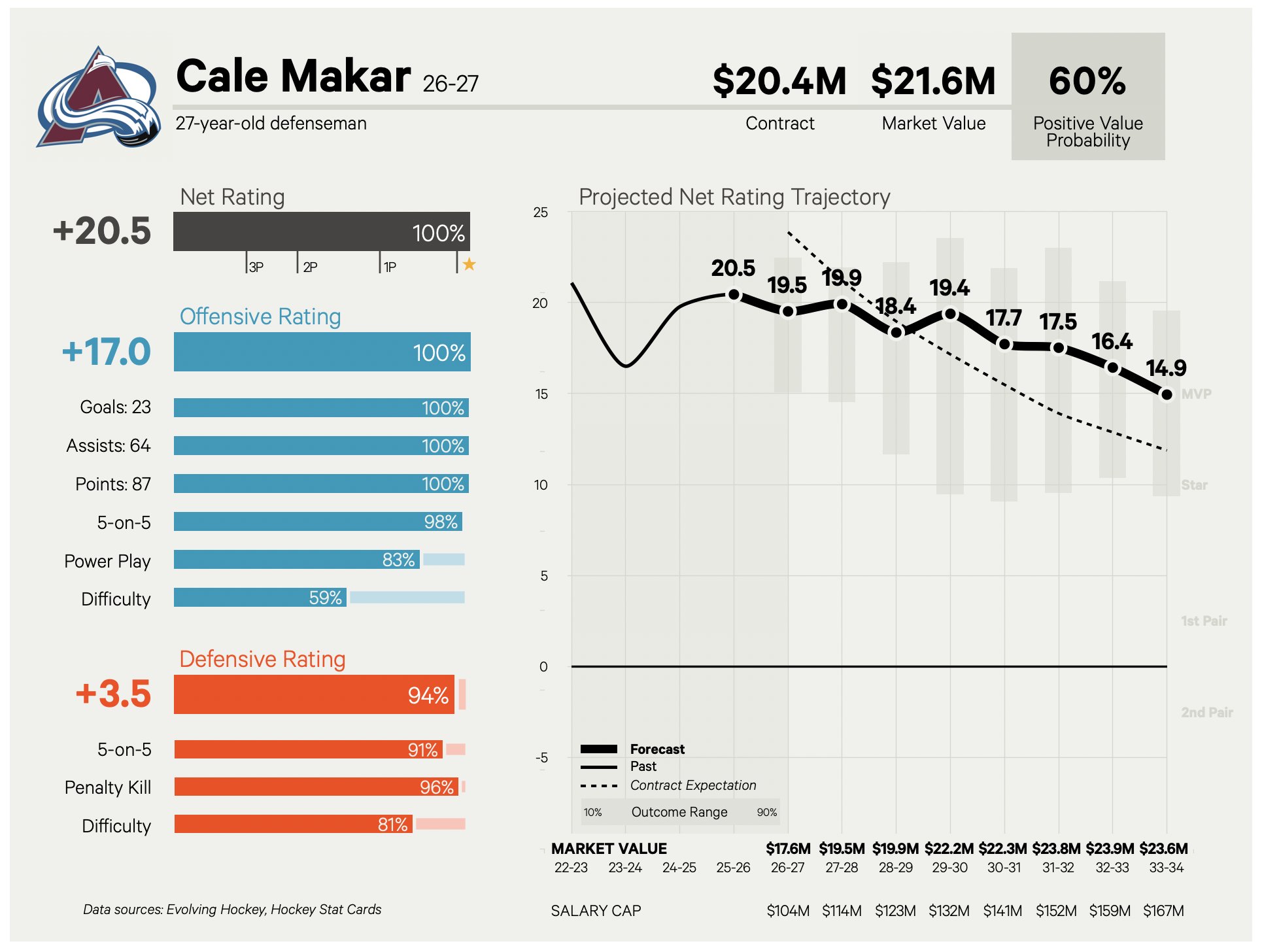

But Hughes’ market value could be irrelevant for three reasons: 1) The internal pressure to re-sign him; 2) The fact Makar created this new bar, and Hughes is the only defenseman in the same tier; and 3) Kaprizov signed for 16.3 percent of the cap, which would already be $18.5 million in relation to the 2027-28 $113.5 million cap ceiling.
After Kaprizov’s blockbuster deal last fall, this summer’s offer sheet by the Philadelphia Flyers for young Anaheim Ducks star Leo Carlsson (which Anaheim matched at an $18 million AAV) continued to push the envelope. Macklin Celebrini, already one of the game’s top players at 20 years old, then signed a five-year deal with a then-league-record $18.8 million AAV.
Hughes will earn $8.25 million this season and carry a cap hit of $7.85 million.
Like Makar, Hughes is among the game’s best players overall — “in the top group of stars” regardless of position, analyst and former GM Craig Button told The Athletic — and they will both be paid like it on their next deals, one way or another.
>