
A young Mariska Hargitay with her mother, Jayne Mansfield.
Courtesy of HBO


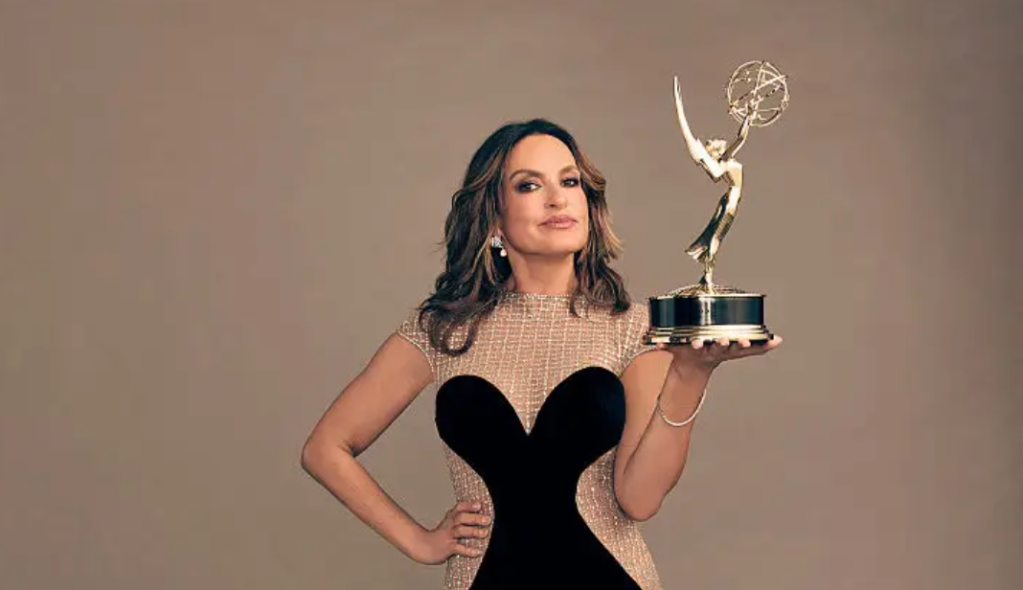
Mariska Hargitay is warming up to host the televised Primetime Emmy Awards in the best way imaginable – by winning two Emmys for her documentary My Mom Jayne.
The HBO film in which Hargitay explores the life and career of her late mother, the actress Jayne Mansfield, as well as a mystery over Mariska’s biological father, won Outstanding Documentary or Nonfiction Special. Hargitay also claimed the Emmy for Outstanding Directing for a Documentary/Nonfiction Program.
The honors came as the 78th Annual Primetime Emmy Awards kicked off Saturday night in Los Angeles with what were formerly called the Creative Arts Emmys. The show will continue Sunday evening from the Peacock Theater downtown, leading up to the televised Primetime Emmys on Monday, September 14 (airing on NBC and the Peacock streaming platform).
Accepting the award for Documentary or Nonfiction Special, Hargitay acknowledged the feminist icon Gloria Steinem, who died Wednesday at the age of 92.
“My hero and friend Gloria Steinem recently said, ‘Please tell your own story,’” Hargitay shared. “The most important thing we can do for each other is to know each other through stories. I got to know my mother through telling the story. It’s a gift that’s indescribable.”
A young Mariska Hargitay with her mother, Jayne Mansfield.
Courtesy of HBO
Accepting the trophy for directing, Hargitay commented, “I’m utterly overwhelmed. I just wanted to share with you that it took me a while when I decided to make this film during the pandemic. It took me a while to realize that this was my story to tell. I could direct it.”
And she alluded again to Steinem’s counsel to women about “telling your own story,” saying, “I just want that invitation to go out, especially to women. I’m so excited to explore and discover and innovate new ways of telling stories from half of the earth’s population because we don’t hear from you enough. I can’t wait to get to know you.”
It’s been an extraordinary year-plus for Hargitay, who is entering the 28th season as the star of Law & Order: SVU. In addition to premiering My Mom Jayne, she made her Broadway debut in Every Brilliant Thing, and then agreed to take on the challenge of hosting the Primetime Emmy Awards.
“Dreaming is actually part of planning,” Hargitay said backstage at the Emmys after her two wins. “I’m at a place in my life where I just say yes, I said yes to Broadway, and I said yes to hosting the Emmys. When they called me, they thought it was a joke. It’s a year of firsts and a year of saying yes. Not limiting myself or not being governed by fear. What if it all works out? That’s the process of art. I’m in that place right now, I’ll figure it out. I’m really happy right now.”
In the Outstanding Documentary or Nonfiction Special category, My Mom Jayne triumphed over John Candy: I Like Me; Marty, Life Is Short; Mel Brooks: The 99 Year Old Man!, and Ocean with David Attenborough (the latter film won Outstanding Cinematography for a Nonfiction Program and Outstanding Sound Editing For A Nonfiction Or Reality Program).
In the documentary directing category, Hargitay was up against Lawrence Kasdan of Marty, Life Is Short; Judd Apatow and Michael Bonfiglio of Mel Brooks: The 99 Year Old Man!; Alexandria Stapelton for Sean Combs: The Reckoning, and Rebecca Miller for Mr. Scorsese.
‘Mr. Scorsese’ director Rebecca with Martin Scorsese
Courtesy of Apple TV
Miller, however, isn’t going home empty-handed. Her five-part docuseries about legendary filmmaker Martin Scorsese won the marquee category of Outstanding Documentary or Nonfiction Series. Robert De Niro, Leonardo DiCaprio, Jodie Foster, screenwriters Paul Schrader and Nicholas Pileggi, Spike Lee, and Daniel Day-Lewis (Miller’s husband) are among the luminaries who appear in the series.
Scorsese himself sat down for intimate interviews in which he addressed his career highs and some early lows, his complicated romantic life, and his upbringing as an asthmatic child in New York City.
>
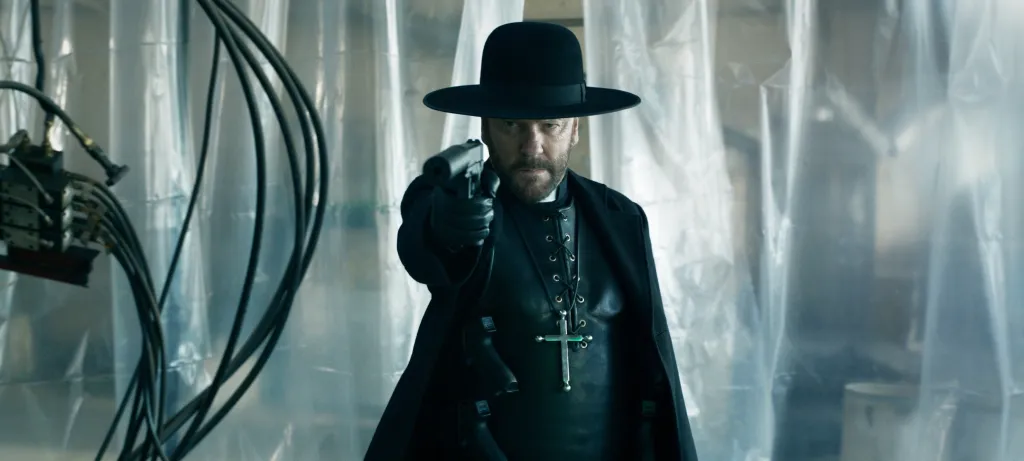
Did you ever feel that King of New York could have done with a bit more Wing Chun? Did you ever think that John Woo’s films weren’t quite Catholic enough? That the siege of Troy might have been handled a bit more successfully if the Greeks had a bazooka? If your answer is yes to even one of these questions, then Barthélémy Grossmann’s old-school beat-’em-is for you, a violent multifaith mob movie with a script so fantastically absurd it can only come from the mind of French auteur Luc Besson, who somehow segued from Le Cinema du Look of the ’80s to Le Cinema du Kaboom of the ’90s.
It’s been 32 years since Besson unveiled his international breakout hit Léon, but it’s yesterday once more in Father Joe, which begins in uptown New York, sometime in the pre-internet ’90s, with the unmistakable sounds of the Notorious B.I.G. blasting out on the radio of a blinged-out town car. Veteran gangster Lino (Michael Rispoli) is taking his trophy girlfriend into the depths of a desolate industrial estate, where bored lackeys with guns and gold chains keep watch. “People would kill to know about this place,” he says, which isn’t quite the flex he thinks it is, and his date is right to be nervous.
“This place” is a drug lab, and while Lino is checking out his investment, a man in black starts picking of his crew with the stealth of a ninja and the armory of the Marine Corp. After shooting Lino in the foot, the stranger reveals himself as Father Joe (Kiefer Sutherland), an actual priest who takes on Manhattan’s drug dealers wearing his work clothes. “I’m here to put you back on the right track,” he says, and orders him to confess.
Being a good Catholic boy, as all mobsters used to be, Lino does so, and Father Joe lets him live on two conditions: One, no selling drugs to kids under the age of 21. “You can’t save everyone,” he reasons, with a strangely beatific smile. The other condition is way more Bessonian: Father Joe injects Lino with a complex homemade virus that will become deadly within seven days. To stay alive, Lino must attend Communion every week at Father Joe’s Church on 118th Street, where he will be given a temporary antidote. But when Lino arrives at the church, he is surprised to see a number of other wiseguys, who line up to take a little blue pill while everyone else gets a wafer.
Father Joe’s operation, which is decimating the local drug trade, is hardly undercover (unless you count the secret arms chamber behind a statue of the Virgin Mary), and pretty soon it comes to the attention of crime boss Giu (Al Pacino), who has noticed a dip in takings lately. Giu pays Father Joe a visit and gets infected with the same virus after being lured into the confession box. Giu, however, is not as gullible as the men who work for him and gets himself to the hospital for a thorough medical. While Giu is doing this, the story shifts up a gear. Vulnerable local children have started going missing, which may or may not have something to do with a privately run hospital, where rich parents pay through the nose for organ transplants of a very dubious provenance.
This sudden shift from drugs to body parts suggests that Father Joe may have been intended as a mini-series (or at the very least a comic book), having the freewheeling quality of ’the ’70s TV show Kung Fu. Father Joe himself certainly has the backstory for it, being a war veteran who married an Asian woman who died young and lost his grieving daughter to an overdose. This not only explains Father Joe’s benevolence, it also opens up room for a sassy sidekick: 16-year-old drug casualty Felicity, who’s played by Ever Anderson, daughter of The Fifth Element star Milla Jovovich. A child from a broken home, Felicity soon goes native and wants in on Father Joe’s set-up, much to his horror.
Despite this strange digression, Besson’s script soon gets back on track when Giu gets the results of his tests back and declares war on Father Joe. And this does mean war; Grossmann’s deliriously violent actioner commands an insane amount of firepower but still finds time for some classic throwbacks — such as a fantastically staged fist fight in an elevator — while the body count climbs into the heights of a Takeshi Miike movie.
Amazingly, Al Pacino is about the only thing that isn’t over the top here, generously giving center stage to Keifer Sutherland in a role that’s fun, unbelievable — and sometimes unbelievably funny (wait for the cardinal to deliver the punchline) — but, like Besson’s 2023 film Dogman, it’s never laughable, such is everyone’s commitment. Is it any good? Who knows. It’s certainly the most balls-out, no-f*cks-given rock’n’roll phenomenon to hit the Lido this year — and that includes the Gallagher brothers.
Title: Father Joe
Festival: Venice (Venice Open – Out Of Competition)
Director: Barthélémy Grossmann
Screenwriter: Luc Besson
Cast: Kiefer Sutherland, Ever Anderson, Al Pacino, Michael Rispoli
World sales: Kinology
Running time: 1 hr 46 mins
>
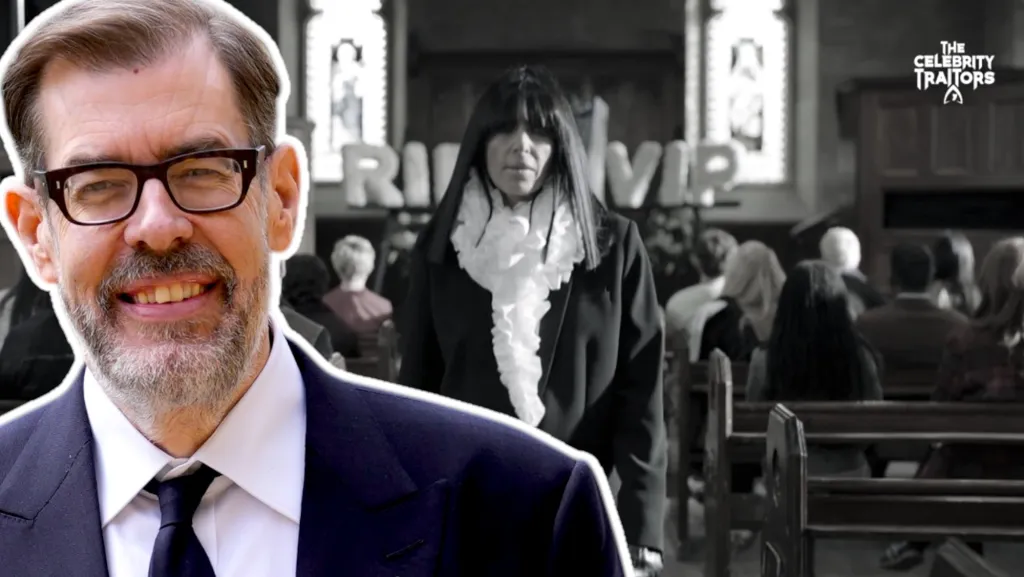
Richard Osman has apparently let slip that The Celebrity Traitors will return to the BBC this month.
Speaking on-stage during a live episode of The Rest Is Entertainment podcast in London, Osman told the audience that The Celebrity Traitors will premiere on September 23.
Osman and co-host Marina Hyde were interviewing special guest Joe Marler, the former England rugby player who has become a fixture on UK television since appearing in Season 1 of The Celebrity Traitors.
Per a Press Association report, Marler was asked what advice he would give contestants when he speculated on Season 2’s premiere date: “What is it, September 23, the next series?”
Osman chimed in: “By the way, to point out, it’s absolutely embargoed that it starts on September 23 … let’s talk about what we call the events of September 23 this year … the cat’s out of the bag, isn’t it? Not to repeat it.”
A BBC insider joked that they did not realize Marler was “moonlighting in the BBC One scheduling team,” but did not deny that September 23 was the premiere date.
During the conversation at London’s Southbank Centre on Saturday, Osman said he had heard from Season 2 celebrities that it “was quite intense” to film.
Deadline has also heard chatter about Season 2, with one well-placed source describing it as a “nightmare” that was tricky for producers Studio Lambert.
Marler shed a little more light. He told Osman and Hyde: “I believe it was a slightly different emotion than our experience. Ours was very laugh-led, and everyone was sort of enjoying catching up, you know, pratting about to the point where they [the producers] went: ‘Guys, we’re trying to play a game.’
He continued: “Whereas this lot really want it from the start, and then I guess they see how well the first series has gone and there’s a little bit of pressure on them to be like: ‘Oh, I’d quite like a bit of that.’”
Speaking at the Edinburgh TV Festival last month, BBC content chief Kate Phillips revealed that there will be tears and surprises in the new season, hosted by Claudia Winkleman.
The show will feature an eye-catching cast including The Last of Us star Bella Ramsey, Good Omens actor Michael Sheen, and Oscar-nominated Richard E. Grant. Others include Industry star Myha’la, Barbie actress Sharon Rooney, Love Island host Maya Jama, Broadchurch’s Julie Hesmondhalgh, and Jerry Hall, the model and actress who was married to Mick Jagger.
Season 1 of The Celebrity Traitors was the most-watched show on British TV last year. It debuted on BBC iPlayer and BBC One in October 2025 and was seen by an average audience of 14.9M, with a peak of 15.4M for the finale. Comedian Alan Carr emerged victorious in a game that featured Stephen Fry and Celia Imrie.
The Celebrity Traitors is produced by Studio Lambert Scotland for BBC One and iPlayer and has been commissioned by Kalpna Patel-Knight, Head of Entertainment Commissioning for the BBC.
The executive producers for All3Media-backed Studio Lambert are Mike Cotton, Sarah Fay, Lewis Thurlow and Katy Fox, with production executives, Lynette Woods-Reynolds, Gemma Scholes and Faye Donaldson. The commissioning editors for the BBC are Neil McCallum and Michael Jochnowitz.
The Traitors (Dutch title: De Verraders) was created and developed by IDTV in cooperation with RTL Creative Unit. All3Media International is global partner for The Traitors and handles format and tape sales worldwide.
>

Danish filmmaker May el-Toukhy, one of the two female directors competing for the Golden Lion this year, in Venice with a sharp, searing analysis of the women thrown to the wolves in the aftermath of World War II.
Women Unknown — Scandinavian in both its aesthetic and precision — was always going to be about class, complicity and survival. For a brief period, it was even going to focus on the Reformation witch hunts, before el-Toukhy found herself a little bored by the perpetrators. “The reasons they were hunting these women were just not that interesting,” she laughs to The Hollywood Reporter.
Inspired by a newspaper picture dated from the 1940s of a woman sitting with a swastika painted on her back, el-Toukhy and co-writer Maren Louise Käehne soon turned their attention to the women whose bodies became a battlefield during the Second World War; those who found themselves with no choice but to fall into the arms of soldiers from occupying armies, and suffered severe consequences — hunted down, publicly shamed and punished for the rest of their lives.
Woman Unknown is backdropped by a Danish city free from Nazi occupation, mere months after World War II has ended. It tells the story of Marie (Mathilde Arcel), a young nanny and housemaid about to marry her wealthy, older, and widowed employer, Christian (Carsten Bjørnlund). But Marie guards a shameful secret. During the war, she was in an intimate relationship with a German soldier. Now Marie’s past threatens to catch up with her, and she is forced to do everything in her power to preserve her new status as lady of the house in post-war anarchy.
It is as much about resistance and patriotism in a euphoric, liberated Europe as it is about the chastisement of women and their sex lives. El-Toukhy is adamant that this is a story about the female experience. “There have been so many films about the Second World War, and that is true. But they’re all based mostly on men’s experiences and recollections of war. So that really energized me,” she says. “Let’s just do another 100 films about the women in this time period, and then we can say we’re over and done with it, you know?”
A co-production between Denmark, Sweden and Latvia, financing the film wasn’t the tallest hurdle — but el-Toukhy has learned to be economical with her resources at a time when filmmaking costs have never higher. With her third feature film, following Long Story Short (2015) and Queen of Hearts (2019), she comes to the Lido buoyed by the hope that Woman Unknown will produce debate. El-Toukhy spoke to THR about the far-and-wide casting search for Marie, why she feels she’s already won before even stepping foot in Italy and whether those nerves have begun to kick in: “I’ve worked 16 hours a day for more than a year. I’ve spent all my savings. I’ve used every part of me to make this film and all the resources, all the muscle power I have. I can’t really do any more, so therefore I feel okay.”
I’m curious about this period of Danish history, and whether you learned about it at school. Why use it as a backdrop for this film?
After my last film, I thought I was going to do a film on the witch hunts after the Reformation, in the middle of [the] 1500s, and so I started researching that subject matter. But I found it quite hard to engage with the perpetrators because the reasons they were hunting these women were just not that interesting. (Laughs.) At that time, me and my co-writer were slowly moving away from that idea, and then while we were moving away from that idea, some photos got republished in the newspaper with a woman who was sitting on a bench with a swastika painted on her back. And she [had been] assaulted in these photographs. Those [were] the propaganda photos that were produced in 1943. So we were reminded of that issue.
It is something that we do learn in school here. It’s part of the curriculum — to deal with the First World War, Second World War, the events between the two wars and the aftermath, but often the aftermath here, in schools, would be focused on the politics, the collaboration the Danish government chose at that time and also the resistance movement. We didn’t spend too much time in school dealing with or talking about [or] debating the destiny of these women. I’m always interested in investigating something that takes a lot for me to engage in; that’s difficult material. Where there’s no black and white, but everything is gray.
And you chose to depict that woman in that photograph in the film.
Yeah. In the propaganda photos, they were reproducing this image of a woman who has been assaulted, but then when I started digging, [I found] an archive [of them]… I think what’s interesting about the situation itself is it’s a societal, structural mob mentality. It’s fellow citizens who are punishing these women. It doesn’t come from the government. The government actually tried to remove these women from the streets — to protect them — but they didn’t manage very well. And sometimes, even on the way to a camp, a woman would be assaulted, even though she was supposed to be protected by the government. For me, it was quite important to really show an audience what this feels like. They didn’t get killed, these women, but their souls were hurt and they were stigmatized and traumatized for life.
How did you find your way to Marie as a character, and her story?
I think there’s a class aspect in the story that I’m very drawn to, and also I had that thematic base in my last film. She’s a young woman who is moving away from the area she knows and her family and takes a job in a big city. [She] probably feels protected by living in a big city compared to being at home where she can be more exposed. She’s a woman who is struggling to survive. I might not agree with some of her actions, but I completely understand where that survival instinct comes from, and the idea that she wants to protect what she’s fought to obtain.

Mathilde Arcel as Marie in ‘Woman Unknown’
Venice Film Festival
What went into that casting search for Marie, and why was Mathilde right for it? As the title suggests, she’s very elusive for much of the film, up until her unraveling.
I always have quite extensive casting processes, partly because I come from theater, but also because I really enjoy [it]. Casting a lead is, for me, like casting a creative partner. So I have to fall in love with the gaze of that person and their take on the character, and therefore I do many rounds and many callbacks. I did that with Mathilde as well, and some of it was improv, some of it was table readings, some of it was written scenes. I think what’s fantastic about Mathilde is that she has so much mystery to her and the way she’s chosen to interpret the character inspired me as a writer-director. That collaboration is key for me, and therefore I spend a lot of time figuring out which direction I want to go [in]. I’ve really enjoyed working with her, and I think she’s extremely talented.
So mysterious but so expressive too.
Yes, yes.
One of the themes that stood out to me was complicity and what it means to be complicit when that head-down mentality is still so entrenched and the hangover of the war so menacing. What were you trying to speak to in this context?
The film is not so much [about] giving answers to what’s right and wrong, but to debate what’s right and wrong, or what’s possibly right and what’s possibly wrong. It’s all a bit murky and muddy. Throughout the development of the film, it’s been quite important for me to to not tell the audience — or the readers, in the development of the script — what they should think, but create a situation where the audience can dive into that discussion with themselves or the people they’ve watched the film with.
And it’s not only in that time, because I think it’s present also today — in many conflicts. It’s quite hard to to say that it’s just one thing, and the ability to contain two opposite thoughts at the same time is quite hard. Both can be true, and that’s my ambition with the film. Obviously, I have my own opinion about what’s going on in the film, but I think it’s quite important for me as a storyteller that there is room for reflection for the audience.
It’s also very much a female-driven story. Do you think this is a period of history for women that isn’t depicted on screen enough? Is it an underrepresented story you’re telling?
When I first started the process of developing the script with my co-writer, I would pitch the idea when people ask me: “What are you doing? What are you working on right now?” I started to semi-pitch it, just to see how people would react and what they respond to. And I could see that they would glaze over. (Laughs.) They would have this empty gaze, because I think there have been so many films about the Second World War, and that is true. But they’re all based mostly on men’s experiences and recollections of war. So that really energized me.
Yes, there have been a lot of films about this period [of history], but let’s just do another 100 films about the women in this time period, and then we can say we’re over and done with it, you know? The invisibility of women is everywhere, and certainly in cinema and in our films. So I don’t think we’re finished with the period, but it also sparked the idea of trying to make this film look different than a classical period piece, and to constantly disrupt the idea of a classical period piece. So that’s been an ongoing process of developing and shooting and in post[-production].
How long did it take you to get this film off the ground? I know it’s a co-production which must have helped.
The process has been long, but not too long. I did my last film, then once it had premiered at Sundance and had the festival run and premiered in Denmark, I started to develop this film — first with the witch idea and then turning to these horizontal collaborators. Then COVID happened… I worked intensively on the script, and we [were in a place where we] could start the financing. But the financing part of it hasn’t been that difficult in the sense that we’ve had a lot of yeses. We’ve had so many people wanting to do this film. The problem in European cinema is that we don’t get very far with the money we get. There’s been an increase of costs after COVID, everything has gone up, and so we have to work faster in every part of the process. That’s been the challenge with this film, not so much getting the money, but getting far enough with the money we managed to get.
What did it mean to you to find out this would be premiering in competition in Venice?
I’m delighted that it’s part of this historic festival and that also this theme gets to be exposed for a European audience. I think it’s very important that we keep reminding ourselves of our past and these stories, so that we understand and we analyze and we debate to be able to handle the present and the future differently — if possible. I don’t think it is. But I’m really happy, [Venice is] the best place to be for European film right now.
I’m excited. I have this place inside of me where I can go after I’ve made a film. I’ve spent all the time I possibly could on this film. I’ve worked 16 hours a day for more than a year. I’ve spent all my savings. I’ve used every part of me to make this film and all the resources, all the muscle power I have. I can’t really do any more, so therefore I feel okay. Slightly anxious, and I think that’s only natural.
There must be a really liberating feeling of finally being able to send it out into the world.
Yeah. And I think getting into the festival and being in competition, I’ve already won.
How can exposure in Venice help a filmmaker like yourself and your career?
[Festivals are] important for the arthouse [films] because it’s a market. It’s also a place where you, as a filmmaker, can create new relationships that you can build on later down the line. But for me, it’s really about the audience that’s there. Through a festival, you can access an audience if you have enough buyers that take the film and they then distribute it around the world. And I think it’s quite important for me as a filmmaker to cling on to [the audience], because it’s so easy to be distracted by other things that are equally nice and shiny and attractive. But especially the way we finance film in Scandinavia, where it’s publicly funded, I think it’s really important that these films find their audience. None of us have that crystal ball where we can look into it and say, “Okay, if I put this person into a film with this theme and shoot…” But that’s really the hope for me, that this film will find its audience.
Are you already thinking about the next one?
I can’t help thinking about the next and the next and the next, especially when I go cycling or walking or hiking. But I don’t have that much spare time right now. So, most of my energy is channelled into promoting this film. I’m in the service of this film still.
The 2026 Venice Film Festival runs Sept. 2-12.
>


Search For Canadian TV Actor Stewart McLean Now Homicide Investigation


These ’90s fashion trends are making a comeback in 2017
According to Dior Couture, this taboo fashion accessory is back
Model Jocelyn Chew’s Instagram is the best vacation you’ve ever had
Emily Ratajkowski channels back-to-school style
9 Celebrities who have spoken out about being photoshopped


Rurouni Kenshin: Hokkaido Arc Manga Takes 1-Issue Break – News


HIDIVE to Stream English Dubs for The World Is Dancing, The Forsaken Saintess and Her Foodie Roadtrip in Another World, The Dangers in My Heart: The Movie Anime – News