
Sports
Kyler Murray’s concussion: How the NFL protocol works and what happens next


Kyler Murray left his debut with the Minnesota Vikings on Sunday and was placed in the NFL’s concussion protocol after taking a hit to the helmet.
The hit that forced Murray out of the game against the Green Bay Packers was a violent collision that included his helmet getting lifted just before he received the blow to the head. In that instance, it was immediately obvious that a head injury was likely.
However, unlike many NFL injuries, concussions can sometimes be harder to notice, for the player and for everybody watching. Not catching a concussion as it occurs can have serious consequences, which is why the NFL has a process in place to identify potential head injuries, undergo a series of examinations to reach a diagnosis and guardrails to encourage a proper timeframe for recovery before there’s a return to play.
Here’s a look at the league’s protocol for diagnosing a concussion during the game.
Identifying a potential concussion
If a player feels concussion-like symptoms, he can remove himself from the game and report to medical personnel to initiate the examination. However, if a player suffers an impact to the head and exhibits signs of a concussion or stinger, certified athletic trainers (ATC), booth ATCs, team physicians, NFL officials, coaches, teammates or unaffiliated neurotrauma consultants (UNC) can initiate the protocol.
At each game, each team is assigned a UNC to be present on the sideline. The UNC is focused on identifying signs or symptoms of concussions and assisting team medical staff in implementing the evaluation and management protocol. The UNC is also present to observe the examinations conducted by the team’s medical staff. Ultimately, according to the NFL’s official concussion protocol, “the responsibility for the diagnosis of concussion and the decision to return a player to a game remains exclusively within the professional judgment of the head team Physician or his/her physician designee responsible for the diagnosis and treatment of concussion.”
In addition to the UNC on each sideline, there is a third UNC in the booth. The booth UNC is located in the stadium alongside the booth ATC. The ATC’s job is to monitor the game live and through a video feed. If the ATC notices somebody who exhibits concussion symptoms, they convey the message to the head team physician via radio to initiate an examination. If the player in question returns to the game prior to a confirmed examination, the booth ATC can call a medical timeout.
The “no-go” symptoms and sideline assessment
Certain symptoms can rule out a player with a concussion, even before any formal examinations. If a player has a loss of consciousness (including impact seizure and/or “fencing posture”), ataxia (abnormality of balance/stability, motor coordination or dysfunctional speech), confusion or amnesia, he may not return to the field on the same day under any circumstance.
If a player does not obviously show the “no-go” symptoms but is suspected to have a concussion, his helmet must be taken away from him and he must complete the NFL’s sideline concussion assessment. This assessment includes:
• Reviewing the no-go symptoms.
• Asking about the event, including before, during and after the impact occurred.
• Reviewing concussion signs and symptoms. Signs include, but are not limited to, disorientation, stumbling, behavior change and having a blank or vacant look. Symptoms include, but are not limited to, headache, dizziness, nausea, light or sound sensitivity and coordination difficulties.
• All Maddocks’ questions (set of five standardized questions), which are: At what venue are we today? Which half is it now? Who scored last in this game? What team did you play last week? Did your team win the last game?
• Video review of the injury, including a discussion with the UNC in the booth.
• Focused neurological exam, which includes: cervical spine examination, evaluation of speech, testing of gait, coordination, and balance and eye movements and pupillary exam.
This is what occurs in the medical blue tent on the sidelines when a player is pulled for a suspected concussion. Only medical personnel involved with the evaluation — team physician, team athletic trainer and sideline UNC — are allowed in the medical tent while the player is being examined.
If any of the elements of the sideline assessment raise suspicion for a concussion, the player must be escorted to the locker room for a more comprehensive exam.
Locker room exam
When a player is taken to the locker room, he undergoes a familiar assessment. As part of a preseason physical exam, players must complete a neurological examination. This can be computerized, traditional pen and paper or a combination of the two. When a player takes a locker room assessment after being suspected of a concussion, the results are measured against the baseline exam taken in the preseason.
Although the assessment is a critical tool, a player may still have a concussion despite completing the assessment favorably to the baseline. The assessment is viewed as one part of the diagnosis instead of a binary answer. The team physician who knows the player more closely — not the independent UNC — is ultimately responsible for determining whether or not a player has a concussion.
Return-to-play protocol
The NFL has a five-phase protocol players must complete before returning to action. Players can only move from one phase to the next if they’re able to fulfill the requirements of the current phase without any concussion symptoms returning.
• Phase 1: Beyond normal day-to-day living, players may engage in limited stretching and balancing activities. If tolerated, players can also attend team meetings and film study.
• Phase 2: Under supervision of the team’s medical staff, a player should begin graduated cardiovascular exercise, such as a stationary bicycle or treadmill, and may also engage in dynamic stretching and balance training. There should be a buildup to the duration and intensity of these activities, only progressing as the player completes the task without concussion symptoms.
• Phase 3: In addition to the cardiovascular exercises, players may begin to mimic sport-specific activities, as well as supervised strength training. Players can exercise with the team for 30 minutes or less in sport-specific exercises, but no contact allowed.
• Phase 4: Players can participate in non-contact football activities such as throwing, catching, running and other position-specific activities, progressing to participation in non-contact team practice activities. All activities at this phase remain non-contact, meaning no contact with other players or objects, such as tackling dummies or sleds.
• Phase 5: The player is cleared by the team doctor for full football activity involving contact. The player must be examined by the independent neurological consultant assigned to his club. If the consultant agrees with the club physician that the player has recovered, he may participate in his team’s next practice or game.
There is some level of subjectivity attached to each situation, including a player’s history of concussions as well as the severity of the active concussion. There is no set timeframe for a return to play. Instead, a player’s return depends on how he progresses through each phase of the protocol.
>

MIAMI — As storms rolled outside of loanDepot Park on Sunday afternoon, Josue De Paula’s monstrous swing in the top of the fourth inning served as its own clap of thunder.
Three games into his major-league career, De Paula announced his arrival with authority. He mashed a 98 mph fastball from Miami Marlins starter Eury Pérez an estimated 416 feet — up several rows of the second deck in right field — for a three-run homer, and his first hit as a big leaguer. He stopped in the batter’s box to admire his work before turning to his new dugout while pounding his chest, saying words he would later admit with a laugh that he wasn’t sure he should repeat on live television.
Unfortunately for the Dodgers, the Marlins would end up raining on De Paula’s big day. After being held scoreless for the first seven innings (six of them by spot starter Emmet Sheehan), Miami erupted for six runs over the final two frames, including four in the ninth, to walk off Los Angeles 6-4.
The unraveling prompted manager Dave Roberts to sigh as reporters later gathered in his office. “That was bad,” he exhaled.
After extending their season-high win streak to eight games Friday, the Dodgers dropped back-to-back clunkers over the weekend to lose the series and whiffed on two potential chances to clinch a National League postseason berth. With the Arizona Diamondbacks losing to the Texas Rangers on Sunday afternoon, Los Angeles (90-59) could have punched its ticket to a 14th straight postseason with a win. Instead, the Dodgers will hope to clinch the National League West over their next series, a four-game set at the Cincinnati Reds.
Winning the division has essentially been a foregone conclusion since the All-Star break, when the Dodgers wrapped up the first half with an 11 1/2 game lead. But there are things the club needs to address — Shohei Ohtani’s injured-list stint included — to give themselves the best chance at locking down a first-round bye. The Dodgers currently hold a 2 1/2 game lead over the Atlanta Braves for the second playoff seed, though the Braves hold the tiebreaker.
Let’s break down the weekend that was as the Dodgers inch closer to October.
JOSUE DE PAULA IS HERE. pic.twitter.com/UhHlmIASKl
— Los Angeles Dodgers (@Dodgers) September 13, 2026
Freddie Freeman’s health a priority, but IL might not be necessary
It only takes one look at Freddie Freeman to see that the Dodgers’ All-Star first baseman isn’t right. Freeman, who turned 37 on Saturday, has been playing through tendinitis in his right knee. It’s reached the point where Freeman might get consistent days off in hopes he’ll be healthy come October.
“I think it’s one of those things where we’ve got to manage it … just pick spots to give him an off day here or there,” Roberts said. “Again, we’ve just got to make sure he’s at optimal health when we finish the season. So I think that he might not love it, but giving him a day off here or there might be beneficial.”
The Dodgers don’t believe an IL stint is necessary. Instead, Roberts is working in frequent off days. That’s rare for Freeman, who hasn’t played in fewer than 147 games in any season as a Dodger. Freeman had a scheduled day off over the Dodgers’ previous nine-game homestand and also served as the designated hitter twice in that span. He wasn’t in the lineup in the last game of the homestand on Wednesday, and following a team travel day, he also sat out Friday’s game.
Since Sept. 1, Freeman has tallied just three hits in 27 at-bats. But the drop-off in power and slugging has been in effect for most of the second half. While he’s been able to hit for average, Freeman’s slugging percentage since the All-Star break is .374. Even more jarring: He’s tallied just one home run.
It’s fair to wonder if knee pain is hindering his performance. Freeman went 0-f0r-4 Sunday with a strikeout and grounded into two double plays. He also misplayed a groundball in the bottom of the ninth, misleading reliever Tanner Scott with a high lob as he attempted to cover first base. Instead of the first out of the inning, the play stood as a leadoff single. The inning, and the ballgame, spiraled from there.
“Just talking to him today, he said he felt good,” Roberts said. “Obviously, the swings don’t indicate that, don’t validate that. On the defense, he’s obviously not moving as well as he’s used to.
“I think that he’s doing anything and everything he can to prepare. But yeah, the last week, it’s pretty obvious that he’s not himself in the box.”
Freeman won’t be in Monday’s starting lineup, Roberts said, but should play Tuesday. The Dodgers could reevaluate Freeman’s playing time once the division is clinched, but given the priority the team has placed on securing a first-round bye and Freeman’s commitment to staying on the field, it’s unlikely he misses significant time.
The kid is all right, at least
De Paula has just 11 plate appearances under his belt, but he hasn’t been afraid to show off his confidence in that small sample size.
He nods his head in confidence when he lays off a pitch. He flipped his bat down after working a walk Saturday. He followed up his home run Sunday with a double off the base of the right-center wall, thumping his chest repeatedly while standing on second base.

Josue De Paula has brought some youthful energy to a Dodgers clubhouse that is loaded with veterans. (Megan Briggs / Getty Images)
De Paula is in the big leagues out of need. His elite control of the strike zone, plus his sweet power stroke, gives the Dodgers confidence he can be an impact player down the stretch, even while making the jump straight from Double A. He’s worked four walks so far and has rarely chased out of the zone. And as he showed Sunday, when he gets a pitch to hit, he can do serious damage.
“I don’t think anyone in our organization is surprised as far as how he was going to conduct an at-bat,” Roberts said. “He had two games where he didn’t get a hit, but got on base a few times. And you just saw that he wasn’t chasing hits today.”
But perhaps what the Dodgers didn’t expect was how De Paula’s raw exuberance could refresh the clubhouse. De Paula has been a Dodger for three games, but Teoscar Hernández has already taken him under his wing and veterans Miguel Rojas and Mookie Betts have also been impressed with his game.
The Dodgers dugout is FIRED UP after Josue De Paula hits a long home run for his first-career hit pic.twitter.com/tbgF4Y5o0f
— Foul Territory (@FoulTerritoryTV) September 13, 2026
“We’re always counting on players stepping up whenever we need them, and we feel like he’s been doing whatever it takes to fit in right away these last three days,” Rojas said. “Obviously, seeing the demeanor and how he approached the moment is pretty exciting, and we’re looking forward to see more of that.”
De Paula was all smiles when recalling his first-career home run, calling it “special” and something he’ll “never forget.” But what’s really left an impression on the 21-year-old is how his teammates have treated him.
“I mean, it’s basically the same game, just around different people,” De Paula said. “But one thing I didn’t expect is this team to be so cool. Like all the players, the way they accepted me, the way they greeted me here, making me feel comfortable and just putting me in a better position to just be me.”
The Dodgers weren’t originally factoring De Paula into their October plans, but his swing could force a change. Until then, learning as much as he can from MLB’s winningest clubhouse can only speed up his adjustment to the big leagues. In turn, maybe his swagger can help jolt his new teammates as well.
“I think that we’re very veteran-laden, so to have that youthful enthusiasm, I think that’s a good reminder for all of us,” Roberts said. “I love the energy. I love the confidence. Just as important, just seeing how the guys responded to him, you can see they were genuinely excited for him.”
Where do the rest of the injured players stand?
The Dodgers are awaiting further clarity on Rojas, who injured his shoulder attempting a diving stop in the eighth inning Sunday.
“I got stuck on the artificial grass, and I felt it right away,” Rojas said. “But that’s something that I know, it happens to me in the past.”
Rojas has played through labrum issues throughout his career, and said he didn’t believe imaging would be necessary. Still, he’ll wait to see how he feels Monday before making a decision on what his next step will be.
“It’s that time of the year when you will do whatever is possible to stay on the roster, to stay on the lineup, and kind of like play through minor stuff,” Rojas said. “I don’t think this is gonna sideline me for a while, but at the same time, I’ve gotta be responsible and see how I feel tomorrow and the next day.”
Losing Rojas for an extended time would be a blow to a lineup centered on ensuring a first-round bye while also keeping its stars healthy and rested for the playoffs. Along with Ohtani, the Dodgers are also without Andy Pages (hand fracture) and Dalton Rushing (elbow discomfort), though both remain hopeful they’ll return for the postseason.
Roki Sasaki (blister) traveled with the team and could return to the Dodgers rotation as early as Thursday’s series finale. However, Edwin Díaz (neck inflammation) might need a bit longer. Díaz threw in back-to-back games for Triple-A Oklahoma City on Wednesday and Thursday, and the Dodgers wanted him to pitch in at least one more game before making an activation decision. He threw again Sunday, and it did not go well. Díaz walked three batters, gave up five earned runs and did not finish the inning. Results are usually secondary in rehab assignments, but given Díaz’s disastrous outings before landing on the IL and the mechanical changes he needs to make to recapture his former success, it would not be surprising if the Dodgers draw out his stint as long as needed.
One name to watch in Triple A is Kris Bubic, an under-the-radar bullpen candidate for the postseason. He’s made six appearances for Oklahoma City. Bubic hasn’t allowed a run over 5 2/3 innings and has struck out nine.
>

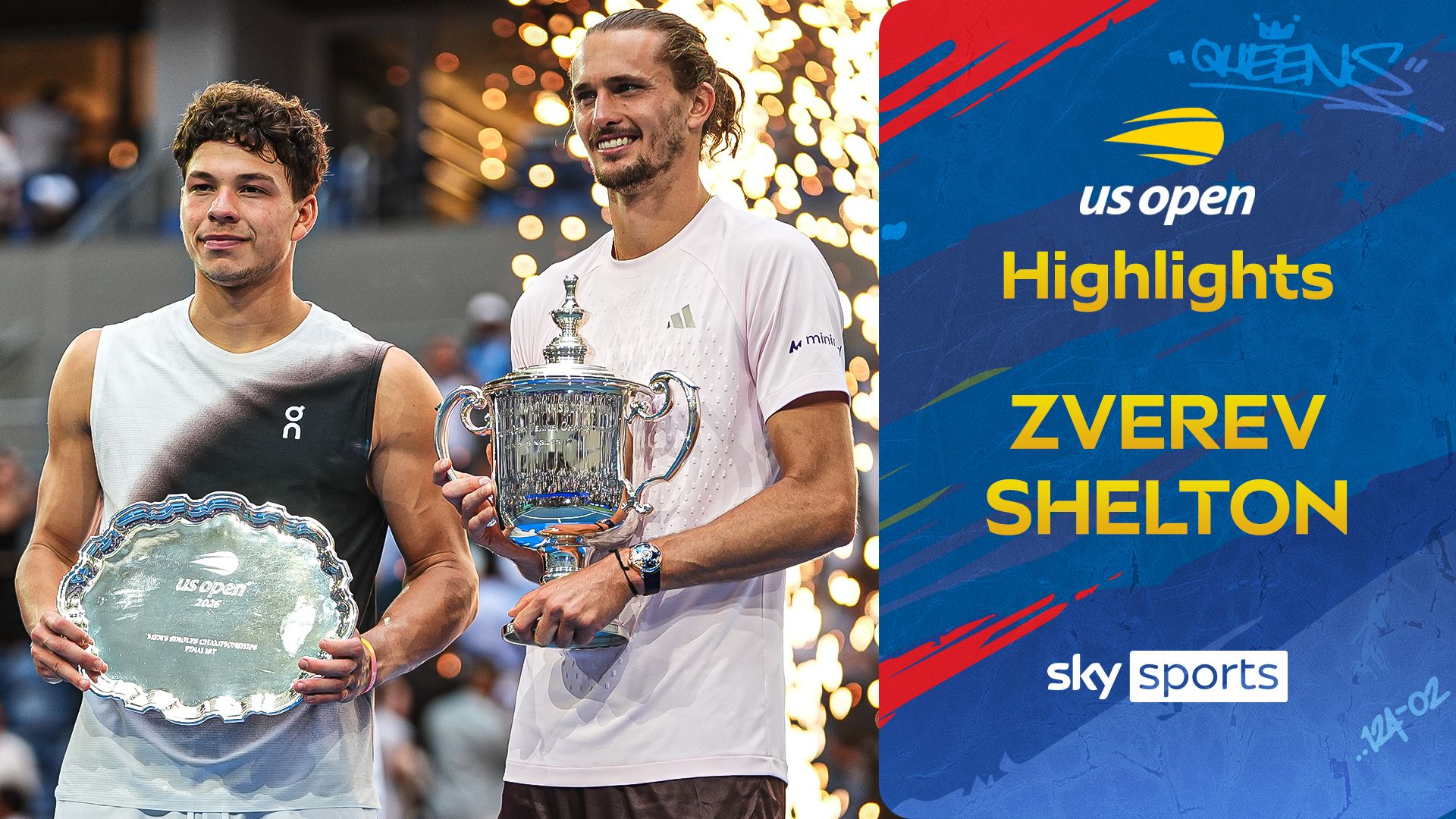
Highlights of Alexander Zverev against Ben Shelton from the men’s US Open final.
>

The Seattle Mariners visit the Athletics at 4:05 p.m. ET on Sunday, with both teams hoping to win the series. Bryce Miller (4-9, 4.22 ERA) will start for the Mariners, who are 70-79 this season and third in the AL West. Jacob Lopez (6-4, 4.78 ERA) is expected to start for the Athletics, who are 60-89 and fourth in the AL West.
How to watch Seattle Mariners vs. Athletics
Mariners vs. Athletics odds
- Favorite Moneyline: Mariners -154
- Underdog Moneyline: Athletics +125
- Total: 9.5
- Total Over Odds: -110
- Total Under Odds: -110
Injury reports
Mariners
Emerson Hancock: 15 Day IL (Groin), Cole Wilcox: 15 Day IL (Oblique), Colt Emerson: 60 Day IL (Wrist), Will Wilson: 60 Day IL (Thumb), Luke Raley: 60 Day IL (Elbow), Matt Brash: 60 Day IL (Lat), Logan Evans: 60 Day IL (Arm), Brennen Davis: 60 Day IL (Hamstring), Nick Davila: 60 Day IL (Shoulder), Brendan Donovan: 7 Day IL (Head)
Athletics
J.T. Ginn: 15 Day IL (Elbow), Jacob Wilson: 60 Day IL (Shoulder), Justin Sterner: 60 Day IL (Knee), Nick Kurtz: 60 Day IL (Thumb), Brooks Kriske: 60 Day IL (Shoulder), Mark Leiter Jr.: 60 Day IL (Hip), Brent Rooker: 60 Day IL (Knee), Luis Severino: 60 Day IL (Shoulder), Josh Kuroda-Grauer: 60 Day IL (Testicle), Tyler Soderstrom: 60 Day IL (Hip), Gunnar Hoglund: 60 Day IL (Knee)
Stats to know
- Randy Arozarena is hitting for a .273 BA, .371 OBP and .464 SLG with a 21.7% strikeout rate and a 10% walk rate. His OPS is .835 and he has scored 97 runs. In 612 plate appearances, he has hit 23 home runs and driven in 71 runs. Arozarena has been crafty on the base paths, recording 22 steals on 30 attempts.
- In 594 plate appearances, Josh Naylor has slashed .270/.325/.363 this season. He has hit 10 long balls and driven in 50 runs with a strikeout rate of 12.8% and a walk rate of 6.9%. He has 27 stolen bases on 34 attempts. He has come around to score 56 times.
- Jeff McNeil has hit eight home runs this season. He has also tallied 54 RBIs and has scored 47 runs. In 472 plate appearances, he has recorded a .268 BA, .317 OBP and .372 SLG with a 5.9% walk rate and an 11% strikeout rate. He has been effective on the base paths, recording eight steals on 10 attempts.
- In 419 plate appearances, Shea Langeliers has hit 23 long balls, tallied 52 RBIs and scored 55 runs. He is batting .264/.332/.496 and has posted a 22.9% strikeout rate and an 8.1% walk rate.
This watch guide was created using technology provided by Data Skrive.
Betting/odds, ticketing and streaming links in this article are provided by partners of The Athletic. Restrictions may apply. The Athletic maintains full editorial independence. Partners have no control over or input into the reporting or editing process and do not review stories before publication.
Photo: Jamie Squire, Ishika Samant, Scott Taetsch, Alika Jenner / Getty Images
>

Otomate Brand Unveils Hakuōki Shinkai Kiwame, Other New Game Releases – News

Freddie Freeman’s health, Josue De Paula’s debut and a Dodgers club on brink of clinching

‘Lemonade’ Review: Barry Keoghan in Ho-Hum Irish Indie Drama
-

 movies4 months ago
Search For Canadian TV Actor Stewart McLean Now Homicide Investigation
-

 Fashion9 years ago
These ’90s fashion trends are making a comeback in 2017
-
Fashion9 years ago
According to Dior Couture, this taboo fashion accessory is back
-
Fashion9 years ago
Model Jocelyn Chew’s Instagram is the best vacation you’ve ever had
-
Fashion9 years ago
Emily Ratajkowski channels back-to-school style
-
Fashion9 years ago
9 Celebrities who have spoken out about being photoshopped
-

 Anime3 months ago
Rurouni Kenshin: Hokkaido Arc Manga Takes 1-Issue Break – News
-

 Anime2 months ago
HIDIVE to Stream English Dubs for The World Is Dancing, The Forsaken Saintess and Her Foodie Roadtrip in Another World, The Dangers in My Heart: The Movie Anime – News