
Entertainment
Black Bear Lands Laika’s Taylor Jenkins Reid Adaptation ‘Atmosphere’

>
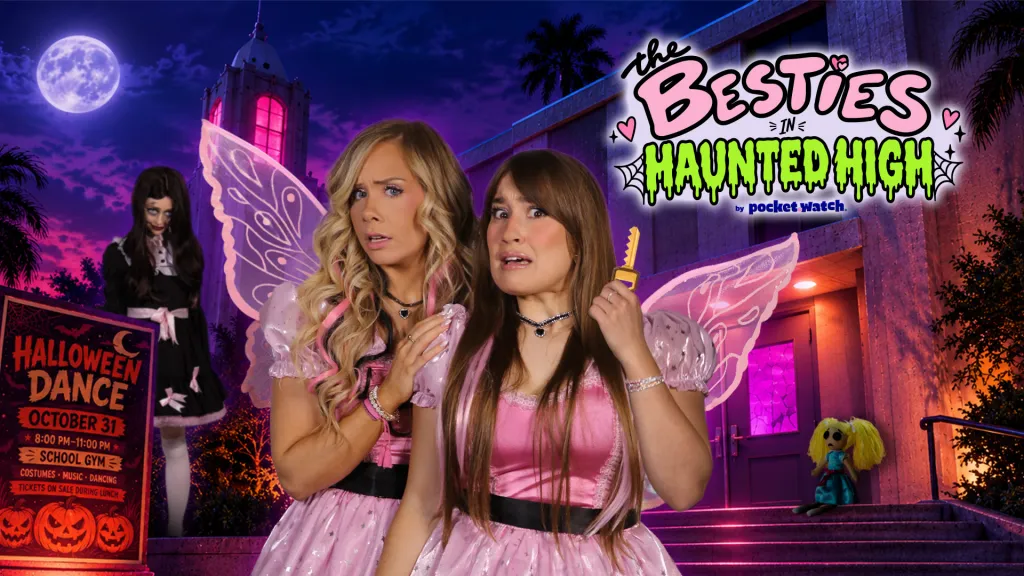
EXCLUSIVE: YouTube creators Mackenzie Turner and Lael Hansen are launching their latest series exclusively on Tubi.
The Besties in Haunted High will debut globally on October 28 comprising six 30-minute episodes, following the online personalities as their school’s empty Halloween dance turns into a nightmare. They are trapped inside and have to complete six games and escape for a supernatural figure hunts them down.
The show is the latest from next-gen creator company Pocket.watch, whose slate has productions on the likes of Prime Video, Disney+ and Hulu.
Turner, Pocket.watch Chief Content Officer Albie Hecht and CEO and founder Chris M. Williams are the executive producers. Turner, Hecht and Carin Davis co-created the show, which was based on an original concept by Turner.
Collectively Turner and Hansen have over 13 million YouTube subscribers, with the former currently on 7.8 million and the latter 1.9 million. Their joint channel, The Besties, has 3.3 million, and is the basis for the show.
“Mackenzie has built one of the most engaged fanbases in the creator space, and The Besties in Haunted High reflects the caliber of premium, scripted storytelling her audience has been asking for,” said Hecht, who is also directing the series.
“The Besties in Haunted High is exactly the kind of storytelling that resonates with our audiences: authentic perspectives by creators that speak directly to their interests,” added Rich Bloom, General Manager, Creator Programs & Executive Vice President, Business Development at Tubi.
In a statement, Turner and Hansen said: “What started as a series our community fell in love with on YouTube is now reaching an even bigger audience through Tubi. Together with pocket.watch, we’ve turned it into a bold, creator-led series, free for everyone to watch.”
Pocket.watch is currently in production on three other creator originals: Love Diana: Music Hunters with Kids Diana Show, in partnership with Amazon MGM Studios, which launches on Prime Video in January 2027; a JJ & Mikey holiday special with gaming duo Maizen, which premieres on several premium platforms later this year; and Captain Future Pirate: Chedda Quest with creators DeeDee Show, Kaven Adventures, Caleb Kids Show, Kamden Boi & Kyraboo, and My PB&J. That debuts on on Ryan and Friends PLUS, pocket.watch’s subscription streaming service for kids.
>
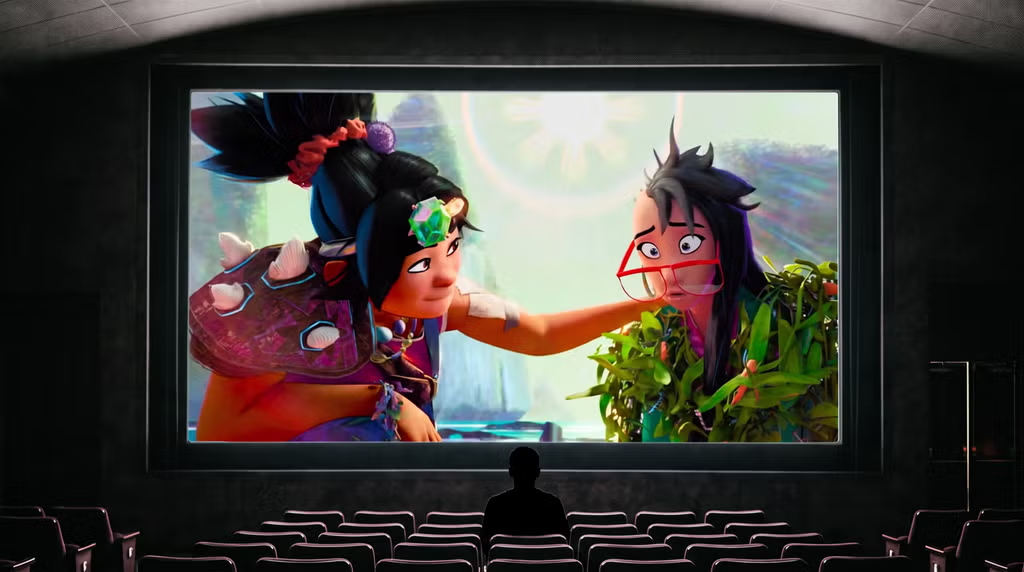
Throughout 2026, things were looking bright for DreamWorks’ “Forgotten Island.”
The Glendale, Calif.-based animation studio, run by Margie Cohn, a smart, decisive leader, had been on an unparalleled run, releasing some of the best films in the company’s 30+ year history, from “The Wild Robot” to “Puss in Boots: The Last Wish,” and finding commercial success to accompany critical acclaim. “Forgotten Island,” an original fantasy adventure comedy that leaned into the mythology of the Philippines and sported an irreverent, mixed media visual aesthetic, looked to continue this upward trajectory.
DreamWorks and Universal were bullish about the movie, screening an unfinished cut at CinemaCon in Las Vegas earlier this year and surprising audiences at the Annecy International Animation Film Festival this summer, where it received a rapturous response. A full-scale marketing campaign rolled out, including a San Diego Comic-Con panel, branding deals with the popular Filipino fast food chain Jollibee and a premiere at the Lucas Museum of Narrative Art, the first film to ever debut at the cutting-edge new space.
The early buzz had Universal so optimistic that there were quiet discussions around sequels and potential theme park attractions, even at a time when most original animated films have performed middling at best at the box office, and no such title has cleared $500 million worldwide in nine years.
Instead, “Forgotten Island” landed at the box office this weekend with one of the Top 5 lowest opening weekends in DreamWorks Animation history: $13 million domestic and $20.6 million worldwide from 35 international territories. All against an $80 million budget before factoring in an extensive marketing campaign and the aforementioned promotional events.
The disastrous launch underlines a serious issue facing the broader animation industry: how to get people to show up for original animation. Without successful original animated films, there can be no new franchises, which are key to the overall strategic goals of these mega media companies. The film still has 37 countries awaiting release, including the United Kingdom, Germany and France alongside much of Europe, but it still faces an extremely uphill battle.
For comparison, director Joel Crawford’s previous DWA film, “Puss in Boots: The Last Wish,” earned an $18 million 5-day Christmas weekend opening in 2022, going on to leg out massively through the lucrative holiday corridor to $186 million domestic and $480 million worldwide. But that film had the advantage of its connections to the beloved “Shrek” franchise along with coming out at Christmas.
We’ve also seen original animation recover from a sluggish start thanks to post-release buzz before. Pixar’s “Elemental” turned a $29.6 million domestic opening — the lowest to that point after inflation adjustment for Pixar — into a $154 million domestic run and a 5.2x multiple.
Even with a slightly higher domestic multiple than “Elemental,” “Forgotten Island” would be looking at a final domestic total somewhere between $65-80 million. And unlike that Pixar film, which grossed a hefty $54.8 million in South Korea and cleared $10 million in 10 other countries, “Forgotten Island” only reached No. 1 this weekend in the Philippines — the country where the film is set -— where it earned a $1.5 million opening that topped even the premiere of “The Odyssey” in that country, but is hardly the foundation for a box office comeback.
It may be too much to ask word-of-mouth for a film with this low of an opening to spread across continents and language barriers, although that buzz is positive and there’s only one other animated film opening in October, Laika’s PG-13 dark fantasy “Wildwood.”
But the more likely outcome is that “Forgotten Island” recoups its costs and turns a small profit through premium on-demand and other post-theatrical revenue sources. While cost-conscious families will turn out for sequels like “Toy Story 5” because they feel confident they will get their money’s worth for four or more movie tickets plus concessions, they are reticent to spend that money on an unfamiliar title. Universal insiders have told TheWrap that it has seen strong PVOD revenue for DreamWorks films like “The Bad Guys 2” and “The Wild Robot,” and the same could happen for “Forgotten Island” when it hits home platforms closer to Thanksgiving.

What went wrong
It will be several weeks before Universal does a proper post-mortem to figure out exactly why the rave reviews in the lead-up to release failed to even get “Forgotten Island” to meet tracker projections of a $15-17 million domestic opening. But it is possible that some of the qualities that made the film so enjoyable for those who did see the film turned into hurdles for selling the film to the uninitiated.
For one, there’s the movie’s teen millennial protagonists, Jo and Raissa, a quirky duo who bond over their mutual love of Filipino folklore who are shown in the film’s emotional opening act to be social outcasts, even when Raissa becomes the pride of her family for getting into Caltech.
Goofy slapstick with college-age female protagonists isn’t necessarily a turnoff for audiences. “KPop Demon Hunters” had plenty of that. But along with the silly hijinks, the members of Huntr/x were also pop stars who performed multiple earworms over the course of the film, from a genre that is popular among today’s kids and teens.

Who, exactly, was the target audience in the “Forgotten Island” marketing? Trailers leaned on the ’80s, ’90s and 2000s references that populate the film like the Simple Minds song “Don’t You Forget About Me,” and it’s possible that its more millennial-skewing humor failed to draw interest from a good chunk of Gen Z teens and Gen Alpha kids.
But while the opening weekend of “Forgotten Island” was skewed more towards millennials than other fall animated films, it wasn’t overly so. Nearly a quarter of the audience was under the age of 18, with 46% 18-34 and 31% over the age of 35. And among moviegoers under 25 surveyed by PostTrak, the film had a 93% overall positive score.
By comparison, “The Wild Robot” had an under-18 opening weekend share of 28% with 34% 18-34 and 37% over the age of 35 with audience scores nearly identical to “Forgotten Island.”
So where else might have Universal’s campaign fallen short? When you look at the critical and audience reviews for “Forgotten Island,” one of the common points of praise is how the film shows the depth of Jo and Raissa’s friendship. Beyond the over-the-top, sometimes cringy bonding moments, there’s an emotional montage where the two spend much of their childhood with Jo’s beloved grandmother, who encourages them to stay true to their offbeat selves.
It’s a key early moment that pays off in the film’s tense climax when all of Jo and Raissa’s memories of their friendship are at risk of being lost, but that emotional anchor to their friendship is nowhere to be seen in the film’s first trailer, which played in front of summer films like “Toy Story 5” and “Minions & Monsters.” That trailer also only skimmed over how Jo and Raissa must make a choice about whether to sacrifice their memories of each other to be returned home by a catlike demon named Batiba, who is barely seen in the marketing but is key to the film’s plot.
In a positive review for IndieWire, film critic David Ehrlich noted that one drawback for “Forgotten Island” is that the movie is so “overstuffed” with jokes, creatures and fantasy concepts that it “makes it difficult to understand the basic principles of its plot” even as its core themes of memories and friendship see it through. It’s possible that Crawford and Mercado’s deep, relentless worldbuilding of Nakali, while enjoyable for those who bought a ticket, didn’t lend itself to an easy explanation that could fit into a two-and-a-half-minute trailer.
The original animation struggle
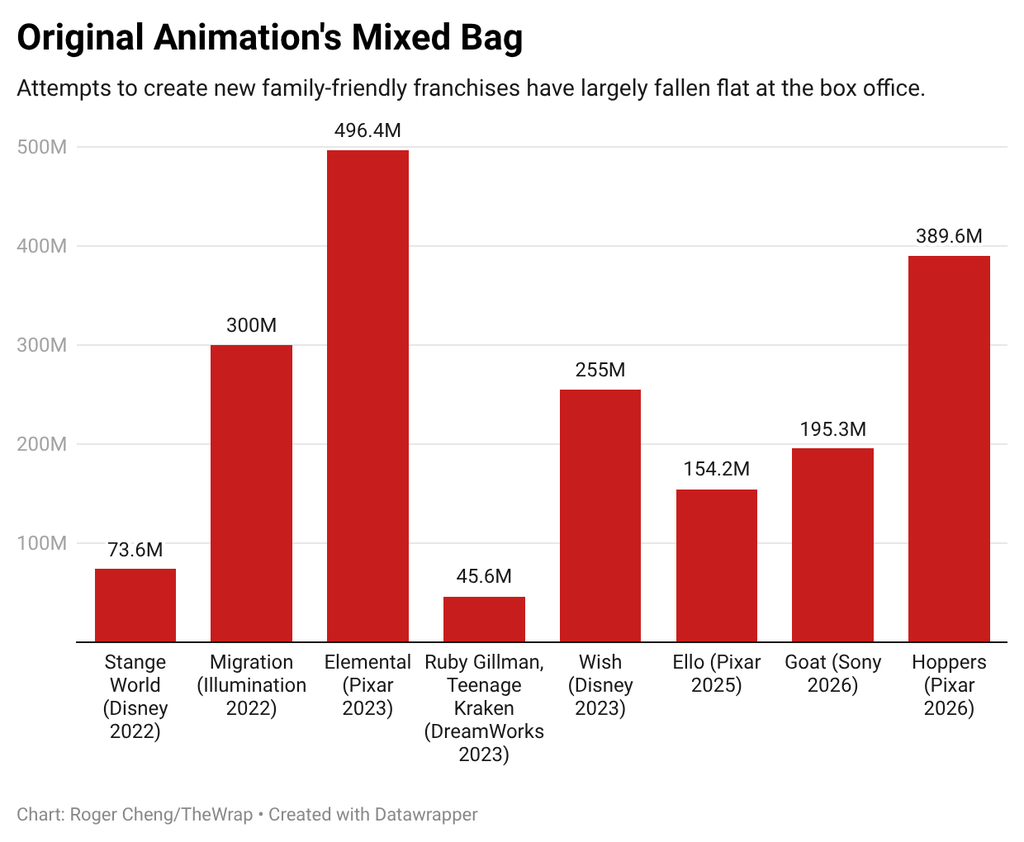
DreamWorks is far from the only studio struggling to make original animation work in theaters. Pixar’s “Elio” made just $154 million in 2025; Disney’s original musical “Wish” underperformed in 2023 with $255 million worldwide while Disney’s 2022 sci-fi adventure “Strange World” was a bomb with $73 million; and DreamWorks has been here before with 2023’s “Ruby Gillman: Teenage Kraken,” which bombed with a global haul of just $43.2 million.
So should they all be banished to streaming with the hopes of landing another “KPop Demon Hunters”-like phenomenon?
If these studios want a property with a chance to break out, the streaming path is less likely to work. Netflix’s “Leo” and “Swapped” were streaming hits but left little cultural footprint (a sequel to “Leo” is only just now materializing), and streaming releases are no guarantee of success, as disappointments “Ultraman: Rising” and “Nimona” can attest.
Pixar’s “Hoppers” was a very modest success earlier this year, grossing $390 million against a $150 million budget, but that’s still a far cry from 2010s Pixar originals like “Brave” ($539 million in 2012), “Inside Out” ($859 million in 2015) and “Coco” ($823 million in 2017).
Illumination had its own modest original success in 2022 with “Migration,” which made $300 million worldwide. But that also paled in comparison to the 2016 franchise-spawning hits like “The Secret Life of Pets” ($875 million) and “Sing” ($639 million.)
In short, effectively selling animated movies that don’t have an easy IP hook is something that nobody in Hollywood has figured out how to do in this new era. But it is essential to figure out, as these studios are in desperate need of the next “Frozen” or “Toy Story” or “Shrek” or even “KPop Demon Hunters” to launch new franchises that keep them relevant to new generations.
Perhaps Disney will solve this puzzle with Pixar’s spring 2027 original offering “Gatto,” about a cat living in Italy. If not, there’s not much else that Pixar, DreamWorks and the rest of Hollywood can do but keep trying.
Because while “Shrek 5” and two more “How to Train Your Dragon” live-action remakes are on their way, no studio can mine their pre-COVID glory days forever.

>
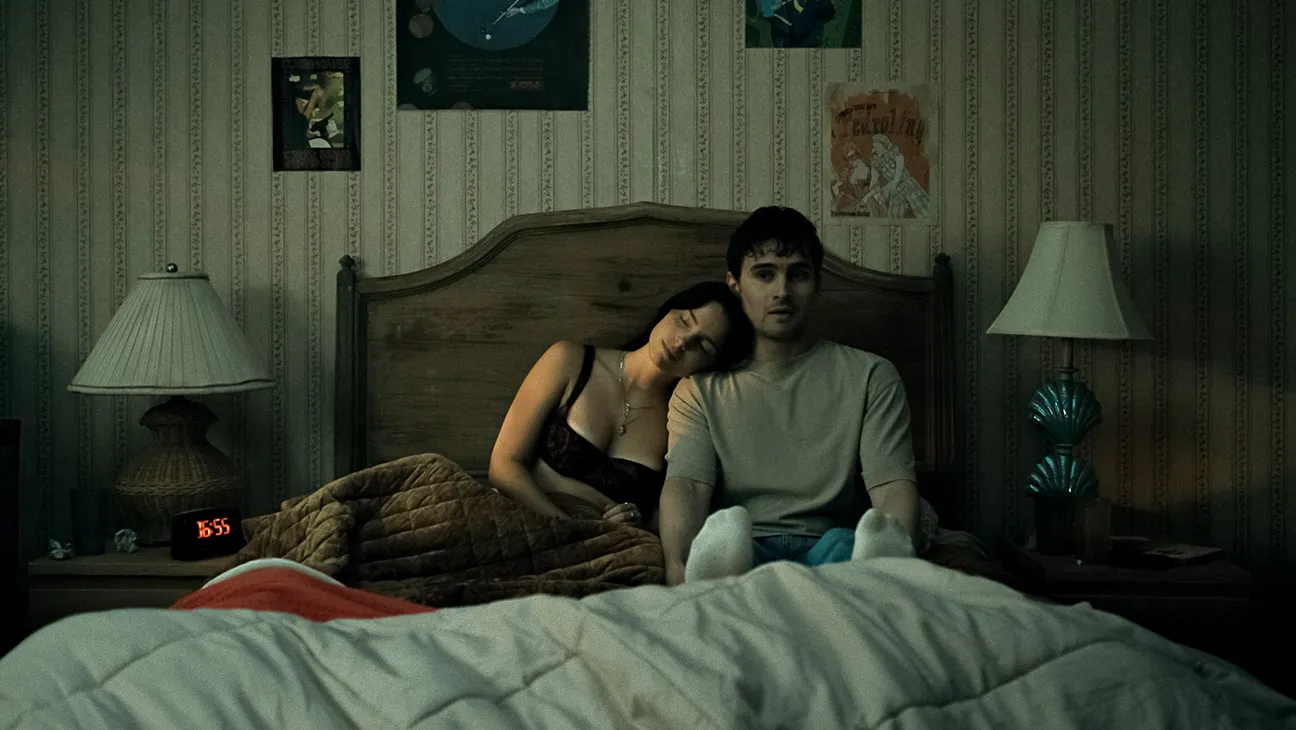
Curry Barker’s Obsession and Kane Parsons’ Backrooms, two Gen Z creatives-led horror stories, have proven the concept that viral online video creators can conquer the box office. And Pedro Pina, vp, YouTube, Europe, the Middle East and Africa (EMEA), thinks that they will be followed by more successful moves from the online into the cinema world.
He shared that forecast on the opening day of the sixth edition of Iberseries & Platino Industria in Spain’s capital, Madrid, on Tuesday in a keynote appearance entitled “YouTube: The Strategic Ally of the Audiovisual System.”
“We can see that creators are defining and shaping the culture. As a result, the cultural impact that we have is phenomenal,” Pina touted. “And you also see, from a cinema standpoint, a huge impact. [The creators of] Obsession and Backrooms, as you know, were YouTubers who decided to go into the box office [business] … – and they were a tremendous success this year. And I would expect to see more and more of these examples [at] the Emmys and Oscars” in the coming years.
Pina on Tuesday also explained YouTube’s recent focus on positioning itself as a partner to media and entertainment content companies. “The objective of being here at this event, as well as so many others … is to really show up and really explain how our model works,” he highlighted. “The majority of people in the industry, unfortunately, don’t understand it as much, and that’s 100 percent our fault. We never spent enough time explaining to the industry how we work, how you can monetize.”
The result? “To a point, a lot of people were afraid of YouTube. They had fear of YouTube mostly because they did not understand how the platform works, how their content could be protected, how it could reach new audiences, and why it works to monetize,” Pina continued. “Once you start breaking down that information and providing examples and showing the way, you see more and more people starting to look at this. So we started this journey roughly three years ago.”
And YouTube has seen the benefit of making its narrative heard. “The amount of content uploaded by traditional players is increasing now,” Pina concluded.
Earlier in the Iberseries day, Amazon MGM Studios executives discussed the success of the Mercedes Ron young adult novel adaptations and Spanish zombie horror film Apocalypse Z, while Parrot Analytics shared data trends and estimates for the subscriber impact of Netflix’s Argentina hit series The Eternaut. The industry gathering runs through Friday.
>
NHL team values keep soaring, average franchise now worth $2.43 billion: Who leads the way?

Still running iOS 26? Update your iPhones, iPads and Macs for this urgent security fix

Pocket.watch Series ‘The Besties In Haunted High’ Set For Tubi Launch
-

 movies4 months ago
Search For Canadian TV Actor Stewart McLean Now Homicide Investigation
-

 Fashion9 years ago
These ’90s fashion trends are making a comeback in 2017
-
Fashion9 years ago
According to Dior Couture, this taboo fashion accessory is back
-
Fashion9 years ago
Model Jocelyn Chew’s Instagram is the best vacation you’ve ever had
-
Fashion9 years ago
Emily Ratajkowski channels back-to-school style
-
Fashion9 years ago
9 Celebrities who have spoken out about being photoshopped
-

 Anime4 months ago
Rurouni Kenshin: Hokkaido Arc Manga Takes 1-Issue Break – News
-

 Anime3 months ago
HIDIVE to Stream English Dubs for The World Is Dancing, The Forsaken Saintess and Her Foodie Roadtrip in Another World, The Dangers in My Heart: The Movie Anime – News