Entertainment
‘Dateline’ at 35: How the True Crime Sensation Became an Always-On Franchise
For some younger true crime fans, “Dateline” is not a television show that became a podcast. It is a podcast that happens to have a television show attached.
That reversal captures how far NBC’s newsmagazine has traveled as it enters its 35th season. The franchise that once depended on viewers showing up to NBC at a scheduled hour now reaches audiences through a showcast feed (an audio version of the episodes) that recently surpassed 2 billion lifetime downloads, a dedicated 24/7 streaming channel, syndication and licensing, social platforms and live events.
True crime itself is having a cultural moment, from the national attention surrounding the Lindsay Clancy trial to Netflix’s hit “Monster” anthology, and “Dateline” is finding new ways to meet that appetite across audio, streaming and social media.
The franchise’s multiplatform growth shows how the future of a legacy TV property may be determined not only by who wins the broadcast hour, but by whether it can build younger audiences and new revenue streams beyond television. That has become increasingly important as ABC’s “20/20” has led “Dateline” in total viewers for four consecutive seasons.
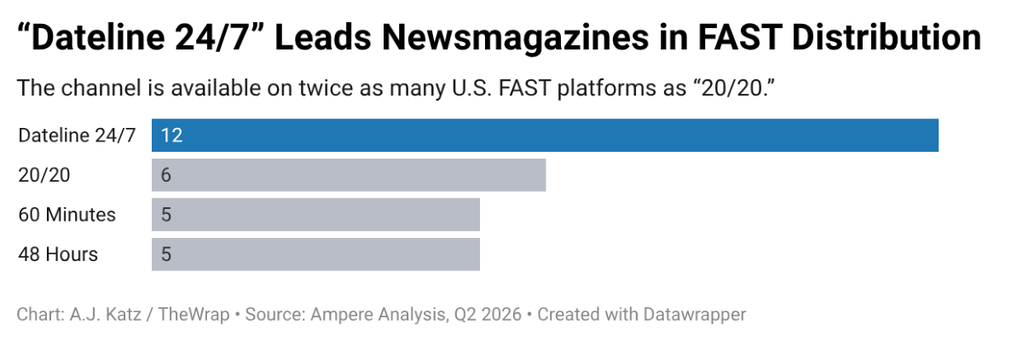
On free ad-supported streaming, however, the venerable NBC newsmagazine has leapt ahead. “Dateline 24/7” was available on 12 U.S. FAST platforms in the second quarter, making it the country’s most widely distributed channel devoted to a single television property, according to exclusive Ampere Analysis data provided to TheWrap. That was twice the reach of ABC’s “20/20” channel and more than double the five platforms carrying channels devoted to CBS’ “60 Minutes” and “48 Hours.”
The goal is not necessarily to steer every listener or streamer back to NBC, but to make “Dateline” a destination wherever true crime audiences already spend time.
“We want to be anywhere people want to consume this kind of journalism and storytelling,” “Dateline” executive producer Liz Cole told TheWrap. “The fact that we’re on broadcast television, cable, streaming, audio — it just gives us a much broader reach.”

A new front door to “Dateline”
The clearest evidence of that reach is audio. During the 2025-26 season through Aug. 31, the “Dateline” showcast and original podcasts generated more than 156 million combined downloads, while original podcasts were pacing 19% ahead of the previous season. Podtrac ranked the showcast among the five largest podcasts across all categories during the period, according to NBC.
The feed also functions as an entry point for younger audiences to a franchise that began on television in 1992. Cole said the podcast audience generally skews younger than the television audience, and that she and fellow executive producer Paul Ryan routinely encounter listeners who know “Dateline” through audio but are surprised to learn it began on television.
“We are finding younger people are coming into contact with ‘Dateline,’ many of them for the first time, through audio,” Cole said.
NBC cannot measure with precision how often those listeners later watch the show on television or Peacock. Ryan said some listeners are additive consumers who prefer audio because it fits into a commute, workout or household routine. “I think they’re audio-first, some of them,” he said.
Bryan Barletta, a partner at podcast-industry trade association Sounds Profitable and president of industry events organization Podcast Movement, said the inability to trace every listener back to television does not diminish the strategy. True crime reaches roughly 42 million American adults each month, or about 16% of the adult population, according to Sounds Profitable research.
“If someone listens to ‘Dateline’ every week but never watches an episode on NBC, they’re still a ‘Dateline’ consumer,” Barletta told TheWrap. “They’re spending time with the brand and they’re monetizable through podcast advertising. That’s real value on its own.”
Barletta called 2 billion downloads “astounding,” but said the audience composition matters more than the raw total.
“The best extension of an established media brand isn’t one that just moves the same audience from one platform to another,” he said. “It’s one that creates an entirely new point of entry into the franchise.”


The true crime genre is particularly suited to that migration. Sounds Profitable found that two-thirds of true crime listeners value podcasts for the companionship they provide. Triton Digital found that half of true crime podcast consumption remained primarily audio, placing it among the genres most oriented toward listening.
“The fundamental product isn’t really the pictures or images on the screen,” Barletta said. “It’s the storytelling.”
A library built for FAST
The same decades-long archive that supplies the showcast has made “Dateline” unusually well suited to free ad-supported streaming television. Its 24/7 channel combines the advantages of a recognizable single-program channel with the appeal of a broader true crime destination.
Ampere counted 521 single-IP FAST channels in the United States in the second quarter of 2026, up 24% from a year earlier. “Dateline 24/7” reached 12 tracked platforms, twice the distribution of “20/20.”

“‘Dateline 24/7’ essentially is both: an existing well-known IP which also curates true crime specials and series,” Ampere senior analyst Christen Tamisin told TheWrap. “This results in the library being prime for FAST distribution.”
Single-IP documentary channels — the category in which true crime services typically sit — remained on tracked platforms for an average of 18.5 months during the two years that ended June 2026, the longest lifespan outside news channels, according to Ampere. Tamisin said oversaturation is difficult in today’s fragmented media market because each additional outlet can expose the franchise to a different audience.
NBC said “Dateline 24/7” was pacing toward its seventh consecutive record season. The company did not disclose viewing hours or revenue for the channel, but Cole said the franchise’s expansion has made its business “far more diversified” at a moment when the television industry is changing rapidly.


That distribution extends well beyond FAST. NBC said the number of “Dateline” hours licensed or syndicated across broadcast and cable rose 29% to 189. The franchise also launched “Dateline en Español,” an always-on streaming channel hosted by Noticias Telemundo and “Weekend NBC Nightly News” anchor José Díaz-Balart.
NBC said the franchise reached 151.2 million linear viewers across broadcast, licensing and syndication during the season, up 4%, using a one-minute viewing threshold.
The Friday night split decision
ABC’s “20/20,” which is entering its 49th season, averaged 3.7 million total viewers this past season — 17% more than “Dateline,” according to Nielsen data provided to TheWrap. Its lead widened from 34,000 viewers in 2024-25 to 543,000.
“20/20” grew 7% in total viewers and 1% among adults 18-49. The franchise has also expanded in audio through “20/20: The After Show” and a slate of true crime podcast series, although ABC did not provide download totals comparable to NBC’s “Dateline” figures.
The picture differs in the key demographics. Under NBC’s L+35 Most Current measure, which excludes retitles, repeats and specials, “Dateline” averaged 517,000 adults 18-49 and 741,000 adults 25-54 on Fridays, ahead of “20/20” at 460,000 and 662,000, respectively. Because the networks’ reported averages use different inclusion rules, their broader ratings claims are not directly comparable.
Taken together, the figures show a split Friday night race: “20/20” attracts the larger overall audience, while “Dateline” leads among adults 18-49 and 25-54 under NBC’s methodology.
Beyond television, “Dateline” counted 5.4 million followers across Facebook, TikTok, Instagram and X, compared with 4.9 million for “48 Hours” and 3.5 million for “20/20.”
Cole said the “Dateline” team treats those followers as a community rather than simply an audience for promotional clips, interacting with viewers and extending those relationships into live events.
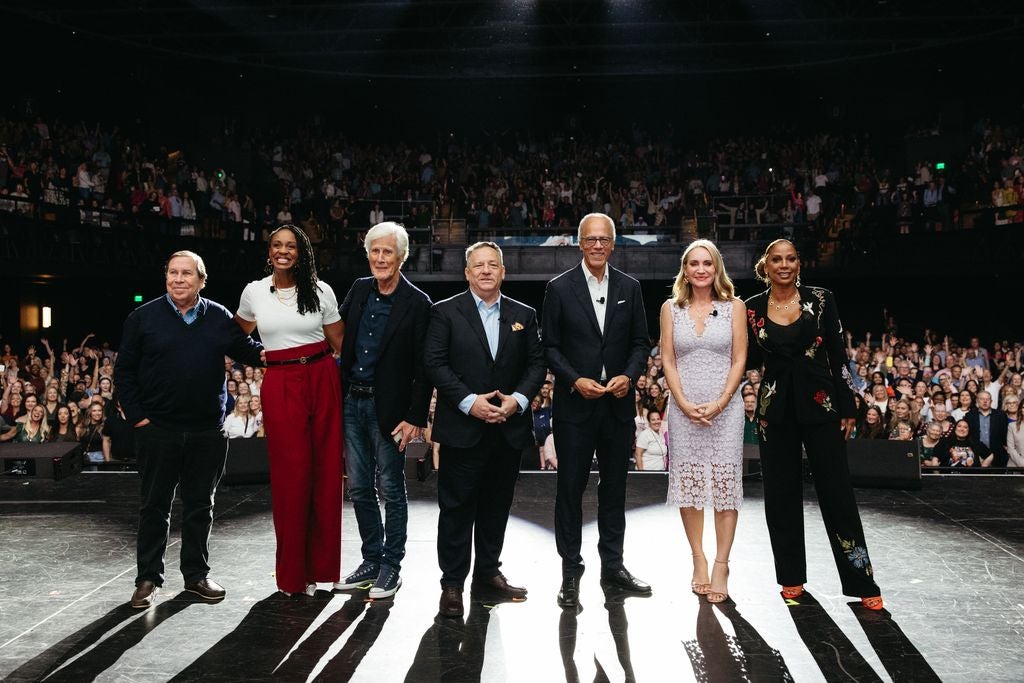
The franchise staged its first live event in Nashville last year. Cole described it as an extension of a connection that had already been built through social media.

One story in many forms
The multiplatform operation has also changed which stories “Dateline” can pursue and how they are developed. “We kind of expect projects to work on all platforms, if possible,” Ryan said, though some concepts are designed for a particular medium from the beginning.
A story that cannot sustain a two-hour NBC broadcast might work as a one-hour episode, a digital series or a podcast. A narrative with enough material for several chapters may be developed first for audio. Cole pointed to one of the franchise’s new Lester Holt podcasts as a project conceived around conversation and the intimacy of listening, even though portions also exist on video.
During the past season, the franchise launched Holt-hosted podcasts “The Last Appeal” and “Before & After,” Keith Morrison’s “Five Miles From Home” and “Something About Cari,” another season of Josh Mankiewicz’s “Missing in America” and Mankiewicz’s “Trace of Subscription.”
“The fact that we’re in so many places gives us ultimate flexibility about what story we’re able to do,” Cole said.
That flexibility will extend to even shorter formats during Season 35. Cole said the team is experimenting with how to compress a “Dateline” story into a roughly 60-second episode for audiences who may never tune to NBC. The exercise sounds almost antithetical to a franchise known for slowly unfolding two-hour mysteries, but it follows the same principle that drove the show into podcasting and FAST: preserve the storytelling voice while adapting the package to the audience’s habits.
For a 35-season television program, longevity no longer means persuading each new generation to inherit the viewing patterns of the last one. It means giving that generation another door in.

>